2018 CADILLAC CT6 steering
[x] Cancel search: steeringPage 338 of 445
Cadillac CT6 Owner Manual (GMNA-Localizing-U.S./Canada-11292458) -
2018 - crc - 2/15/17
VEHICLE CARE 337
FusesUsage
F26 Steering wheel controls
F27 USB charge port
F28 Wireless charger
F29 –
F30 SpeakerRear Compartment Fuse
Block
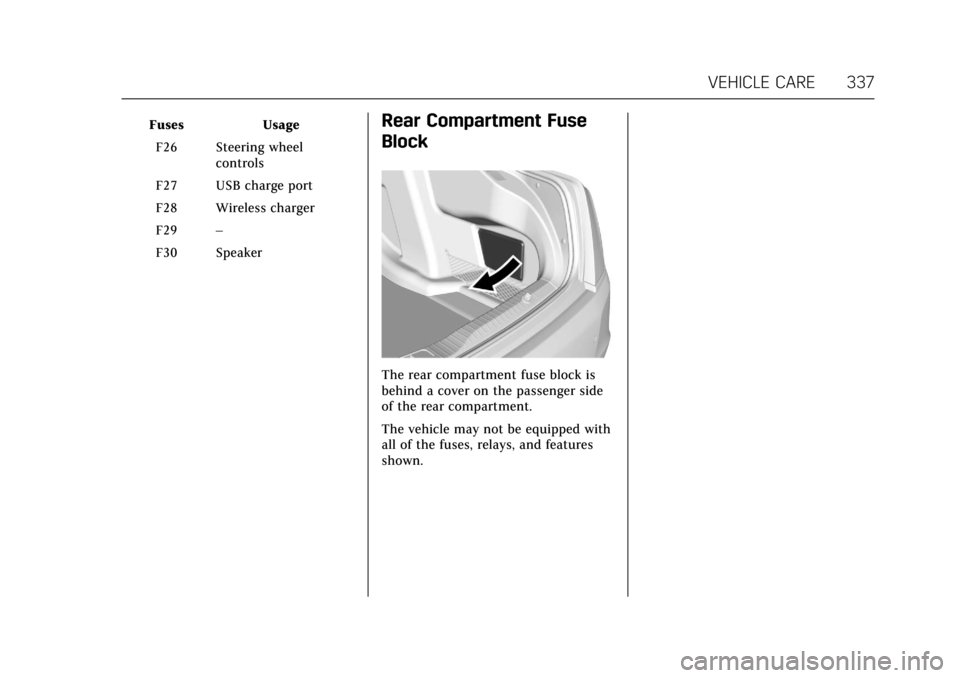
The rear compartment fuse block is
behind a cover on the passenger side
of the rear compartment.
The vehicle may not be equipped with
all of the fuses, relays, and features
shown.
Page 353 of 445
Cadillac CT6 Owner Manual (GMNA-Localizing-U.S./Canada-11292458) -
2018 - crc - 2/15/17
352 VEHICLE CARE
light and the DIC message should
go off after successfully
completing the sensor matching
process. See "TPMS Sensor
Matching Process" later in this
section.
. One or more TPMS sensors are
missing or damaged. The
malfunction light and the DIC
message should go off when the
TPMS sensors are installed and
the sensor matching process is
performed successfully. See your
dealer for service.
. Replacement tires or wheels do
not match the original equipment
tires or wheels. Tires and wheels
other than those recommended
could prevent the TPMS from
functioning properly. See Buying
New Tires 0355.
. Operating electronic devices or
being near facilities using radio
wave frequencies similar to the
TPMS could cause the TPMS
sensors to malfunction.
If the TPMS is not functioning
properly it cannot detect or signal a
low tire pressure condition. See your dealer for service if the TPMS
malfunction light and DIC message
comes on and stays on.
TPMS Sensor Matching Process
Each TPMS sensor has a unique
identification code. The identification
code needs to be matched to a new
tire/wheel position after rotating the
vehicle’s tires or replacing one or more
of the TPMS sensors. The TPMS
sensor matching process should also
be performed after replacing a spare
tire with a road tire containing the
TPMS sensor. The malfunction light
and the DIC message should go off at
the next ignition cycle. The sensors
are matched to the tire/wheel
positions, using a TPMS relearn tool,
in the following order: driver side
front tire, passenger side front tire,
passenger side rear tire, and driver
side rear. See your dealer for service or
to purchase a relearn tool. A TPMS
relearn tool can also be purchased.
See Tire Pressure Monitor Sensor
Activation Tool at
www.gmtoolsandequipment.com or
call 1-800-GM TOOLS
(1-800-468-6657).
There are two minutes to match the
first tire/wheel position, and
five minutes overall to match all four
tire/wheel positions. If it takes longer,
the matching process stops and must
be restarted.
The TPMS sensor matching process is:
1. Set the parking brake.
2. Place the vehicle in Service Mode. See Ignition Positions
0 217.
3. Make sure the Tire Pressure info display option is turned on. The
info displays on the DIC can be
turned on and off through the
Options menu. See Driver
Information Center (DIC) 0162.
4. Use the five-way DIC control on the right side of the steering
wheel to scroll to the Tire
Pressure screen under the DIC
info page. See Driver Information
Center (DIC) 0162.
5. Press and hold SEL in the center of the five-way DIC control.
Page 361 of 445

Cadillac CT6 Owner Manual (GMNA-Localizing-U.S./Canada-11292458) -
2018 - crc - 2/15/17
360 VEHICLE CARE
Tire Chains
{Warning
If the vehicle has 265/45R18 size
tires on the rear axle, do not use
tire chains. There is not enough
clearance. Tire chains used on a
vehicle without the proper amount
of clearance can cause damage to
the brakes, suspension, or other
vehicle parts. The area damaged by
the tire chains could cause loss of
control and a crash. Use another
type of traction device only if its
manufacturer recommends it for
the vehicle's tire size combination
and road conditions. Follow that
manufacturer's instructions. To
avoid vehicle damage, drive slow
and readjust or remove the traction
device if it contacts the vehicle. Do
not spin the wheels. If traction
devices are used, install them on
the rear tires.
Caution
If the vehicle is equipped with a tire
size other than 265/45R18 on the
rear, use tire chains only where
legal and only when necessary. Use
low profile chains that add no more
than 10 mm thickness to the tire
tread and inner sidewall. Use chains
that are the proper size for the tires.
Install them on the tires of the rear
axle. Do not use chains on the tires
of the front axle. Tighten them as
tightly as possible with the ends
securely fastened. Drive slowly and
follow the chain manufacturer's
instructions. If the chains contact
the vehicle, stop and retighten
them. If the contact continues, slow
down until it stops. Driving too fast
or spinning the wheels with chains
on will damage the vehicle.
If a Tire Goes Flat
It is unusual for a tire to blow out
while driving, especially if the tires are
maintained properly. SeeTires0340.
If air goes out of a tire, it is much more likely to leak out slowly. But if
there is ever a blowout, here are a few
tips about what to expect and what
to do:
If a front tire fails, the flat tire creates
a drag that pulls the vehicle toward
that side. Take your foot off the
accelerator pedal and grip the steering
wheel firmly. Steer to maintain lane
position, and then gently brake to a
stop, well off the road, if possible.
A rear blowout, particularly on a
curve, acts much like a skid and may
require the same correction as used in
a skid. Stop pressing the accelerator
pedal and steer to straighten the
vehicle. It may be very bumpy and
noisy. Gently brake to a stop, well off
the road, if possible.
{Warning
Driving on a flat tire will cause
permanent damage to the tire.
Re-inflating a tire after it has been
driven on while severely
underinflated or flat may cause a
blowout and a serious crash. Never
(Continued)
Page 384 of 445

Cadillac CT6 Owner Manual (GMNA-Localizing-U.S./Canada-11292458) -
2018 - crc - 2/15/17
VEHICLE CARE 383
Caution
Using petroleum-based tire dressing
products on the vehicle may
damage the paint finish and/or
tires. When applying a tire dressing,
always wipe off any overspray from
all painted surfaces on the vehicle.
Wheels and Trim—Aluminum or
Chrome
Use a soft, clean cloth with mild soap
and water to clean the wheels. After
rinsing thoroughly with clean water,
dry with a soft, clean towel. A wax
may then be applied.
Caution
Chrome wheels and other chrome
trim may be damaged if the vehicle
is not washed after driving on roads
that have been sprayed with
magnesium, calcium, or sodium
chloride. These chlorides are used
on roads for conditions such as ice
and dust. Always wash the chrome
with soap and water after exposure.
Caution
To avoid surface damage, do not
use strong soaps, chemicals,
abrasive polishes, cleaners, brushes,
or cleaners that contain acid on
aluminum or chrome-plated wheels.
Use only approved cleaners. Also,
never drive a vehicle with
aluminum or chrome-plated wheels
through an automatic car wash that
uses silicone carbide tire cleaning
brushes. Damage could occur and
the repairs would not be covered by
the vehicle warranty.
Brake System
Visually inspect brake lines and hoses
for proper hook-up, binding, leaks,
cracks, chafing, etc. Inspect disc brake
pads for wear and rotors for surface
condition. Inspect brake linings/shoes
for wear or cracks. Inspect all other
brake parts.
Steering, Suspension, and
Chassis Components
Visually inspect steering, suspension,
and chassis components for damaged,
loose, or missing parts or signs of
wear at least once a year.
Inspect power steering for proper
attachment, connections, binding,
leaks, cracks, chafing, etc.
Visually check constant velocity joint
boots and axle seals for leaks.
Body Component Lubrication
Lubricate all key lock cylinders, hood
hinges, liftgate hinges, and the steel
fuel door hinges, unless the
components are plastic. Applying
silicone grease on weatherstrips with a
clean cloth will make them last
longer, seal better, and not stick or
squeak.
Underbody Maintenance
At least twice a year, spring and fall,
use plain water to flush any corrosive
materials from the underbody. Take
care to thoroughly clean any areas
where mud and other debris can
collect.
Page 392 of 445

Cadillac CT6 Owner Manual (GMNA-Localizing-U.S./Canada-11292458) -
2018 - crc - 2/14/17
SERVICE AND MAINTENANCE 391
.Visually inspect windshield wiper
blades for wear, cracking,
or contamination. See Exterior
Care 0380. Replace worn or
damaged wiper blades. See Wiper
Blade Replacement 0327.
. Check tire inflation pressures. See
Tire Pressure 0347.
. Inspect tire wear. See Tire
Inspection 0353.
. Visually check for fluid leaks.
. Inspect engine air cleaner filter.
See Engine Air Cleaner/Filter 0311.
. Inspect brake system. See Exterior
Care 0380.
. Visually inspect steering,
suspension, and chassis
components for damaged, loose,
or missing parts or signs of wear.
See Exterior Care 0380.
. Check restraint system
components. See Safety System
Check 083.
. Visually inspect fuel system for
damage or leaks. .
Visually inspect exhaust system
and nearby heat shields for loose
or damaged parts.
. Lubricate body components. See
Exterior Care 0380.
. Check starter switch. See Starter
Switch Check 0326.
. Check automatic transmission
shift lock control function. See
Automatic Transmission Shift Lock
Control Function Check 0327.
. Check parking brake and
automatic transmission park
mechanism. See Park Brake and
P (Park) Mechanism Check 0327.
. Check accelerator pedal for
damage, high effort, or binding.
Replace if needed.
. Visually inspect gas strut for signs
of wear, cracks, or other damage.
Check the hold open ability of the
strut. If the hold open ability is
low, service the gas strut. See Gas
Strut(s) 0328.
. Inspect sunroof track and seal,
if equipped. See Sunroof061.
Page 398 of 445

Cadillac CT6 Owner Manual (GMNA-Localizing-U.S./Canada-11292458) -
2018 - crc - 2/14/17
SERVICE AND MAINTENANCE 397
brake lamps need to be checked
periodically to ensure that they
light when braking.
. With a multi-point inspection,
your dealer can check the lamps
and note any concerns.
Shocks and Struts
Shocks and struts help aid in control
for a smoother ride.
. Signs of wear may include steering
wheel vibration, bounce/sway
while braking, longer stopping
distance, or uneven tire wear.
. As part of the multi-point
inspection, trained dealer
technicians can visually inspect
the shocks and struts for signs of
leaking, blown seals, or damage,
and can advise when service is
needed. Tires
Tires need to be properly inflated,
rotated, and balanced. Maintaining
the tires can save money and fuel, and
can reduce the risk of tire failure.
.
Signs that the tires need to be
replaced include three or more
visible treadwear indicators; cord
or fabric showing through the
rubber; cracks or cuts in the tread
or sidewall; or a bulge or split in
the tire.
. Trained dealer technicians can
inspect and recommend the right
tires. Your dealer can also provide
tire/wheel balancing services to
ensure smooth vehicle operation
at all speeds. Your dealer sells and
services name brand tires.
Vehicle Care
To help keep the vehicle looking like
new, vehicle care products are
available from your dealer. For
information on how to clean and
protect the vehicle’s interior and
exterior, see Interior Care 0384 and
Exterior Care 0380. Wheel Alignment
Wheel alignment is critical for
ensuring that the tires deliver optimal
wear and performance.
.
Signs that the alignment may need
to be adjusted include pulling,
improper vehicle handling,
or unusual tire wear.
. Your dealer has the required
equipment to ensure proper wheel
alignment.
Windshield
For safety, appearance, and the best
viewing, keep the windshield clean
and clear.
. Signs of damage include scratches,
cracks, and chips.
. Trained dealer technicians can
inspect the windshield and
recommend proper replacement if
needed.
Page 417 of 445

Cadillac CT6 Owner Manual (GMNA-Localizing-U.S./Canada-11292458) -
2018 - crc - 2/14/17
416 CUSTOMER INFORMATION
Give only the necessary information
to police and other parties involved in
the crash.
For emergency towing seeRoadside
Service 0411.
Gather the following information:
. Driver name, address, and
telephone number
. Driver license number
. Owner name, address, and
telephone number
. Vehicle license plate number
. Vehicle make, model, and
model year
. Vehicle Identification
Number (VIN)
. Insurance company and policy
number
. General description of the damage
to the other vehicle
Choose a reputable repair facility that
uses quality replacement parts. See
“Collision Parts ”earlier in this section. If the airbag has inflated, see
What
Will You See after an Airbag Inf lates?
0 89.
Managing the Vehicle Damage
Repair Process
In the event that the vehicle requires
damage repairs, GM recommends that
you take an active role in its repair.
If you have a pre-determined repair
facility of choice, take the vehicle
there, or have it towed there. Specify
to the facility that any required
replacement collision parts be original
equipment parts, either new Genuine
GM parts or recycled original GM
parts. Remember, recycled parts will
not be covered by the GM vehicle
warranty.
Insurance pays the bill for the repair,
but you must live with the repair.
Depending on your policy limits, your
insurance company may initially value
the repair using aftermarket parts.
Discuss this with the repair
professional, and insist on Genuine
GM parts. Remember, if the vehicle is
leased, you may be obligated to have the vehicle repaired with Genuine GM
parts, even if your insurance coverage
does not pay the full cost.
If another party's insurance company
is paying for the repairs, you are not
obligated to accept a repair valuation
based on that insurance company's
collision policy repair limits, as you
have no contractual limits with that
company. In such cases, you can have
control of the repair and parts choices
as long as the cost stays within
reasonable limits.
Service Publications
Ordering Information
Service Manuals
Service Manuals have the diagnosis
and repair information on the engines,
transmission, axle, suspension, brakes,
electrical, steering, body, etc.
Owner Information
Owner publications are written
specifically for owners and intended
to provide basic operational
Page 437 of 445

Cadillac CT6 Owner Manual (GMNA-Localizing-U.S./Canada-11292458) -
2018 - crc - 2/14/17
436 INDEX
Frequency StatementRadio . . . . . . . . . . . . . . . . . . . . . . . . . . . . . . 417
Front Pedestrian Braking (FPB) System . . . . . . . . . . . . . . . . . . . . . . . . . . . . . 264
Front Seats Heated and Ventilated . . . . . . . . . . . . . 72
Fuel . . . . . . . . . . . . . . . . . . . . . . . . . . . . . . . . . . 286
Additives . . . . . . . . . . . . . . . . . . . . . . . . . . 287
Economy Driving . . . . . . . . . . . . . . . . . . . 32
Filling a Portable FuelContainer . . . . . . . . . . . . . . . . . . . . . . . . 290
Filling the Tank . . . . . . . . . . . . . . . . . . . 288
Foreign Countries . . . . . . . . . . . . . . . . . 287
Gauge . . . . . . . . . . . . . . . . . . . . . . . . . . . . . . 135
Low Fuel Warning Light . . . . . . . . . 150
Requirements, California . . . . . . . . . 287
Fuses Engine Compartment FuseBlock . . . . . . . . . . . . . . . . . . . . . . . . . . . . . 332
Fuses and Circuit Breakers . . . . . . . 331
Instrument Panel Fuse Block . . . . 335
Rear Compartment Fuse Block . . . . . . . . . . . . . . . . . . . . . . . . . . . . . 337
G
Garage Door Opener . . . . . . . . . . . . . . . . 179Programming . . . . . . . . . . . . . . . . . . . . . . 179
Gas Strut(s) . . . . . . . . . . . . . . . . . . . . . . . . . 328 Gauges
Battery . . . . . . . . . . . . . . . . . . . . . . . . . . . . . 135
Boost . . . . . . . . . . . . . . . . . . . . . . . . . . . . . . 136
Engine Coolant Temperature . . . . 139
Engine Oil Pressure . . . . . . . . . . . . . . . 137
Engine Oil Temperature . . . . . . . . . . 138
Fuel . . . . . . . . . . . . . . . . . . . . . . . . . . . . . . . . 135
Odometer . . . . . . . . . . . . . . . . . . . . . . . . . . 134
Power Indicator . . . . . . . . . . . . . . . . . . . 136
Speedometer . . . . . . . . . . . . . . . . . . . . . . 134
Tachometer . . . . . . . . . . . . . . . . . . . . . . . 134
Trip Odometer . . . . . . . . . . . . . . . . . . . . 134
Voltmeter . . . . . . . . . . . . . . . . . . . . . . . . . . 140
Warning Lights and
Indicators . . . . . . . . . . . . . . . . . . . . . . . . 126
General Information
Service and Maintenance . . . . . . . . 388
Towing . . . . . . . . . . . . . . . . . . . . . . . . . . . . 290
Vehicle Care . . . . . . . . . . . . . . . . . . . . . . . 297
Glove Box . . . . . . . . . . . . . . . . . . . . . . . . . . . 115
H
Hazard Warning Flashers . . . . . . . . . . 186
Head Restraints . . . . . . . . . . . . . . . . . . . . . . 65
Head-up Display . . . . . . . . . . . . . . . . . . . . 165
Headlamps Aiming . . . . . . . . . . . . . . . . . . . . . . . . . . . . . 329
Automatic . . . . . . . . . . . . . . . . . . . . . . . . . 185
Bulb Replacement . . . . . . . . . . . . . . . . 330 Headlamps (cont'd)
Daytime Running
Lamps (DRL) . . . . . . . . . . . . . . . . . . . . 185
Flash-to-Pass . . . . . . . . . . . . . . . . . . . . . . 185
High-Beam On Light . . . . . . . . . . . . . . 151
High/Low Beam Changer . . . . . . . . . 185
Lamps On Reminder . . . . . . . . . . . . . . 151
Heated Steering Wheel . . . . . . . . . . . . . . . . . . . . 119
Heated and Ventilated Front Seats . . . . . . . . . . . . . . . . . . . . . . . . . . . . . . . . 72
Heated and Ventilated Rear Seats . . . . . . . . . . . . . . . . . . . . . . . . . . . . . . . . 77
Heated Mirrors . . . . . . . . . . . . . . . . . . . . . . . 55
Heater
Engine . . . . . . . . . . . . . . . . . . . . . . . . . . . . . 223
Heating . . . . . . . . . . . . . . . . . . . . . . . . .191, 197
High Voltage Battery Gauge . . . . . . . 135
High-Beam On Light . . . . . . . . . . . . . . . . 151
High-Speed Operation . . . . . . . . . . . . . . 349
Hill and Mountain Roads . . . . . . . . . . 211
Hill Start Assist (HSA) . . . . . . . . . . . . . 237
Hood . . . . . . . . . . . . . . . . . . . . . . . . . . . . . . . . . 299
Horn . . . . . . . . . . . . . . . . . . . . . . . . . . . . . . . . . 120
How to Wear Seat Belts Properly . . . 79
HVAC . . . . . . . . . . . . . . . . . . . . . . . . . . .191, 197