2018 AUDI S3 SEDAN start
[x] Cancel search: startPage 327 of 404

LL co .... N
" N .... 0 N > co
Coolant additive
The coolant additive is made of anti-freezing and
corrosion protection agents. Only use the follow
ing coolant additives . These additives may be
mixed with each other .
Coolant additive Specification
Gl3 TL 774 J
Gl2++ TL 774 G
The amount of coo lant add itive that needs to be
mixed with water depends on the climate where
the vehicle will be operated .
If the coolant addi
tive percentage is too low, the coolant can freeze
and damage the engi ne.
Coolant Freeze protec-
additive tion
Warm min
.40% m in. -13 ° F
regions (-25 °C)
max. 45%
Cold min. 50% max . -40 °F
reg ions (-40 °C)
max. 55%
(D Note
- Before t he start of winter, have an author
i zed Audi dealer or author ized Audi Se rvice
Facil ity check if the coolant additive in yo ur
vehicle matches the percentage appropriate
for the climate . Th is is especially important
when driving in co lder climates .
- If the appropriate coolant additive is not available in an emergency, do not add any
other additive. You co uld damage the en
gine. If this happens, only use water and re
store the correct mixture ratio with the
spec ified coolant additive as soon as possi
ble .
- Only refill with new coo lant .
- Radiator sealant must not be mixed with
the coolant.
@ Tips
App lies to: RS models: In certain weather
conditions, moisture such as rain or snow may
evaporate on the rad iator after stopping the
Chec king and Filling
vehicle . This may cause s team to escape from
the front of the vehicle .
Adding coolant
Fig . 270 E ng in e co mpa rtment: ma rkings o n th e coo lant
expansio n
tan k
Observe the safety precautions r:::;, page 318,
Working in the engine compartment .
Checking the engin e coolant level
.,. Park the vehicle o n a level surface.
.,. Switch t he ignit ion off.
.,. Read the coolant level on the coolant expansion
tank
r:::;, fig. 2 70. The coolant level must be be
tween the markings when the eng ine in cold .
W hen the eng ine is warm it can be slig htly
above the upper marking.
Adding coolant
Applies to: vehicles with plug-in hybrid drive:
your vehicle has two coolant expans ion tanks
that are separate from each other. The smaller of
the two expansion tanks must not be opened
r:::;, page 102. Read and follow the important safe
ty preca utions
r:::;, .&. in Coolant on page 103 .
Requirement: there must be a residua l amount of
coolant in the expansion tank
c::> (D .
.,. Let the eng ine cool down.
.,. Place a cloth over the coolant expansion tank
cap and unscrew the cap counterclockw ise
c::> .&_ .
.,. Add coo lant m ixed in the cor rect ra tio
r:::;, page 324 up to the upper m arking .
.,. Make sure that the f lu id leve l remains stab le.
Ad d mo re coolant if necessa ry.
.,. Close the cap securely.
325
Page 329 of 404
LL co .... N
" N .... 0 N > co
The term "vehicle battery" refers to the 12 Volt
batte ry in your vehicle.
Appl ies to: vehicles w ith plug-in hybrid drive: you
can find important informa tion abo ut yo ur high
voltage battery in
r=> page 92.
Detail ed warning s for the vehicle battery :
~
Always wear eye protect ion .
&
Battery acid is high ly corrosive. Always
wea r protect ive g loves and eye protect ion .
.
®
Fire, spa rks, open flame and smoking are
forbidden .
A
A highly exp losive mixt ure of gases can
form when charging ba tte ries.
®
Always keep children far away from bat-
tery electrolyte and the battery .
~
Always follow the instructions in the oper -
ating manual.
A WARNING
All work on the battery or electrical system in
your vehicle can result in injuries, chemical burns, accidents or burns. Because of this, all
work m ust be perfo rmed
only by an author
ized Aud i dea le r or autho rized Aud i Serv ice
Facili ty.
A WARNING
Cali fornia P roposi tion 65 Warn ing:
- Battery posts, termina ls and re lated acc es
sories contain le ad and lead compounds,
c hem ica ls known to the St ate of C alifornia
to cause cance r and rep roductive problems.
Wash hands after handling.
(D Note
If the veh icle w ill be par ked for long periods
of t ime, pro tect it agains t the col d so that i t
w ill not be destroyed by "freezing"
q page 32 7, Charging the vehicle battery .
Checking and Filling
Charging the vehicle battery
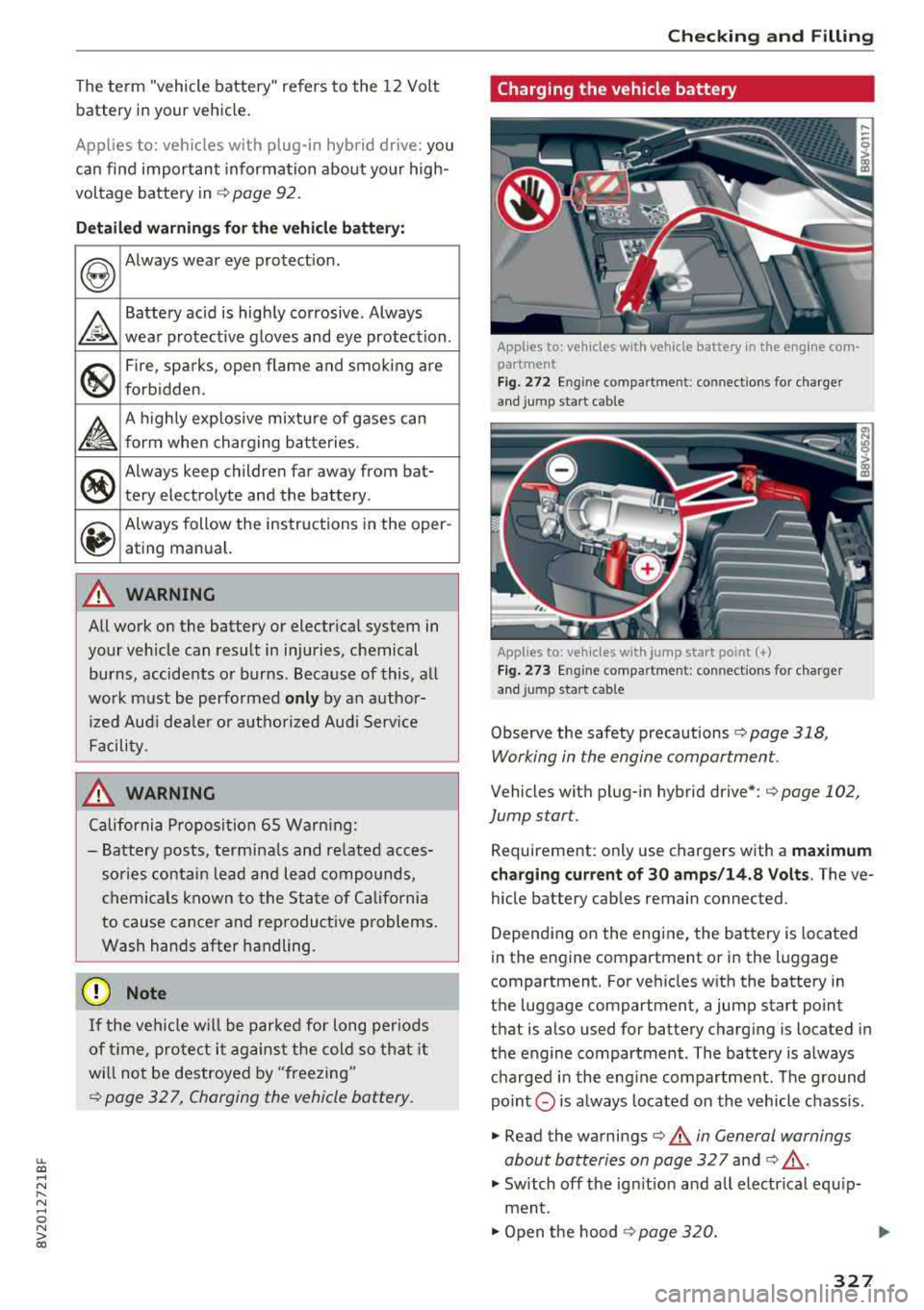
Applies to: veh icles w ith vehicle battery in t he e ng in e com
partment
Fig . 272 En g in e co mpa rtm en t: c onnect ions for charge r
a nd j ump start c abl e
Applies to: vehicles w ith jump s ta rt point(+)
Fig . 2 73 Engin e compar tm ent: c onn ect io ns fo r charge r
a n d j ump s ta rt c able
Observe the safety precautions r=>page 318,
Working in the engine compartment .
Vehicles with plug-in hybrid drive*: r=> page 102,
Jump s tar t.
Requirement: only use chargers with a ma ximum
charging current of 30 amp s/14.8 Volt s.
The ve
hicle battery cab les remain connected.
Depend ing on the engine, the battery is located
in the engine compartment or i n the l uggage
compartment. For vehicles w ith the battery in
the luggage compartment, a jump start point
that is also used for battery charg ing is located i n
the engine compartment . The battery is a lways
charged in the eng ine compartment. The g round
poin t
0 is always loca ted on the vehicle chass is .
.,. Read the warnings r=> .&.. in General warnings
about batteries on page 32 7
and r=> .&._.
.,. Switch off the ig nitio n and all electrical equ ip
ment .
.,. Open the hood r=> page 320.
327
Page 330 of 404
Check ing and F illing
~ Applies to: vehicles with the vehicle battery in
the engine compartment: open the battery cov
er
¢ fig. 272 .
~ Applies to: vehicles with jump start point(+):
open the cover on the posi tive term inal
¢ fig . 273 .
~ Clamp the charger terminal clamps as instruct
ed on the
p os itiv e t erminal (+ ) and only on the
bo dy ground p oin t(-).
~ Inse rt the powe r cable for the charg ing device
into the socket and switch the device on.
~ At the end of the charging process, switch the
charger off and pull the power cab le out of the
socket.
~ Remove the charger terminal clamps.
~ Applies to: vehicles with the vehicle battery in
the engine compartment: fold the cover back
on the battery correctly .
~ Applies to: vehicles with jump start point(+):
close t he cover on the positive term inal.
~ Close the hood ¢ page 320.
A WARNING
-A highly exp losive mixture of gases can form
when charging batteries . On ly charge the
vehicle battery in well -venti lated areas.
- A drained vehicle battery can freeze at tem
peratures around 32
QF (0 QC). A frozen or
thawed vehicle battery must not be charged
and must not be used anymore. If ice forms,
the battery housing can crack and battery electrolyte can leak out, which increases the
risk of a n explos ion and chemical burns .
Contact an autho rized Aud i deale r or au
tho rized Aud i Serv ice Facility fo r more info r
mation .
-Do not connect o r disconne ct the c ha rg ing
cable while charg ing beca use th is increases
the risk of an exp losion.
(D Tips
-Only charge the vehicle battery through the
con nections in t he e ng ine compartment.
-Read all of the manufacture r's instructions
fo r th e cha rger befo re charg ing t he ve hicle
battery.
32 8
Windshield washer
system
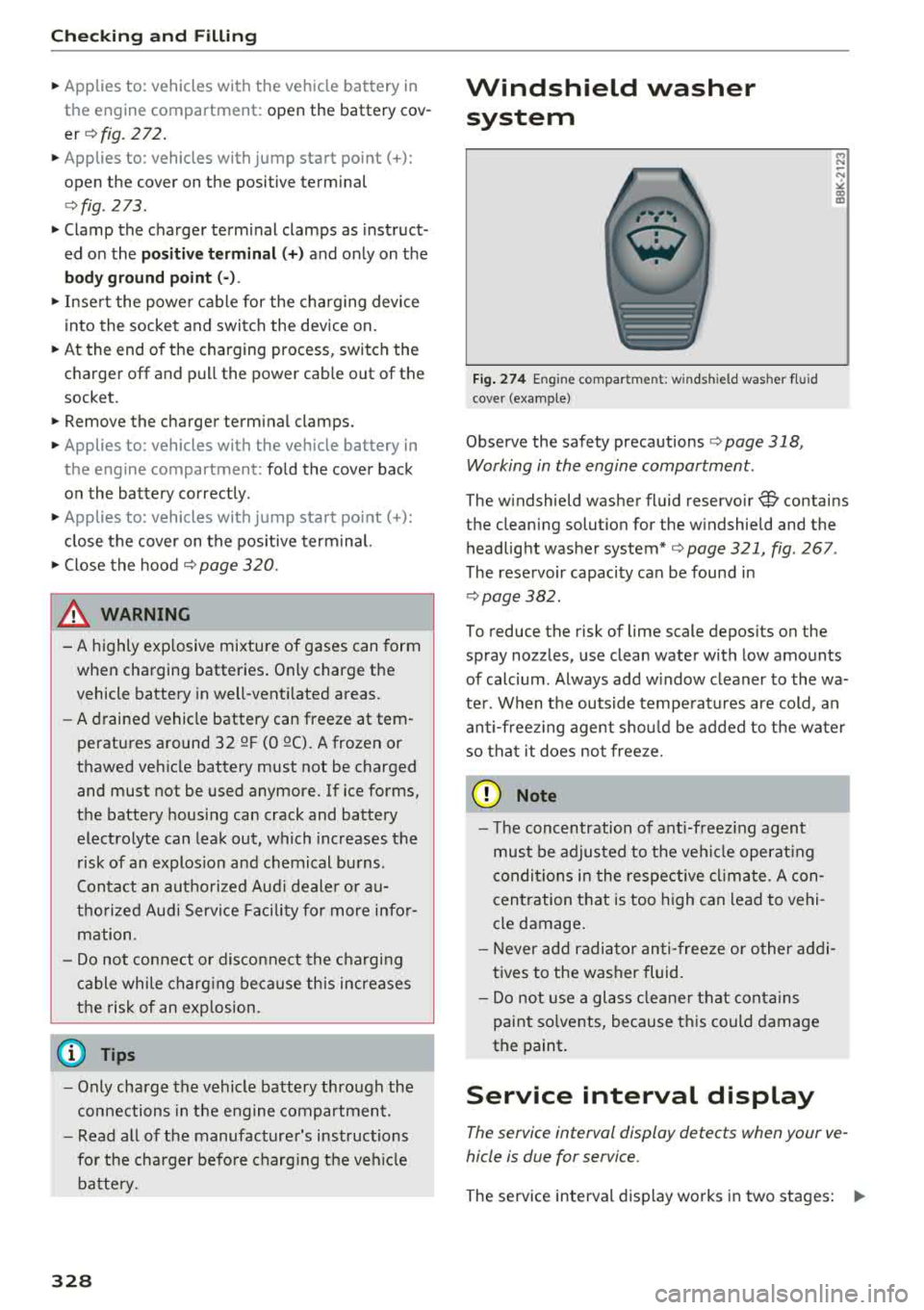
Fig . 274 En gin e compar tmen t: w inds hield was he r fl ui d
cove r (example)
Observe the safety precautions ¢ page 318 ,
Working in the engine compartment .
M N
-N
"' "' m
The windshield washer fluid reservo ir W contains
the cleaning solution for the w indshield and the
headlight washer system*
¢ page 321, fig . 267 .
The reservoir capacity can be found in
¢page 382.
To reduce the risk of lime scale depos its on the
sp ray nozzles, use clean water with low amounts
of calcium . Always add w indow cleaner to the wa
ter . When the outside temperatures are cold , an
ant i-freez ing agent sho uld be added to t he wate r
so that it does no t freeze.
@ Note
-Th e concentration of ant i-freez ing agent
must be adjusted to t he ve hicle operat ing
c ondi tions i n the respective clima te . A con
centration t hat is too high can lead to vehi
cle damage .
-Never add radia to r an ti- free ze o r o ther ad di
t ives to the washer fluid.
-Do not use a glass clea ner th at conta ins
paint so lvents, because t his could damage
the paint.
Service interval display
The service interval display detects when your ve
hicle is due for service .
The service interval display works in two stages: .,.
Page 350 of 404

Wheels
The grade C corresponds to a leve l of perform
ance which all passenger car tires must meet un
der the Federa l Motor Vehicle Safety Standard
No.
109. Grades Band A represent higher levels
of performance on the laboratory test wheel than
the minimum required by law.
A WARNING -
The traction grade ass igned to this tire is
based on straight-ahead braking traction
tests, and does not include acce le rat ion, cor
ne ring, hydroplaning or peak traction charac
teristics.
A WARNING
Th e temperatu re grade for this tire is estab
lished for a tire that is properly inflated and
not overloaded. Excessive speed, underinfla
tion, or excessive loading, either separate ly or
in combination, can cause heat buildup and
possible tire failure.
A WARNING
-
-
Temperature grades apply to tires that are properly inflated and not over or underinflat
ed.
Tire Pressure Monitoring System indicator
(J.) General notes
Each t ire, including the spare (if provided),
should be checked monthly when cold and inflat
ed to the inflation pressure recommended by the
ve hicl e manufacturer on the vehicle placard or
tire in flat ion press ure label. ( If yo ur vehicle has
t ires of a different siz e than the size indicated on
the vehicle placard or tire inflation pressure la
be l, you should determine the proper tire infla
tion pressure for those t ires) .
As an added safety feature, your veh icle has been
equipped with a tire pressure monitoring system
(TPMS) that illuminates a low tire pressure te ll
tale when one or more of your t ires is significant
ly under-inflated. Accordingly, when the low tire
pressure tellta le illuminates, you should stop and
348
check your tires as soon as possible, and inflate
them to the proper pressure . Driving on a signifi
cant ly under-inflated t ire causes the t ire to over
heat and can lead to tire fa ilure . Under-inflation
also reduces fue l eff iciency and tire tread life,
and may affect the vehicle's handling and stop
ping ability .
Please note that the TPMS is not a substitute for
proper tire maintenance, and it is the dr iver's re
spons ibility to maintain correct tire pressure,
even if under-inflation has not reached the level
to trigger illumination of the TPMS low tire pres
su re te lltale.
Your vehicle has also been equipped with a TPMS
malfunction indicator to indicate when the sys
tem is not operating prope rly . The TPM S mal
function indicator is combined with the low tire
pressure telltale. When the system detects a
malfunction, the telltale will flash for approxi
mately one minute and then remain continuously
illuminated. This sequence wi ll continue upon
s ub sequent vehicle start-ups as long as the mal
funct ion exists.
When the malfunction indicator is illuminated,
the system may not be able to detect or signal
l ow tire pressure as intended. TPMS malfunctions
may occur for a variety of reasons, including the
i nstallation of replacement or alternate tires or
wheels on the veh icle that prevent the TPMS
from functioning properly. Always check the
TPMS ma lfunction telltale after replac ing one or
more tires or wheels on you r vehicle to ens ure
that the rep lacement or alternate tires and
whee ls allow the TPMS to continue to function
properly.
Tire Pressure Monitoring System indicator
appears
App lies to : vehicles wit h Tire Pressure Mo nitor ing System in
dicator
The tire pressure indicator in the instrument
cluster informs you if the tire pressure is too low
or if there is a system malfunction .
Using the ABS sensors, the tire pressure monitor
in g system compares the tire tread circumfer
en ce and vibration characteristics of the
Page 352 of 404

Wheels
~ Select in the Infotainment system: IMENUI but
ton
> Vehicle > left control button > Service &
checks > Tire pressure monitoring > Store tire
pressure> Yes, store now.
(D Tips
Do not store the tire pressures if snow chains
are installed.
Tire pressure monitoring
system
(.L) General notes
Each tire, including the spare (if provided),
should be checked monthly when cold and inflat
ed to the inflation pressure recommended by the
vehicle manufacturer on the vehicle placard or
tire inflation pressure label. (If your vehicle has
tires of a different size than the size indicated on
the vehicle placard or t ire inflation pressure la
bel, you should determine the proper tire infla
tion pressure for those tires).
As an added safety feature, your vehicle has been
equ ipped w ith a t ire pressure monitoring system
(TPMS) that illuminates a low tire pressure tell
tale when one or more of your tires is significant
ly under-inflated. Accordingly, when the low tire
pressure telltale illuminates, you should stop and
check your tires as soon as possible, and inflate
them to the proper pressure. Driving on a signifi
cantly under-inflated tire causes the tire to over heat and can lead to tire failure . Under -inflation
also reduces fuel efficiency and tire tread life,
and may affect the vehicle's handling and stop
p in g ability.
Please note that the TPMS is not a substitute for
proper tire maintenance, and it is the driver's re
sponsibility to maintain correct tire pressure,
even if under-inflation has not reached the leve l
to trigger illuminat ion of the TPMS low tire pres
sure telltale .
Your vehicle has also been equipped with a TPMS
malfunct ion indicator to indicate when the sys
tem is not operating properly. The TPMS mal
function indicator is combined with the low tire
pressure telltale. When the system detects a
350
malfunction, the telltale will flash for approxi
mately one minute and then remain continuously
illuminated. This sequence will continue upon
subsequent vehicle start-ups as long as the mal
function exists.
When the malfunction indicator is illuminated,
the system may not be able to detect or signal
low tire pressure as intended. TPMS malfunctions
may occur for a variety of reasons, including the
installation of replacement or alternate tires or
wheels on the vehicle that prevent the TPMS
from functioning properly. Always check the
TPMS malfunction tel ltale after replac ing one or
more tires or wheels on your vehicle to ensure
that the replacement or alternate tires and
wheels allow the TPMS to continue to function
properly.
Description
Applies to: vehicles with tire pressure monitoring system
The tire pressure monitoring system monitors
the pressure in the four tires when driving.
The system uses sensors that measure the tema
perature and pressure in the tires. The data is
sent from these sensors to the control module by
radio frequency .
The tire pressure monitoring system shows the
current pressures and temperatures of the tires
in the Infotainment system while driving
¢ page 351. It also compares the current tire
pressures with the stored tire pressures and
gives a warning if the tire pressure is different
from what is stored
¢ page 351.
The system does not detect if the stored tire
pressures match the recommended tire pres
sures . You must store the tire pressures again
¢ page 352:
- every time the tire pressures change, for exam
ple when the load in the vehicle changes,
- after replacing a tire, or
- if wheels with new wheel sensors are used.
Page 356 of 404

Care and cl eaning
Care and cleaning
General information
Applies to: vehicles with plug-in hybrid drive: for
additiona l cleaning and care information, see
¢ page 117.
Reg ula r, prope r ca re helps to maintai n your veh i
cle's value. It can a lso be a requirement when
submitting warranty claims for corrosion damage
and paint defects on the body.
The ne cessary care prod ucts c an be ob tained
from an authorized Aud i dea ler o r authorized
Audi Service Facility. Read and follow the instruc
tions fo r use on the packaging.
A WARNING
- Us ing clean ing and ca re products incorrectly
can be dangero us to your hea lth.
- Always store clean ing and ca re products out
of reach of children to reduce the r is k of po i
so ning.
@ For the sake of the environment
- Prefe rab ly purchase environmenta lly-friend
l y cleaning products.
- Do not dispose of leftove r cleaning and ca re
p roducts wit h house hold trash.
Car washes
The longer that deposits s uch as insects, bird
droppings, tree sap or road salt remain on the ve
h icle, the more the surface can be damaged. High
temperatures such as those caused by sunlight increase the damaging effect .
Before washing, rinse
off heavy deposits with
p lenty of water.
S tu bborn deposits s uch as bird d roppings or tree
sap are best removed with plenty of water and a
microfiber cloth.
A lso, wash t he u nderside of yo ur vehicle once
road sa lt stops being used for the season .
354
Pressure washers
When was hing yo ur vehicle wi th a press ure was h
er, always follow the operat ing instruct ions pro
vided with the pressure washer . This is especia lly
important in regard to the pressure and spraying
distance. Do not aim the spray direct ly at sea ls on
s ide windows, doors, the hood, the luggage com
partment lid or the panorama g lass roof * or at
tires, rubbe r hoses, insula ting material, the pow
e r top*, senso rs* o r camera lenses* . Keep a d is
tance of at least 16 in (40 cm).
Do not remove snow and ice with a p ressure
washer.
Never use cone nozzles o r high press ure nozzles.
The wate r temperatu re must not be above 140 °F
(60 °C).
Automatic car washes
Sp ray off the ve hicle befo re wash ing.
Make su re t hat the wi ndows, the pa norama g lass
roof* and the power top* are closed and the
winds hield wipers a re
off. Fo llow instructions
from the ca r was h operator, espec ia lly if there
a re acc esso ries attached to your ve hicle.
If possible, use car washes that do not have
brushes.
Applies to: RS models
Only use car washes where the veh icle remains
stationary and the washing equipment moves around the vehicle when wash ing and dry ing . Car
washes that move the veh icle t hrough the ca r
wash using a c ha in a re not re commended .
Washing by hand
Clean the ve hicle starting from t he top and work
i ng down using a soft sponge or cleaning brus h.
U se solvent-free cleaning prod ucts .
Washing vehicles with matte finish paint by
hand
To avo id damaging the paint when washing, fi rs t
r emove d ust and la rge pa rt icles from your vehi
cl e. Insects, grease spots a nd fingerpr ints are
best re moved w ith a spe cial cleane r fo r m atte
finish pai nt.
Page 363 of 404

LL co ..... N
" N ..... 0 N > co
"To open the side panel, turn the lock and re
move the cover
unt il the cargo floor engages beh ind the tabs
@ in both s ide panels¢ fig. 281 (upper im
age) .
" Fold the cargo floor back befo re closing the
luggage compartment lid .
Veh icle tool kit and cargo floor co ve r
App lies to: ve hicles with vers ion 2
The vehicle tool kit, tire mobility kit* and com
pressor* are stored in the luggage compartment
u nder the cargo floor
cover @¢ fig. 280.
"Engage the plastic hook ® in the luggage com-
partment
seal ¢ fig. 281.
" Fold the cargo floor back before closing the
luggage compartment lid .
..&, WARNING
Applies to: vehicles w ith jack
Improper use of the vehicle jac k can ca use se
rious personal injuries.
- Never use the screw drive r hex head to
t ighten whee l bolts, since the bolts cannot
attain the necessary tightening torque if you
use the hex head, potentially causing an ac
cident.
-The factory -supplied jack is intended only
for your vehicle model. Under no circum
stances should it be used to lift heavy
vehicles or other loads; you r isk injuring
yourself.
-Never start the engine when the vehicle is
ra ised, which could cause a n accident.
-Support the veh icle secure ly with appropri
ate stands if work is to be performed under
neath the vehicle; otherwise, there is a po
tent ial risk for injury .
-Never use the jack supplied with your Audi
on another vehicle, particularly on a heav ier
one . The jack is only suitable for use on the
vehicl e it came w ith.
@ Tips
The vehicle jack* in your vehicle is mainte
nance-free.
Em ergen cy as sis tanc e
Tire mobility kit
Preparation
Applies to: veh icles w it h tire mob ility kit
" Read and follow the important safety precau-
tions i n
¢page 360.
"Se t the park ing brake.
" Move the selector lever into the P position .
"Check if a repair with the tire mobi lity kit is pos -
sible
¢ page 361.
Using the tire mobility kit
Applies to: veh icles w it h tire mob ility kit
Fig. 282 Tire : tire damage t hat cannot be repaired
The tire repair is only meant for temporary use .
Change the spare tire as soon as
possible¢ &.
If the t ire is p ie rced by an object su ch as a nail,
do not remove the objec t from t he tire.
The tire repair set is able to be used at tempera
tures as low as -4 °F ( -20 °C) .
The tire mobility kit may not be us ed :
-if the t ire has cuts or punctures that are larger
than 0.16 in (4 mm)
(D ¢ fig. 282
-if the rim is damaged @
-if you drove with very low tire pressure or with-
out air in the tire @
In this case, see an authorized Aud i dea ler o r au
thorized Audi Serv ice Facility for ass istance.
.&_ WARNING
-Please note that the tire mobility kit cannot
be used in all situations, and that it may on
ly be used temporarily .
-The tire sealant must not come in contact
with skin, eyes, or clothes.
361
Page 368 of 404

Emergency assistance
Raising the vehicle
The vehicle must be li~ed with the jack first be
fore the wheel can be removed.
Fig. 288 Sill panels : mark in gs (exa mple)
Fig. 289 Sill : positio nin g th e ve hicle jack
,.. Engage the parking brake to prevent your vehi
cle from rolling unintentionally.
,.. Move the selector lever to position P.
,.. Find the marking (imprint) on the sill that is
nearest the wheel that will be changed
c> fig . 288 . Behind the marking, there is a lift
ing point on the sill for the vehicle jack.
,.. Vehicles with a sill: Note the position of the sill
when positioning the vehicle jack
c::> fig. 289.
,.. Place the vehicle jack (vehicle tool kit) on a firm
surface. Use a flat, stable support if necessary.
On a slippery surface such as tile, you should
use a non-slip pad (such as a rubber mat)
c::> ,&..
,.. Turn the vehicle jack located under the lifting
point on the sill to raise the jack until its arm @
c> fig. 289 is located under the designated plas
tic mount
c::> ,& , c::>G) .
,.. Align the jack so that its arm@ c::> fig. 289 en
gages in the designated lifting point in the door
sill and the movable base @ lies flat on the
ground. The base @ must be
vertical under the
lifting point @.
366
,.. Wind the jack up further until the flat tire
comes off the ground
c::> ,&. .
Position the vehicle jack only under the designat
ed lifting points on the sill
c::>fig. 288. There is ex
actly
one location for each wheel. The jack must
not be positioned at any other location
c::> & c::>(I) .
An unstable surface under the jack can cause the
vehicle to slip off the jack. Always provide a firm
base for the jack on the ground. If necessary
place a sturdy board or similar support under the
jack. On
hard, slippery surfaces (such as tiles)
use a rubber mat or similar to prevent the jack
from slipping
c::> & .
A WARNING -
-You or your passengers could be injured
while changing a wheel if you do not follow
these safety precautions :
-Position the vehicle jack only at the desig
nated lifting points and align the jack.
Otherwise, the vehicle jack could slip and
cause an injury if it does not have suffi
cient hold on the vehicle .
-A soft or unstable surface under the jack
may cause the vehicle to slip off the jack.
Always provide a firm base for the jack on
the ground . If necessary, use a sturdy
board under the jack.
-On hard, slippery surface (such as tiles)
use a rubber mat or similar to prevent the
jack from slipping.
-Only raise your vehicle with the vehicle
jack provided by the factory. If you use a
vehicle jack for another vehicle, your vehi
cle can slide and cause injury.
-Changes in load can affect the height of
the vehicle.
-Never start the engine when the vehicle is
raised, which could cause an accident.
-Support the vehicle securely with appro
priate stands if work is to be performed
underneath the vehicle; otherwise, there
is a potential risk for injury .
-To help prevent injury to yourself and your
passengers: