2018 AUDI S3 SEDAN ESP
[x] Cancel search: ESPPage 339 of 404

u. a, ... N
" N ... 0 N > a:,
by the tire manufacturer. This in
formation is used to contact con sumers if a tire defect requires a
recall.
Vehicle capacity weight
means the rated cargo and lug
gage load plus 150 lbs . (68 kilo
grams) times the vehicle's desig
nated seating capacity.
Vehicle ma ximum load on the
tire
means that load on an indiv idual
tire that is determined by distrib
uting to each axle its share of the
maximum loaded vehicle weight
and dividing by two.
Vehicle normal load on the tire
means that load on an indiv idual
tire that is determined by distrib uting to each axle its share of the
curb weight, accessory weight,
and normal occupant weight (dis
tributed in accordance
with ¢ ta
ble on page 342)
and dividing by
two .
Occupant loading and distr i
bution for vehicle normal load
for various designated seating
capacities
Refer to the tire inflation pres
s u re
label¢ page 341, fig . 2 78
Wheels
for the n umber of seating posi
tions . Refer to the table
¢ table
on page 34 2
for the number of
people tha t correspond to the ve
hicle normal load.
New tires or wheels
Audi recommends having all work
on tires o r wheels performed by
an authorized Audi dealer or au
thorized Audi Service Facility.
These facilities have the proper
knowle dge and are eq uipped with
the requ ired too ls and replace
ment parts.
.,. New tires do not yet have the
optimum g ripping properties .
Drive carefully and at mode rate
speeds for the first 350 miles
(500 km) with new tires.
.,. Only use tires with the same de
s ign , size (rolling circumfer
ence), and as close to the same
tread pattern as possible on all
four whee ls .
.,. Applies to: RS models : only use
tires with the same design and
the same tread pattern on all
four whee ls.
.,. Do not replace tires indiv idually .
At least replace both tires on the
same axle at the same time .
...
337
Page 350 of 404

Wheels
The grade C corresponds to a leve l of perform
ance which all passenger car tires must meet un
der the Federa l Motor Vehicle Safety Standard
No.
109. Grades Band A represent higher levels
of performance on the laboratory test wheel than
the minimum required by law.
A WARNING -
The traction grade ass igned to this tire is
based on straight-ahead braking traction
tests, and does not include acce le rat ion, cor
ne ring, hydroplaning or peak traction charac
teristics.
A WARNING
Th e temperatu re grade for this tire is estab
lished for a tire that is properly inflated and
not overloaded. Excessive speed, underinfla
tion, or excessive loading, either separate ly or
in combination, can cause heat buildup and
possible tire failure.
A WARNING
-
-
Temperature grades apply to tires that are properly inflated and not over or underinflat
ed.
Tire Pressure Monitoring System indicator
(J.) General notes
Each t ire, including the spare (if provided),
should be checked monthly when cold and inflat
ed to the inflation pressure recommended by the
ve hicl e manufacturer on the vehicle placard or
tire in flat ion press ure label. ( If yo ur vehicle has
t ires of a different siz e than the size indicated on
the vehicle placard or tire inflation pressure la
be l, you should determine the proper tire infla
tion pressure for those t ires) .
As an added safety feature, your veh icle has been
equipped with a tire pressure monitoring system
(TPMS) that illuminates a low tire pressure te ll
tale when one or more of your t ires is significant
ly under-inflated. Accordingly, when the low tire
pressure tellta le illuminates, you should stop and
348
check your tires as soon as possible, and inflate
them to the proper pressure . Driving on a signifi
cant ly under-inflated t ire causes the t ire to over
heat and can lead to tire fa ilure . Under-inflation
also reduces fue l eff iciency and tire tread life,
and may affect the vehicle's handling and stop
ping ability .
Please note that the TPMS is not a substitute for
proper tire maintenance, and it is the dr iver's re
spons ibility to maintain correct tire pressure,
even if under-inflation has not reached the level
to trigger illumination of the TPMS low tire pres
su re te lltale.
Your vehicle has also been equipped with a TPMS
malfunction indicator to indicate when the sys
tem is not operating prope rly . The TPM S mal
function indicator is combined with the low tire
pressure telltale. When the system detects a
malfunction, the telltale will flash for approxi
mately one minute and then remain continuously
illuminated. This sequence wi ll continue upon
s ub sequent vehicle start-ups as long as the mal
funct ion exists.
When the malfunction indicator is illuminated,
the system may not be able to detect or signal
l ow tire pressure as intended. TPMS malfunctions
may occur for a variety of reasons, including the
i nstallation of replacement or alternate tires or
wheels on the veh icle that prevent the TPMS
from functioning properly. Always check the
TPMS ma lfunction telltale after replac ing one or
more tires or wheels on you r vehicle to ens ure
that the rep lacement or alternate tires and
whee ls allow the TPMS to continue to function
properly.
Tire Pressure Monitoring System indicator
appears
App lies to : vehicles wit h Tire Pressure Mo nitor ing System in
dicator
The tire pressure indicator in the instrument
cluster informs you if the tire pressure is too low
or if there is a system malfunction .
Using the ABS sensors, the tire pressure monitor
in g system compares the tire tread circumfer
en ce and vibration characteristics of the
Page 351 of 404

u. 00 .-< N l' N .-< 0 N > 00
individual tires. If the pressure changes in one or
more tires, this is indicated in the instrument
cluster display with an
RE ind icator light and a
message . If only one tire is affected, the location
of that tire w ill be ind icated.
The tire pressures must be stored in the menu
d isp lay aga in each time the press ures c hange
(sw itching between part ial and fu ll load p res
sure) or after changing or replac ing a tire on your
ve hicle
r=>page 349 . The t ire pressure monitor
in g sys tem only monito rs t he tire pressure you
have stored . Refe r to the ti re p ressure labe l for
the recommended ti re p ressure for you r veh icle
r=>page 341, fig. 278.
Tire tread circumference and v ibrat ion character
i stics can change a nd cause a t ire pressure warn
in g if:
- the tire pressure i n one or more tires is too low
- the tire has structura l damage
- the tire was replaced o r the tire p ressure was
changed and it was not stored
r=> page 349
- one si de of the vehicle is more heavily loaded
than the other
- th e whee ls on one ax le are mo re heavi ly loaded
t h an the others (for examp le, w hen tow ing a
trailer or when driv ing up and down hills)
- snow c hains a re installed
- the spare t ire* is ins talle d
- on ly one tire w as replaced on each ax le
Indicator lights
RE -loss of pressu re in at least one tire r=> ,&. .
Check the ti res and rep lace o r repa ir if necessary .
C heck/ co rrect t he p ressures of a ll four tires. Then
s to re t he ti re p ressures i n the men u
r=> page 349 .
mm (Ti re Pressure Monitori ng System) Tire
pressure: malfunction! See owner's manual. If
mm appears after switching t he ign it io n on o r
while driving and the
RE i ndicato r light in the in
s trumen t cluster blinks fo r approxim ately one
minu te and t hen stays o n, there is system ma l
f u nction. Check/cor rect the pressu res on all fo ur
tires an d sto re t he p ressures
r=> page 349. If the
ind icator light does turn
off or turns on again af
ter a short per iod of t ime, drive to an author ized
Wheels
Audi dealer or author ized A udi Se rvice Fac ility im
med iate ly to have the ma lfu nction co rrected.
A WARNING
--
- If the tire p ressure ind icator appears in the
instr ument cluster disp lay, reduce your
speed immediately and avoid any hard
steer ing o r braking maneuvers . Stop as soon
as poss ible and check the tires and the ir
p ressures.
- The drive r is responsible fo r maintain ing the
correct tire press ures . You must check the
tire p ressures regularly.
- Unde r ce rtain condit ions (such as a sporty
d riving s tyle, win ter condi tions or unpaved
roads), the pressu re moni tor indicator may
be de layed.
- Do not use run -flat tires on your vehicle. Us
ing them when no t pe rm itted can lead to
veh icle d amage o r acc id en ts .
(D Tips
- The tire p ressure mon itoring system can al
so s top working w hen
th ere is a n ESC/ ABS
m alfunc tion.
- Us ing snow chains may resul t in a system
m alfu nction.
- The tire p ressure mon itoring system in your
Audi was calibrat ed with "Audi Original
Ti res"
r=>page 33 7. Usi ng these tires is rec
ommende d.
- The tire p ressure mon itoring system can on
ly moni to r the tire p res sure o f the d riving
t ires. Check the tir e press ure o f the spare
wheel in the l uggage compa rtment so tha t
if necessary it is ready for use .
Storing tire pressures
Applies to: vehicles wit h Tir e Pressure Monito rin g Syste m in·
dicator
A change in tire pr essure or a change in tires
must be stored in the system.
Make su re before stori ng that the tire p ressures
of all fo ur tir es meet the specified val ues and a re
adapted to the load
r=> pag e 339. .,,.
349
Page 353 of 404

u. 00 .-< N l' N .-< 0 N > 00
A WARNING
-The tire pressure monitoring system assists
the driver in monitoring tire pressures . The
driver is responsible for having the tires in
flated to the correct pressure.
- Do not change the tire pressure when the
temperature of the tire is extremely high.
This could result in serious damage to the
tire and even cause the tire to burst, in
creasing the risk of an accident.
- A tire with low pressure flexes more. This
heats the tire up too much. This could cause
the tread to separate and even cause the
tire to burst, increasing the risk of an acci
dent.
- The tire pressure monitoring system does
not warn about damage or defects in the
tire construction that could cause the tire to burst, for example . Inspect your tires regu
larly .
(D Tips
-If tires are replaced, the sensors/valves do
not need to be removed or replaced. Just re
placed the valve stem and, if necessary, the
valve and the wheel electronics. If you have
questions, see an authorized Audi dealer or
authorized Audi Service Facility .
- An incorrect display or a malfunction in the
tire pressure monitoring system can occur
after using the tire mobility kit . Have the
sensors replaced by an authorized Audi
dealer or authorized Audi Service Facility.
- For an explanation on conformity with the
FCC regulations in the United States and the
Industry Canada regulations, see
r=;,page 386.
Displaying tire pressures/temperatures
Applies to: vehicles with tire pressure mo nito ring system
Requirement: you must be driving the vehicle.
"'Select in the Infotainment system: the I MENU I
button > Vehicle > left control button > Service
& checks > Tire pressure monitoring > Display
tire pressures.
Wheels
The current tire pressures are shown in green,
yellow or red numbers in the Infotainment sys
tem:
- Green: the current tire pressure and the speci
fied tire pressure are approximately the same.
- Yellow: the current tire pressure is too low
compared to the specified tire pressure.
-Red: the current tire pressure is extremely low
compared to the specified tire pressure .
The specified tire pressure is the last tire pres
sure that was stored
r=;, page 352.
Note that the tire pressure also depends on the
temperature of the tire. The tire pressure in
creases as the engine becomes warmer while
driving.
A WARNING
Read and follow the important information
and notes
"*page 350.
(D Tips
The tire pressure or temperature is not dis
played while the vehicle is stationary and in
adaptation mode. Dashes--.-- are shown in
place of the pressure and temperature.
ill Tire pressure loss
Applies to: vehicles with tire press ure mo nito ring system
-
If the [tE indicator light turns on, the pressure in
at least one tire is too low or new sensors were
not adapted:
RE Indicator light turns on after turning the
ignition on
The tire pressure is too low compared to the
specified pressure .
.,. Check and store the tire pressure(s) the next
time it is possible
"*page 352.
RE Indicator light turns on while driving
Wheels with new sensors were not adapted or
the tire pressure has reached a critical level com
pared to the specified pressure.
"'Avoid unnecessary steering and braking maneu-
vers.
..,_
351
Page 356 of 404

Care and cl eaning
Care and cleaning
General information
Applies to: vehicles with plug-in hybrid drive: for
additiona l cleaning and care information, see
¢ page 117.
Reg ula r, prope r ca re helps to maintai n your veh i
cle's value. It can a lso be a requirement when
submitting warranty claims for corrosion damage
and paint defects on the body.
The ne cessary care prod ucts c an be ob tained
from an authorized Aud i dea ler o r authorized
Audi Service Facility. Read and follow the instruc
tions fo r use on the packaging.
A WARNING
- Us ing clean ing and ca re products incorrectly
can be dangero us to your hea lth.
- Always store clean ing and ca re products out
of reach of children to reduce the r is k of po i
so ning.
@ For the sake of the environment
- Prefe rab ly purchase environmenta lly-friend
l y cleaning products.
- Do not dispose of leftove r cleaning and ca re
p roducts wit h house hold trash.
Car washes
The longer that deposits s uch as insects, bird
droppings, tree sap or road salt remain on the ve
h icle, the more the surface can be damaged. High
temperatures such as those caused by sunlight increase the damaging effect .
Before washing, rinse
off heavy deposits with
p lenty of water.
S tu bborn deposits s uch as bird d roppings or tree
sap are best removed with plenty of water and a
microfiber cloth.
A lso, wash t he u nderside of yo ur vehicle once
road sa lt stops being used for the season .
354
Pressure washers
When was hing yo ur vehicle wi th a press ure was h
er, always follow the operat ing instruct ions pro
vided with the pressure washer . This is especia lly
important in regard to the pressure and spraying
distance. Do not aim the spray direct ly at sea ls on
s ide windows, doors, the hood, the luggage com
partment lid or the panorama g lass roof * or at
tires, rubbe r hoses, insula ting material, the pow
e r top*, senso rs* o r camera lenses* . Keep a d is
tance of at least 16 in (40 cm).
Do not remove snow and ice with a p ressure
washer.
Never use cone nozzles o r high press ure nozzles.
The wate r temperatu re must not be above 140 °F
(60 °C).
Automatic car washes
Sp ray off the ve hicle befo re wash ing.
Make su re t hat the wi ndows, the pa norama g lass
roof* and the power top* are closed and the
winds hield wipers a re
off. Fo llow instructions
from the ca r was h operator, espec ia lly if there
a re acc esso ries attached to your ve hicle.
If possible, use car washes that do not have
brushes.
Applies to: RS models
Only use car washes where the veh icle remains
stationary and the washing equipment moves around the vehicle when wash ing and dry ing . Car
washes that move the veh icle t hrough the ca r
wash using a c ha in a re not re commended .
Washing by hand
Clean the ve hicle starting from t he top and work
i ng down using a soft sponge or cleaning brus h.
U se solvent-free cleaning prod ucts .
Washing vehicles with matte finish paint by
hand
To avo id damaging the paint when washing, fi rs t
r emove d ust and la rge pa rt icles from your vehi
cl e. Insects, grease spots a nd fingerpr ints are
best re moved w ith a spe cial cleane r fo r m atte
finish pai nt.
Page 358 of 404

Care and cl eaning
Component Situation Solution
W hee ls
Road salt Water
Brake dust Acid-free special cleaning solution
Ex haust t ail p ipe s Road salt Water, cleaning solution suitab le for stainless steel, if nee-
essary
P ow er t op Deposits Clea n water, power top clean ing prod uct, if necessa ry.
C lean with the grain of the fabric using a soft brush and al -
l ow to air dry .
Wind deflect o r Deposits Water, mild soap solut ion, if necessaryal
Dec orat ive part s/ Deposits Mild soap so
lution al, a cleaning so lution suitable for stain-
trim less stee l, if necessary
Paint Paint damage Refer to the paint numbe r on the veh icle data label, repair
with touch up pa int¢
page 381
Spilled fuel Rinse with water immediately
S urface r ust Rust remover, then protect w ith hard wax; for questions,
consult an authorized Audi dealer or authorized Audi Serv -
ice Facility .
Corros ion Have it removed by an authorized Aud i dealer or author-
i zed Audi Service Fac ility.
Water no longer Protect with hard wax (at least twice per year)
beads on the surface
of clean paint
No sh ine even though Treat with s uitable polish; then apply paint protectant if
paint has been pro- the polish that was used does not contain any protectant
tected/paint looks poor
Deposits such as in- Dampen w ith wate r immediately and remove w it h a m icro-
sects, bird dropp ings, fiber cloth
tree sap and road salt
Grease-based con-Remove immediately with a mild soap solution al and a
tam inants such as soft cloth
cosmetics or sunblock
Ca rbon part s Deposits clean the
same way as painted parts ¢ page 354
Decorat ive decal s Deposits Soft sponge with a mild soap so lutional
a ) Mild soap so lution: maxim um two tablespoo ns of neut ra l soap i n 1 quart (1 liter) of water
Int erior cleaning
Component Situation Solution
Wind ows
Deposits Glass cleaner, then
wipe dry
Deco ra tive part s/ Deposits Mild soap solutional
trim
Pla stic part s
Deposits Damp cloth
Heavier deposits M ild soap so lution al, detergent-free p lastic clean ing solu-
tion, if necessa ry
356
Page 359 of 404

u. 00 ... N l' N ... 0 N > 00
Care and cleaning
Component Situation Solution
Di spl ays/ins tru·
Deposits Soft cloth with LCD cleaner
men t clus ter
C o ntro ls
Deposits Soft brush, then a soft cloth with a mild soap solution3>
S af ety be lt s Deposits Mild soap solution al, allow to dry before letting them re-
tract
T ex tile s Deposits adhering to Vacuum cleaner
a
rtificial leather , the surface
Alcanta ra Water-based deposits Absorbent cloth and mild soap solutional
such as coffee, tea,
b lood , etc.
Oil-based deposits Apply a mild soap solution
al, blot away the dissolved oil or
such as oil, make-up, dye, treat afterward with water, if necessary
etc.
Special deposits such
Specia l stain remove r, blot with absorbent material, treat
as ink, nai l polish, la- afterward with mild soap solution, if necessary
a)
tex paint, shoe pol-
ish, etc.
Na tural l eather F resh sta ins Cotton clot h with a m ild soap so lution3l
Water-based deposits Fresh stains: absorbent cloth
such as coffee, tea, Dried stains: stain remover suitable for leather
blood, etc .
Oi l-based deposits Fresh stains : absorbent cloth and stain remover suitable
such as oil, make-up ,
for leather
etc. Dried stains: grease dissolving spray
Special deposits such Spot remove r su itab le for leather
as ink, na il polish, la -
tex paint, shoe po l-
ish, etc .
Care Regularly apply condit ion ing cream that protects from
light and penetrates into the material. Use specia l co lored
cond itioni ng cream, if necessary.
Car bon part s Deposits clean the same way as plast ic parts
a) M ild soap solut ion : max imu m two tablespoons of neutral soa p in 1 quar t (1 liter) of water
A WARNING
The windsh ie ld may not be treated with wa
ter-repell ing wi ndsh ield coating agents. Un
favorable cond it ions su ch as wet ness, dar k
ness, o r low sun can resul t in increased glare.
Wiper blade chatter is also possib le.
(QJ) Note
- Headlights /tail light s
-
-Never clean headlights or tail lights w ith a
dry cloth or sponge.
- Do not use any cleaning product that con
tains alcoho l, because they could cause
cracks to form.
-Wheels
- Neve r use any pa int polish or other abra-
sive mate rials.
- Damage to the protect ive layer o n the
rims such as stone ch ips or sc ratches must
be repai red immediately.
.,.
357
Page 362 of 404
Emergency assistance
Emergency assistance
Trunk escape latch
Applies to: vehicles with trunk escape latch (Sedan and Cab
r io let)
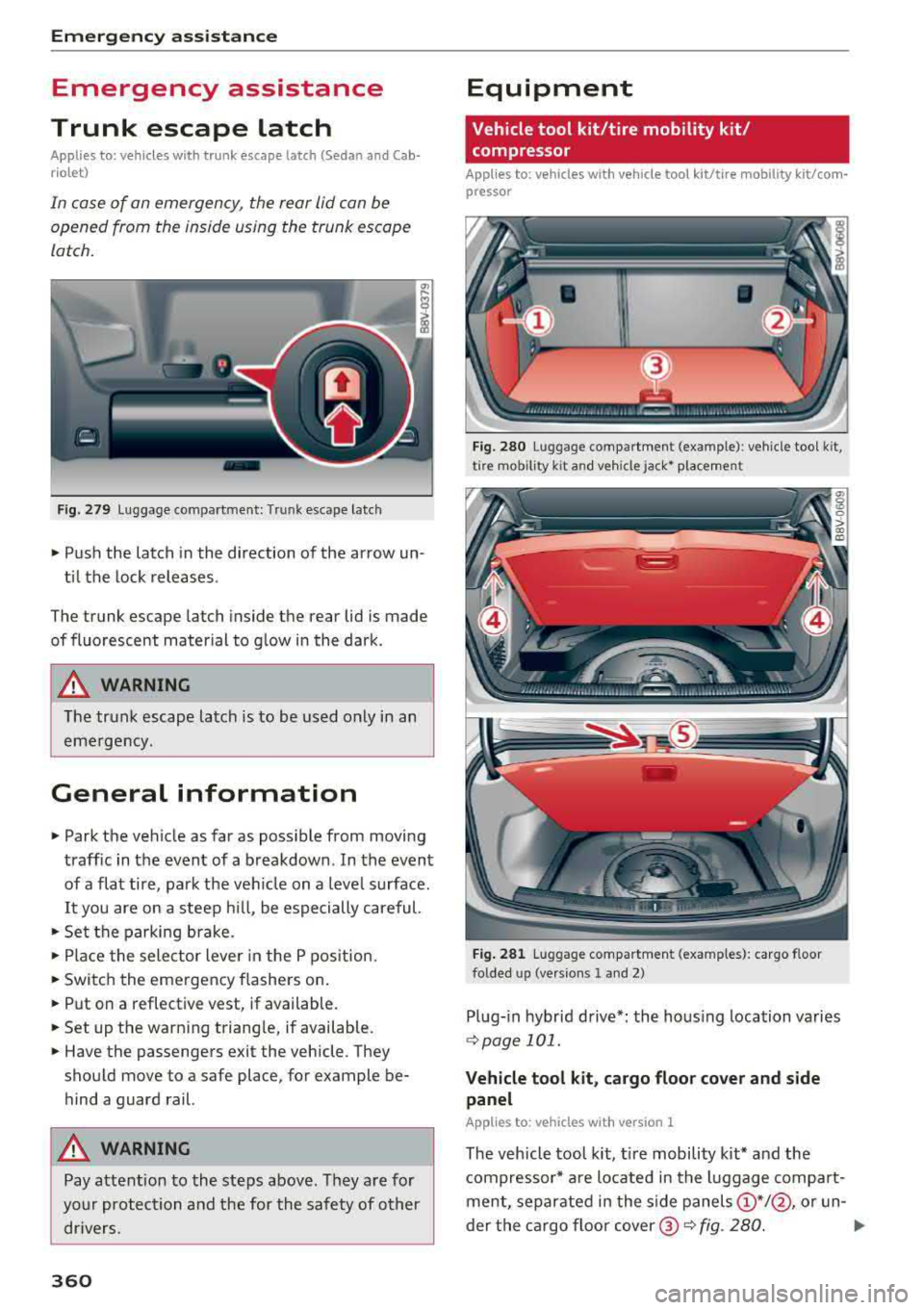
In case of an emergency , the rear lid can be
opened from the inside using the trunk escape
latch.
Fig. 279 L uggage co mpar tment: T runk esc ape latch
• Push the latch in the direction of the arrow un
til the lock releases .
The trunk escape latch inside the rear lid is made
of fluorescent material to glow in the dark .
_&. WARNING
The trunk escape latch is to be used only in an
emergency.
General information
• Park the vehicle as far as possible from moving
traff ic in the event of a breakdown . In the event
of a flat tire , park the vehicle on a leve l surface.
It you are on a steep hill, be especially careful.
• Set the parking brake.
• Place the selector lever in the P pos ition.
• Switch the emergency flashers on.
• Put on a reflective vest, if available.
• Setup the warning triangle, if available.
• Have the passengers exit the vehicle. They
should move to a safe place, for example be
hind a guard rail.
_&. WARNING
Pay attention to the steps above . They are for
your protection and the for the safety of other
dr ivers .
360
Equipment
Vehicle tool kit/tire mobility kit/
compressor
Applies to: vehicles wi th vehicle tool kit/tire mobility kit/com
pressor
Fig. 280 L u ggage compartment (ex ample): ve hicle tool kit,
tire mob ility k it a nd vehicle jack* placemen t
Fig. 281 Lug gage compartment (examp les ): cargo floor
fo lded up (ver sions 1 and 2)
Plug-in hybrid drive*: the hous ing location varies
~ page 101.
Vehicle tool k it , cargo floor cover and side
panel
Applies to: vehicles with version 1
The vehicle tool kit, tir e mobility kit* and the
compressor* are located in the luggage compart
ment, separated in the s ide
panels @*/@ , or un-
der the cargo floor cover @¢
fig. 280. II>-