2018 AUDI Q3 ECU
[x] Cancel search: ECUPage 111 of 230

a
co
...... N r--. N
'"' 0 0 ::, co
A WARNING
Not wearing safety belts or wearing them im
properly increases the risk of serious personal
injury and death. Safety belts can work only
when used correctly.
-Always fasten your safety belts correctly be fore driving off and make sure all passen
gers are correctly restrained.
- For maximum protection, safety belts must
always be positioned properly on the body.
- Never strap more than one person, includ
ing small children, into any belt.
- Never place a safety belt over a child sitting
on your lap.
- Always keep feet in the footwell in front of
the seat while the vehicle is being driven.
- Never let any person ride with their feet on
the instrument panel or sticking out the
window or on the seat.
- Never remove a safety belt while the vehicle
is moving . Doing so will increase your risk of
being injured or killed.
- Never wear belts twisted.
- Never wear belts over rigid or breakable ob-
jects in or on your clothing , such as eye
glasses, pens, keys, etc., as these may cause
injury.
- Never allow safety belts to become dam
aged by being caught in door or seat hard
ware.
- Do not wear the shoulder part of the belt
under your arm or otherwise out of position .
- Several layers of heavy clothing may inter
fere with correct positioning of belts and re
duce the overall effectiveness of the system.
- Always keep belt buckles free of anything
that may prevent the buckle from latching
securely .
- Never use comfort clips or devices that cre
ate slack in the shoulder belt. However, spe
cial clips may be required for the proper use
of some child restraint systems.
- Torn or frayed safety belts can tear, and
damaged belt hardware can break in an acci
dent. Inspect belts regularly.
If webbing,
bindings, buckles, or retractors are dam-
Safety belts
aged, have belts replaced by an authorized
Audi dealer or qualified workshop.
- Safety belts that have been worn and loaded
in an accident must be replaced with the
correct replacement safety belt by an au
thor ized Audi dealer. Replacement may be
necessary even if damage cannot be clearly
seen. Anchorages that were loaded must al
so be inspected.
- Never remove, modify, disassemble, or try
to repair the safety belts yourself.
-Always keep the belts clean. Dirty belts may not work properly and can impair the func
tion of the inertia reel~
table Interior
cleaning on page 187.
Safety belts
Fastening safety belts
Safety first -everybody buckle up!
Fig. 107 Belt buckle and tongue on t he driver 's seat
To provide maximum protection, safety belts
must always be positioned correctly on the wear
er's body .
.. Adjust the front seat and head restraint proper
ly ¢
page 42, Front seats.
.. Make sure the seatback of the rear seat bench
is in an upright position and securely latched in
place before using the belt¢,&. .
.. Pull the safety belt evenly across the chest and
pelvis¢ ,&. .
.. Ins ert the tongue into the correct buckle of
your seat until you hear it latch securely.
.. Pull on the belt to make sure that it is securely
latched in the buckle .
IIJ,,
109
Page 112 of 230

Safe ty belts
Autom ati c s afet y belt retr actors
Every safety belt is equ ipped with an automa tic
be lt retractor on the shoulder belt. This feature
locks the belt when the belt is pulled out fast,
during hard braking and in a n accident . The belt
may a lso lock when you drive up or down a steep
hill or through a sharp curve. Dur ing normal driv
ing the belt lets you
move freely .
Safety belt p ret en sion ers
Safety belts w ith pretensioners he lp to tighten
the safety belt and remove s lack when the pre
tensioners are activated ¢
page 112. The func
tion of the pretensioner is monitored by a warn ing light
¢ page 14.
Con vertib le loc king retract or
Every safety belt except the one on the driver
seat is equipped with a convertible locking retrac
tor that
m ust be used when the safety belt is
used to attach a child safety seat. Be sure to read
the impo rtant information about this feature
¢ page 144.
.&_ WARNING
Improperly pos itioned safety be lts can cause
ser ious injury in an accident
¢page 110,
Safety belt position.
- Safety belts offer optimum protection only
when the seatback is upright and belts are
properly positioned on the body.
- Always make sure that the rear seat bac k
rest to which the center rea r safety belt is
attached is secure ly latched whenever the
rear center safety belt is being used. If the
backrest is not securely latched, the passen
ger will move forward with the backrest dur
ing sudden braking, in a sudden maneuver
and especially in a crash.
- Never attach the safety belt to the buckle for another seat. Attaching the belt to the
wrong buckle wi ll reduce safety belt effec
t iveness and can cause serious persona l in
jury.
- A passenger who is not properly restrained can be seriously in ju red by the safety be lt it
self when it moves from the stronger parts
110
of the body into critical areas like the abdo men.
- Always lock the convertible locking retractor
when you are securing a child safety seat in
the vehicle ¢
page 146.
Safety belt position
Correct belt position is the key to getting maxi
mum protection from safety belts .
Fig. 108 Safety belt pos it ion
-"' .... 9 I ... a,
Standard features on your vehicle help you adjust
the position of the safety belt to match your body
s ize.
- belt height adjustment for the front seats,
- height-adjustab le front seats .
.&_ WARNING
Improperly positioned safety belts can cause
serious personal injury in an acc ident .
- The shoulder belt should lie as close to the
center of the collar bone as possib le and
should fit well on the body. Hold the belt
above the latch tongue and pull it evenly
across the chest so that it s its as low as pos
sib le on the pe lvis and there is no p ressure
on the a bdomen . The belt sho uld a lways f it
snug ly ¢
fig. 108. Pull on the belt to tig hten
if necessary .
- The lap be lt portion of the safety belt must
be positioned as low as possible across pel
vis and never
over the abdomen. Make sure
the belt lies flat and snug ¢
fig. 108. Pull on
the belt to tighten if necessary.
- A loose-fitting safety belt can ca use serious
injuries by sh ifting its position on your body ..,_
Page 113 of 230
a
co
...... N r--. N .-< 0 0 ::, co
from the strong bones to more vulnerable,
soft tissue and cause serious injury.
- Always read and heed all WARNINGS and
other important information
9 page 108.
Pregnant women must also be correctly
restrained
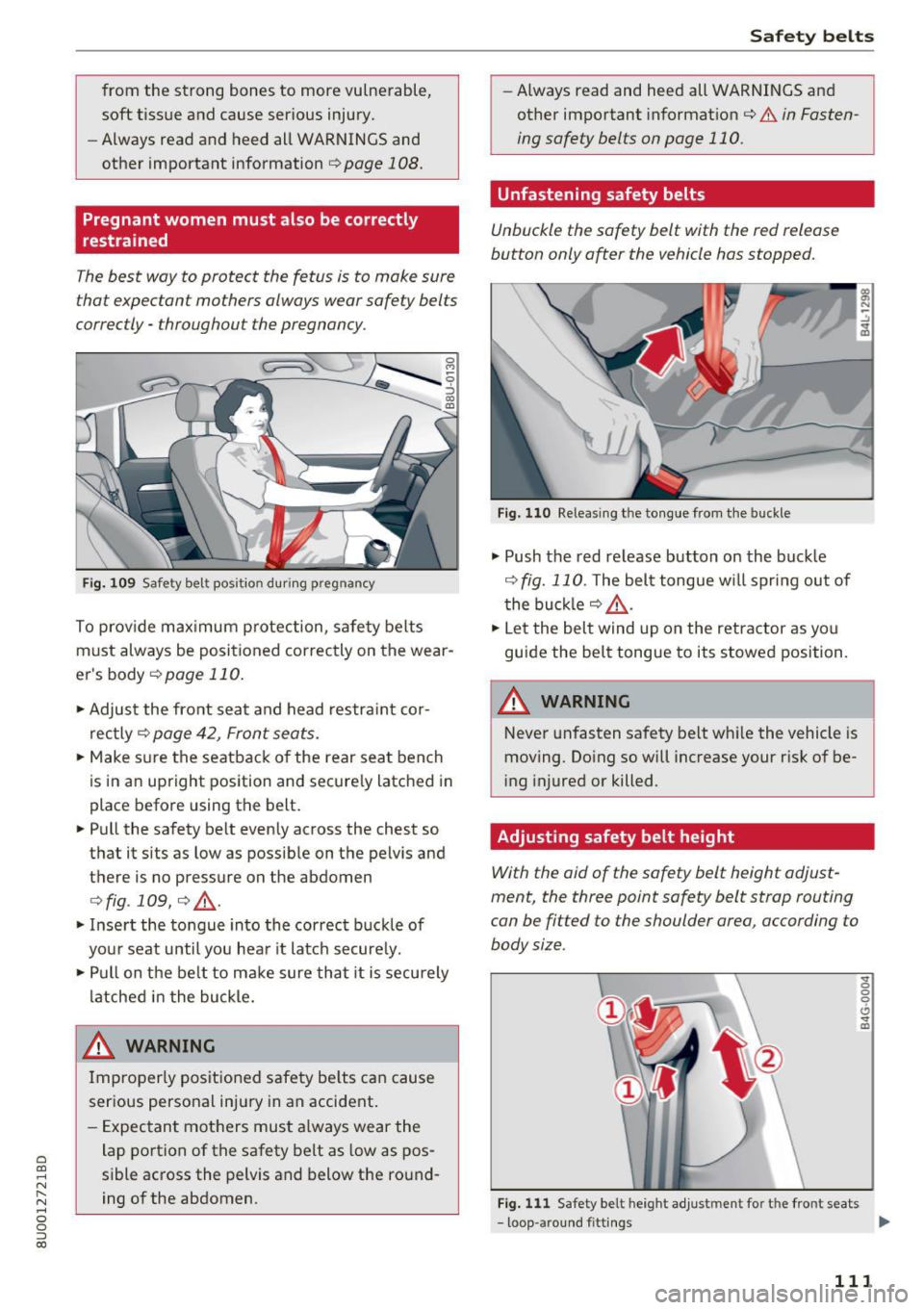
T he best way to protect the fetus is to make sure
tha t expec tan t mothers always wear safe ty bel ts
correctly -throughou t the pregnancy .
Fig. 10 9 Safety be lt pos itio n durin g p reg nancy
To p rov ide max imum p rotection, safety belts
must always be positioned correctly on the wear
e r's body
c::> page 110 .
• Adjus t the front seat and head restra int cor
rec tly
c::> page 42 , Front seats .
• Make s ure the seatback of the rear seat bench
is in a n upright position and secure ly latched in
place before using th e belt.
• Pull the safety belt evenly across the chest so
that it sits a s low as possible on the pelv is and
there is no pressure on the abdomen
c::> fig . 109, c::> .&_ .
• Inse rt the to ngue into the cor rec t buckle of
you r seat until you hea r it latch secure ly .
• Pullon the belt to m ake sure that it is secu rely
latched in the bu ckle.
_& WARNING
Improperly posit ioned safety be lts ca n cause
serious personal inj ury in an accident .
- E xpec tant mot hers mus t always wear the
lap portion of the safety belt as low as pos
sible across the pelvis and below the ro und
ing of the abdomen .
Safety bel ts
-Always read and heed all WARNINGS and
other important informat ion
c::> A in Fasten
ing safety belts on page 110.
Unfastening safety belts
Unbuckle the safety belt with the red release
button only o~er the vehicle has stopped.
Fig. 1 10 Releasi ng t he to ngue from t he bu ckle
.,. Push the red re lease but ton on the buck le
c::> fig. 110 . The belt tongue w ill spr ing out of
t he buck le
c::> _&. .
• Let the belt wind up on the retra ctor as yo u
guide the belt tongue to its stowed posit ion.
_& WARNING
Never unfasten safety belt whi le the vehicle is
moving . Do ing so will increase your r isk of be
i ng injured or killed .
Adjusting safety belt height
With the aid of the safety belt height adjust
ment, the three point safety belt strap rout ing
can be fi tted to the shoulder area, according to
body size .
Fig. 11 1 Safety belt height a dju stm ent fo r th e fro nt seat s
... 0 0
0
6 ... a,
-loop -a ro und fitt ings Ill>
111
Page 139 of 230
0 co ......
"' ,....
"' ...... 0 0 :::,
00
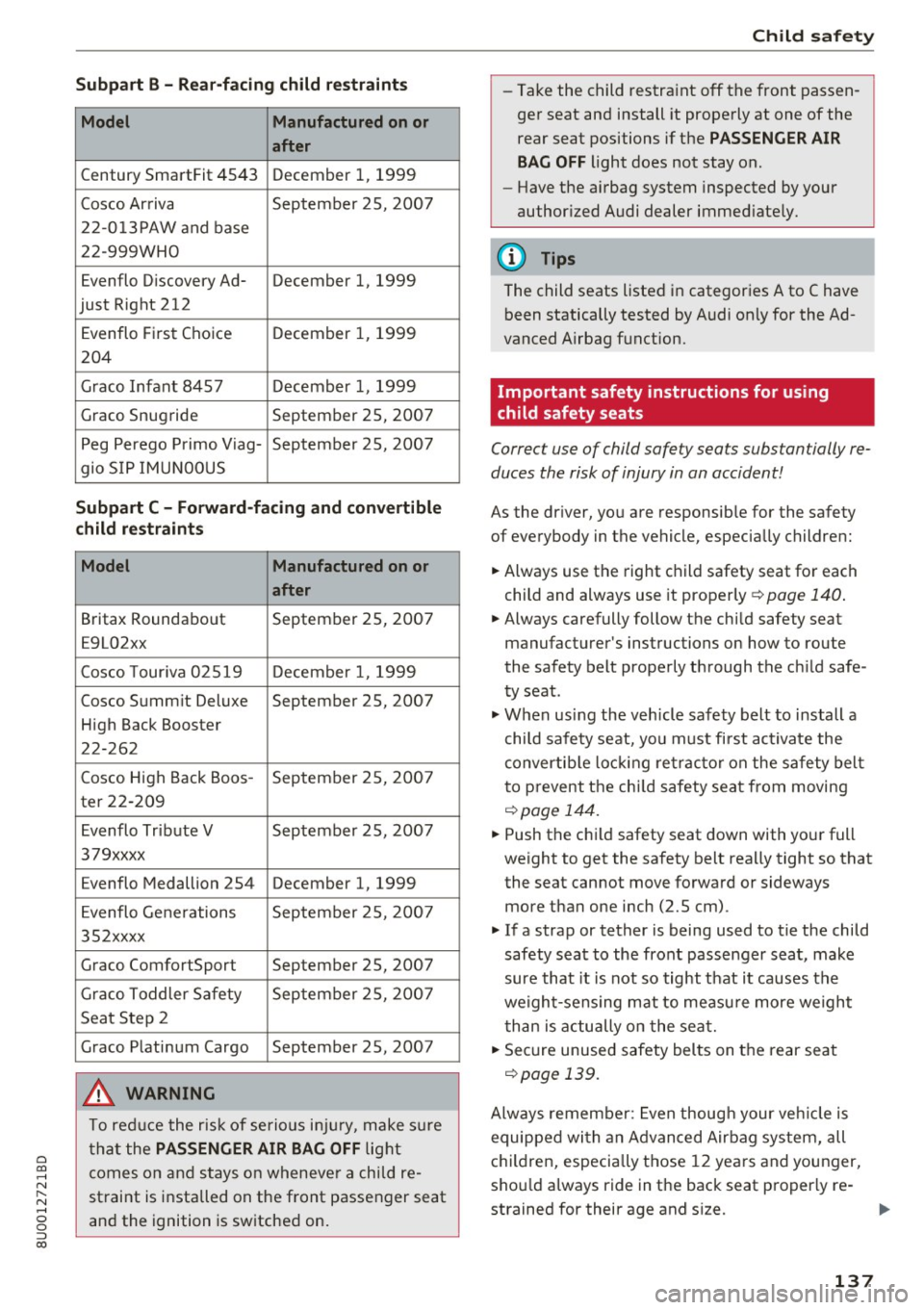
Subpart B - Rear-facing child restraints
Model Manufactured on or
after
Century SmartFit 4543 December 1, 1999
Cosco Arriva September 25, 2007
22-013PAW and base
22-999WHO
Evenflo Discovery Ad- December 1, 1999
just Right 212
Evenflo First Choice December 1, 1999
204
Graco Infant 8457 December 1, 1999
Grace Snug ride September 25, 2007
Peg Perego Primo Viag- September 25, 2007
gio S IP IMUNOOUS
Subpart C -Forward-facing and convertible
child restraints
Model Manufactured on or
after
Britax Roundabout September 25, 2007
E9L02xx
Cosco Tour iva 02519 December 1, 1999
Cosco Summit Deluxe September 25, 2007
High Back Booster
22-262
Cosco High Back Boos-
September 25, 200 7
ter 22-209
Evenflo Tribute V September 25, 2007
379xxxx
Evenflo Medallion 2S4 December 1, 1999
Evenflo Generations September 25, 2007
352xxxx
Grace ComfortSport September 25, 2007
Grace Toddler Safety September 25, 2007
Seat Step 2
Grace Platinum Cargo September 25, 2007
A WARNING
To reduce the risk of serious injury, make sure
that the
PASSENGER AIR BAG OFF light
comes on and stays on whenever a child re
straint is installed on the front passenger seat
and the ignition is switched on.
Child safety
- Take the child restraint off the front passen
ger seat and install it properly at one of the
rear seat positions if the
PASSENGER AIR
BAG OFF
light does not stay on.
- Have the airbag system inspected by your
authorized Audi dealer immed iately.
(D Tips
The child seats listed in categor ies A to C have
been statically tested by Audi only for the Ad
vanced Airbag function.
Important safety instructions for using
child safety seats
Correct use of child safety seats substantially re
duces the risk of injury in an accident!
As the driver, you are responsible for the safety
of everybody in the vehicle, especially children:
.,. Always use the right child safety seat for each
child and always use it properly ¢
page 140 .
.,. Always carefully follow the chi ld safety seat
manufacturer's instructions on how to route
the safety belt properly through the child safe ty seat.
.,. When using the vehicle safety belt to install a
child safety seat, you must first activate the
convertible locking r etractor on the safety belt
to prevent the chi ld safety seat from moving
~page 144.
.,. Push the chi ld safety seat down with yo ur full
weight to get the safety belt really tight so that the seat cannot move forward or sideways more than one inch (2.5 cm).
.,. If a strap or tether is being used to tie the child
safety seat to the front passenger seat, make
sure that it is not so tight that it causes the
weight-sensing mat to measu re more weight
than is actually on the seat.
.,. Secure unused safety belts on the rear seat
~page 139.
Always remember: Even though your veh icle is
equipped with an Advanced Airbag system, all
children, especia lly those 12 years and younger,
shou ld a lways ride in the back seat proper ly re-
strained for their age and s ize.
liJJ..
137
Page 141 of 230
a
co
...... N r--. N .-< 0 0 ::, co
the airbag as possible, before installing
the forward-facing child restraint.
- Always make sure that the safety belt up
per anchorage is behind the child restraint
and not next to or in front of the child re
straint so that the safety belt will be prop
erly positioned .
- Always make sure that nothing prevents
the front passenger's seat from being
moved to the rearmost position in its fore
and aft adjustment range .
- Always make sure that the backrest is in the upright position .
- Always buckle the child safety seat firmly in
place even if a child is not sitting in it. A
loose child safety seat can fly around during
a sudden stop or in a collision.
-Always read and heed all WARNINGS when
ever using a child restrained in a vehicle is
being used
¢ page 106, Safety belts,
¢p age 114, Airbag system
and
~ page 134, Child safety.
_& WARNING
To reduce the risk of serious injury, make sure
that the
PASSENGER AIR BAG OFF light
comes on and stays on whenever a child re
straint is installed on the front passenger seat
and the ignition is switched on.
- Take the child restraint off the front passen
ger seat and install it properly at one of the
rear seat positions if the
PASSENGER AIR
BAG OFF
light does not stay on.
- Have the airbag system inspected by your
authorized Audi dealer immediately.
Child safety
Secure unused safety belts on the rear seat
Fig. 120 Sc hema tic overv iew: keep unused safety belts
away from children in chil d safety seats. @-ou ter rear
safety belt,@ -center rear safety belt
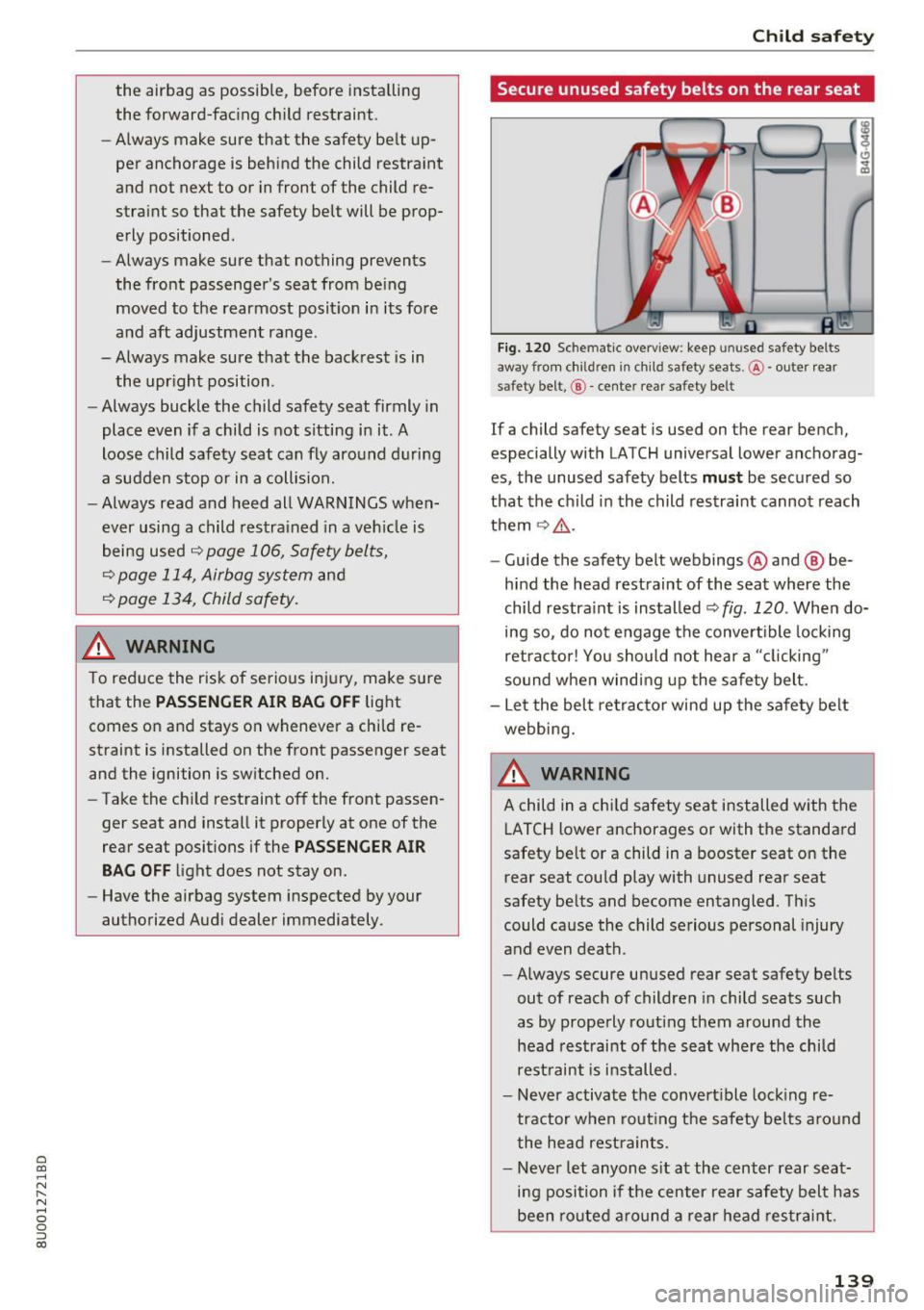
If a child safety seat is used on the rear bench,
especially with LATCH universal lower anchorag
es, the unused safety belts
must be secured so
that the child in the child restraint cannot reach
them ~.&. -
- Guide the safety belt webbings @ and @ be
hind the head restraint of the seat where the
child restraint is installed
c::> fig. 120 . When do
ing so , do not engage the convertible locking
retractor! You should not hear a "clicking"
sound when winding up the safety belt.
- Let the belt retractor wind up the safety belt
webbing.
A WARNING
-
A child in a child safety seat installed with the LATCH lower anchorages or with the standard
safety belt or a child in a booster seat on the rear seat could play with unused rear seat
safety belts and become entangled. This
could cause the child serious personal injury
and even death.
- Always secure unused rear seat safety belts
out of reach of children in child seats such
as by properly routing them around the head restraint of the seat where the child
restraint is installed .
- Never activate the convertible locking re
tractor when routing the safety belts around
the head restraints.
- Never let anyone s it at the center rear seat
ing position if the center rear safety belt has
been routed around a rear head restraint .
139
Page 142 of 230
Child safety
Child safety seats
Infant seats
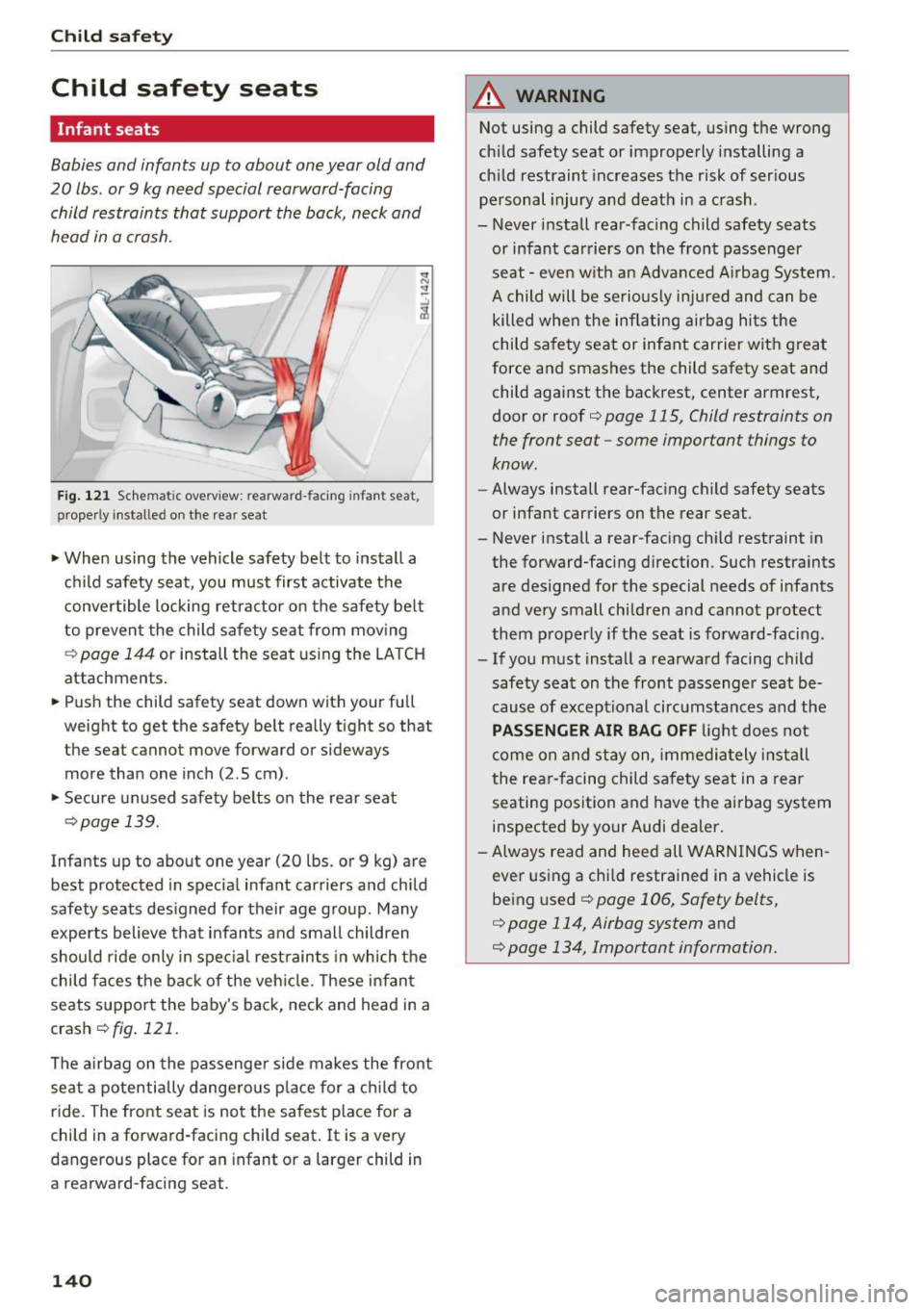
Babies and infants up to about one year old and
20 lbs. or 9 kg need special rearward -facing
child restraints that support the back, neck and
head in a crash.
Fig. 121 Schema tic overv iew: rearwa rd -facing infan t sea t,
properly installe d on the rea r seat
• When using the vehicle safety belt to install a
child safety seat, you must first activate the
convertible locking retractor on the safety belt
to prevent the child safety seat from moving
c::>poge 144 or install the seat using the LA TCH
attachments.
• Push the child safety seat down with your full
weight to get the safety belt really tight so that
the seat cannot move forward or sideways
more than one inch (2 .5 cm) .
• Secure unused safety belts on the rear seat
c::>page 139.
Infants up to about one year (20 lbs. or 9 kg) are
best protected in special infant carriers and child
safety seats des igned for their age group. Many
experts believe that infants and small children
should ride only in spec ial restraints in which the
child faces the back of the veh icle. These infant
seats support the baby 's back, neck and head in a
crash
c::> fig . 121 .
The airbag on the passenger side makes the front
seat a potentially dangerous place for a child to
ride . The front seat is not the safest place for a
child in a forward -facing child seat.
It is a very
dangerous place for an infant or a larger child in
a rearward-facing seat.
140
A WARNING
Not using a child safety seat, using the wrong
child safety seat or improperly installing a
child restraint increases the risk of serious
personal injury and death in a crash .
- Never install rear-facing child safety seats
or infant carriers on the front passenger
seat -even w ith an Advanced A irbag System .
A child will be serio usly injured and can be
killed when the inflating airbag hits the
child safety seat or infant carrier with great
force and smashes the child safety seat and
child against the backrest, center armrest,
door or roof
c::> page 115, Child restraints on
the front seat -some important things to
know .
-Always install rear-facing child safety seats
or infant carriers on the rear seat.
- Never install a rear-facing child restraint in
the forward-facing direction. Such restraints
are designed for the special needs of infants
and very small children and cannot protect
them properly if the seat is forward-facing.
- If you must install a rearward facing child
safety seat on the front passenger seat be
cause of exceptional circumstances and the
PASSENGER AIR BAG OFF light does not
come on and stay on, immediately install
the rear-facing child safety seat in a rear
seating position and have the airbag system
inspected by your Audi dealer.
-Always read and heed all WARNINGS when
ever using a child restrained in a vehicle is
being used
c::> page 106, Safety belts,
c::> page 114, Airbag system and
c::> page 134, Important information.
Page 143 of 230
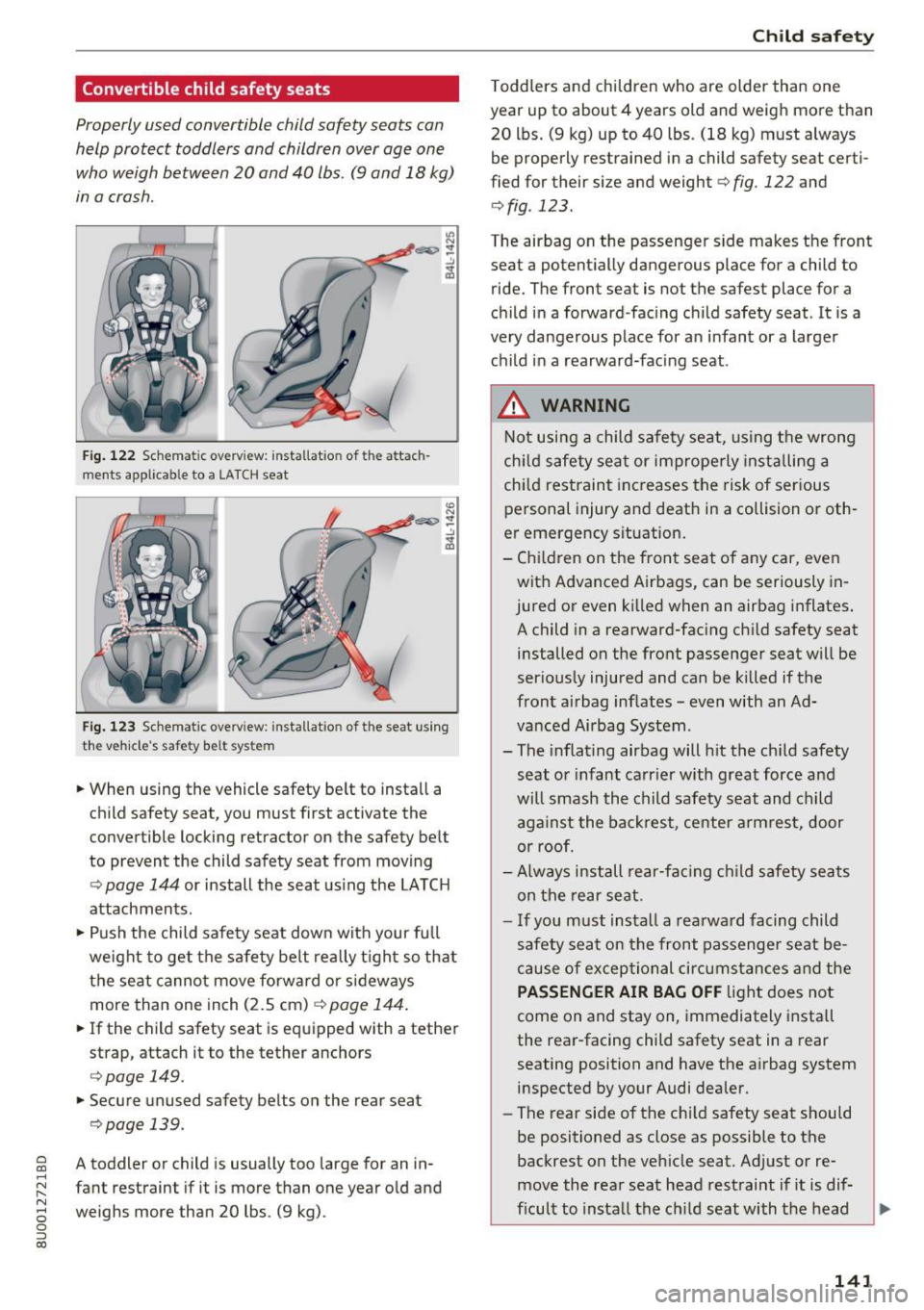
Convertible child safety seats
Properly used convertible child safety seats can
help protect toddlers and children over age one
who weigh between
20 and 40 lbs. (9 and 18 kg)
in a crash.
Fig. 122 Schemat ic overv iew: installatio n of the attac h
ments app lica ble to a LA TCH seat
Fig. 123 Schematic overv iew : installat io n of the seat using
the vehicle 's safe ty be lt syste m
.. When using the vehicle safety belt to install a
child safety seat, you must first activate the
convertible locking retractor on the safety belt
to prevent the child safety seat from moving
Q page 144 or install the seat us ing the LATC H
attachments .
.. Push the child safety seat down with your fu ll
weight to get the safety belt really tight so that
the seat cannot move forward o r sideways
more than one inch (2.5 cm)
Q page 144.
.. If the child safety seat is equipped with a tether
strap, attach it to the tether anchors
Q page 149.
.. Secure unused safety belts on the rear seat
Q page 139.
~ A toddler or child is usually too large for an in-
~ fant restraint if it is more than one year old and r--.
;; weighs more than 20 lbs . (9 kg) .
0 ::, (X)
Child safety
Toddlers and children who are older than one
year up to about 4 years old and weigh more than
20 lbs. (9 kg) up to 40 lbs. (18 kg) must always
be properly restrained in a child safety seat certi
fied for their size and weight
Q fig . 122 and
q fig . 123.
The airbag on the passenger side makes the front
seat a potentially dangerous place for a child to
ride. The front seat is not the safest place for a
child in a forward -facing child safety seat. It is a
very dangerous place for an infant or a larger
child in a rearward-facing seat .
_&. WARNING
Not using a child safety seat, us ing the wrong
child safety seat or improperly instal ling a
chi ld restraint increases the risk of serious
personal injury and death in a collision or oth
er emergency situation.
- Children on the front seat of any car, even
with Advanced Airbags, can be seriously in
jured or even killed when an airbag inflates.
A child in a rearward-facing ch ild safety seat
installed on the front passenger seat will be
seriously injured and can be killed if the
front airbag inflates -even with an Ad
vanced Airbag System .
- The inflating airbag will hit the child safety
seat or infant carr ier with great force and
will smash the child safety seat and child
against the backrest, center armrest, door
or roof.
-Al ways install rear-fa cing child safety seats
on the rear seat .
- If you must insta ll a rearward facing child
safety seat on the front passenger seat be
cause of exceptional circumstances and the
PASSENGER AIR BAG OFF light does not
come on and stay on, immediately install
the rea r-facing child safety seat in a rear
seating position and have the a irbag system
inspected by your Audi dealer .
- The rear side of the ch ild safety seat shou ld
be positioned as close as possible to the
backrest on the veh icle seat. Adjust or re
move the rear seat head restraint if it is dif-
ficult to install the child seat with the head
91>
141
Page 145 of 230

0 co ......
"' ,....
"' ...... 0 0 :::,
00
use the safety belt height adjustment to help
adjust the shoulder portion properly .
~ Secure unused safety belts on the rear seat
¢ page 139.
Children up to at least 8 years old (over 40 lbs. or
18 kg) are best protect ed in child safety s eats de
signed for their age and weight. Experts say that
the skeletal structure, particularly the pelvis, of
these children is not fully developed, and they
must not use the vehicle safety belts without a
suitable child restra int .
It is usually best to put these children in appro priate booster seats . Be sure the booster seat
meets all applicable safety standards .
Booster se ats raise the seating position of the
child and reposition both the lap and shoulder
parts of the safety belt so that they pass across
the child's body in the right places. The rout ing of
the belt over the child's body is very important
for the child's protection, whether or not a boos
ter seat is used. Chi ld ren age 12 and unde r must
a lways ride in the rear seat .
Ch ildren who are at least 4 ft . 9 in. (57 inches/
1.45 mete rs) tall ca n genera lly use the veh icle's
three po int lap and shoulder be lts. Neve r use the
l ap belt po rtion of the vehicle 's safety belt alone
to restrain any child, regardless of how big the
chi ld is. A lways remember that children do not
hav e the pronounced pelvic structure required for
the proper function of lap belt port ion of the ve
h icle 's three point lap and shoulder be lt s. The
chi ld 's safety absolutely requires that a lap belt
port ion of the safety belt be fastened snugly and
as low as possible around the pelvis . Never let
the lap belt portion of the safety belt pass over
the child's stomach or abdomen.
In a crash, a irbags must inflate within a blink of
an eye and wit h considerable force . In order to do
its job, the airbag needs room to inflate so that it
will be there to p rotect the occupant as the occu
pant moves forward into the a irbag.
A vehicle occupant who is out of position and too
close to the airbag gets in the way of an inflating
ai rbag. When an occ upant is too close, he o r she
will be struck v iolently and will receive ser ious or
possibly even fatal injury.
Ch ild safety
In order for the a irbag to offer protection, it is
important that a ll vehicle occupants, especially
any ch ildren, who m ust be in the front seat be
cause of exceptiona l circumstances, be properly
res tra ined and as far away from the airbag as
poss ible. By keeping room between the child 's
body and the front of the passenger compart
ment, the a irbag can inflate completely and pro
vide s upplementa l protec tion in certain frontal
collisions.
A WARNING
-
Not using a booster seat, using the booster
seat improperly, incorrect ly installing a boos
ter seat or using the vehicle safety belt im
properly increases the risk of serious personal
i njury and death in a collision or other emer
gency situation. To help reduce the risk of se rious personal injury and/or death:
- The shou lder belt must lie as close to the
center of the ch ild's collar bone as possible
and must lie flat and snug on the upper
body. It must never lie across the throat or
neck. The lap belt must lie ac ross the pelvis
and never across the stomach o r abdomen.
Make sure the bel t lies flat and sn ug. Pu ll on
the belt to tighten if necessary.
- Fail ure to properly route safety bel ts over a
child's body w ill cause severe injuries in an
accident or other emergency situation
¢ page 106.
- The rear side of the chi ld safety seat should
be positioned as close as possible to the
backrest on the vehicle seat. Adjust or re
move the rear seat head restraint if it is dif
f icult to insta ll the ch ild seat with the head
restraint in place¢
page 44 . Install the
head restraint again immed iately once the
child seat is removed . Driving without head
rest raints or with head restra ints that a re
not properly adj usted increases the r is k of
serio us or fatal ne ck in jury dramatically .
- Never let a chi ld put the shoulder belt under
the arm or behind the ba ck, because i t could
cause severe inj uries in a crash .
- Ch ild ren on the fron t seat of any car, even
with Advanced Airbags, can be seriously in-
jured or even ki lled when an airbag inflates .
Ill>
143