0 co ......
"' ,....
"' ...... 0 0 :::,
00
use the safety belt height adjustment to help
adjust the shoulder portion properly .
~ Secure unused safety belts on the rear seat
¢ page 139.
Children up to at least 8 years old (over 40 lbs. or
18 kg) are best protect ed in child safety s eats de
signed for their age and weight. Experts say that
the skeletal structure, particularly the pelvis, of
these children is not fully developed, and they
must not use the vehicle safety belts without a
suitable child restra int .
It is usually best to put these children in appro priate booster seats . Be sure the booster seat
meets all applicable safety standards .
Booster se ats raise the seating position of the
child and reposition both the lap and shoulder
parts of the safety belt so that they pass across
the child's body in the right places. The rout ing of
the belt over the child's body is very important
for the child's protection, whether or not a boos
ter seat is used. Chi ld ren age 12 and unde r must
a lways ride in the rear seat .
Ch ildren who are at least 4 ft . 9 in. (57 inches/
1.45 mete rs) tall ca n genera lly use the veh icle's
three po int lap and shoulder be lts. Neve r use the
l ap belt po rtion of the vehicle 's safety belt alone
to restrain any child, regardless of how big the
chi ld is. A lways remember that children do not
hav e the pronounced pelvic structure required for
the proper function of lap belt port ion of the ve
h icle 's three point lap and shoulder be lt s. The
chi ld 's safety absolutely requires that a lap belt
port ion of the safety belt be fastened snugly and
as low as possible around the pelvis . Never let
the lap belt portion of the safety belt pass over
the child's stomach or abdomen.
In a crash, a irbags must inflate within a blink of
an eye and wit h considerable force . In order to do
its job, the airbag needs room to inflate so that it
will be there to p rotect the occupant as the occu
pant moves forward into the a irbag.
A vehicle occupant who is out of position and too
close to the airbag gets in the way of an inflating
ai rbag. When an occ upant is too close, he o r she
will be struck v iolently and will receive ser ious or
possibly even fatal injury.
Ch ild safety
In order for the a irbag to offer protection, it is
important that a ll vehicle occupants, especially
any ch ildren, who m ust be in the front seat be
cause of exceptiona l circumstances, be properly
res tra ined and as far away from the airbag as
poss ible. By keeping room between the child 's
body and the front of the passenger compart
ment, the a irbag can inflate completely and pro
vide s upplementa l protec tion in certain frontal
collisions.
A WARNING
-
Not using a booster seat, using the booster
seat improperly, incorrect ly installing a boos
ter seat or using the vehicle safety belt im
properly increases the risk of serious personal
i njury and death in a collision or other emer
gency situation. To help reduce the risk of se rious personal injury and/or death:
- The shou lder belt must lie as close to the
center of the ch ild's collar bone as possible
and must lie flat and snug on the upper
body. It must never lie across the throat or
neck. The lap belt must lie ac ross the pelvis
and never across the stomach o r abdomen.
Make sure the bel t lies flat and sn ug. Pu ll on
the belt to tighten if necessary.
- Fail ure to properly route safety bel ts over a
child's body w ill cause severe injuries in an
accident or other emergency situation
¢ page 106.
- The rear side of the chi ld safety seat should
be positioned as close as possible to the
backrest on the vehicle seat. Adjust or re
move the rear seat head restraint if it is dif
f icult to insta ll the ch ild seat with the head
restraint in place¢
page 44 . Install the
head restraint again immed iately once the
child seat is removed . Driving without head
rest raints or with head restra ints that a re
not properly adj usted increases the r is k of
serio us or fatal ne ck in jury dramatically .
- Never let a chi ld put the shoulder belt under
the arm or behind the ba ck, because i t could
cause severe inj uries in a crash .
- Ch ild ren on the fron t seat of any car, even
with Advanced Airbags, can be seriously in-
jured or even ki lled when an airbag inflates .
Ill>
143
Child safety
Location
;
a: ex, a,
Fig. 125 Schem atic overv iew : LA TCH anchorage point loca
tio ns
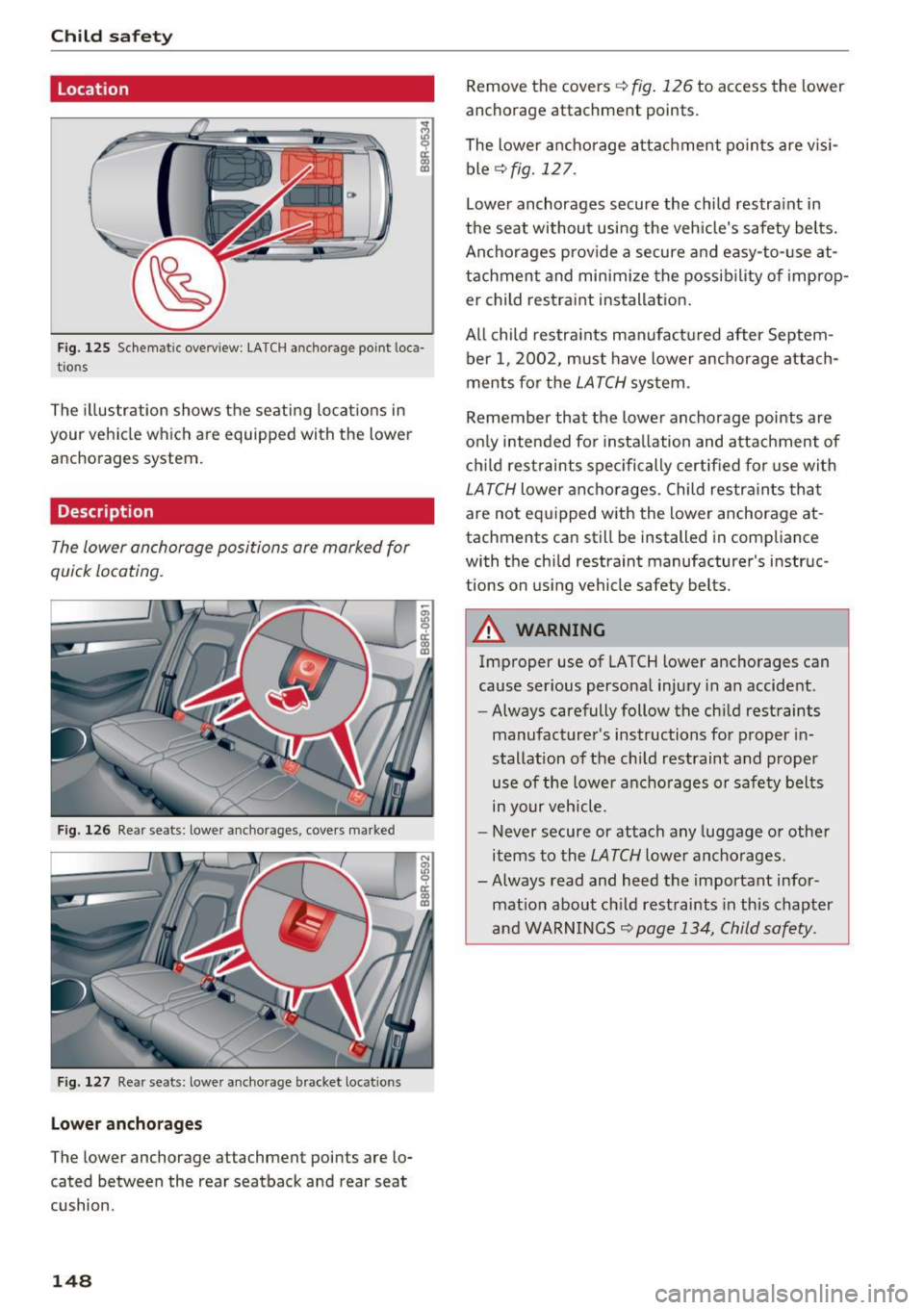
The illustration shows the seating locat ions in
your vehicle w hich are equipped with the lower
anchorages system.
Description
The lower anchorage positions are marked for
quick locating.
F ig. 126 Re ar s eats: lowe r an cho rages, covers ma rked
F ig . 127 Re ar seats: lowe r an cho rage b racket locatio ns
Lowe r ancho rage s
The lower anchorage attachment points are lo
cated between the rear seatback and rear seat
cushion .
148
Remove the covers c::> fig. 126 to access the lower
anchorage attachment po ints.
The lower anchorage a ttachment po in ts are v is i
ble
c::> fig. 12 7 .
Lower anchorages secure the child restra int in
the seat without using the vehicle's safety bel ts.
Ancho rages prov ide a secure and easy-to- use at
tachment and minimize the possib ility of improp
er child restraint installat ion .
All child restraints manufact ured after Septem
ber 1 , 2002, must have lower anchorage attach
ments for t he
LATCH system.
Remember that the lower ancho rage points are
on ly intended for insta llation and attachment of
ch ild rest raints spec ifically certif ied for use wi th
LATCH lower anchorages. Child restraints that
are not eq uipped with the lower anchorage at
tachments can still be installed in compliance
with the chi ld restraint manufacturer's instruc
tions on us ing vehicle safety belts.
A WARNING
Improper use of LATCH lower anchorages can
cause ser ious persona l injury in an accide nt.
- Always carefully follow the ch ild restraints
manufacturer's instructions for proper in
stallation of the child restraint and proper
use of the lower ancho rages or safety belts
in your vehicle.
- Never secure or attach any luggage or othe r
items to the
LATCH lower anchorages.
-Always read and heed the important infor mat ion about c hild restraints in this chapter
and WARN INGS
c::> page 134, Child safety .