2018 AUDI Q3 coolant
[x] Cancel search: coolantPage 157 of 230

a
co
...... N r--. N .... 0 0 ::, co
Fuel filler door emergency release
If the central locking system is faulty, the fuel filler door can be unlocked manually.
Fi g. 134 Right si de tr im j:>ane l in the luggage compart
ment: emergen cy release mechani sm
The emergency opening mechanism is located
behind the right side trim panel in the luggage
compa rtme nt.
• Remove the cover in the side panel.
• Loosen the strap from its bracket -arrow- and
pull on it carefully<=:>
fig. 134 c:>(D . The filler
doo r is released .
• Press on the lef t side of the fuel fille r doo r to
open it
<=:> page 153, fig. 132 .
(D Note
Onl y pull o n the loop until you feel resi stance.
You will not he ar it relea se. O therwise yo u
co uld d amage the eme rge ncy re lea se me ch a
nism .
Catalytic converter
The vehicle may o nly be dr iven with unleaded
gasoline, otherwise the catalyt ic converter will be
destroyed .
N ever d rive until the tank is comp letely e mpty .
The irregular supply of f uel th at resul ts from that
can cause engine m isfires. Uncombus ted f uel will
enter the exhaust system, wh ic h can cau se ove r
heat ing and damage to the catalyt ic converter .
A WARNING
-The temperature in the ex ha ust system is
high, both when dr iving and after stopping
the engine.
-
Checking and Filling
- Never touch the exhaust tail pipes o nce they
have become hot . This cou ld resu lt in burns.
- Do not par k your vehicle over flammable
mate ria ls s uch as grass or leaves because
the high temperature of the emissions con
trol system could start a fire.
- Do not app ly unde rbody protectant in the
exhaust system area, because this increases
the risk of fire.
Engine compartment
' Working in the engine compartment
Special care is required if you are working in the
engine compartmen t
For work in the engine compartment, such as
checking and fill ing fluids, there is a risk of in
jury, scalding, accident s, and burns . For thi s
reason, follow all the warnings and general
s afety pre caution s provided in the following in
formation. The engine compartment is a dan
gerous a rea on the vehicle .
<=:> .&.
A WARNING
-Turn the engine off .
- Sw itch th e ignition off .
- Se t the p arking brak e.
- M ove the selec tor lever i nto the P position.
- Never open the hood whe n th ere is steam o r
coo lant escaping from the engine comp art
men t, bec ause there is a risk that yo u could
be burned. Wai t until no s te a m o r coolan t is
escaping .
- Le t t he eng ine cool down.
- Keep children away from th e eng in e com-
p ar tme nt.
- N ever sp ill fluid s on a ho t engine . These flu
i d s (su ch as the free ze p ro te ct ion contained
in the coolant) c an catch fi re.
- Avoid short circui ts in th e electrical system.
- When working in the engine compartment,
remember that the radiator fan can swi tch
o n even if t he igni tion i s sw itched off, w hich
i n cre a ses the r is k of person al injury.
~
155
Page 158 of 230

Checking and Filling
-Never open the cap on the coolant expan
sion tank when the engine is warm. The
cooling system is under pressure.
- To protect your face, hands, and arms from
hot steam or coolant, cover the cap with a
large cloth when opening.
- Do not remove the engine cover under any circumstances. This increases the risk of
burns.
- If tests need to be performed with the en
gine running, there is additional danger due
to moving components (such as the ribbed belt, alternator and radiator fan) and from
the high-voltage ignition system.
- Do not under any circumstances give gas in
advertently (for example, by hand from the
engine compartment) if the vehicle is sta
tionary but the engine is running and a gear
is engaged. Otherwise, the vehicle will start
to move immediately and this could result
in an accident.
- Pay attention to the following warnings list
ed when work on the fuel system or on the
electrical equipment is required.
- Do not smoke .
- Never work near open flames.
- Always have a working fire extinguisher
nearby.
- All work on the battery or electrical system
in your vehicle can result in injuries, chemi
cal burns, accidents or burns. Because of
this, all work must be performed
only by an
authorized Audi dealer or authorized Audi
Service Facility.
- To reduce the risk of electric shock and in
jury, never touch the following components when the engine is running or is being start
ed:
- Ignition cable
- Other components in the electronic high-
voltage ignition system
- If you must check or perform work on the
engine while it is running:
- Set the parking brake and place the selec
tor lever in the P (park) position first .
- Always proceed with extreme caution so
that clothing, jewelry or long hair do not
156
become caught in the radiator fan, fan
belt or other moving components or do
not come into contact with hot compo
nents. Tie back long hair before beginning
work and do not wear clothing that can
hang down into the engine .
- Limit your exposure to exhaust and chemi cals to as short a time as possible
¢ &, .
A WARNING
California Proposition 65 Warning:
- Engi ne exhaust, some of its constituents,
and certain vehicle components contain or
emit chemicals known to the State of Cali
fornia to cause cancer and birth defects and
reproductive harm . In addition, certain flu
ids contained in vehicles and certain prod
ucts of component wear contain or emit
chemicals known to the State of California
to cause cancer and birth defects or other reproductive harm .
- Battery posts, terminals and related acces
sories contain lead and lead compounds,
chemicals known to the State of California
to cause cancer and reproductive harms.
Wash hands after handling.
@ Note
When filling fluids, be sure not to mix the flu
ids up. Otherwise severe malfunctions and en
gine damage will occur .
@ For the sake of the environment
You should regularly check the ground under
your vehicle in order to detect leaks quickly. If there are visible spots from oil or other fluids,
bring your vehicle to an authorized Audi deal
er or authorized Audi Service Facility to be
checked.
Page 159 of 230

a
co
,....,
N r--. N
'"' 0 0 ::, co
Opening/closing the hood
The hood is released from inside the vehicle.
Fig. 135 Driver footwell: release lever
Fig. 136 Rocker switch under the hood
"' 0 0
0
=i
~
Make sure the wiper arms are not raised up from
the windshield. Otherwise the paint could be
damaged.
Opening the hood
.. With the driver's door open, pull the lever be
low the instrument panel in the direction of the
arrow¢fig.135.
Checking and Filling
.. Raise the hood slightly¢,& .
.. Press the rocker switch under the hood upward
¢fig. 136. This releases the catch .
.. Open the hood.
Closing the hood
.. Push the hood down until you override the
force of the strut .
.. Let the hood fall lightly into the latch.
Do not
press it in.
c> ,&.
A WARNING
-
-Never open the hood when there is steam or
coolant escaping from the engine compart
ment, because there is a risk that you could
be burned. Wait until no steam or coolant is
escaping.
- If the hood is not latched completely, it
could fly up while you are driving and ob
struct your vision.
- For safety reasons, the hood must always be
closed securely while driving. Because of
this, always check the hood after closing it
to make sure it is latched correctly. The
hood is latched if the front corners cannot
be lifted.
- If you notice that the hood is not latched
while you are driving, stop immediately and
close it, because dr iving when the hood is
not latched increases the risk of an accident .
157
Page 160 of 230
Checking and Filling
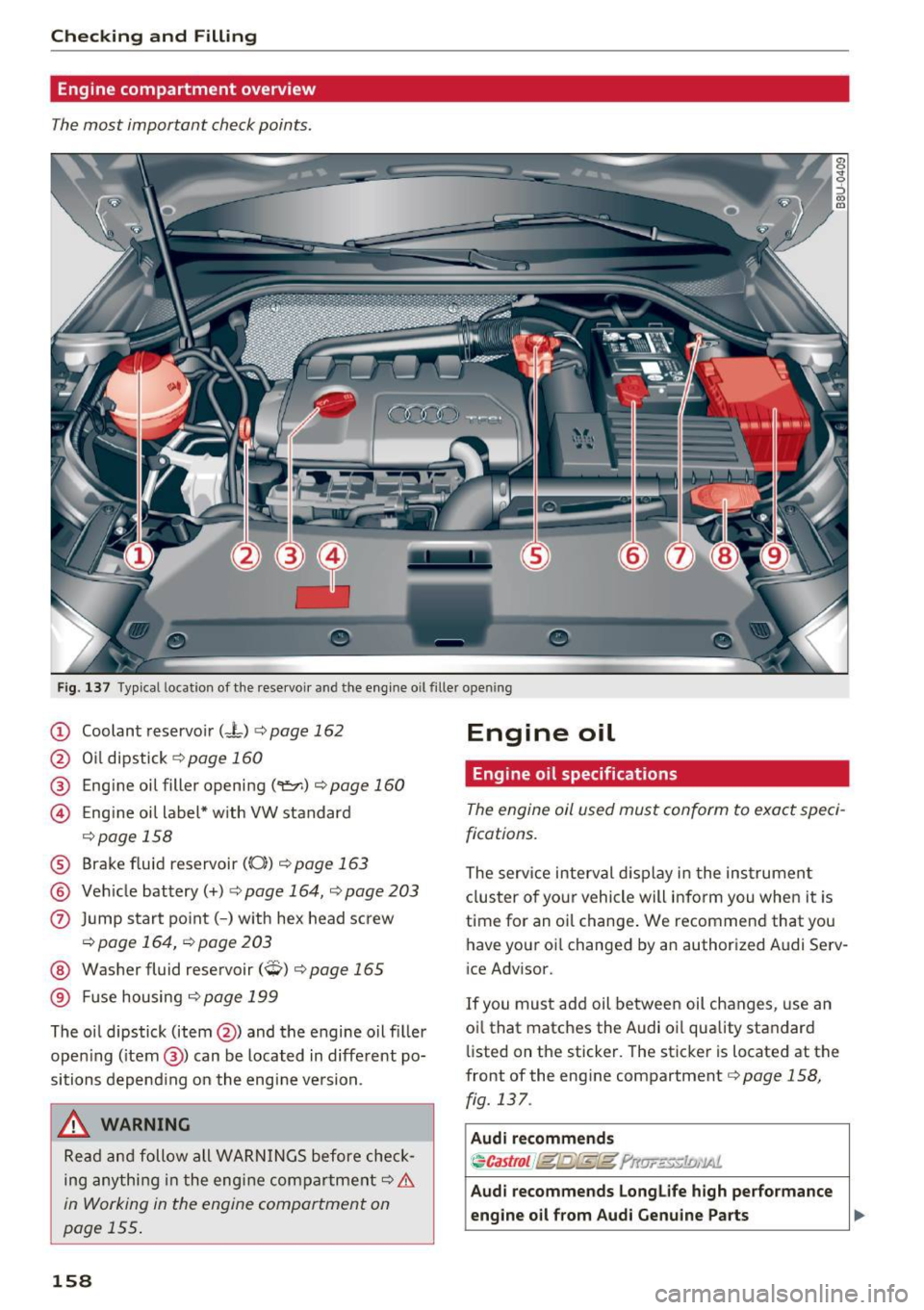
Engine compartment overview
The most important check points.
Fig. 137 Typical location of the rese rvoir and the engine o il fil le r open ing
(D Coolant reservoir ( - L) ¢ page 162
@ Oil dipstick ¢ page 160
® Engine oil filler opening ('t:::r.) ¢page 160
© Eng ine oil label* w ith VW standard
evpage 158
® Brake f luid reservoir ((0)) ¢ page 163
® Vehicle battery(+) ¢ page 164, evpage 203
(?) Jump start point( -) w ith hex head screw
ev page 164, ev page 203
@ Washer fluid reservoir (O) ev page 165
® Fuse housing c:::> page 199
The oil dipstick (item @) and the engine oil fi ller
open ing (item @) can be located in different po
sitions depend ing on the engine version.
_& WARNING
Read and follow all WARN INGS before check
ing anything i n the engi ne compa rtment¢ &.
in Working in the engine compartment on
page 155 .
158
Engine oil
Engine oil specifications
The engine oil used must conform to exact speci
fications.
The serv ice interval d isplay in the inst rumen t
cluster of your vehicle will inform you when it is
time for an o il change . We recommend that you
have your oi l changed by a n authorized Audi Se rv
i ce Advisor.
If you must add oil betwee n oil changes, use an
oi l that matches the Audi oil quality standard
li sted on the sticker. The sticker is located at the
front of the eng ine compartment ¢
page 158,
fig. 137 .
Audi re commend s
~Castrol /fg/j;Sf.g;fg f'r
eng ine oil from Aud i Genuine Pa rt s
liJI,
Page 164 of 230

Check ing and F illing
Cooling system
Coolant
The engine coo ling system is filled with a mixture
of pur ified wate r and coolan t addit ive at the fa c
t ory . T his coo la nt must not be not changed .
The coolant leve l is monito red throug h the . in
d icator light
¢ page 12. Howeve r, we do recom
mend occasionally chec king the coo la nt level
manually.
If you must add coolant, use a m ixt ure of wa ter
a nd coo lant add it ive. Mixing the coolant additive
with d istilled water is recommended.
Coolant additive
The coolant additive is made of ant i-freezing and
corros ion protection agents. Only use the fo llow
ing coolant add it ives. These addit ives may be
m ixed w it h each other.
Coolant additive Specification
G13
TL 774 J
G12++ TL 774 G
The amount of coo lant add itive that needs to be
mixed wit h water depends on the climate where
the vehicle will be operated . If the coolant addi
tive percentage is too low, the coolant can free ze
and damage the engine.
Coolant Freeze protec-
additive tion
Warm min . 40% m in. -13 °F
reg ions max . 45% (
- 25 °C)
Co ld min. 50% max. -40 °F
reg ions max. 55% (-40 °C)
CJ) Note
- Befo re the start of winter, have an author
i zed Audi dealer or authorized A udi Service
Fac ility check if the coolant additive in yo ur
vehicle matc hes the percentage approp riate
for the climate . Th is is especially important
whe n driving in co lde r clima tes.
- If the approp riate coolant additive is not
available in an emergency, do no t add any
other addi tive . You cou ld damage the en-
162
gine . If this h appens, on ly use wa ter and re
store the correct m ixt ure ratio with t he
specified coo lant ad ditive as soon as poss i
ble.
- Only refill w ith new coolant .
- Radiator sealant mus t not be mixed wi th
the coolant .
Adding coolant
Fig. 140 En gine co mpar tm ent: coo la nt expans io n ta nk
cove r
Observe the safety precautions¢ page 155,
Working in the engine compartment .
Checking the eng ine c oolant level
.,. Park the vehicle on a level surface .
.,. Sw itch the ignit ion off.
-"' -"' •
"" co a,
.,. Read the coolant level on the coolant expansion
tank ¢
page 158 , fig. 137. T he coolant leve l
must be betwee n the markings when the en
gi ne i n cold . When t he e ng ine is warm it can be
slightly above the uppe r mar king .
Adding coolant
Requirement: there must be a residual amount of
coolant in the expansion ta nk
¢ (D .
.,. Let the engine coo l down.
.,. Place a clot h over the coolant expansion tan k
cap and unscrew the cap counterclockw ise
¢ .&._ .
.,. Add coo lant m ixed in the cor rect rat io
c;, page 162 up to t he up per ma rk ing .
.,. Make sure that the fluid level remains stab le.
Add mo re coolan t if necess ary.
.,. Close the cap sec urely .
Coo lant loss usually ind icates there is a lea k. Im-
med iate ly dr ive you r ve hicl e to a n author ized .,.
Page 165 of 230

a
co
...... N r-,. N
"" 0 0 ::, co
Audi dealer or authorized Audi Service Facility
and have the cooling system inspected. If the
cooling system is not leaking, a loss can come
from the coolant boiling through overheating
and being pushed out of the cooling system.
A WARNING
- The cooling system is under pressure . Do
not open the coolant expansion tank cap
when the engine is hot . This increases the
risk of burns .
- The coolant additive and the coolant can be
dangerous to your health. For this reason,
keep the coolant in the original container
and away from children. There is a risk of
poisoning.
- When working in the engine compartment,
remember that the radiator fan can switch
on even if the ignition is switched off, which
increases the risk of injury.
CD Note
-
Do not add coolant if the expansion tank is
empty . Air could enter the cooling system and
damage the engine.
If this is the case, do not
continue driving. See an authorized Audi deal
er or authorized Audi Service Facility for assis
tance.
Brake fluid
Fig. 141 Eng ine compartment: cap on brake flu id reservoir
Observe the safety precautions ¢ page 155,
Working in the engine compartment .
Checking the brake fluid level
~ Read the brake fluid Level on the brake fluid
reservoir ~
page 158, fig . 13 7. The brake fluid
Checking and Filling
Level must be between the MIN and MAX mark
ings
~ A .
The brake fluid Level is monitored automatically.
Changing the brake fluid
Have the brake fluid changed regularly by an au
thorized Audi dealer or authorized Audi Service Facility .
A WARNING
- If the brake fluid level is below the MIN
marking, it can impair the braking effect
and driving safety, which increase the risk of
an accident. Do not continue driving. See an
authorized Audi dealer or authorized A udi
Service Facility for assistance.
- If the brake fluid is old, bubbles may form
in the brake system during heavy braking .
This would impair braking performance and driving safety, which increases the risk of an
accident .
- To ensure the brake system functions cor
rectly, only use brake fluids that comply
with VW standard 501 14 or
FMVSS-116 DOT 4.
CD Note
- If the brake flu id level is above the MAX
marking, brake fluid may Leak out over the
edge of the reservoir and result in damage
to the vehicle.
- Do not get any brake fluid on the vehicle
paint, because it will corrode the paint.
Battery
General warnings about batteries
Because of the complex power supp ly, all work
on batteries such as disconnecting, replacing,
etc. should
only be performed by an authorized
Audi dealer or authorized Audi Service Facility
¢ .&,.
The term "vehicle battery " refers to the 12 Volt
battery in your vehicle.
163
...
Page 171 of 230

0 C0
-N
" N
-0 g a)
Glossary of tire and loading
terminology
Accessory weight
means the combined we ight (in
excess of those standard items
which may be replaced) of auto matic transmission, power steer
ing, power brakes, power win
dows, power seats, radio, and
heater, to the extent that these
items a re available as factory- in
stalled equipment (whether in
stalled or not) .
Aspect ratio
means the ratio of the height to
the width o f the tire in percent .
Numbers of 55 or lower indicate a
low s idewal l for improved steer
ing response and better overall
handling on dry pavement.
Bead
means the part of the t ire that is
made of steel wires, wrapped or
reinforced by ply cords and that is
shaped to fit the rim .
Bead separation
means a breakdown of the bond
between components in the bead .
Wheels
Cord
means the strands forming the
plies in the tire.
Cold tire inflation pressure
means the tir e pressure recom
mended by the vehicle manufac
tu rer for a tire of a designated
size that has not been driven for
more than a couple of m iles (k ilo
meters) at low speeds in the
three hour period before the t ire
pressure is measured or adjusted .
Curb weight
means the weight of a motor ve
hicle with standard equipment in
cluding the maximum capacity of
f u el, o il, and coolant, a ir cond i
tioning and additional weight of
optio nal eq uipment .
Extra load tire
means a tire designed to operate
at higher loads and at higher in
flat ion pressu res than the corre
sponding standard tire . Extra load
tires may be ident ified as "X L",
"xl", "EXTRA LOAD", or "RF" on
the sidewall. .,.
169
Page 181 of 230
fuel, oil, coolant and other fluids plus maximum load. The maxi
mum load includes the number of
passengers that the vehicle is in
tended to carry ("seating capaci
ty") with an assumed weight of
1 50 lbs. (68 kg) for each passen
ger at a designated seating posi
tion and the total weight of any
luggage in the vehicle. If you tow
a trailer, the weight of the trailer
hitch and the tongue weight of
the loaded trailer must be includ
ed as part of the vehicle load.
The
Gr oss Axle Weight R ating
("GAWR") is the maximum load
that can be applied at each of the
veh icle's two axles.
The fact that there is an upper limit to your vehicle's Gross Vehi
cle Weight Rating means that the
total weight of whatever is being
carried in the vehicle (including
the weight of a trai ler hitch and
the tongue weight of the loaded
trailer) is limited. The more pas
sengers in the vehicle or passen
gers who are heavier than the
standard weights assumed mean
that less weight can be carried as
~ luggage.
-N
" N
-0
0
::, a)
Wheels
The Gross Vehicle Weight Rating and the Gross Axle Weight Rating
are listed on the safety compli
ance sticker label located on the
driver's side B-pillar.
_&. WA RNIN G
Overloading a vehicle can cause
loss of vehicle control, a crash
or other accident, serious per
sonal injury, and even death.
- Carrying more weight than
your vehicle was designed to carry will prevent the vehicle
from handling properly and increase the risk of the loss of
vehicle control.
-The brakes on a vehicle that
has been overloaded may not
be able to stop the vehicle
within a safe distance.
- Tires on a vehicle that has
been overloaded can fail sud
denly, including a blowout and
sudden deflation, causing loss
of control and a crash.
- Always make sure that the to
tal load being transported -
including the weight of a trail
er hitch and the tongue
weight of a loaded trailer -
does not make the vehicle heavier than the vehicle's
Gross Veh icle Weight Rating .
179