Child sa fety
all the time whenever the ignition is
sw itched on.
- If the
PASSENGER AIR BAG OFF light
does not come on and stay on, immediate ly install the forward-facing child seat in a
rear seating posit ion and have the airbag
system inspected by your authorized Aud i
dealer .
- Always buckle the child seat firmly in
place even if a ch ild is not sitt ing in it . A
loose child seat can fly around during a
sudden stop o r in a collision.
- Always read and heed all WARNINGS
wheneve r us ing a child restraint in a vehi
cle ~ page 134 , Safety belts, ~ page 142,
Airbag system
and ~page 166, Impor
tant information .
(D Tips
Always replace chi ld restraints that were in
stalled in a vehicle dur ing a crash. Damage to
a child res traint that is not visib le cou ld cause
it to fail in anothe r collision situation .
Advanced front airbag system and children
Your ve hicle is equipped with a front "Advanced
Airbag System" in compliance with United States Federal Motor Vehicle Safety Standard (FMVSS)
208, as well as Canada Motor Veh icle Safe ty
Standard (CMVSS) 208 as applicable at the time
your ve hicle was manufactured .
The Advanced Airbag system in you r veh icle has
been cert ified to meet the "low-risk" requ ire
ments for 3- and 6 -year old children on the pas
senger s ide and small adults on the driver side .
The low risk deployment cr ite ria are intended to
reduce t he r isk of injury through inte ract ion with
the airbag t hat can occur, for examp le, by being
too close to the steering whee l and instrument
panel when the airbag inflates . In addition, the
system has been certified to comply with the
"suppress ion" req uirements of the Safety Stand
ard, to turn off the front airbag for infants up to
12 months who are restra ined on the front pas
senger seat in child restraints that are listed in
the Standard .
168 Even thoug
h your vehicle is equipped w ith an Ad
vanced Airbag system, all chi ldren, especially
t h ose 12 years and younger, shou ld a lways ride
i n the back seat properly restrained for their age
and s ize . The airbag on the passenger s ide makes
the front seat a potentia lly dangerous p lace for a
c hi ld to ride . T he front seat is not the safest place
fo r a ch ild in a fo rward-fac ing ch ild safety seat .
It
can be a very dangerous place fo r an infant o r a
l a rge r ch ild in a re ar war d-facing seat.
The veh icle's Advanced A irbag System has a ca
pac it ive passenger detection system in the front
passenge r seat cushion that can detect the p res
ence of a baby o r a c hild i n a child res train t sys
tem on this seat .
The capacitive passenger detection system reg is
te rs the changes that result i n an elect rical field
whe n a child, a chi ld restra int, and a baby b la nk et
are on the front passenger sea t. The change in
the measured capacitance due to the presence of
a chi ld, a c hild restraint, and a baby blanket on
the front passenger seat is re lated to the child
restra int system resting on the seat . The meas
ured capacitance of a child restra int system var
i es depending on the type of system and specific
make and model.
The elect rical capac itance of the various types,
makes, and models of child restraints specif ied
by the U .S . National Highway Traffic Safety Ad
min istrat ion (NHTSA) in the releva nt safety
standard are stored in the Advanced Airbag Sys
tem contro l unit together with the capacitances
typ ic al of infants and a 1 -year old ch ild. When a
c hi ld restraint is used on the front passenger
seat wit h a typical 1 year-old infant, t he Ad
vanced Airbag System compares the capacitance
measured by the capacitive passenger detection
system with the data stored in the electronic con
tro l unit .
Child restraints and Advanced front airbag
system
Regardless of the ch ild rest raint that yo u use,
make s ure tha t it has been ce rtified to mee t Safe
ty Standards and has been cert ified by its man u-
facturer for use with an airbag . A lways be sure
..,.
a co ,...,
N
" N ,...,
0 0 <..:l '
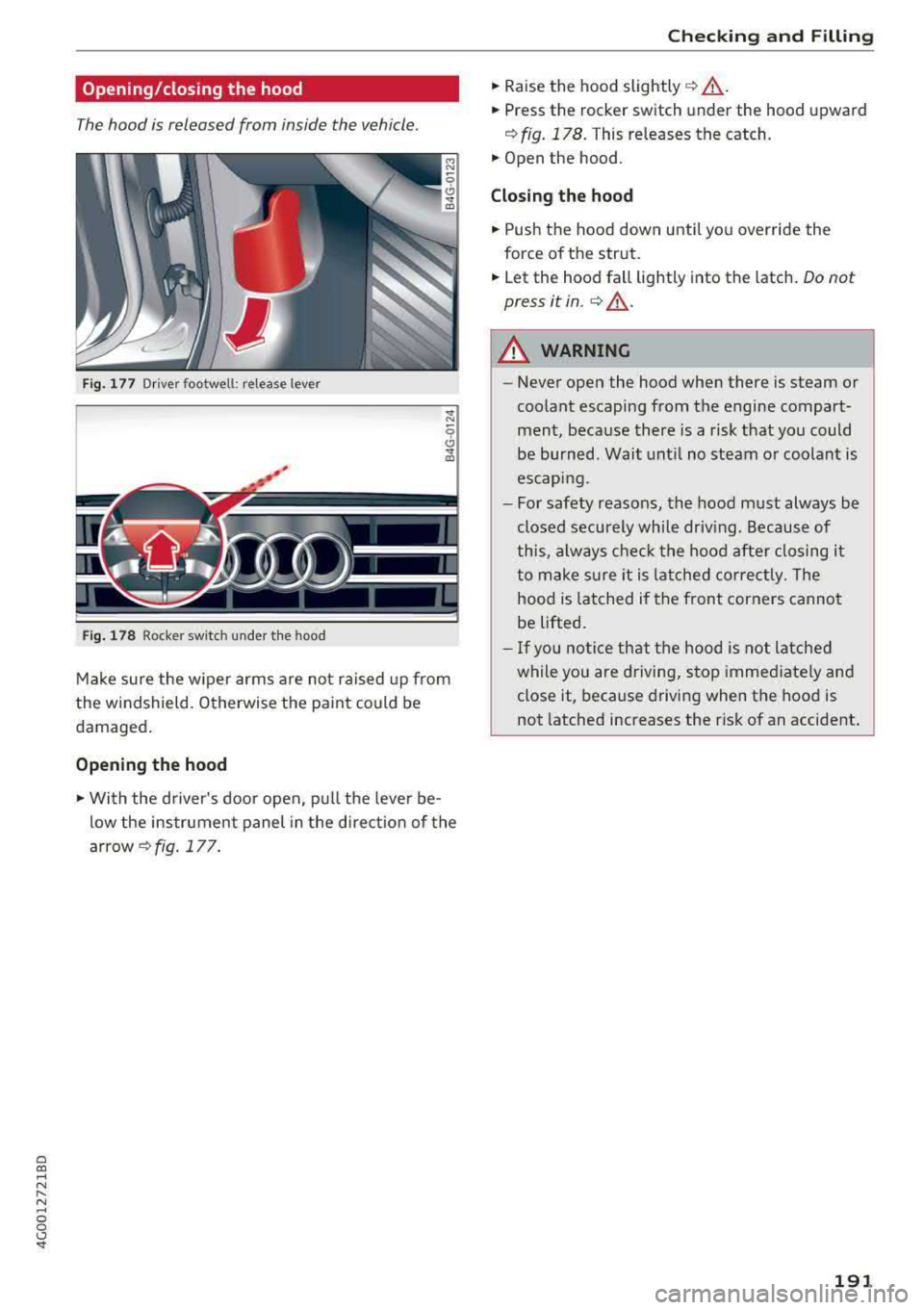
Opening/closing the hood
The hood is released from inside the vehicle.
Fig. 177 Dr ive r footwell: release leve r
Fi g. 178 Rocker sw itc h under the hood
Make sure the w iper arms are not raised up from
the windshield . Otherwise the pa int could be
damaged .
Opening the hood
.. With the driver's door open, pu ll the leve r be
low the instrument panel in the direct ion of the
arrow ¢ fig. 177 .
Checking and Filling
.. Raise the hood slightly ¢.&_ .
.. Press the rocker switch under the hood upward
¢
fig. 178. T his releases the catch .
.. Open the hood.
Closing the hood
.. Push the hood down until yo u over ride the
force of the strut .
.. Let the hood fall lightly into the latch. Do not
press it in.
¢ .&_ .
A WARNING
-
-Never open the hood when there is steam or
coolant escaping from the engine compart ment, because there is a risk that you could
be burned . Wait unti l no steam or coolan t is
escaping.
- For safety reasons, the hood m ust always be
closed securely while driv ing . Because of
this, always check t he hood afte r closing i t
t o make sure it is latched correct ly . T he
hood is latched if the front corners cannot
be lifted.
- If you no tice that the hood is not latched
while you are d riving, stop immed iately and
close it, because drivi ng when the hood is
not latched increases the r isk of an accident .
191