2018 AUDI A5 COUPE child lock
[x] Cancel search: child lockPage 76 of 409
Sea ts and stor age
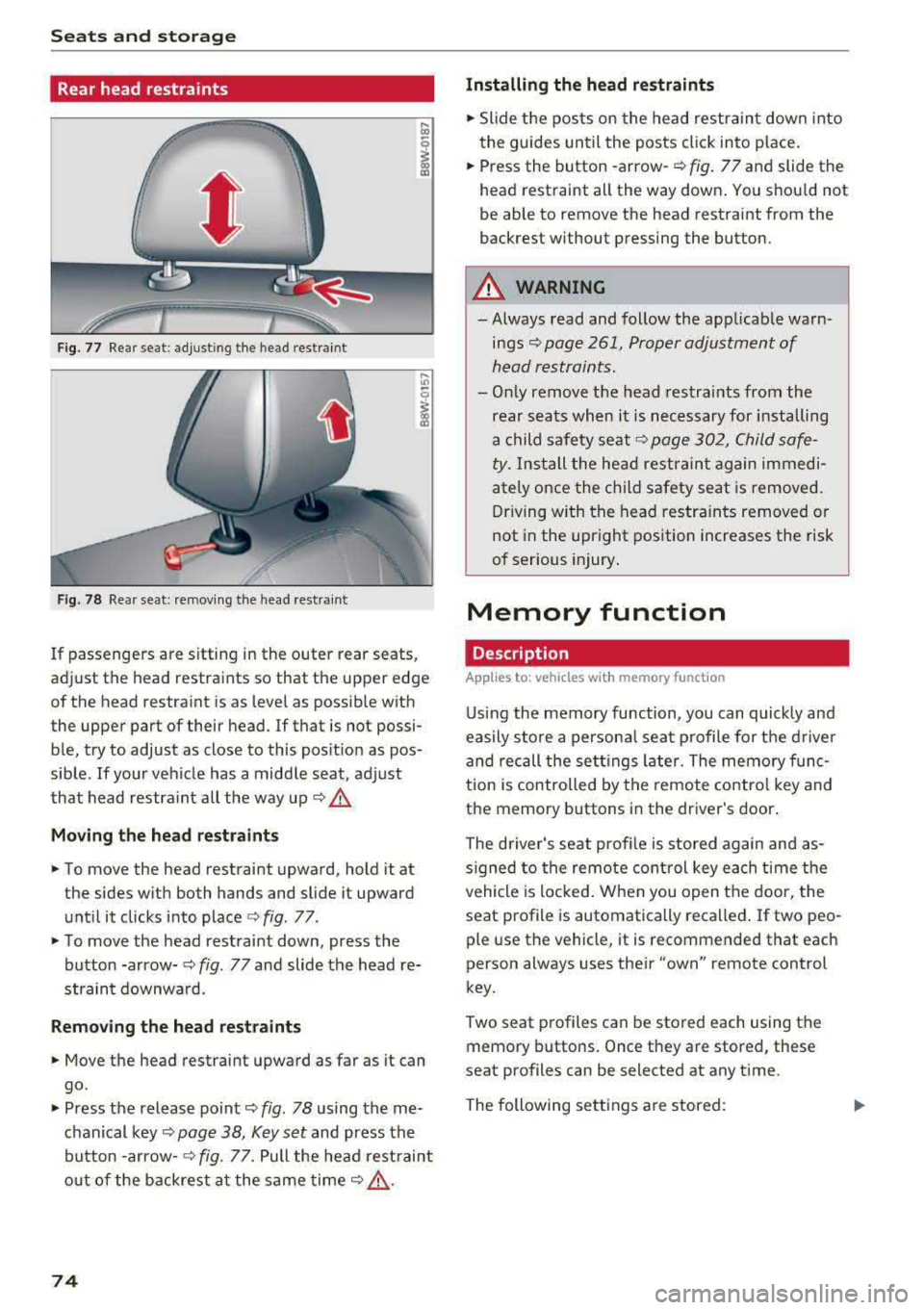
Rear head restraints
Fig. 77 Rear seat: adjust ing the head restraint
F ig. 78 Rear seat: remov ing the head rest rai nt
If passengers are s itting in the outer rear seats,
adjust the head restraints so that the upper edge
of the head restraint is as level as possible with
the upper part of their head . If that is not possi
ble, try to adjust as close to this position as pos
sible . If your vehicle has a middle seat, adjust
that head restra int all the way up
c::> .&.
Mov ing the he ad re st raints
• To move the head restraint upward, hold it at
the sides w ith both hands and slide it upward
unt il it clicks into place
c::> fig . 77.
• To move the head restraint down, press the
button -arrow-
c::> fig. 77 and slide the head re
straint downwa rd.
Remo ving the he ad rest raints
• Move the head restraint upward as far as it can
go.
• Press the release point c::> fig. 78 using the me
chanical
key~ page 38, Key set and press the
button -arrow-
c::> fig. 77. Pull the head rest raint
o ut of the backrest a t the same
time~ ,&..
74
Installing the head re straints
• Slide the posts on the head restraint down into
the guides until the posts click into place .
• Press the button -arrow-c::> fig. 77 and slide the
head restraint all the way down . You should not
be able to remove the head restraint from the
backrest without pressing the button.
A WARNING
-Always read and follow the applicable warn
ings~ page 261, Proper adjustment of
head restraints.
-Only remove the head restraints from the
rear seats when it is necessary for installing
a child safety seat
c::> page 302, Child safe
ty. Install the head restraint again immedi
ately once the ch ild safety seat is removed.
Driving w ith the head restra ints removed or
not in the upright position increases the risk
of serious injury .
Memory function
Description
Applies to: vehicles wit h memo ry funct ion
Using the memory function, you can quick ly and
easily store a persona l seat profile for t he driver
and recall the sett ings later. The memory func
tion is controlled by the remote control key and
the memory buttons in the driver's door.
The driver's seat prof ile is stored again and as
s igned to the remote control key each time the
vehicle is locked . When you open the door, the
seat profile is automatically recalled . If two peo
ple use the vehicle, it is recommended that each
person always uses their
"own" remote control
key.
Two seat profiles can be stored each using the
memory buttons. Once they are stored, these
seat profiles can be selected at any time.
The following sett ings a re stored:
Page 97 of 409

<( a, .... N ,....
N .... 0 \0
3 a,
sounds when the C®> switch is pulled . Emergency
braking stops as soon as
the(®) switch is released
or the accelerator peda l is pressed.
Parking
.,. Press t he b rake peda l to stop the vehicle .
.,. Pull the(®) switc h to set the parking brake .
.,. Applies to: automatic transmission: Select the
P selector lever position .
.,. Turn the eng ine off c> & .
.,. Applies to: manual transmission: Engage 1st
gear .
.,. Turn the steer ing wheel when parking on in
clines so that the wheels will roll into the curb
i f the veh icle starts moving.
_& WARNING
- Never ac celer ate o r release the clutch pedal
carelessly when a gear or a selector lever
posit ion (automatic transm ission) is engag
ed wh ile the vehicle is stationary and the
en
gine is runn ing. Otherwise, the vehicle will
start to move immediately and this cou ld
re
sult in an accident.
- Emergency braking should only be used in an emergency, when the normal brake peda l
has failed or the brake pedal is obstructed.
During emergency braking, your veh icle will
bra ke sim ila r to heavy brak ing . ESC and the
associated components (ABS, ASR, EDL)
c annot overcome the laws of physics.
Around curves and when road or weather conditions are bad, a fu ll brake application
can cause the vehicle to skid or the rear end
to swerve, which increases the risk of an
ac
c ident.
- If the power supply fails, you cannot set the
park ing brake if it is released. If th is is the
case, stop the veh icle on leve l ground and
secure it by engaging 1st gear (manual
transmiss ion) or select ing the P selector lev
er position (automatic t ransm iss ion). See an
authorized Aud i dealer o r autho rized Aud i
Service Facility for assistance.
- Always take the vehicle key with you when
leaving your vehicle, even if for a short pe ri
od of time. Th is app lies p articu larly when
children rema in in the vehicle. Otherwise,
D riv ing
children could start the engine, release the
parking brake or operate e lectrical equip
ment such as power w indows, which
in
creases the risk of an accident.
- No one, especially children, should remain
in the vehicle when it is locked. Locked
doors make it more difficu lt for emergency
wo rkers to get into the vehicle, which puts
lives at risk .
(D Tips
Applies to: vehicles with automatic transmissions
When stopp ing at a t raff ic signa l or stopp ing
i n city traffic, yo u can set the park ing bra ke
manually. The vehicle does not have to be
held with the brake pedal. The park ing brake
eliminates the tendency to creep when a
se
l ector lever position is engaged. As soon as
you press the accelerator peda l, the parking
brake re leases automatically and your vehicle
starts to move
c>page 95.
(D Tips
- Occasional noises when the parking brake is
set and released are normal and are not a
cause for concern.
- The parking brake goes through a self-test cycle at regu lar intervals when the vehicle is
stopped. Any no ises assoc iated with th is are
normal.
- If there is a power failure, the parking brake
w ill not set if it is released, and it will not
release if it is set
c> A . See an a uthorized
Audi dealer or author ized Audi Service
Fa
cility for assis tance.
Starting to drive
Various convenience and safety funct ions may be
available when the vehicle begins driving,
de
pend ing on vehicle equipment.
Starting on hills w ith the pa rking brake set
Requirement: the driver's door must be closed .
.,. To start driving comfortably when on a hi ll, set
the parking brake and begin driving as usual.
The braking force of the parking brake does not
..,.
95
Page 265 of 409

Driving sa fe ty
Loose items in the luggage compartment can
shift s udden ly, changing vehicle handling charac
ter istics . Loose items can also increase the risk of
serious personal in jury in a sudden vehicle
ma
neuver or in a coll is ion.
.,. Distribute the load evenly in the luggage com
partment .
.,. Always place and properly secure heavy items in
the luggage compartment as low and as far for
ward as possible
c> fig . 230 .
.,. Secure luggage us ing the tie-downs provided
¢ page 79 .
.,. Make su re that the rea r seatbac k is securely
latched in place .
A WARNING
Improperly stored luggage or othe r items can
fly through the vehicle causing serious per
sonal injury in the event of hard braking or an
accident . To help reduce the risk of serious
personal injury :
- Always put objects, for example, luggage or
other heavy items in the luggage compart
ment.
- Always sec ure objects in the luggage com
partment using the tie-down eyelets and
s u itable straps.
A WARNING
Heavy loads will influence the way your vehi
cle handles . To he lp reduce the r isk of a loss
of contro l leading to serious pe rsonal i njury:
- Always keep in mind when transporting heavy objects, that a change i n the center of
grav ity can also cause changes in vehicle
hand ling:
- Always distr ibute the load as even ly as
possible.
- Place heavy objects as far forward in the
luggage compartment as poss ible.
- Never exceed the Gross Axle Weight Rating
o r the Gross Vehicle Weight Rating specified
on the safety compliance sticker on the
front end of the driver's door. Exceeding permissible weight standards can cause the
vehicle to s lide and handle diffe rently .
264
-Please observe info rmation on safe driving
¢page 258 .
A WARNING
To he lp prevent po isonous exhaust gas from
being drawn into the vehicle, always keep the
rear lid closed while driving.
- Never transport objects larger than those
fitting completely into the luggage area be
cause the rear lid cannot be fully closed .
- If you absolutely must dr ive with the rear lid
open, observe the following notes to reduce
the risk of poisoning :
- C lose all windows,
- Close the s unroof*,
- Close the power top*,
- Open all a ir outlets in the instrument pan -
el,
- Switch off the air reci rculat ion,
- Set the fresh air fan to the highest speed.
A WARNING
-
Always make sure that the doors, all win
dows, the sunroof*, the power top * and the
rear lid are securely closed and locked to re
duce the risk of in jury when the veh icle is not
being used.
-After clos ing the rear lid, always make sure
that it is properly closed and locked .
- Never leave your veh icle unattended espe
cially wi th the rear lid left ope n. A child
could crawl into th e vehicle th rough the lug
gage compa rtment and close the rea r lid be
comi ng trapped and u nable to ge t out. Be
ing trapped in a vehicle can lead to ser ious
pe rsonal inj ury.
- Never let c hild ren p lay in o r around the vehi
cle.
- Never let passenge rs ride in the luggage
comp artment. Vehicle occu pants mus t
al
ways be proper ly restrained in one of the ve
hicle's seat ing pos itions.
(D Tips
- Air circu lation helps t o reduce w indow fog
ging . Stale air escapes to the o uts ide
Page 274 of 409

Convertibl e lo ck ing r etr actor
Every safety be lt except the one on the driver
seat is equipped with a convertible locking retrac
tor that
mu st be used when the safety belt is
used to attach a child safety seat. Be sure to read
the important information about this feature
c::;,page 313.
_& WARNING
Improperly positioned safety belts can cause
ser ious injury in an accident
c::;, page 2 73,
Safety belt position.
-Safety belts offer optimum protection only
when the seatback is upright and belts are
properly pos itioned on the body.
-Always make sure that the rear seat back rest to wh ich the center rear safety belt is
attached is secure ly latched whenever the
rea r center safety belt is being used.
If the
backrest is not securely latched, the passen
ger will move forward with the backrest dur
ing sudden braking, in a sudden maneuver
and especially in a crash.
-Never attach the safety belt to the buckle
for another seat. Attaching the belt to the
wrong buck le wi ll reduce safety belt effec
t iveness and can cause serious personal in
jury.
- A passenger who is not properly restrained
can be seriously injured by the safety belt it
self when it moves from the stronger parts
of the body into critical areas like the abdo
men.
- Always lock the convertible locking retractor
when you are secur ing a child safety seat in
the vehicle
c::;, page 315 .
Safety bel ts
Safety belt position
Correct belt position is the key to getting maxi
mum protection from safety belts.
Fig. 24 1 Safety belt position
Standard features on your vehicle help you adjust
the position of the safety belt to match your body
size.
-be lt height adjustment for the front seats,
-he ight-adjustable fron t seats.
_& WARNING
Improperly positioned safety belts can cause
serious personal injury in an accident.
-The shou lder belt should l ie as close to the
center of the collar bone as possib le and
should fit well on the body . Ho ld the belt
above the latch tongue and pull it evenly
across the chest so that it sits as low as pos
sible on the pelvis and there is no pressure
on the abdomen. The belt should always fit
snugly
c::;, fig. 241. Pu ll on the belt to tighten
if necessary .
- The lap belt portion of the safety belt must
be positioned as low as possible across pel
vis and neve r over the abdomen. Make s ure
the belt lies flat and
snug~ fig. 241. Pull on
the bel t to tig hte n if necessary.
-A loose-fitting safety belt can cause serious
inj uries by shifting its position on your body
from the stro ng bones to mo re vulnerable,
soft tissue and cause se rious inj ury.
- Always read and heed all WARNINGS and
o ther important informat ion
c::;, page 271.
273
Page 282 of 409

-Improper installation of child restraints can
reduce their effect iveness or even prevent
them from providing any protection.
- An improper ly installed ch ild restraint can
interfere w ith the airbag as it deploys and
seriously injure or even kill the child
-even
with an Advanced Airbag System .
- Always carefu lly follow the manufacturer's
instructions provided with the child safety
seat or carrier.
- Always make sure that there is nothing on
the front passenger seat that will cause the
capacit ive passenger detection system in
the seat to signa l to the Airbag System that
the seat is occupied by a person when it is
not, or to signa l tha t it is occ upied by some
one who is heavier than the person actua lly
sitting on the seat. The p resence of addi
t ional objects could cause the passenge r
front airbag to be turned on when it shou ld
be off, or could cause the airbag to work in a
way that is different from the way it would have worked without the object on the seat .
Front airbags
Description of front airbags
The airbag system can provide supplemental
protection to properly restrained front seat occu
pants.
F ig. 2 45 Location of driver airbag: in steering whee l
Airb ag sys tem
Fig. 246 Location of front passenger's airbag: in the in·
st rument pane l
Your vehicle is equipped with an "Advanced Air
bag System" in compliance with United States
Federal Motor Vehicle Safety Standard
(FMVSS) 208, as well as Canada Motor Veh icle
Safety Standard (CMVSS) 208 as applicable at
the time your veh icle was manufactured.
The airbag for the driver is in the steering wheel
hub
¢ fig. 245 and the airbag for the front pas
senger is in the instrument panel
~ fig . 246. The
general locat ion of the airbags is marked ''AIR·
BAG".
There is a lot you need to know about the airbags
i n your vehicle. We urge you to read the deta iled
information abo ut airbags, safety belts and child
safe ty in this and the othe r chapte rs that make
u p the owner's li terature . Please be sure to heed
the WARNINGS
-they are ex tremely important
for your sa fety and the safety of your passengers,
especially infants and small children.
A WARNING
-
Never rely on ai rbags alone for protection .
- Even w hen they deploy, airbags provide only
supp lemental protection .
- Airbag wor k most effec tively when used
with p roper ly worn safety be lts.
- Therefo re, always wea r you r safety be lts and
make sure that everybody in your ve hicl e is
p roper ly restrained.
- Always hold the steering w heel with both
hands on the outside of the steering wheel
rim at the 9:00 o'clock and 3:00 o'clock po
sitions to help reduce the risk of personal in-
jury if the driver's a irbag inflates.
~
281
Page 283 of 409

Airbag system
-Never hold the steering wheel at the 12
o'clock position or with your hands any
where inside the steering wheel or on the
steering wheel hub. Holding the steering
wheel the wrong way increases the risk of
severe injury to the arms, hands, and head if
the driver airbag deploys.
,& WARNING
Objects between you and the airbag will in
crease the risk of injury in a crash by interfer
ing with the way the airbag unfolds and/or by
being pushed into you as the airbag inflates.
- Always make sure nothing is in the front air-
bag deployment zone that could be struck
by the airbag when it inflates.
-
- Objects in the zone of a deploying airbag
can become projectiles when the airbag de
ploys and cause serious personal injury.
- Never hold things in your hands or on your
lap when the vehicle is in use.
- Never place accessories or other objects
(such as cup holders, telephone brackets,
note pads, navigation systems, or things
that are large, heavy, or bulky) on the doors;
never attach then to the doors or the wind
shield; never place them over or near or at
tach them to the area marked ,,AIRBAG" on
the steering wheel, instrument panel or the
seat backrests; never place them between
these areas and you or any other person in
the vehicle.
- Never attach objects to the windshield
above the passenger front airbag, such as
accessory GPS navigation units or music
players. Such objects could cause serious in
jury in a collision, especially when the air bags inflate.
- Never recline the front passenger seat to transport objects. Items can also move into
the deployment area of the side airbags or
the front airbag during breaking or in a sud
den maneuver. Objects near the airbags can
fly dangerously through the passenger com partment and cause injury, particularly
when the seat is reclined and the airbags in
flate.
282
,& WARNING
, -
A person on the front passenger seat, espe
cially infants and small children, will receive
serious injuries and can even be killed by be ing too close to the airbag when it inflates .
- Although the Advanced Airbag System in your vehicle is designed to turn off the front passenger airbag if an infant or a small child
is on the front passenger seat, nobody can
absolutely guarantee that deployment un
der these special conditions is impossible in
all conceivable situations that may happen
during the useful life of your vehicle.
- The Advanced Airbag System can deploy in accordance with the
,.low risk" option for 3-
and 6-year-old children under the U.S. Fed
eral Standard if a child with electrical capac
itance greater than the combined capaci
tance of a typical one-year old infant re
strained in one of the forward facing or rear
ward-facing child seats with which your ve hicle was certified is on the front passenger
seat and the other conditions for airbag de
ployment are met.
- Accident statistics have shown that children
are generally safer in the rear seat area than
in the front seating position.
- For their own safety, all children, especially
12 years and younger, should always ride in
the back properly restrained for their age
and size.
Advanced front airbag system
Your vehicle is equipped with a front Advanced
Airbag System in compliance with United States
Federal Motor Vehicle Safety Standard (FMVSS)
208, as well as Canada Motor Vehicle Safety
Standard (CMVSS) 208 as applicable at the time
your vehicle was manufactured .
-
The front Advanced Airbag System supplements
the safety belts to provide additional protection
for the driver's and front passenger's heads and upper bodies in frontal crashes. The airbags in
flate only in frontal impacts when the vehicle de-
celeration is high enough.
ll>
Page 307 of 409

Child safety
-Take the child restraint off the front passen
ger seat and install it properly at one of the
rear seat positions if the
PASSENGER AIR
BAG
OFF~; light does not stay on .
- Have the airbag system inspected by your
authorized Audi dealer immediately.
(D Tips
The child seats listed in categories A to C have
been statically tested by Audi only for the Ad
vanced Airbag function.
Important safety instructions for using
child safety seats
Correct use of child safety seats substantially re
duces the risk of injury in an accident!
As the driver, you are responsible for the safety
of everybody in the vehicle, especially children:
.,. Always use the right child safety seat for each
child and always use it properly
c::> page 308.
.,. Always carefully follow the child safety seat
manufacturer's instructions on how to route
the safety belt properly through the child safe
ty seat .
.,. When using the vehicle safety belt to install a
child safety seat , you must first activate the
convertible locking retractor on the safety belt
to prevent the child safety seat from moving
c::>page 313.
.,. Push the child safety seat down with your full
weight to get the safety belt really tight so that
the seat cannot move forward or sideways
more than one inch (2.5 cm).
.,. Secure unused safety belts on the rear seat
c::> page 308 .
Always remember: Even though your vehicle is
equipped with an Advanced Airbag system, all
children, especially those 12 years and younger,
should always ride in the back seat properly re
strained for their age and size.
_& WARNING
Not using a child safety seat, using the wrong
child safety seat or improperly installing a
306
child restraint increases the risk of serious
personal injury and death.
- All vehicle occupants and especially children
must be restrained properly whenever riding
in a vehicle. An unrestrained or improperly
restrained child could be injured by striking
the interior or by being ejected from the ve
hicle during a sudden maneuver or impact .
An unrestrained or improperly restrained
child is also at greater risk of injury or death
through contact with an inflating airbag.
- Commercially available child safety seats
are required to comply with U.S. Federal
Motor Vehicle Safety Standard (FMVSS) 213
(in Canada CMVSS 213).
- When buying a child restraint, select one
that fits your child and the vehicle .
- Only use child restraint systems that fully
contact the flat portion of the seat cush ion. The child restraint must not tip or
lean to either side . Audi does not recom
mend using child safety seats that rest on
legs or tube-like frames. They do not pro
vide adequate contact with the seat.
- Always heed all legal requirements per
taining to the installation and use of child
safety seats and carefully follow the in
structions provided by the manufacturer
of the seat you are using.
- Never allow children under 57 inches
(1.45 meters) to wear a normal safety belt .
They must always be restrained by a proper
child restraint system. Otherwise, they
could sustain injuries to the abdomen and
neck areas during sudden braking maneu
vers or accidents .
- Never let more than one child occupy a child
safety seat.
- Never let babies or older children ride in a
vehicle while sitting on the lap of another
passenger .
- Holding a child in your arms is never a sub
stitute for a child restraint system.
- The strongest person could not hold the
child with the forces that exist in an acci
dent. The child will strike the interior of
the vehicle and can also be struck by the
passenger.
Page 309 of 409

Child safety
-Take the child restraint off the front passenger seat and install it proper ly at one of the
rear seat positions if the
PASSEN GER AIR
BA G
OFF~; light does not stay on.
-Have the airbag system inspected by your
authorized Aud i dealer immediately.
Secure unused safety belts on the rear seat
l8
,h- --lJ ;g
---0
Fig . 256 Schematic overv iew: keep unused safety be lts
away from chi ld ren i n chil d safety
seats. @-oute r rear
safety belt, @ - center rear safety be lt*
~
If a chi ld safety seat is used on the rear bench,
especially with LA TCH universal lower anchorag
es, the unused safety be lts
mu st be secured so
that the child in the child restraint cannot reach
them¢,& .
-Gu ide the safety belt webbings @and ®* be
hind the head restraint of the seat where the
child restraint is installed
¢fig. 256. When do
ing so, do not engage the convertible locking
retractor! You should not hear a "click ing"
sound when w inding up the safety be lt .
-Let the belt retractor wind up the safety belt
webb ing .
_& WARNING
A ch ild in a child safety seat installed with the
LATC H lower anchorages or w ith the standard
safety belt or a child in a booste r seat on the
rear seat could p lay with unused rear seat
safety belts and become entangled. This
cou ld cause t he chi ld ser ious personal injury
and even death.
-Always sec ure unused rear seat safety belts
o ut of reach of ch ild ren in child seats such
as by proper ly routing them around the
308 head restraint of the seat where the child
restraint is installed .
-Never activate the convertible locking re
tractor when routing the safety belts around
the head restraints.
-Never let anyone s it at the center rear seat
ing position if the center rear safety belt has
been routed around a rear head restraint.
Child safety seats
Infant seats
Babies and infants up to about one year old and
20 lbs . or
9 kg need special rearward-facing
child restraints that support the back, neck and
head in a crash.
Fig. 257 Sc hema tic ove rview : rearward -facing infa nt sea t,
prope rly installed on th e rear sea t
.. When using the veh icle safe ty belt to install a
child safe ty seat, yo u must first a ct ivate the
convertib le locking re tractor on the safe ty belt
to prevent the child safety seat from moving
r::!>poge 313 or insta ll the seat using the LATCH
attachments .
.. Push the child safety seat down with your full
weight to get the safety belt really tight so that
the seat cannot move forward or sideways
more than one inch (2 .5 cm).
.. Secure unused safety bel ts on the rear seat
c:!> page 308 .
Infants up to about one year (20 lbs . or 9 kg) are
best protected in special infant carr iers and child
safe ty seats designed for the ir age group. Many
expe rts be lieve that infa nts and small ch ildren
shou ld r ide o nly in special res tra ints in wh ich the
ch ild faces the back of the vehicle. These infant
II>