Page 235 of 276
Tires — General Information
Tire Pressure
Proper tire inflation pressure is essential
to the safe and satisfactory operation of
your vehicle. Four primary areas are
affected by improper tire pressure:
Safety and Vehicle Stability
Economy
Tread Wear
Ride Comfort
Safety
Warning!
Improperly inflated tires are dangerous
and can cause collisions.
Underinflation increases tire flexing and
can result in overheating and tire failure.
Overinflation reduces a tire's ability to
cushion shock. Objects on the road and
chuckholes can cause damage that result in
tire failure.
Overinflated or underinflated tires can
affect vehicle handling and can fail
suddenly, resulting in loss of vehicle control.
Unequal tire pressures can cause steering
problems. You could lose control of your
vehicle.
Unequal tire pressures from one side of
the vehicle to the other can cause the
vehicle to drift to the right or left.
Always drive with each tire inflated to the
recommended cold tire inflation pressure.
Both under-inflation and over-inflation
affect the stability of the vehicle and can
produce a feeling of sluggish response or
over responsiveness in the steering.
Note:
Unequal tire pressures from side to
side may cause erratic and
unpredictable steering response.
Unequal tire pressure from side to
side may cause the vehicle to drift left or
right.
Fuel Economy
Underinflated tires will increase tire
rolling resistance resulting in higher fuel
consumption.
Tread Wear
Improper cold tire inflation pressures can
cause abnormal wear patterns and
reduced tread life, resulting in the need
for earlier tire replacement.
Ride Comfort And Vehicle Stability
Proper tire inflation contributes to a
comfortable ride. Over-inflation
produces a jarring and uncomfortable
ride.
Tire Inflation Pressures
The proper cold tire inflation pressure is
listed on the driver's side B-Pillar or rear
edge of the driver's side door.
At least once a month:
Check and adjust tire pressure with a
good quality pocket-type pressure gauge.
Do not make a visual judgement when
determining proper inflation. Tires may
look properly inflated even when they are
under-inflated.
Inspect tires for signs of tire wear or
visible damage.
Caution!
After inspecting or adjusting the tire
pressure, always reinstall the valve stem
cap. This will prevent moisture and dirt from
entering the valve stem, which could
damage the valve stem.
Inflation pressures specified on the
placard are always “cold tire inflation
pressure”. Cold tire inflation pressure is
defined as the tire pressure after the
vehicle has not been driven for at least
three hours, or driven less than 1 mile
(1.6 km) after sitting for a minimum of
three hours. The cold tire inflation
pressure must not exceed the maximum
inflation pressure molded into the tire
sidewall.
233
Page 247 of 276
TECHNICAL SPECIFICATIONS
For the enthusiasts, the technician, or
those who just want to know every detail
of their vehicle, useful information on
understanding how your vehicle works is
contained in this chapter and illustrated
with data, tables and graphics.IDENTIFICATION DATA.........246
ENGINE ................. .247
POWER SUPPLY .............248
TRANSMISSION .............249
BRAKES ................. .250
SUSPENSION ............. .251
STEERING ............... .252
DIMENSIONS .............. .253
WEIGHTS ................ .254
FUEL REQUIREMENTS ........255
FLUID CAPACITIES ...........257
FLUIDS AND LUBRICANTS ......258
PERFORMANCE .............260
245
Page 249 of 276
ENGINE
2.9L V6 Engine
CycleFo
ur
Number and position of cylinders 6/V
Piston bore and stroke (mm) 86.5 × 82
Total displacement (cm³) 2891
Compression ratio 9.3:1
Maximum power (SAE) (HP) 505
Maximum power (kW) 375
Corresponding engine speed (rpm) 6500
Maximum torque (SAE) (ft-lb) 443
Maximum torque (Nm) 600
Corresponding engine speed (rpm) 2500
Fuel 87 Octane Minimum, 91 Recommended, ethanol percentage is
0–15%.
247
Page 256 of 276
WEIGHTS
Weights (lbs)2.9L V6 engine
Unladen weight (with all fluids, fuel tank filled to 90% and without
optional
equipment) 4394
Payload including the driver
(*)992
Maximum permitted loads
(**)242
– Front axle 2491
– Rear axle 2976
– Total 5247
(*) If special equipment is fitted (trailer towing equipment, etc.) the empty weight will increase and consequently the payload will decrease in relation to the maximum
permitted loads.
(**) Loads not to be exceeded. The user is responsible for arranging goods in the luggage compartment and/or on the load platform within the maximum permitted loads.
254
TECHNICAL SPECIFICATIONS
Page 257 of 276
FUEL REQUIREMENTS
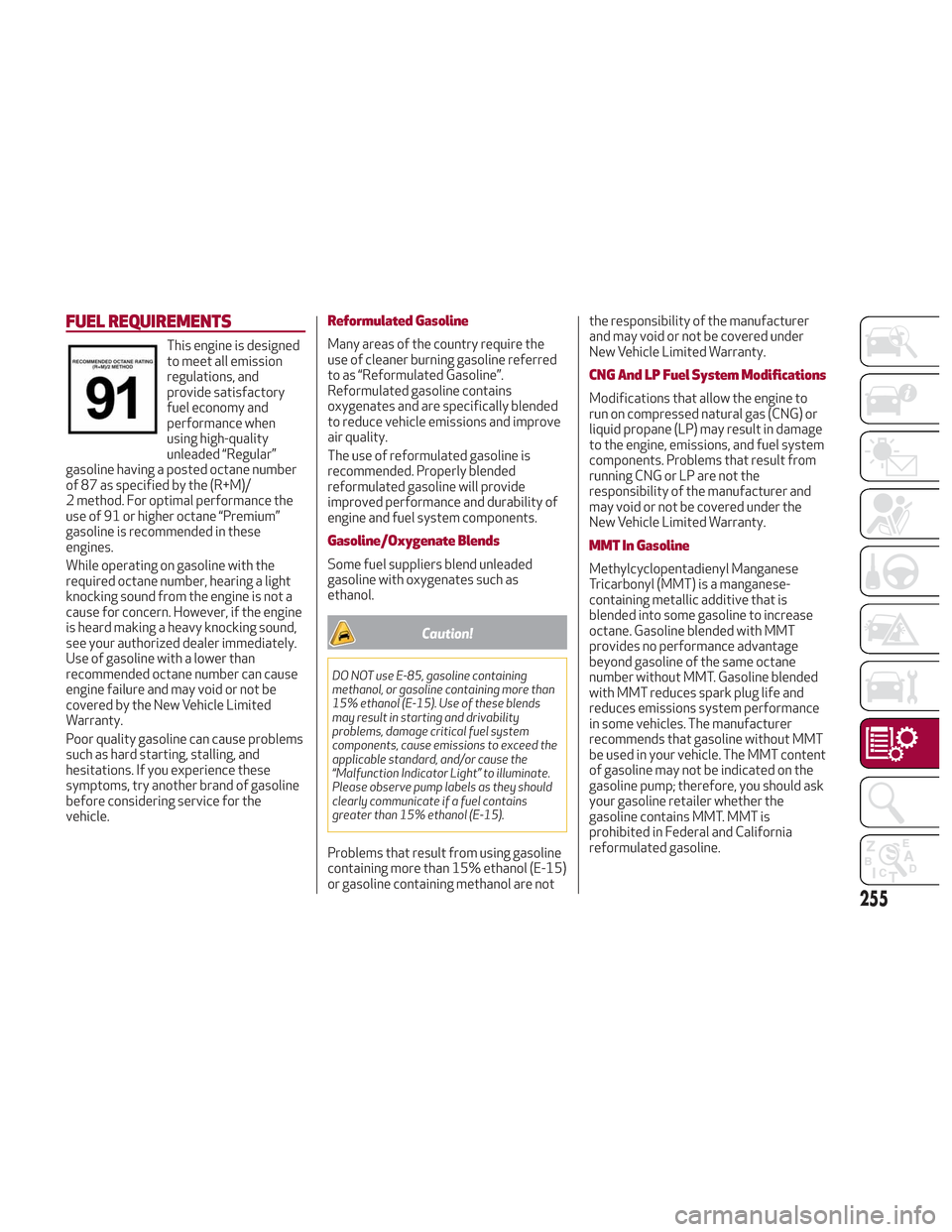
This engine is designed
to meet all emission
regulations, and
provide satisfactory
fuel economy and
performance when
using high-quality
unleaded “Regular”
gasoline having a posted octane number
of 87 as specified by the (R+M)/
2 method. For optimal performance the
use of 91 or higher octane “Premium”
gasoline is recommended in these
engines.
While operating on gasoline with the
required octane number, hearing a light
knocking sound from the engine is not a
cause for concern. However, if the engine
is heard making a heavy knocking sound,
see your authorized dealer immediately.
Use of gasoline with a lower than
recommended octane number can cause
engine failure and may void or not be
covered by the New Vehicle Limited
Warranty.
Poor quality gasoline can cause problems
such as hard starting, stalling, and
hesitations. If you experience these
symptoms, try another brand of gasoline
before considering service for the
vehicle.
Reformulated Gasoline
Many areas of the country require the
use of cleaner burning gasoline referred
to as “Reformulated Gasoline”.
Reformulated gasoline contains
oxygenates and are specifically blended
to reduce vehicle emissions and improve
air quality.
The use of reformulated gasoline is
recommended. Properly blended
reformulated gasoline will provide
improved performance and durability of
engine and fuel system components.
Gasoline/Oxygenate Blends
Some fuel suppliers blend unleaded
gasoline with oxygenates such as
ethanol.
Caution!
DO NOT use E-85, gasoline containing
methanol, or gasoline containing more than
15% ethanol (E-15). Use of these blends
may result in starting and drivability
problems, damage critical fuel system
components, cause emissions to exceed the
applicable standard, and/or cause the
“Malfunction Indicator Light” to illuminate.
Please observe pump labels as they should
clearly communicate if a fuel contains
greater than 15% ethanol (E-15).
Problems that result from using gasoline
containing more than 15% ethanol (E-15)
or gasoline containing methanol are not the responsibility of the manufacturer
and may void or not be covered under
New Vehicle Limited Warranty.
CNG And LP Fuel System Modifications
Modifications that allow the engine to
run on compressed natural gas (CNG) or
liquid propane (LP) may result in damage
to the engine, emissions, and fuel system
components. Problems that result from
running CNG or LP are not the
responsibility of the manufacturer and
may void or not be covered under the
New Vehicle Limited Warranty.
MMT In Gasoline
Methylcyclopentadienyl Manganese
Tricarbonyl (MMT) is a manganese-
containing metallic additive that is
blended into some gasoline to increase
octane. Gasoline blended with MMT
provides no performance advantage
beyond gasoline of the same octane
number without MMT. Gasoline blended
with MMT reduces spark plug life and
reduces emissions system performance
in some vehicles. The manufacturer
recommends that gasoline without MMT
be used in your vehicle. The MMT content
of gasoline may not be indicated on the
gasoline pump; therefore, you should ask
your gasoline retailer whether the
gasoline contains MMT. MMT is
prohibited in Federal and California
reformulated gasoline.
255
Page 258 of 276

Materials Added To Fuel
Besides using unleaded gasoline with the
proper octane rating, gasolines that
contain detergents, corrosion and
stability additives are recommended.
Using gasolines that have these additives
will help improve fuel economy, reduce
emissions, and maintain vehicle
performance.Designated TOP TIER
Detergent Gasoline
contains a higher level
of detergents to
further aide in
minimizing engine and
fuel system deposits.
When available, the usage of TOP TIER
Detergent gasoline is recommended.
Visit www.toptiergas.com for a list of
TOP TIER Detergent Gasoline Retailers.
Indiscriminate use of fuel system
cleaning agents should be avoided. Many
of these materials intended for gum and
varnish removal may contain active
solvents or similar ingredients. These can
harm fuel system gasket and diaphragm
materials.
Fuel System Cautions
Caution!
Follow these guidelines to maintain your
vehicle’s performance:
The use of leaded gasoline is prohibited
by Federal law. Using leaded gasoline can
impair engine performance and damage the
emissions control system.
An out-of-tune engine or certain fuel or
ignition malfunctions can cause the
catalytic converter to overheat. If you
notice a pungent burning odor or some light
smoke, your engine may be out of tune or
malfunctioning and may require immediate
service. Contact an authorized dealer for
service assistance.
The use of fuel additives, which are now
being sold as octane enhancers, is not
recommended. Most of these products
contain high concentrations of methanol.
Fuel system damage or vehicle
performance problems resulting from the
use of such fuels or additives is not the
responsibility of the manufacturer and may
void or not be covered under the New
Vehicle Limited Warranty.
Note: Intentional tampering with the
emissions control system can result in
civil penalties being assessed against
you.
256
TECHNICAL SPECIFICATIONS
Page 259 of 276
FLUID CAPACITIES
2.9 V6 EngineU.S. Metric
Fuel tank 16.9 Gallons64 Liters
Fuel
tank reserve 2.5 Gallons 9.6 Liters
Engine cooling system 2.95 Gallons11.2 Liters
Intercooler cooling system 1.5 Gallons5.75 Liters
Engine sump and filter 7.2 Quarts7 Liters
Hydraulic brake circuit 0.9 Quarts0.9 Liters
Windshield washer fluid reservoir 1.1 Gallons4.1 Liters
Differentials and reduction gears RDU 230-TV Main body: 0.8 Quarts
Left TV: 0.64 Quarts
Right TV: 0.72 QuartsMain body: 0.8 Liters
Left TV: 0.61 Liters
Right TV: 0.68 Liters
AWD System FAD transfer case 0.48 Quarts0.45 Liters
AWD System TRANSFER CASE 0.7 Quarts0.7 Liters
257
Page 260 of 276
FLUIDS AND LUBRICANTS
Your vehicle is equipped with an engine oil that has been thoroughly developed and tested in order to meet the requirements of the
Scheduled Servicing Plan. Constant use of the prescribed lubricants guarantees the fuel consumption and emission specifications.
Lubricant quality is crucial for engine operation and duration.
2.9L V6 — Engine Lubrication
FeaturesSpecificationReplacement interval
5W-40
A
CEA C3
API SN FPT 9.55535-GH2
MS-12991 According to the Maintenance Plan
If lubricants conforming to the specific request are not available, products that meet the indicated specifications can be used to top
up; in this case optimal performance of the engine is not guaranteed.
258
TECHNICAL SPECIFICATIONS


