2018 Alfa Romeo Stelvio weight
[x] Cancel search: weightPage 185 of 276

Curb Weight
The curb weight of a vehicle is defined as
the total weight of the vehicle with all
fluids, including vehicle fuel, at full
capacity conditions, and with no
occupants or cargo loaded into the
vehicle. The front and rear curb weight
values are determined by weighing your
vehicle on a commercial scale before any
occupants or cargo are added.
Loading
The actual total weight and the weight of
the front and rear of your vehicle at the
ground can best be determined by
weighing it when it is loaded and ready
for operation.The entire vehicle should first be weighed
on a commercial scale to insure that the
GVWR has not been exceeded. The
weight on the front and rear of the
vehicle should then be determined
separately to be sure that the load is
properly distributed over the front and
rear axle. Weighing the vehicle may show
that the GAWR of either the front or rear
axles has been exceeded but the total
load is within the specified GVWR. If so,
weight must be shifted from front to rear
or rear to front as appropriate until the
specified weight limitations are met.
Store the heavier items down low and be
sure that the weight is distributed
equally. Stow all loose items securely
before driving.
Improper weight distributions can have
an adverse effect on the way your vehicle
steers and handles and the way the
brakes operate.
Caution!
Do not load your vehicle any heavier than the
GVWR or the maximum front and rear
GAWR. If you do, parts on your vehicle can
break, or it can change the way your vehicle
handles. This could cause you to lose control.
Also overloading can shorten the life of your
vehicle.
SUGGESTIONS FOR DRIVING
Saving Fuel
Below are some suggestions which may
help you save fuel and lower the amount
of harmful emissions released into the
atmosphere.
Vehicle Maintenance
Checks and operations should be carried
out in accordance with the Maintenance
Plan. Refer to "Scheduled Servicing" in
"Servicing And Maintenance" for further
information.
Tires
Check the tire pressures at least once
every four weeks: if the pressure is too
low, consumption levels increase as
resistance to rolling is higher.
Note:
Tire pressure that is too high can
cause premature tire wear, reduced
control, etc.
Unnecessary Loads
Do not travel with an overloaded liftgate.
The weight of the vehicle and its
arrangement greatly affect fuel
consumption and stability.
183
Page 187 of 276
Brakes
The car braking system may be available
with four carbon-ceramic material brake
discs, one on each wheel.
In order to guarantee the maximum
braking capacity for the first use, Alfa
Romeo performs a "run-in" procedure for
discs and pads directly at the factory.
The use of carbon-ceramic material
brake discs guarantees braking features
(better deceleration/pedal load ratio,
braking distances, fading resistance)
proportional to the dynamic features of
the car in addition to considerably
decreasing the unsprung component
weight.
The materials used and the structural
features of the system could generate
unusual noises which have absolutely no
adverse effect on correct operation and
reliability of the braking system.
Greater pressure may need to be applied
to the brake pedal the first time to keep
the same braking capacities in presence
of condensation or salt on the braking
surfaces, for example after washing or if
the car is not used for a long time.
Note:Given the high technological level
of this system, any servicing on it must be
performed by your authorized dealer
which exclusively has the skills needed
for the repair operations. In case of intensive, high-performance
use of the car, have the efficiency of the
carbon-ceramic material braking system
inspected as shown on the Maintenance
Plan at your authorized dealer.
Driving On Race Tracks
Before driving on a track using a racing
style, it is necessary to:
Attend a race track driving course.
Check the liquid levels in the engine
compartment. For more information, see
the “Checking Levels” section in the
“Servicing And Maintenance” chapter.
Have the car inspected at an
authorized dealer.
Remember that the car was not designed
to be driven exclusively on the race track
and that this use increases stress and
component wear.
Note: Quadrifoglio front brakes are
equipped with NAO type pads. These
pads are NOT suitable for high termic
loads (vehicle track use). If you want to
use vehicle on a track it is necessary to
use the optional CCM (Carbon Ceramic
Brake disc). Preheating the carbon ceramic material
brake discs
The brake discs must be warmed up to
make them fully efficient. You are
advised to perform the following
procedure:
Brake nine times from 80 mph to
18 mph (130 km/h to 30 km/h) with
deceleration equal to 0.7g (the
longitudinal acceleration value is shown
on the instrument panel display by
setting RACE mode and selecting the
“Performance” page) with 20 second
intervals between brake applications;
keep the car at a speed comprised
between 37 mph and 62 mph (60 km/h
and 100 km/h) and do not brake for
4 minutes to allow the brakes to cool
down;
Then brake three times from 124 mph
to 18 mph (200 km/h to 30 km/h) with
deceleration equal to 1.1g (ABS
operation) with 30 second intervals
between brake applications; keep the car
at a speed comprised between 37 mph
and 62 mph (60 km/h and 100 km/h) and
do not brake for 5 minutes to allow the
brakes to cool down.
185
Page 215 of 276

Thousands of miles10
20 30
40 50
60
70
80
90
100
110
120
130
140
150
Years123456789101112131415
Thousands of kilometers16
32 48
64 80
96
112
128
144
160
176
192
208
224
240
Visually inspect conditions and wear of front/rear disc brake
pads and operation of pad wear indicators. ●●●●●●●●●
●●●●●●
Brake disc wear status check with diagnostic tool. ●●●●●●●●●●●●●●●
Visually inspect the brake discs surface and edge. ●●●●●●●●●●●●●●●
Brake pads/brake discs replacement.
(2)
Visually inspect the condition and tensioning of the
accessory drive belt(s). ●●● ●●● ●●● ●●●
Change engine coolant ●
Change engine oil and replace oil filter. ●●●●●●●●●●●●●●●
Replace transfer case oil (AWD models only) ●
Replace accessory drive belt/s.
(3)
Replace air cleaner cartridge(4)●●●●●●●
Replace the additional fuel filter (if equipped). ●●●●●●●●●●●●●●●
(2) The actual interval for changing the brake pads and the carbon ceramic brake discs depends on the vehicle usage conditions and is signaled by the warning light or
message on the instrument panel. It is advisable to check brake disc weight and thickness after each intensive use.
(3) Areas that are not dusty: recommended maximum mileage 36,000 miles (60,00 km). Regardless of the mileage, the belt must be replaced every 4 years. Dusty areas and/or demanding use of the vehicle (cold climates, town use, long periods of idling): advised maximum mileage 18,000 miles (30,000 km). Regardless of the mileage,
the belt must be replaced every 2 years.
(4) If the vehicle is used in dusty areas, this cleaner must be replaced every 10,000 miles (16,000 km).
213
Page 232 of 276
Tire Loading And Tire Pressure
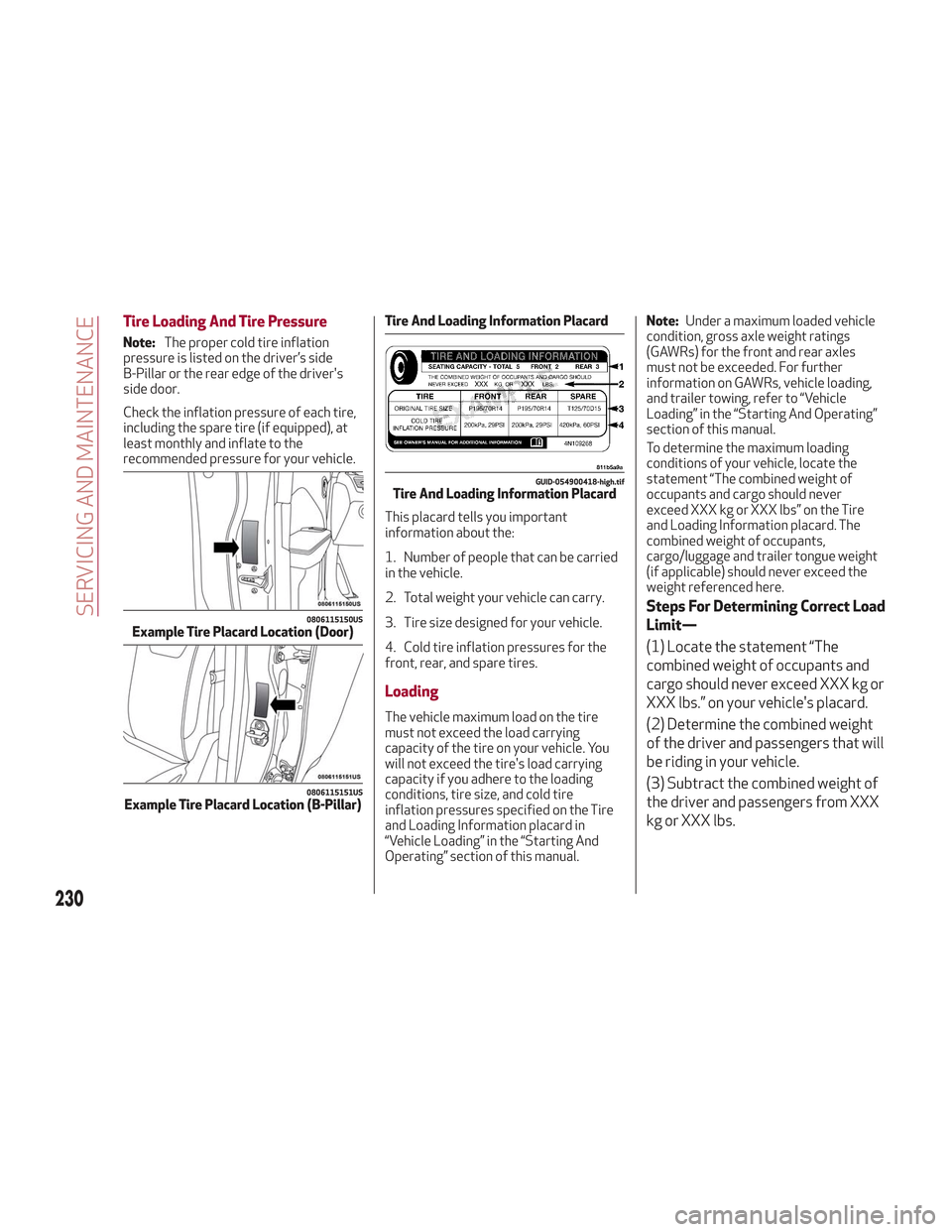
Note:The proper cold tire inflation
pressure is listed on the driver’s side
B-Pillar or the rear edge of the driver's
side door.
Check the inflation pressure of each tire,
including the spare tire (if equipped), at
least monthly and inflate to the
recommended pressure for your vehicle. Tire And Loading Information Placard
This placard tells you important
information about the:
1. Number of people that can be carried
in the vehicle.
2. Total weight your vehicle can carry.
3. Tire size designed for your vehicle.
4. Cold tire inflation pressures for the
front, rear, and spare tires.
Loading
The vehicle maximum load on the tire
must not exceed the load carrying
capacity of the tire on your vehicle. You
will not exceed the tire's load carrying
capacity if you adhere to the loading
conditions, tire size, and cold tire
inflation pressures specified on the Tire
and Loading Information placard in
“Vehicle Loading” in the “Starting And
Operating” section of this manual.Note:
Under a maximum loaded vehicle
condition, gross axle weight ratings
(GAWRs) for the front and rear axles
must not be exceeded. For further
information on GAWRs, vehicle loading,
and trailer towing, refer to “Vehicle
Loading” in the “Starting And Operating”
section of this manual.
To determine the maximum loading
conditions of your vehicle, locate the
statement “The combined weight of
occupants and cargo should never
exceed XXX kg or XXX lbs” on the Tire
and Loading Information placard. The
combined weight of occupants,
cargo/luggage and trailer tongue weight
(if applicable) should never exceed the
weight referenced here.
Steps For Determining Correct Load
Limit—
(1) Locate the statement “The
combined weight of occupants and
cargo should never exceed XXX kg or
XXX lbs.” on your vehicle's placard.
(2) Determine the combined weight
of the driver and passengers that will
be riding in your vehicle.
(3) Subtract the combined weight of
the driver and passengers from XXX
kg or XXX lbs.0806115150USExample Tire Placard Location (Door)
0806115151USExample Tire Placard Location (B-Pillar)
GUID-054900418-high.tifTire And Loading Information Placard
230
SERVICING AND MAINTENANCE
Page 233 of 276

(4) The resulting figure equals the
available amount of cargo and
luggage load capacity. For example,
if “XXX” amount equals 1400 lbs. and
there will be five 150 lb passengers
in your vehicle, the amount of
available cargo and luggage load
capacity is 650 lbs. (1400-750
(5x150) = 650 lbs.)
(5) Determine the combined weight
of luggage and cargo being loaded on
the vehicle. That weight may not
safely exceed the available cargo and
luggage load capacity calculated in
Step 4.
(6) If your vehicle will be towing a
trailer, load from your trailer will be
transferred to your vehicle. Consult
this manual to determine how this
reduces the available cargo and
luggage load capacity of your vehicle.Metric Example For Load Limit
For example, if “XXX” amount equals
635 kg and there will be five 68 kg
passengers in your vehicle, the amount of
available cargo and luggage load capacity
is 295 kg (635-340 (5x68) = 295 kg) as
shown in step 4.
Note:
If your vehicle will be towing a trailer,
load from your trailer will be transferred
to your vehicle. The following table
shows examples on how to calculate
total load, cargo/luggage, and towing
capacities of your vehicle with varying
seating configurations and number and
size of occupants. This table is for
illustration purposes only and may not
be accurate for the seating and load
carry capacity of your vehicle.
For the following example, the
combined weight of occupants and
cargo should never exceed 865 lbs
(392 kg).
231
Page 247 of 276

TECHNICAL SPECIFICATIONS
For the enthusiasts, the technician, or
those who just want to know every detail
of their vehicle, useful information on
understanding how your vehicle works is
contained in this chapter and illustrated
with data, tables and graphics.IDENTIFICATION DATA.........246
ENGINE ................. .247
POWER SUPPLY .............248
TRANSMISSION .............249
BRAKES ................. .250
SUSPENSION ............. .251
STEERING ............... .252
DIMENSIONS .............. .253
WEIGHTS ................ .254
FUEL REQUIREMENTS ........255
FLUID CAPACITIES ...........257
FLUIDS AND LUBRICANTS ......258
PERFORMANCE .............260
245
Page 248 of 276

IDENTIFICATION DATA
Vehicle Identification Number
The Vehicle Identification Number (VIN)
is stamped on a plate on the front left
corner of the dashboard trim, which can
be seen from outside the vehicle, through
the windshield.This number is also stamped on the
chassis near the front left shock
absorber and can be seen by opening the
engine compartment hood.
Vehicle Identification Number (VIN)
Plate
The plates are located on the left side A
pillar and contain the data about:
Chassis number (VIN).
Vehicle type (USA and Canada only).
Color code.
Place of manufacturing of the vehicle
(USA and Mexico only).
Vehicle manufacturing date.
Maximum permitted weights.
Permitted tire inflation pressure (USA
and Canada only).
10016V0001EMVehicle Identification Number
10016V0002EMVehicle Identification Number
246
TECHNICAL SPECIFICATIONS
Page 256 of 276

WEIGHTS
Weights (lbs)2.9L V6 engine
Unladen weight (with all fluids, fuel tank filled to 90% and without
optional
equipment) 4394
Payload including the driver
(*)992
Maximum permitted loads
(**)242
– Front axle 2491
– Rear axle 2976
– Total 5247
(*) If special equipment is fitted (trailer towing equipment, etc.) the empty weight will increase and consequently the payload will decrease in relation to the maximum
permitted loads.
(**) Loads not to be exceeded. The user is responsible for arranging goods in the luggage compartment and/or on the load platform within the maximum permitted loads.
254
TECHNICAL SPECIFICATIONS