Page 206 of 276
Warning!
You or others can be badly burned by hot
engine coolant (antifreeze) or steam from
your radiator. If you see or hear steam
coming from under the hood, do not open the
hood until the radiator has had time to cool.
Never try to open a cooling system pressure
cap when the radiator or coolant bottle is
hot.
Caution!
Driving with a hot cooling system could
damage your vehicle. If temperature gauge
reads “H”, pull over and stop the vehicle. Idle
the vehicle with the air conditioner turned
off until the pointer drops back into the
normal range. If the pointer remains on the
“H”, turn the engine off immediately, and call
for service.
Note:
If the cooling fan does not operate
while the engine is running, the engine
temperature will increase. Stop the
engine and contact an authorized dealer.
If the engine continues to overheat or
frequently overheats, have the cooling
system inspected. The engine could be
seriously damaged unless repairs are
made. Contact an authorized dealer.
TOWING A DISABLED VEHICLE
This section describes procedures for
towing a disabled vehicle using a
commercial towing service.
Caution!
The vehicle should be transported with all
four wheels OFF the ground on the flatbed
of a roadside assistance vehicle. Avoid
towing with only the front (or rear) wheels
lifted. When towing with only the front (or
rear) wheels lifted, in addition to damaging
the body, it could damage the transmission.
Do not use sling-type equipment when
towing. Vehicle damage may occur.
When securing the vehicle to a flatbed
truck, do not attach to front or rear
suspension components. Damage to your
vehicle may result from improper towing.
Ensure that the Electric Park Brake is
released, and remain released, while being
towed.
Damage from improper towing is not
covered under the New Vehicle Limited
Warranty.
Note: If your vehicle is equipped with a
Anti-Lift Protection system, you will need
to disable the system prior to towing by
pushing the button located on the
overhead console. Refer to “Anti-Lift
Protection — If Equipped” in “Getting To
Know Your Vehicle” for further
information.
The operators of the assistance vehicle
must be informed with regard to the
vehicle's minimum height from ground in
order to avoid contact between the ends
of the bumpers with the equipment of the
breakdown truck.
The following image illustrates the front
and rear attachment corners of the
vehicle, to be taken into consideration
when loading the vehicle on the
commercial towing vehicle.
204
IN CASE OF EMERGENCY
Page 218 of 276

Engine Oil
The engine oil level can be seen on the
instrument cluster display every time the
engine is started, or on the Information
and Entertainment system display by
activating on the main menu (MENU
button) the following functions in
sequence:
1. “Apps”
2. “My Car”
3. “Oil Level”
Check on the display using the 6 notches
that the oil level is between the MIN and
MAX level: 1 notch MIN level, 6 notches
MAX level.
If the oil level is close to or below the MIN
mark, add oil gradually through the filler,
(refer to “Top-Up And Oil Level Indication
Update On Display” in this section)
considering that each notch shown on the
display corresponds to approximately
8.8floz(250ml).
Caution!
Make sure not to add too much oil when
topping off the engine. Engine oil in excess
may damage the engine. Have the vehicle
checked. Never exceed the MAX level when
topping off engine oil.
Caution!
The oil level is not refreshed immediately on
the display after topping off. Consequently,
wait for the oil level to be refreshed on the
display and follow the procedure below.
Note:Always reinstall the oil cap and
tighten to proper torque whenever it is
removed to add oil to engine. Never run
the engine with cap removed this could
cause oil to leak from engine.
Top-Up And Oil Level Indication Update
On Display
If a engine oil top-off is needed, in order
to ensure the correct indication of the oil
level on the display, leave the vehicle on
flat ground with the engine running for
approximately five minutes (temperature
higher than 176°F (80°C)) and shut the
engine off. Then, start the engine again,
and idle it for about five minutes.
Note: If you have added the specified
amount of oil and the indicator is not
reading “Full”, please contact an
authorized dealer.
Warning!
If the engine oil is being topped up, wait for
the engine to cool down before loosening the
filler cap, particularly for vehicles with
aluminium cap (if equipped). WARNING: risk
of burns!
Caution!
The oil level must never exceed the MAX
mark.
If the MAX mark is exceeded MAX (last
notch on the right turns red) after the fill-up,
go to an authorized dealer as soon as
possible to have the oil in excess removed.
Do not add oil with specifications
different from those of the oil already in the
engine.
Used engine oil and oil filters contain
substances which are harmful to the
environment. To change the oil and filters,
we advise you to contact an authorized
dealer.
Engine Coolant Fluid
If the level is too low, unscrew the cap of
the reservoir and add the fluid described
in the "Technical Specifications" chapter.
216
SERVICING AND MAINTENANCE
Page 237 of 276
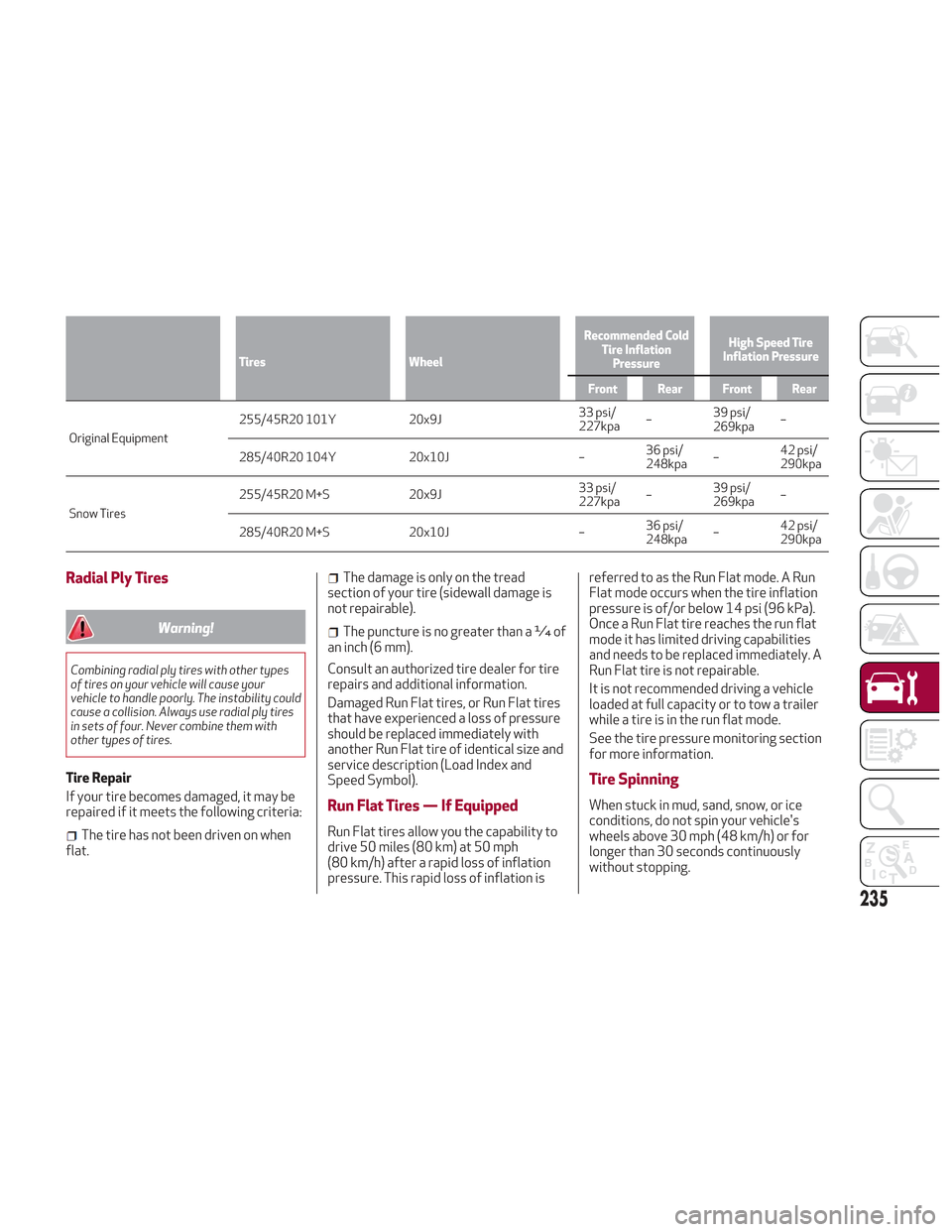
TiresWheel Recommended Cold
Tire InflationPressure High Speed Tire
Inflation Pressure
Front Rear Front Rear
Original Equipment 255/45R20
101Y
20x9J 33 psi/
227kpa–39 psi/
269kpa–
285/40R20 104Y 20x10J –36 psi/
248kpa–42 psi/
290kpa
Snow Tires 255/45R20 M+S
20x9J33 psi/
227kpa–39 psi/
269kpa–
285/40R20 M+S 20x10J–36 psi/
248kpa–42 psi/
290kpa
Radial Ply Tires
Warning!
Combining radial ply tires with other types
of tires on your vehicle will cause your
vehicle to handle poorly. The instability could
cause a collision. Always use radial ply tires
in sets of four. Never combine them with
other types of tires.
Tire Repair
If your tire becomes damaged, it may be
repaired if it meets the following criteria:
The tire has not been driven on when
flat.
The damage is only on the tread
section of your tire (sidewall damage is
not repairable).
The puncture is no greater than a ¼ of
an inch (6 mm).
Consult an authorized tire dealer for tire
repairs and additional information.
Damaged Run Flat tires, or Run Flat tires
that have experienced a loss of pressure
should be replaced immediately with
another Run Flat tire of identical size and
service description (Load Index and
Speed Symbol).
Run Flat Tires — If Equipped
Run Flat tires allow you the capability to
drive 50 miles (80 km) at 50 mph
(80 km/h) after a rapid loss of inflation
pressure. This rapid loss of inflation is referred to as the Run Flat mode. A Run
Flat mode occurs when the tire inflation
pressure is of/or below 14 psi (96 kPa).
Once a Run Flat tire reaches the run flat
mode it has limited driving capabilities
and needs to be replaced immediately. A
Run Flat tire is not repairable.
It is not recommended driving a vehicle
loaded at full capacity or to tow a trailer
while a tire is in the run flat mode.
See the tire pressure monitoring section
for more information.
Tire Spinning
When stuck in mud, sand, snow, or ice
conditions, do not spin your vehicle's
wheels above 30 mph (48 km/h) or for
longer than 30 seconds continuously
without stopping.
235