2017 YAMAHA YZ85 Oul
[x] Cancel search: OulPage 44 of 88

Operation and important rid ing points
6-4
6 be used, but sustained full-throttle
operation should be avoided.
Stop the engine and check the
spark plug again.
6. Allow the engine to cool, remove the cylinder head and cylinder,
and inspect the piston and cylin-
der. Remove any high spots on
the piston with #600-grit wet
sandpaper. Clean all components
and carefully reassemble the cyl-
inder head and cylinder.
7. Drain the break-in oil-fuel mixture from the fuel tank and refill with
the specified mix. (See page 4-4.)
8. Start the engine and check the op- eration of the motorcycle through-
out its entire operating range.
Stop the engine and check the
spark plug condition. Restart the
motorcycle and ride it for about 10
to 15 more minutes. The motorcy-
cle will now be ready to ride nor-
mally.
After the engine break-in period, thor-
oughly check the motorcycle for loose
parts, oil leakage and any other prob-
lems. Be sure to inspect and make ad-
justments thoroughly, especially cable
and drive chain slack and loose
spokes. In addition, check all fittings
and fasteners for looseness, and tight-
en if necessary.
NOTICE
ECA15561
When any of the following parts
have been replaced , they must
b e broken in.
Cylin der or crankshaft:
A bout one hour of b reak-in op-
eration is necessary. Piston, rin
gs or transmission
g ears:
These parts require a bout 30
minutes of b reak-in operation at
half-throttle or less. O bserve the
con dition of the en gine carefully
d urin g operation.
If any en gine trou ble shoul d oc-
cur durin g the en gine break-in
perio d, imme diately have a
Yamaha dealer check the vehi-
cle.
U1SN85E0.book Page 4 Friday, June 10, 2016 1:20 PM
Page 46 of 88

Periodic maintenance an d a djustment
7-1
7
EAU42074
Periodic inspection, adjustment, and
lubrication will keep your vehicle in the
safest and most efficient condition
possible. Safety is an obligation of the
vehicle owner/operator. The most im-
portant points of vehicle inspection,
adjustment, and lubrication are ex-
plained on the following pages.
The intervals given in the periodic
maintenance and lubrication chart
should be simply considered as a gen-
eral guide under normal riding condi-
tions. However, depending on the
weather, terrain, geographical location,
and individual use, the maintenance in-
tervals may need to be shortened.
WARNING
EWA10322
Failure to properly maintain the vehi-
cle or performin g maintenance ac-
tivities incorrectly may increase
your risk of injury or d eath durin g
service or while usin g the vehicle. If
you are not familiar with vehicle ser-
vice, have a Yamaha d ealer perform
service.
WARNING
EWA15123
Turn off the en gine when performin g
maintenance unless otherwise
specified .
A runnin g en gine has movin g
parts that can catch on body
parts or clothin g an d electrical
parts that can cause shocks or
fires.
Runnin g the en gine while ser-
vicin g can lead to eye injury,
b urns, fire, or car bon monoxi de
poisonin g – possi bly lea din g to d
eath. See pag e 2-2 for more in-
formation a bout car bon monox-
i d e.
WARNING
EWA15461
Brake discs, calipers, drums, an d
linin gs can b ecome very hot during
use. To avoi d possi ble burns, let
b rake components cool before
touchin g them.
U1SN85E0.book Page 1 Friday, June 10, 2016 1:20 PM
Page 47 of 88

Periodic maintenance an d a djustment
7-2
7
EAU66350
Perio dic maintenance an d lu brication chart
The following chart is intended as a general guide to maintenance and lubrication.
Bear in mind that such factors as weather, terrain, geographical location, and in-
dividual usage will alter the required maintenance and lubrication intervals. If you
are in doubt as to what intervals to follow in maintaining and lubricating your mo-
torcycle, consult your Yamaha dealer.
TIP
Items marked with an asterisk should be performed by a Yamaha dealer as they
require special tools, data and technical skills.
NO. ITEM ROUTINEAfter
break-in
Everyrace
Every
third race
Every
fifth race
As
required
1 *Piston Check piston for carbon deposits and
cracks or damage.√√ Clean.
Replace.
√√
2 *
Piston rings Check piston ring end gap and rings
for damage.√√
Replace.√√
3 *
Piston pin and small
end bearing Check piston pin and small end
bearing for damage.√
Replace.√
4 *
Cylinder head Check cylinder head for carbon
deposits.
√√ Clean.
Check cylinder head gasket for damage.
√√ Tighten cylinder head nuts if necessary.
Replace cylinder head gasket.
√
5 *
Cylinder Check cylinder for score marks or
wear.√√ Clean.
Replace.
√
U1SN85E0.book Page 2 Friday, June 10, 2016 1:20 PM
Page 51 of 88
Periodic maintenance an d a djustment
7-6
7
EAU19614
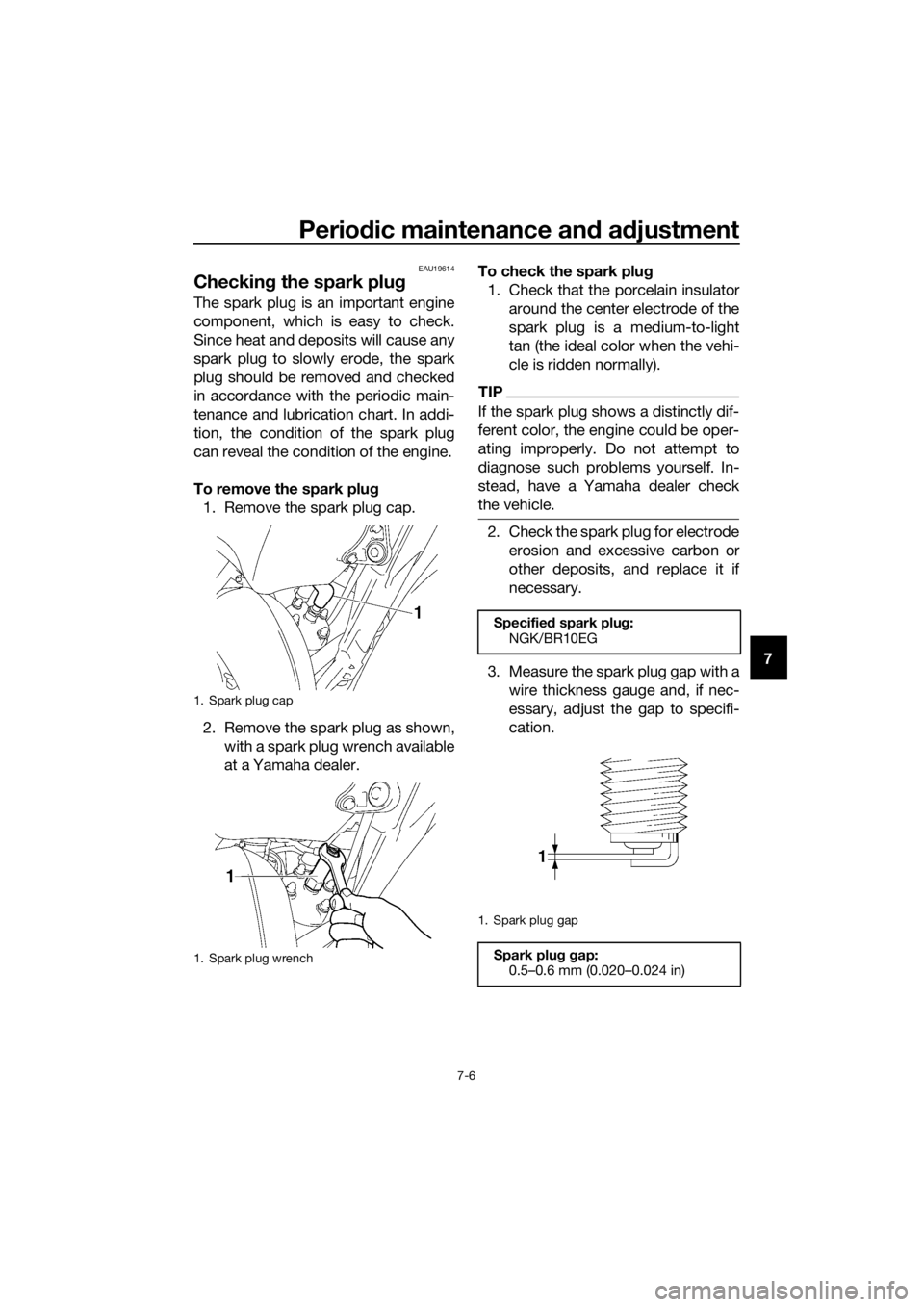
Checkin g the spark plu g
The spark plug is an important engine
component, which is easy to check.
Since heat and deposits will cause any
spark plug to slowly erode, the spark
plug should be removed and checked
in accordance with the periodic main-
tenance and lubrication chart. In addi-
tion, the condition of the spark plug
can reveal the condition of the engine.
To remove the spark plu g
1. Remove the spark plug cap.
2. Remove the spark plug as shown, with a spark plug wrench available
at a Yamaha dealer. To check the spark plu
g
1. Check that the porcelain insulator around the center electrode of the
spark plug is a medium-to-light
tan (the ideal color when the vehi-
cle is ridden normally).
TIP
If the spark plug shows a distinctly dif-
ferent color, the engine could be oper-
ating improperly. Do not attempt to
diagnose such problems yourself. In-
stead, have a Yamaha dealer check
the vehicle.
2. Check the spark plug for electrodeerosion and excessive carbon or
other deposits, and replace it if
necessary.
3. Measure the spark plug gap with a wire thickness gauge and, if nec-
essary, adjust the gap to specifi-
cation.
1. Spark plug cap
1. Spark plug wrench
Specified spark plu g:
NGK/BR10EG
1. Spark plug gap
Spark plu g g ap:
0.5–0.6 mm (0.020–0.024 in)
U1SN85E0.book Page 6 Friday, June 10, 2016 1:20 PM
Page 52 of 88

Periodic maintenance an d a djustment
7-7
7 To install the spark plu
g
1. Clean the surface of the spark plug gasket and its mating surfa-
ce, and then wipe off any grime
from the spark plug threads.
2. Install the spark plug with the spark plug wrench, and then tight-
en it to the specified torque.
TIP
If a torque wrench is not available
when installing a spark plug, a good
estimate of the correct torque is 1/4–
1/2 turn past finger tight. However, the
spark plug should be tightened to the
specified torque as soon as possible.
3. Install the spark plug cap.
EAU4144B
Transmission oil
The transmission must be checked for
oil leakage before each ride. If any
leakage is found, have a Yamaha deal-
er check and repair the motorcycle. In
addition, the transmission oil must be
changed at the intervals specified in
the periodic maintenance and lubrica-
tion chart.1. Start the engine, warm it up for several minutes, and then turn it
off.
2. Place the motorcycle on a level surface and hold it in an upright
position.
3. Place an oil pan under the trans- mission case to collect the used
oil.
4. Remove the transmission oil filler cap and its O-ring, and then re-
move the transmission oil drain
bolt and its gasket to drain the oil
from the transmission.
5. Install the drain bolt and its new gasket, and then tighten the bolt
to the specified torque.
Tightenin g torque:
Spark plug: 20 N·m (2.0 kgf·m, 14 lb·ft)
1. Transmission oil filler cap
2. O-ring
3. Transmission oil drain bolt
4. Gasket
34
1
2
U1SN85E0.book Page 7 Friday, June 10, 2016 1:20 PM
Page 53 of 88

Periodic maintenance an d a djustment
7-8
7
6. Refill with the specified amount of
the recommended transmission
oil.
NOTICE
ECA10453
In or der to prevent clutch slip-
pa ge (since the transmission oil
also lu bricates the clutch), do
not mix any chemical additives.
Do not use oils with a diesel
specification of “CD” or oils of a
hi gher quality than specifie d. In
a ddition, do not use oils la bele d
“ENERGY CONSERVING II” or
hi gher.
Make sure that no forei gn mate-
rial enters the transmission.
7. Check the O-ring for damage, and replace it if necessary.
8. Install and tighten the transmis- sion oil filler cap and its O-ring.
9. Start the engine, and then let it idle for several minutes while checking
it for oil leakage. If oil is leaking,
immediately turn the engine off
and check for the cause.
EAU20071
Coolant
The coolant level should be checked
before each ride. In addition, the cool-
ant must be changed at the intervals
specified in the periodic maintenance
and lubrication chart.
EAUM1296To check the coolant level1. Place the vehicle on a level surfa- ce and hold it in an upright posi-
tion.
TIP
The coolant level must be
checked on a cold engine since
the level varies with engine tem-
perature.
Make sure that the vehicle is posi-
tioned straight up when checking
the coolant level. A slight tilt to the
side can result in a false reading.
2. Remove the radiator cap and
check the coolant level in the radi-
ator. WARNING! Never attempt
to remove the ra diator cap
when the en gine is hot.
[EWA10382]
Ti ghtening torque:
Transmission oil drain bolt: 10 N·m (1.0 kgf·m, 7.2 lb·ft)
Recommen ded transmission oil:
See page 9-1.
Oil chan ge quantity:
0.51 L (0.54 US qt, 0.45 Imp.qt)
1. Radiator cap
1
U1SN85E0.book Page 8 Friday, June 10, 2016 1:20 PM
Page 54 of 88

Periodic maintenance an d a djustment
7-9
7
TIP
The coolant should be at the bottom of
the radiator filler neck. The level will
change with variation of engine tem-
perature.
3. If the coolant is below the correct
coolant level, add coolant, and
then install the radiator cap.
NOTICE: If coolant is not avail-
a b le, use distille d water or soft
tap water instea d. Do not use
har d water or salt water since it
is harmful to the en gine. If water
has been used instead of cool-
ant, replace it with coolant as
soon as possi ble, otherwise the
coolin g system will not be pro-
tected against frost an d corro-
sion. If water has b een added to
the coolant, have a Yamaha
d ealer check the antifreeze con-
tent of the coolant as soon as
possi ble, otherwise the effec-
tiveness of the coolant will be
re duce d.
[ECA10473]
EAUM1318
To change the coolant
1. Place the vehicle on a level surfa- ce and let the engine cool if neces-
sary. 2. Place a container under the en-
gine to collect the used coolant.
3. Remove the radiator cap, and then the coolant drain bolt and its
gasket to drain the cooling sys-
tem. WARNING! Never attempt
to remove the ra diator cap
when the en gine is hot.
[EWA10382]
4. After the coolant is completely
drained, thoroughly flush the cool-
ing system with clean tap water.
5. Install the coolant drain bolt and its new gasket, and then tighten
the bolt to the specified torque.
1. Correct coolant level
1
1. Radiator cap
1. Coolant drain bolt
2. Gasket
Tightening torque:
Coolant drain bolt: 10 N·m (1.0 kgf·m, 7.2 lb·ft)
1
12
U1SN85E0.book Page 9 Friday, June 10, 2016 1:20 PM
Page 55 of 88

Periodic maintenance an d a djustment
7-10
7
6. Pour the recommended coolant
into the radiator until it is full.
7. Install the radiator cap, start the engine, let it idle for several minu-
tes, and then turn it off.
8. Remove the radiator cap to check the coolant level in the radiator. If
necessary, add sufficient coolant
until it reaches the bottom of the
radiator filler neck, and then install
the radiator cap.
9. Start the engine, and then check the vehicle for coolant leakage. If
coolant is leaking, have a Yamaha
dealer check the cooling system.
EAU48392
Cleanin g the air filter element
The air filter element should be cleaned
or replaced at the intervals specified in
the periodic maintenance and lubrica-
tion chart. Clean or, if necessary, re-
place the air filter element more
frequently if you are riding in unusually
wet or dusty areas.
1. Remove the seat. (See page 4-8.)
2. Remove the air filter case cover as shown.
3. Remove the air filter element by removing the wing bolt and its
washer.
Antifreeze/water mixture ratio:1:1
Recommen ded antifreeze:
High-quality ethylene glycol anti-
freeze containing corrosion inhibi-
tors for aluminum engines
Coolant quantity:
Radiator (including all routes):0.54 L (0.57 US qt, 0.48 Imp.qt)
1. Air filter case cover
U1SN85E0.book Page 10 Friday, June 10, 2016 1:20 PM