2017 YAMAHA WR 250F length
[x] Cancel search: lengthPage 150 of 432

CHASSIS
4-7
EAS2GBB149SUSPENSION SETTING (REAR SHOCK ABSORBER)
TIP
• If any of the following symptoms is experienced with the standard position as the base, make reset-
ting by reference to the adjustment procedure given in the same chart.
• Adjust the rebound damping in 2-click increments or decrements.
• Adjust the low compression damping in 1-click increments or decrements.
• Adjust the high compression damping in 1/6 turn increments or decrements. Low front, tend-
ing to lower
front postureCompression
damping forceTurn adjuster clockwise (about
2 clicks) to increase damping.
Rebound
damping forceTurn adjuster counterclock-
wise (about 2 clicks) to de-
crease damping.
Balance with
rear endSet sunken length for 95–100
mm (3.7–3.9 in) when one
passenger is astride seat (low-
er rear posture).
Oil amount Increase oil amount by about 5
cm
3 (0.2 US oz, 0.2 Imp.oz).
“Obtrusive”
front, tending to
upper front pos-
tureCompression
damping forceTurn adjuster counterclock-
wise (about 2 clicks) to de-
crease damping.
Balance with
rear endSet sunken length for 90–95
mm (3.5–3.7 in) when one
passenger is astride seat (up-
per rear posture).
Spring Replace with soft spring.
Oil amount Decrease oil amount by about
5–10 cm
3 (0.2–0.3 US oz, 0.2–
0.4 Imp.oz).
SymptomSection
Check Adjust
JumpLarge
gapMedi-
um
gapSmall
gap
Stiff, tending to
sinkRebound
damping forceTurn adjuster counterclock-
wise (about 2 clicks) to de-
crease damping.
Spring set
lengthSet sunken length for 90–100
mm (3.5–3.9 in) when one
passenger is astride seat.
Spongy and un-
stableRebound
damping forceTurn adjuster clockwise (about
2 clicks) to increase damping.
Low compres-
sion dampingTurn adjuster clockwise (about
1 click) to increase damping.
Spring Replace with stiff spring. SymptomSection
Check Adjust
JumpLarge
gapMedi-
um
gapSmall
gap
Page 151 of 432

CHASSIS
4-8
Heavy and
draggingRebound
damping forceTurn adjuster counterclock-
wise (about 2 clicks) to de-
crease damping.
Spring Replace with soft spring.
Poor road grip-
pingRebound
damping forceTurn adjuster counterclock-
wise (about 2 clicks) to de-
crease damping.
Low compres-
sion dampingTurn adjuster clockwise (about
1 click) to increase damping.
High compres-
sion dampingTurn adjuster clockwise (about
1/6 turn) to increase damping.
Spring set
lengthSet sunken length for 90–100
mm (3.5–3.9 in) when one
passenger is astride seat.
Spring Replace with soft spring.
Bottoming outHigh compres-
sion dampingTurn adjuster clockwise (about
1/6 turn) to increase damping.
Spring set
lengthSet sunken length for 90–100
mm (3.5–3.9 in) when one
passenger is astride seat.
Spring Replace with stiff spring.
BouncingRebound
damping forceTurn adjuster clockwise (about
2 clicks) to increase damping.
Spring Replace with soft spring.
Stiff travelHigh compres-
sion dampingTurn adjuster counterclock-
wise (about 1/6 turn) to de-
crease damping.
Spring set
lengthSet sunken length for 90–100
mm (3.5–3.9 in) when one
passenger is astride seat.
Spring Replace with soft spring. SymptomSection
Check Adjust
JumpLarge
gapMedi-
um
gapSmall
gap
Page 197 of 432

FRONT FORK
5-43
b. Repeat this step until the inner tube can be
pulled out from the outer tube.
▲▲▲▲▲▲▲▲▲▲▲▲▲▲▲▲▲▲▲▲▲▲▲▲▲▲▲▲▲▲▲▲
5. Remove:
• Base valve “1”
(from the damper assembly)
TIP
Hold the damper assembly with the cap bolt
ring wrench “2” and use the cap bolt wrench “3”
to remove the base valve.
EAS2GBB200CHECKING THE FRONT FORK LEGS
1. Check:
• Inner tube surface “a”
Scratches Repair or replace.
Use #1000 grit wet sandpaper.
Damaged oil lock piece Replace.
• Inner tube bends
Out of specification Replace.
Use the dial gauge “1”.
TIP
The bending value is shown by one half of the
dial gauge reading.
EWA
WARNING
Do not attempt to straighten a bent inner
tube as this may dangerously weaken it.
2. Check:
• Outer tube
Scratches/wear/damage Replace.
3. Measure:
• Fork spring free length “a”
Out of specification Replace.
4. Check:
• Damper assembly “1”
Bend/damage Replace.
• O-ring “2”
Wear/damage Replace.
ECA
NOTICE
• The front fork leg has a built-in damper ad-
justing rod and a very sophisticated inter-
nal construction, which are particularly
sensitive to foreign material.
• When disassembling and assembling the
front fork leg, do not allow any foreign ma-
terial to enter the front fork. Cap bolt wrench
90890-01500
Cap bolt wrench
YM-01500
Cap bolt ring wrench
90890-01501
Cap bolt ring wrench
YM-01501
Inner tube bending limit
0.2 mm (0.01 in)
1 23
Fork spring free length
470.0 mm (18.50 in)
Limit
465.0 mm (18.31 in)
Page 223 of 432
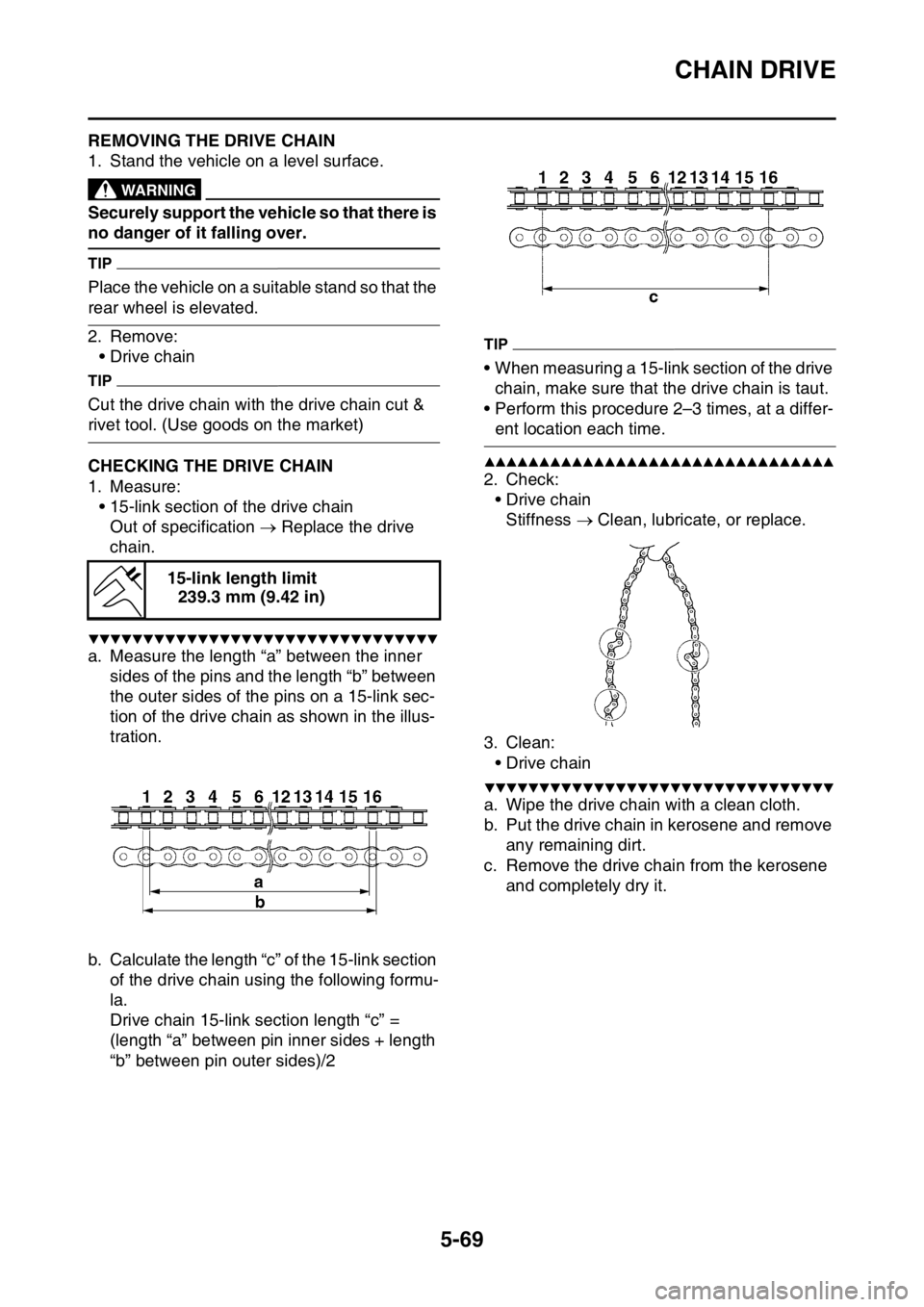
CHAIN DRIVE
5-69
EAS23420REMOVING THE DRIVE CHAIN
1. Stand the vehicle on a level surface.
EWA
WARNING
Securely support the vehicle so that there is
no danger of it falling over.
TIP
Place the vehicle on a suitable stand so that the
rear wheel is elevated.
2. Remove:
•Drive chain
TIP
Cut the drive chain with the drive chain cut &
rivet tool. (Use goods on the market)
EAS23441CHECKING THE DRIVE CHAIN
1. Measure:
• 15-link section of the drive chain
Out of specification Replace the drive
chain.
▼▼▼▼▼▼▼▼▼▼▼▼▼▼▼▼▼▼▼▼▼▼▼▼▼▼▼▼▼▼▼▼
a. Measure the length “a” between the inner
sides of the pins and the length “b” between
the outer sides of the pins on a 15-link sec-
tion of the drive chain as shown in the illus-
tration.
b. Calculate the length “c” of the 15-link section
of the drive chain using the following formu-
la.
Drive chain 15-link section length “c” =
(length “a” between pin inner sides + length
“b” between pin outer sides)/2
TIP
• When measuring a 15-link section of the drive
chain, make sure that the drive chain is taut.
• Perform this procedure 2–3 times, at a differ-
ent location each time.
▲▲▲▲▲▲▲▲▲▲▲▲▲▲▲▲▲▲▲▲▲▲▲▲▲▲▲▲▲▲▲▲
2. Check:
•Drive chain
Stiffness Clean, lubricate, or replace.
3. Clean:
•Drive chain
▼▼▼▼▼▼▼▼▼▼▼▼▼▼▼▼▼▼▼▼▼▼▼▼▼▼▼▼▼▼▼▼
a. Wipe the drive chain with a clean cloth.
b. Put the drive chain in kerosene and remove
any remaining dirt.
c. Remove the drive chain from the kerosene
and completely dry it. 15-link length limit
239.3 mm (9.42 in)
Page 258 of 432
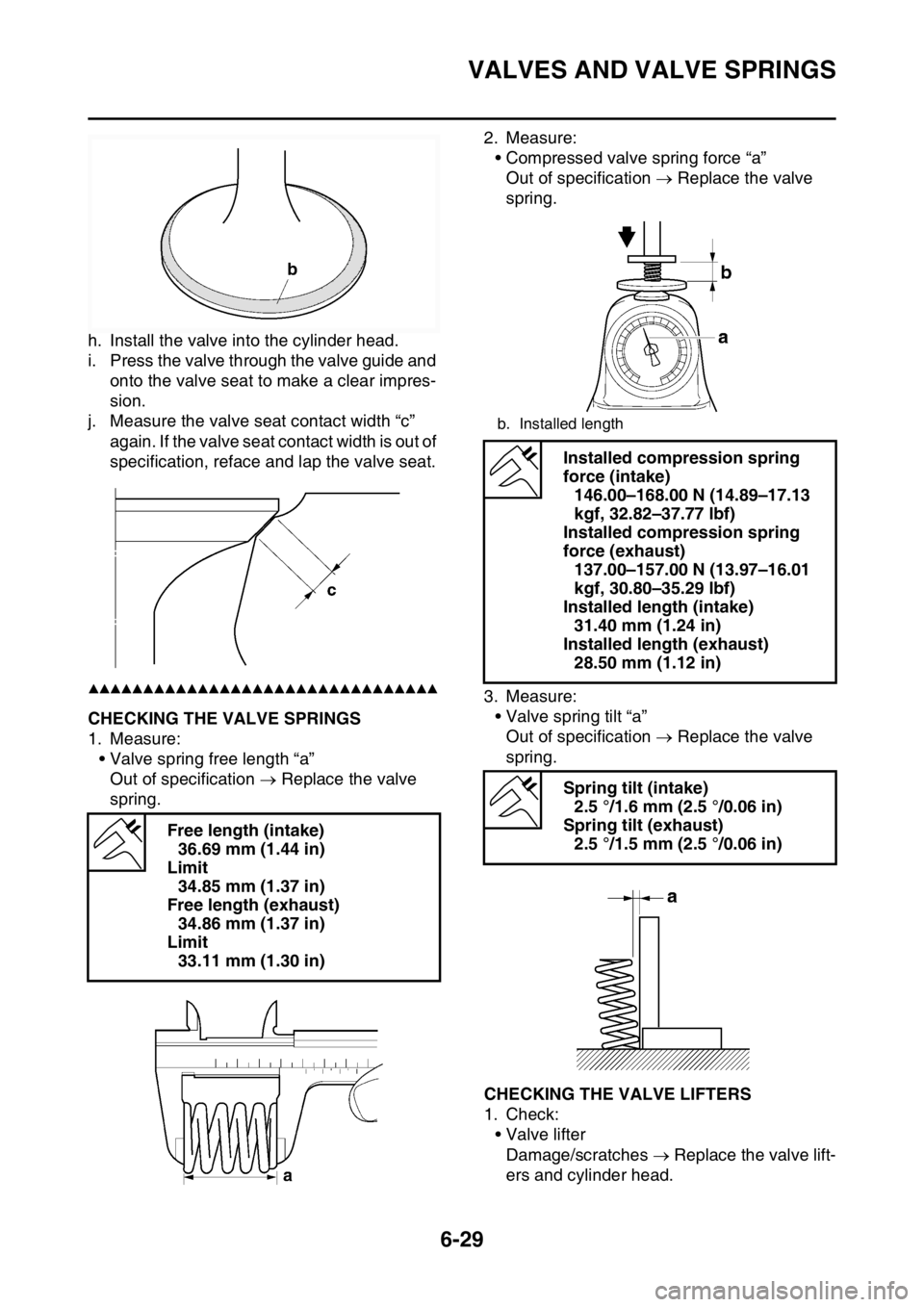
VALVES AND VALVE SPRINGS
6-29
h. Install the valve into the cylinder head.
i. Press the valve through the valve guide and
onto the valve seat to make a clear impres-
sion.
j. Measure the valve seat contact width “c”
again. If the valve seat contact width is out of
specification, reface and lap the valve seat.
▲▲▲▲▲▲▲▲▲▲▲▲▲▲▲▲▲▲▲▲▲▲▲▲▲▲▲▲▲▲▲▲
EAS2GBB253CHECKING THE VALVE SPRINGS
1. Measure:
• Valve spring free length “a”
Out of specification Replace the valve
spring.2. Measure:
• Compressed valve spring force “a”
Out of specification Replace the valve
spring.
3. Measure:
• Valve spring tilt “a”
Out of specification Replace the valve
spring.
EAS2GBB254CHECKING THE VALVE LIFTERS
1. Check:
• Valve lifter
Damage/scratches Replace the valve lift-
ers and cylinder head. Free length (intake)
36.69 mm (1.44 in)
Limit
34.85 mm (1.37 in)
Free length (exhaust)
34.86 mm (1.37 in)
Limit
33.11 mm (1.30 in)
b. Installed length
Installed compression spring
force (intake)
146.00–168.00 N (14.89–17.13
kgf, 32.82–37.77 lbf)
Installed compression spring
force (exhaust)
137.00–157.00 N (13.97–16.01
kgf, 30.80–35.29 lbf)
Installed length (intake)
31.40 mm (1.24 in)
Installed length (exhaust)
28.50 mm (1.12 in)
Spring tilt (intake)
2.5 °/1.6 mm (2.5 °/0.06 in)
Spring tilt (exhaust)
2.5 °/1.5 mm (2.5 °/0.06 in)
Page 268 of 432

ELECTRIC STARTER
6-39
EAS2GBB263CHECKING THE STARTER MOTOR
1. Check:
•Commutator
Dirt Clean with 600 grit sandpaper.
2. Measure:
• Commutator diameter “a”
Out of specification Replace the starter
motor.
3. Measure:
• Mica undercut “a”
Out of specification Scrape the mica to
the proper measurement with a hacksaw
blade that has been grounded to fit the com-
mutator.
TIP
The mica of the commutator must be undercut
to ensure proper operation of the commutator.
4. Measure:
• Armature assembly resistances (commuta-
tor and insulation)
Out of specification Replace the starter
motor.
▼▼▼▼▼▼▼▼▼▼▼▼▼▼▼▼▼▼▼▼▼▼▼▼▼▼▼▼▼▼▼▼
a. Measure the armature assembly resistanc-
es with the pocket tester.b. If any resistance is out of specification, re-
place the starter motor.
▲▲▲▲▲▲▲▲▲▲▲▲▲▲▲▲▲▲▲▲▲▲▲▲▲▲▲▲▲▲▲▲
5. Measure:
• Brush length “a”
Out of specification Replace the brush
set.
6. Measure:
• Brush spring force
Out of specification Replace the brush
set.
7. Check:
• Gear teeth
Damage/wear Replace the starter motor. Limit
16.6 mm (0.65 in)
Mica undercut (depth)
1.50 mm (0.06 in)
Pocket tester
90890-03112
Analog pocket tester
YU-03112-C
Armature coil
Commutator resistance “1”
0.0189–0.0231
Insulation resistance “2”
Above 1 M
Limit
3.50 mm (0.14 in)
Brush spring force
3.92–5.88 N (400–600 gf, 14.11–
21.17 oz)
Page 274 of 432

CLUTCH
6-45
EAS2GBB266REMOVING THE CLUTCH
1. Remove:
• Clutch boss nut “1”
• Lock washer “2”
• Clutch boss “3”
TIP
• Straighten the lock washer tab.
• While holding the clutch boss with the clutch
holder “4”, loosen the clutch boss nut.
EAS2GBB267CHECKING THE FRICTION PLATES
1. Check:
• Friction plate
Damage/wear Replace the friction plates
as a set.
2. Measure:
• Friction plate thickness
Out of specification Replace the friction
plates as a set.
TIP
Measure it at four points on the friction plate.
EAS2GBB268CHECKING THE CLUTCH PLATES
1. Check:
• Clutch plate
Damage Replace the clutch plates as a
set.
2. Measure:
• Clutch plate warpage
(with a surface plate and thickness gauge
“1”)
Out of specification Replace the clutch
plates as a set.
EAS2GBB269CHECKING THE CLUTCH SPRINGS
1. Check:
• Clutch spring
Damage Replace the clutch springs as a
set.
2. Measure:
• Clutch spring free length
Out of specification Replace the clutch
springs as a set. Universal clutch holder
90890-04086
Universal clutch holder
YM-91042
Friction plate thickness
2.90–3.10 mm (0.114–0.122 in)
Wear limit
2.85 mm (0.112 in)
34
12
Warpage limit
0.10 mm (0.004 in)
Clutch spring free length
47.80 mm (1.88 in)
Limit
45.41 mm (1.79 in)