Page 119 of 172
8-20
8
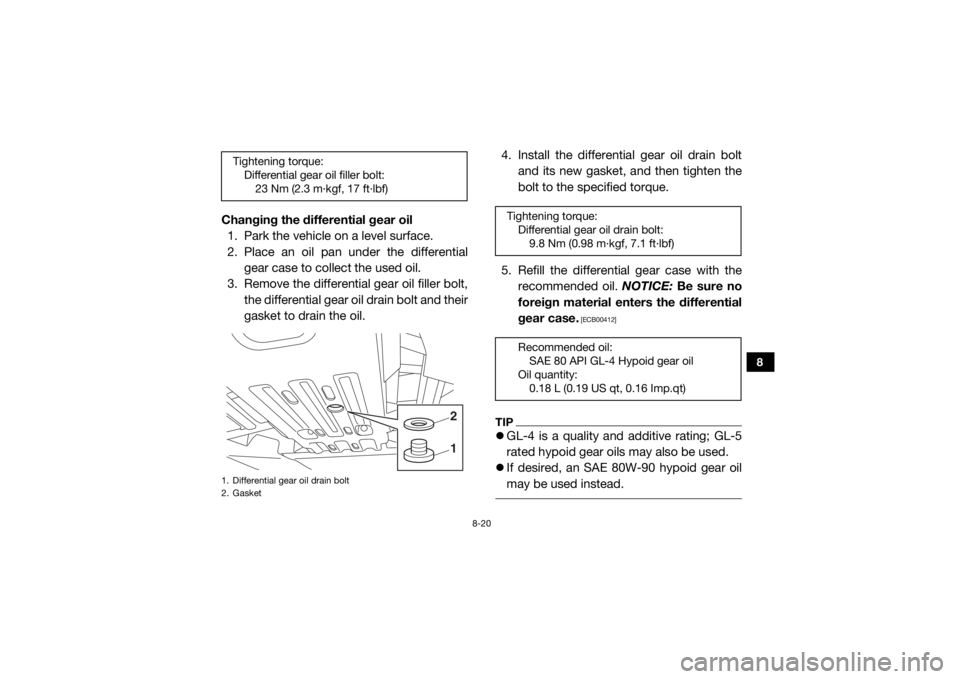
Changing the differential gear oil1. Park the vehicle on a level surface.
2. Place an oil pan under the differential
gear case to collect the used oil.
3. Remove the differential gear oil filler bolt,
the differential gear oil drain bolt and their
gasket to drain the oil. 4. Install the differential gear oil drain bolt
and its new gasket, and then tighten the
bolt to the specified torque.
5. Refill the differential gear case with the recommended oil. NOTICE: Be sure no
foreign material enters the differential
gear case.
[ECB00412]
TIP GL-4 is a quality and additive rating; GL-5
rated hypoid gear oils may also be used.
If desired, an SAE 80W-90 hypoid gear oil
may be used instead.
Tightening torque:
Differential gear oil filler bolt:23 Nm (2.3 m·kgf, 17 ft·lbf)1. Differential gear oil drain bolt
2. Gasket
12
Tightening torque: Differential gear oil drain bolt:9.8 Nm (0.98 m·kgf, 7.1 ft·lbf)
Recommended oil: SAE 80 API GL-4 Hypoid gear oil
Oil quantity: 0.18 L (0.19 US qt, 0.16 Imp.qt)
UB427BE0.book Page 20 Friday, February 5, 2016 2:14 PM
Page 120 of 172
8-21
8
6. Check the oil filler bolt gasket for dam-age, and replace it if necessary.
7. Install the differential gear oil filler bolt and its gasket, and then tighten the bolt
to the specified torque.
8. Check for oil leakage. If oil leakage is found, check for the cause.EBU32990CoolantThe coolant level should be checked before
each ride.
Checking the coolant level
1. Park the vehicle on a level surface.
2. Check the coolant level in the coolant reservoir when the engine is cold as the
coolant level varies with engine tempera-
ture.
TIPThe coolant should be between the minimum
and maximum level marks. 3. If the coolant is at or below the minimumlevel mark, remove the coolant reservoir
cap, add coolant to the maximum level
mark, install the reservoir cap.
Tightening torque:Differential gear oil filler bolt:23 Nm (2.3 m·kgf, 17 ft·lbf)
1. Coolant reservoir cap
2. Maximum level mark
3. Minimum level mark
123
UB427BE0.book Page 21 Friday, February 5, 2016 2:14 PM
Page 123 of 172
8-24
8
Inspection
The spark plug is an important engine com-
ponent and is easy to inspect. The condition
of the spark plug can indicate the condition of
the engine.
The ideal color of the porcelain insulator
around the center electrode is a medium-to-
light tan for a vehicle that is being ridden nor-
mally.
You should periodically remove and inspect
the spark plug because heat and deposits will
cause the spark plug to slowly break down
and erode. If electrode erosion becomes ex-
cessive, or if carbon and other deposits are
excessive, you should replace the spark plug
with the specified plug.
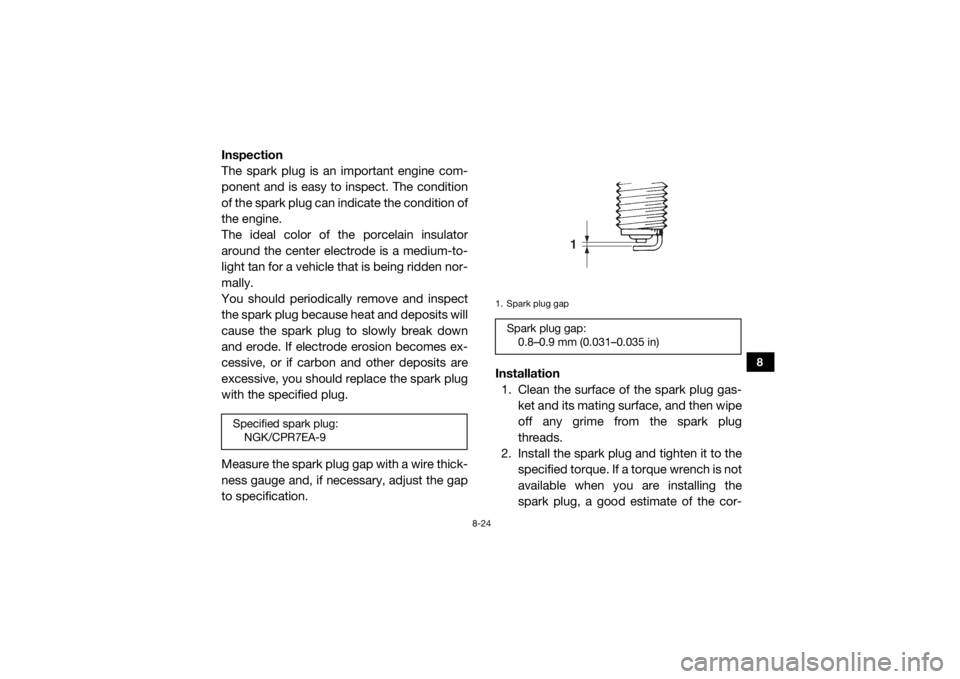
Measure the spark plug gap with a wire thick-
ness gauge and, if necessary, adjust the gap
to specification.Installation
1. Clean the surface of the spark plug gas- ket and its mating surface, and then wipe
off any grime from the spark plug
threads.
2. Install the spark plug and tighten it to the
specified torque. If a torque wrench is not
available when you are installing the
spark plug, a good estimate of the cor-Specified spark plug:NGK/CPR7EA-9
1. Spark plug gapSpark plug gap:0.8–0.9 mm (0.031–0.035 in)
1
UB427BE0.book Page 24 Friday, February 5, 2016 2:14 PM
Page 124 of 172
8-25
8
rect torque is one-quarter to one-half turn
past finger tight. Have the spark plug
tightened to the specified torque as soon
as possible.
3. Install the spark plug cap.
4. Lower the cargo bed.
EBU34811Cleaning the air filter elementThe air filter element should be cleaned every
20–40 hours. It should be cleaned and lubri-
cated more often if the vehicle is operated in
extremely dusty areas. Each time air filter ele-
ment maintenance is performed, check the air
inlet to the air filter case for obstructions. Check the air filter element rubber joint to the
throttle body and manifold fittings for an air-
tight seal. Tighten all fittings securely to avoid
the possibility of unfiltered air entering the en-
gine.
NOTICEECB02270Never operate the engine with the air filter
element removed. Doing so would allow
unfiltered air to enter, causing rapid en-
gine wear and possible engine damage.
Additionally, the fuel injection system
would be affected, resulting in poor engine
performance and possible overheating. 1. Remove the center passenger seat cush-
ion. (See page 4-15 for seat cushion re-
moval and installation procedures.)
2. Lift up the rubber damper, and then re- move the center passenger seat by re-
moving the bolts.
Tightening torque:Spark plug:13 Nm (1.3 m·kgf, 9.4 ft·lbf)
UB427BE0.book Page 25 Friday, February 5, 2016 2:14 PM
Page 129 of 172
8-30
8
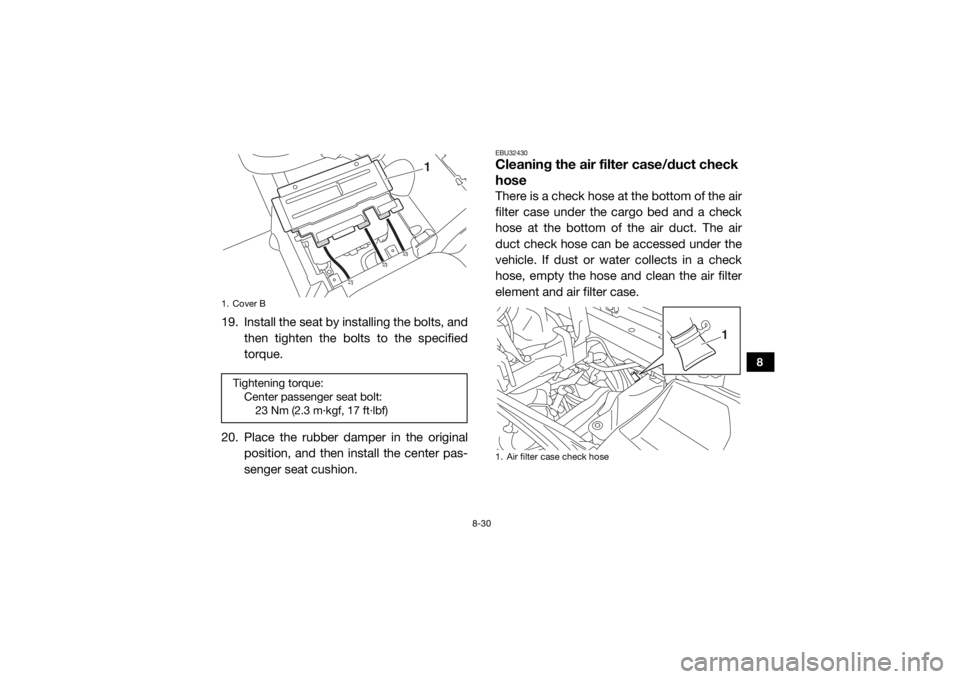
19. Install the seat by installing the bolts, andthen tighten the bolts to the specified
torque.
20. Place the rubber damper in the original position, and then install the center pas-
senger seat cushion.
EBU32430Cleaning the air filter case/duct check
hoseThere is a check hose at the bottom of the air
filter case under the cargo bed and a check
hose at the bottom of the air duct. The air
duct check hose can be accessed under the
vehicle. If dust or water collects in a check
hose, empty the hose and clean the air filter
element and air filter case.
1. Cover BTightening torque:Center passenger seat bolt:23 Nm (2.3 m·kgf, 17 ft·lbf)
1
1. Air filter case check hose
1
UB427BE0.book Page 30 Friday, February 5, 2016 2:14 PM
Page 131 of 172
8-32
8
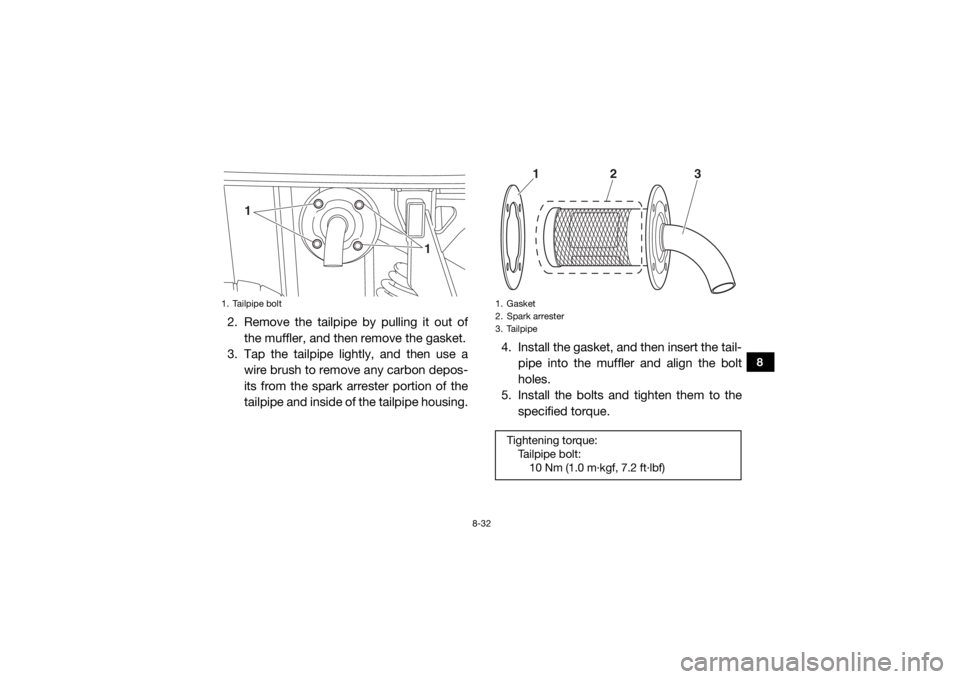
2. Remove the tailpipe by pulling it out ofthe muffler, and then remove the gasket.
3. Tap the tailpipe lightly, and then use a
wire brush to remove any carbon depos-
its from the spark arrester portion of the
tailpipe and inside of the tailpipe housing. 4. Install the gasket, and then insert the tail-
pipe into the muffler and align the bolt
holes.
5. Install the bolts and tighten them to the
specified torque.1. Tailpipe bolt
1
1
1. Gasket
2. Spark arrester
3. TailpipeTightening torque:
Tailpipe bolt:10 Nm (1.0 m·kgf, 7.2 ft·lbf)
3
2
1
UB427BE0.book Page 32 Friday, February 5, 2016 2:14 PM
Page 141 of 172
8-42
8
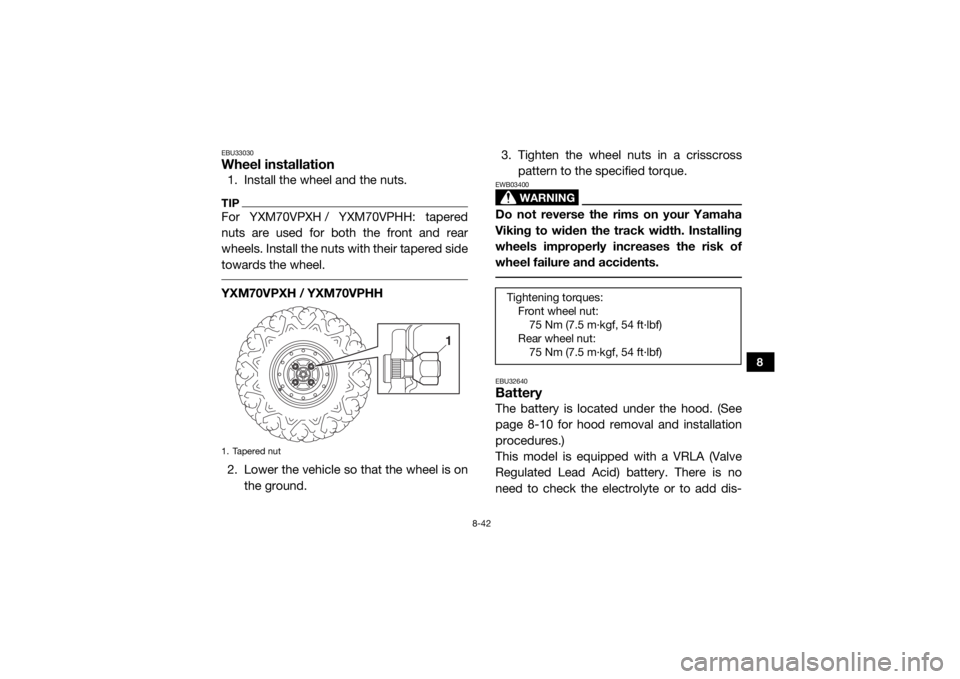
EBU33030Wheel installation1. Install the wheel and the nuts.TIPFor YXM70VPXH / YXM70VPHH: tapered
nuts are used for both the front and rear
wheels. Install the nuts with their tapered side
towards the wheel. YXM70VPXH / YXM70VPHH2. Lower the vehicle so that the wheel is on the ground. 3. Tighten the wheel nuts in a crisscross
pattern to the specified torque.
WARNING
EWB03400Do not reverse the rims on your Yamaha
Viking to widen the track width. Installing
wheels improperly increases the risk of
wheel failure and accidents. EBU32640BatteryThe battery is located under the hood. (See
page 8-10 for hood removal and installation
procedures.)
This model is equipped with a VRLA (Valve
Regulated Lead Acid) battery. There is no
need to check the electrolyte or to add dis-
1. Tapered nut
1
Tightening torques:Front wheel nut:75 Nm (7.5 m·kgf, 54 ft·lbf)
Rear wheel nut: 75 Nm (7.5 m·kgf, 54 ft·lbf)
UB427BE0.book Page 42 Friday, February 5, 2016 2:14 PM
Page 153 of 172

8-54
8
2. Remove the tail/brake light bulb holder(together with the bulb) by turning it
counterclockwise.
3. Push the burnt-out bulb in and turn it counterclockwise to remove it from the
bulb holder.
4. Push a new bulb in and turn it clockwise to install in the bulb holder.
5. Install the bulb holder (together with the
bulb) by turning it clockwise.
6. Install the panel. 7. Install the quick fastener screws, bolts,
and nuts, and then tighten the panel nuts
and the panel rear bolt to the specified
torques.
EBU32700TroubleshootingAlthough Yamaha vehicles receive an inspec-
tion before shipment from the factory, trouble
may occur during operation. Any problem in
the fuel, compression, or ignition systems can
cause poor starting and loss of power. The
troubleshooting chart describes a quick, easy
procedure for making checks. If your vehicle
requires any repair, take it to a Yamaha deal-
er.
1. Tail/brake light bulb holder
1
Tightening torques:Panel nut:7 Nm (0.7 m·kgf, 5.1 ft·lbf)
Panel rear bolt: 4.0 Nm (0.40 m·kgf, 2.9 ft·lbf)
UB427BE0.book Page 54 Friday, February 5, 2016 2:14 PM