2017 YAMAHA SUPERJET start
[x] Cancel search: startPage 3 of 78
Important manual information
EJU3008E
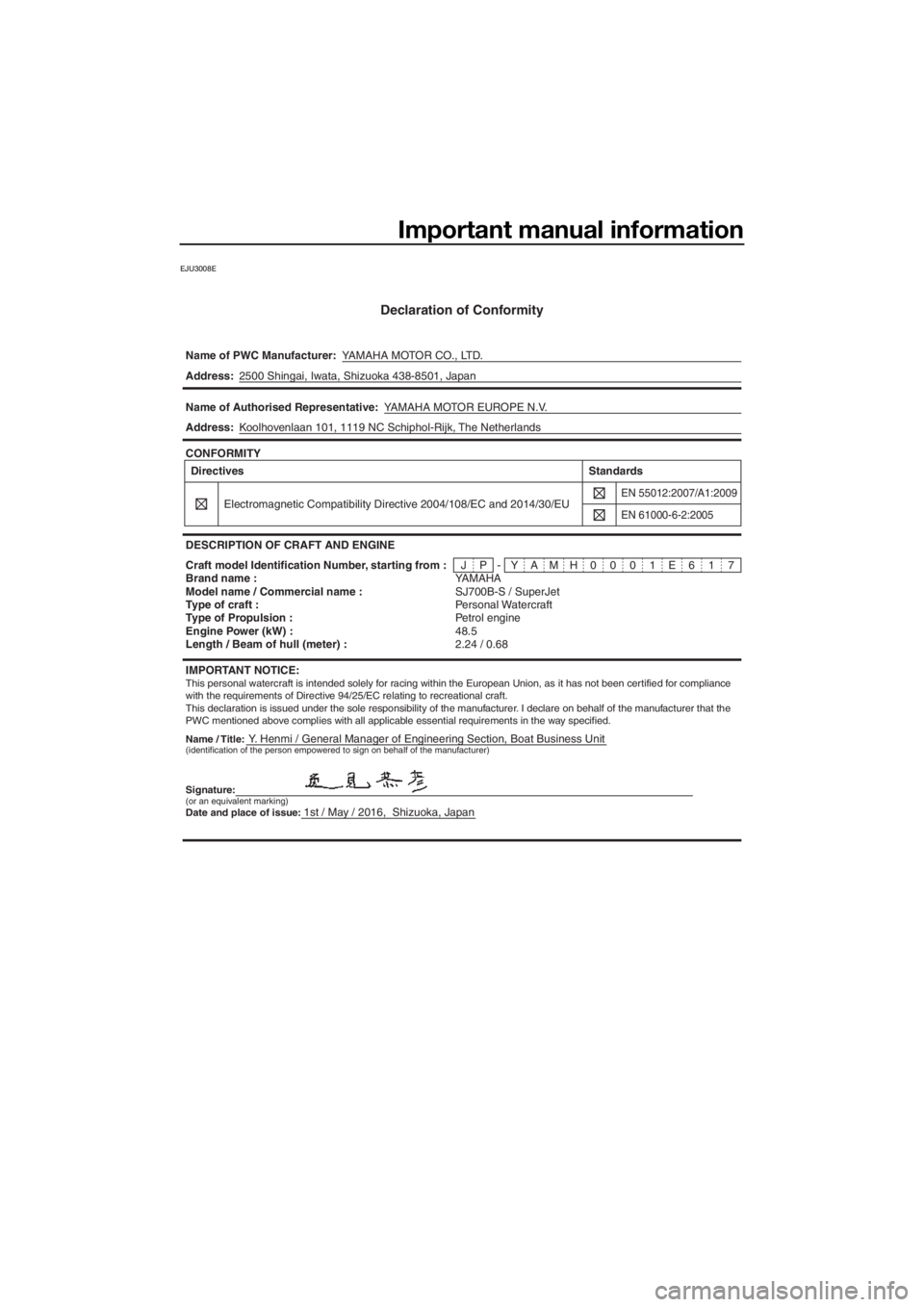
Declaration of Conformity
Name of PWC Manufacturer:YAMAHA MOTOR CO., LTD.
Name / Title:Y. Henmi / General Manager of Engineering Section, Boat Business Unit Address:2500 Shingai, Iwata, Shizuoka 438-8501, Japan
Name of Authorised Representative:YAMAHA MOTOR EUROPE N.V.
Address:Koolhovenlaan 101, 1119 NC Schiphol-Rijk, The Netherlands
JP-YAMH0001E617 CONFORMITY
DESCRIPTION OF CRAFT AND ENGINE
Craft model Identification Number, starting from :
YAMAHA Brand name :
SJ700B-S / SuperJet Model name / Commercial name :
Personal Watercraft Type of craft :
Petrol engine Type of Propulsion :
48.5 Engine Power (kW) :
2.24 / 0.68 Length / Beam of hull (meter) :Directives
Electromagnetic Compatibility Directive 2004/108/EC and 2014/30/EU
EN 55012:2007/A1:2009
Standards
EN 61000-6-2:2005
IMPORTANT NOTICE:This personal watercraft is intended solely for racing within the European Union, as it has not been certified for compliance
with the requirements of Directive 94/25/EC relating to recreational craft.
This declaration is issued under the sole responsibility of the manufacturer. I declare on behalf of the manufacturer that the
PWC mentioned above complies with all applicable essential requirements in the way specified.
(identification of the person empowered to sign on behalf of the manufacturer)
Signature:(or an equivalent marking)Date and place of issue:1st / May / 2016, Shizuoka, Japan
UF4D73E0.book Page 1 Wednesday, March 23, 2016 11:40 AM
Page 5 of 78

Table of contents
General and important labels ........... 1
Identification numbers .................... 1
Primary Identification (PRI-ID)
number............................................ 1
Craft Identification Number (CIN) ....... 1
Engine serial number.......................... 1
Manufactured date label .................... 2
Important labels .............................. 3
Warning labels.................................... 4
Other labels ........................................ 7
Safety information ............................. 8
Limitations on who may operate
the watercraft ............................... 8
Cruising limitations .......................... 9
Operation requirements ................ 10
Recommended equipment ........... 12
Hazard information........................ 13
Watercraft characteristics ............. 13
Safe boating rules ......................... 14
Enjoy your watercraft
responsibly ................................. 15
Description....................................... 16
Watercraft glossary ....................... 16
Location of main components ...... 17
Control function operation ............. 19
Watercraft control functions ......... 19
Engine stop switch .......................... 19
Engine shut-off switch .................... 19
Start switch ..................................... 19
Throttle lever .................................... 20
Steering system ............................... 20
Steering pole .................................... 20
Fuel cock knob................................. 21
Choke knob ..................................... 21
Cooling water pilot outlet ................. 21
Water separator................................ 22
Engine overheat warning system ..... 22
Equipment operation ...................... 24
Equipment..................................... 24
Hood................................................. 24
Bow rope hole .................................. 25
Stern rope hole ................................. 25
Storage pouch .................................. 25
Fire extinguisher container ............... 26
Operation and handling
requirements ................................... 28
Fuel and engine oil
requirements .............................. 28
Fuel................................................... 28
2-stroke engine oil ............................ 28
Mixing fuel and oil ............................ 28
Filling the fuel tank ........................... 29
Draining the bilge water ................ 30
Draining the bilge water on water .... 30
Transporting.................................. 31
First-time operation ........................ 32
Engine break-in............................. 32
Pre-operation checks ..................... 33
Pre-operation checklist .................... 33
Pre-operation check points .......... 35
Pre-launch checks ........................... 35
Post-launch checks.......................... 39
Operation ......................................... 40
Operating your watercraft ............. 40
Getting to know your watercraft....... 40
Learning to operate your
watercraft ...................................... 40
Operating positions .......................... 40
Launching the watercraft ................. 41
Starting the engine on water ............ 41
Stopping the engine ......................... 43
Leaving the watercraft ...................... 43
Operating the watercraft .................. 43
Turning the watercraft ...................... 43
Stopping the watercraft.................... 45
Starting off........................................ 45
UF4D73E0.book Page 1 Wednesday, March 23, 2016 11:40 AM
Page 15 of 78
Safety information
9
EJU30762
Cruising limitations
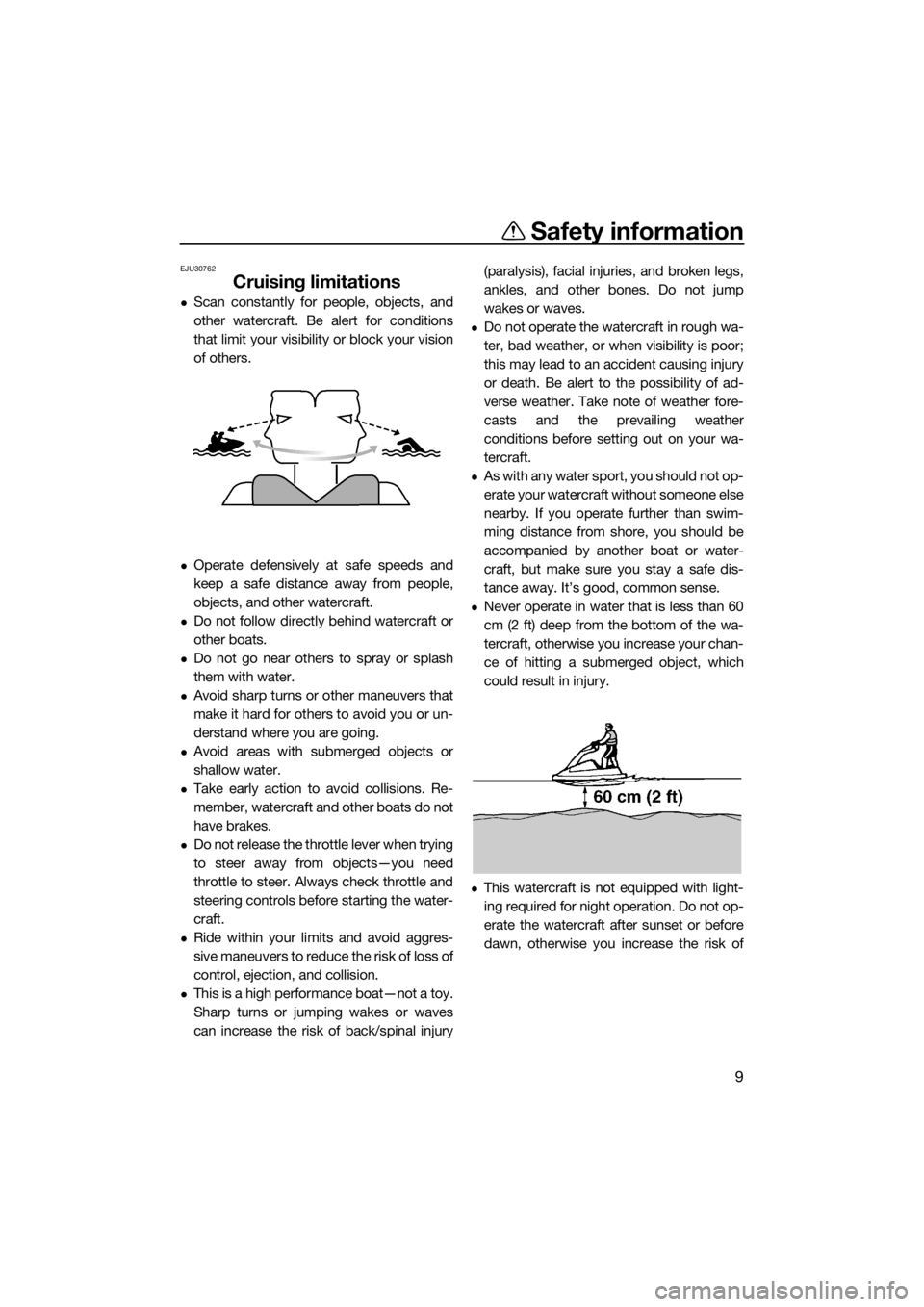
Scan constantly for people, objects, and
other watercraft. Be alert for conditions
that limit your visibility or block your vision
of others.
Operate defensively at safe speeds and
keep a safe distance away from people,
objects, and other watercraft.
Do not follow directly behind watercraft or
other boats.
Do not go near others to spray or splash
them with water.
Avoid sharp turns or other maneuvers that
make it hard for others to avoid you or un-
derstand where you are going.
Avoid areas with submerged objects or
shallow water.
Take early action to avoid collisions. Re-
member, watercraft and other boats do not
have brakes.
Do not release the throttle lever when trying
to steer away from objects—you need
throttle to steer. Always check throttle and
steering controls before starting the water-
craft.
Ride within your limits and avoid aggres-
sive maneuvers to reduce the risk of loss of
control, ejection, and collision.
This is a high performance boat—not a toy.
Sharp turns or jumping wakes or waves
can increase the risk of back/spinal injury(paralysis), facial injuries, and broken legs,
ankles, and other bones. Do not jump
wakes or waves.
Do not operate the watercraft in rough wa-
ter, bad weather, or when visibility is poor;
this may lead to an accident causing injury
or death. Be alert to the possibility of ad-
verse weather. Take note of weather fore-
casts and the prevailing weather
conditions before setting out on your wa-
tercraft.
As with any water sport, you should not op-
erate your watercraft without someone else
nearby. If you operate further than swim-
ming distance from shore, you should be
accompanied by another boat or water-
craft, but make sure you stay a safe dis-
tance away. It’s good, common sense.
Never operate in water that is less than 60
cm (2 ft) deep from the bottom of the wa-
tercraft, otherwise you increase your chan-
ce of hitting a submerged object, which
could result in injury.
This watercraft is not equipped with light-
ing required for night operation. Do not op-
erate the watercraft after sunset or before
dawn, otherwise you increase the risk of
UF4D73E0.book Page 9 Wednesday, March 23, 2016 11:40 AM
Page 17 of 78

Safety information
11
in certain kinds of accidents and that it
could injure you in others.
A helmet is designed to provide some head
protection. Although helmets cannot pro-
tect against all foreseeable impacts, a hel-
met might reduce your injuries in a collision
with a boat or other obstacle.
A helmet may have potential safety haz-
ards, as well. Falling into the water could
risk the chance of the helmet catching wa-
ter, commonly known as “bucketing”, and
the resulting strain on your neck could cau-
se choking, severe and permanent neck in-
juries, or death. A helmet could also
increase the risk of an accident if it reduces
your vision or hearing, or if it distracts you
or increases your fatigue.
How should you decide if a helmet’s poten-
tial safety benefits outweigh its potential
risks for you? Consider your particular rid-
ing conditions. Consider factors such as
your riding environment and your riding
style and ability. Also consider the likeli-
hood of traffic congestion, and the water
surface conditions.
If you decide to wear a helmet based upon
your riding circumstances, choose one
carefully. Look for a helmet designed for
personal watercraft use, if possible. If you
will be engaging in closed-course competi-
tion, follow the helmet requirements of the
sanctioning organization.
Never operate the watercraft after consum-
ing alcohol or taking other drugs.
For reasons of safety and proper care of
the watercraft, always perform the pre-op-
eration checks listed on page 33 before op-
erating the watercraft.
The operator should always keep both feet
or knees on the riding tray when the water-
craft is in motion. Lifting your feet increasesthe chances of losing your balance or hit-
ting objects outside the watercraft with
your feet.
Always consult your doctor on whether it is
safe for you to operate this watercraft if you
are pregnant or in poor health.
Do not attempt to modify this watercraft.
Modifications to your watercraft may re-
duce safety and reliability, and render the
watercraft unsafe or illegal for use.
Attach the engine shut-off cord (lanyard) to
y o u r l ef t w r is t an d k ee p i t fr e e f r o m t h e h an -
dlebars so that the engine stops if you, the
operator, fall off. After riding, remove the
engine shut-off cord (lanyard) from the wa-
tercraft to avoid accidental starting or un-
authorized use by children or others.
Scan carefully for swimmers, and stay
away from swimming areas. Swimmers are
hard to see and you could accidentally hit
someone in the water.
UF4D73E0.book Page 11 Wednesday, March 23, 2016 11:40 AM
Page 19 of 78
Safety information
13
EJU30851
Hazard information
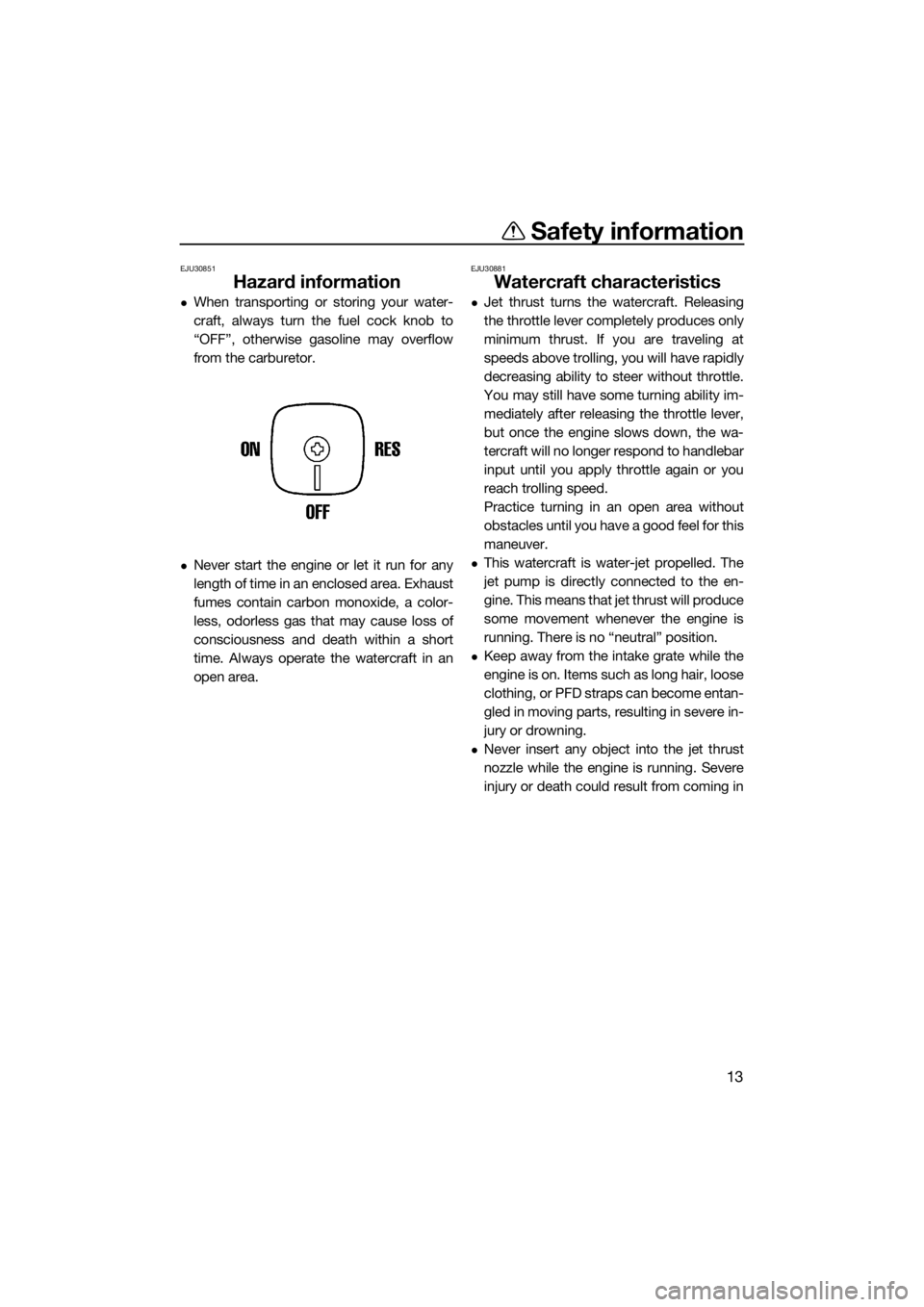
When transporting or storing your water-
craft, always turn the fuel cock knob to
“OFF”, otherwise gasoline may overflow
from the carburetor.
Never start the engine or let it run for any
length of time in an enclosed area. Exhaust
fumes contain carbon monoxide, a color-
less, odorless gas that may cause loss of
consciousness and death within a short
time. Always operate the watercraft in an
open area.
EJU30881
Watercraft characteristics
Jet thrust turns the watercraft. Releasing
the throttle lever completely produces only
minimum thrust. If you are traveling at
speeds above trolling, you will have rapidly
decreasing ability to steer without throttle.
You may still have some turning ability im-
mediately after releasing the throttle lever,
but once the engine slows down, the wa-
tercraft will no longer respond to handlebar
input until you apply throttle again or you
reach trolling speed.
Practice turning in an open area without
obstacles until you have a good feel for this
maneuver.
This watercraft is water-jet propelled. The
jet pump is directly connected to the en-
gine. This means that jet thrust will produce
some movement whenever the engine is
running. There is no “neutral” position.
Keep away from the intake grate while the
engine is on. Items such as long hair, loose
clothing, or PFD straps can become entan-
gled in moving parts, resulting in severe in-
jury or drowning.
Never insert any object into the jet thrust
nozzle while the engine is running. Severe
injury or death could result from coming in
UF4D73E0.book Page 13 Wednesday, March 23, 2016 11:40 AM
Page 24 of 78

Description
18
1Fire extinguisher container
2Fuel cock knob
3Choke knob
4Clip
5Start switch
6Throttle lever
7Engine shut-off cord (lanyard)
8Engine stop switch
9Engine shut-off switch
10Fuel tank
11Battery
12Silencer
13Spark plug/Spark plug cap
14Water separator
15Muffler
16Fuel filter
17Flushing hose connector
18Electrical box
UF4D73E0.book Page 18 Wednesday, March 23, 2016 11:40 AM
Page 25 of 78

Control function operation
19
EJU31026
Watercraft control functionsEJU31153Engine stop switch “ ”
The engine stop switch (red button) stops the
engine when the switch is pushed.
EJU31164Engine shut-off switch “ ”
The engine shut-off switch automatically
stops the engine when the clip, on the end of
the engine shut-off cord (lanyard), is removed
from the switch, such as if the operator falls
off the watercraft.
Insert the clip under the engine shut-off
switch before starting the engine.
When the engine is not running, remove the
clip from the engine shut-off switch to pre-vent accidental starting or unauthorized op-
eration by children or others.
EJU41051Start switch “ ”
NOTICE
ECJ01361
Do not run the engine for more than 15
seconds on land without supplying water,
otherwise the engine could overheat.
The start switch (green button) starts the en-
gine when the switch is pushed.
Release the start switch as soon as the en-
gine starts to run. If the engine does not start
in 5 seconds, release the start switch, wait 15
seconds, and then try again. NOTICE: Never
push the start switch while the engine is
running. Do not operate the start switch
for more than 5 seconds, otherwise the
battery will be discharged and the engine
1Engine stop switch
1Engine shut-off switch
2Clip
3Engine shut-off cord (lanyard)
1
STOP
312
UF4D73E0.book Page 19 Wednesday, March 23, 2016 11:40 AM
Page 26 of 78
![YAMAHA SUPERJET 2017 Owners Manual Control function operation
20
will not start. Also, the starter motor could
be damaged.
[ECJ01041]
The engine will not start when the clip is re-
moved from the engine shut-off switch.
EJU31212Thrott](/manual-img/51/51268/w960_51268-25.png "YAMAHA SUPERJET 2017 Owners Manual Control function operation
20
will not start. Also, the starter motor could
be damaged.
[ECJ01041]
The engine will not start when the clip is re-
moved from the engine shut-off switch.
EJU31212Thrott")
Control function operation
20
will not start. Also, the starter motor could
be damaged.
[ECJ01041]
The engine will not start when the clip is re-
moved from the engine shut-off switch.
EJU31212Throttle lever
The throttle lever increases the engine speed
when the lever is squeezed.
The throttle lever returns automatically to its
fully closed (idle) position when released.
EJU35933Steering system
By turning the handlebars in the direction you
wish to travel, the angle of the jet thrust noz-zle is changed, and the direction of the water-
craft is changed accordingly.
Since the strength of the jet thrust determines
the speed and degree of a turn, throttle must
always be applied when attempting a turn,
except at trolling speed.
The angle of the jet thrust nozzle can be ad-
justed to suit operator preference. (See page
57 for information on adjusting the jet thrust
nozzle angle.)
EJU31273Steering pole
The steering pole can be moved up or down
to change the height of the handlebars.
1Start switch
1Throttle lever
START
1
1Handlebar
2Jet thrust nozzle
UF4D73E0.book Page 20 Wednesday, March 23, 2016 11:40 AM