2017 YAMAHA SUPERJET fuel
[x] Cancel search: fuelPage 56 of 78
Care and storage
50
EJU41192
Post-operation care
WARNING
EWJ00321
Always turn the fuel cock knob to “OFF”
when storing the watercraft, otherwise
fuel could leak out into the engine or en-
gine compartment, which would create a
fire hazard.
After using the watercraft, always take it out
of the water, clean it, and store it. Leaving the
watercraft in the water for extended periods
will accelerate the rate of normal deteriora-
tion of the jet pump and hull. Marine organ-
isms and corrosion are some of the
conditions that can shorten the life of many
watercraft components.
EJU3351AFlushing the cooling water passages
NOTICE
ECJ01361
Do not run the engine for more than 15
seconds on land without supplying water,
otherwise the engine could overheat.
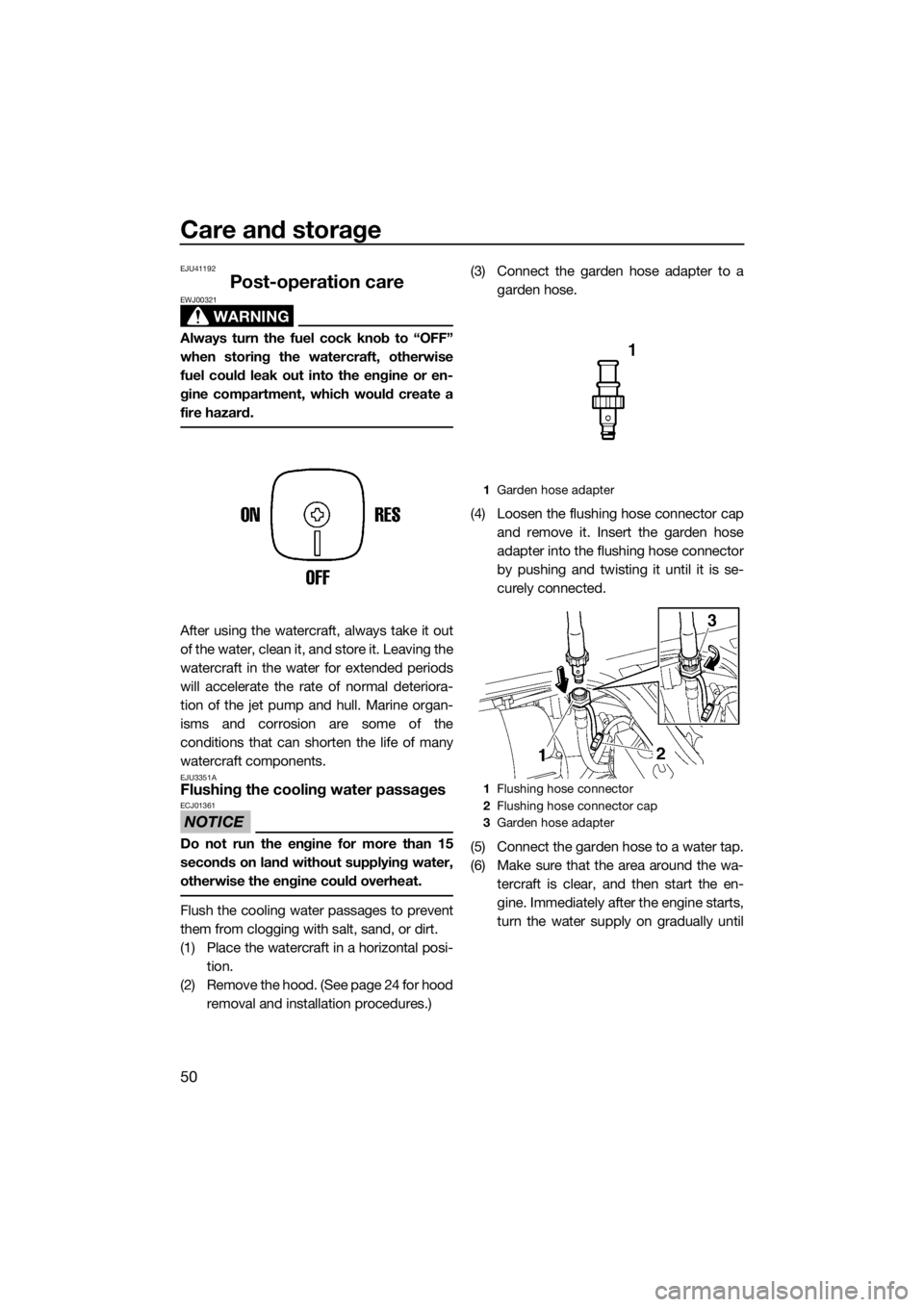
Flush the cooling water passages to prevent
them from clogging with salt, sand, or dirt.
(1) Place the watercraft in a horizontal posi-
tion.
(2) Remove the hood. (See page 24 for hood
removal and installation procedures.)(3) Connect the garden hose adapter to a
garden hose.
(4) Loosen the flushing hose connector cap
and remove it. Insert the garden hose
adapter into the flushing hose connector
by pushing and twisting it until it is se-
curely connected.
(5) Connect the garden hose to a water tap.
(6) Make sure that the area around the wa-
tercraft is clear, and then start the en-
gine. Immediately after the engine starts,
turn the water supply on gradually until
1Garden hose adapter
1Flushing hose connector
2Flushing hose connector cap
3Garden hose adapter
UF4D73E0.book Page 50 Wednesday, March 23, 2016 11:40 AM
Page 60 of 78
Care and storage
54
EJU33484
Long-term storage
WARNING
EWJ00321
Always turn the fuel cock knob to “OFF”
when storing the watercraft, otherwise
fuel could leak out into the engine or en-
gine compartment, which would create a
fire hazard.
Storage for long periods of time, such as win-
ter storage, requires preventive maintenance
to ensure against deterioration. It is advisable
to have the watercraft serviced by a Yamaha
dealer prior to storage.
However, the following procedures can be
performed easily by the owner.
EJU40763Cleaning
(1) Flush the cooling water passages. (See
page 50 for information on flushing the
cooling water passages.)
TIP:
If you will be storing the watercraft for a pro-
longed period, such as winter storage, top off
the fuel tank with fresh gasoline and add fuel
stabilizer and conditioner to the fuel tank ac-
cording to the manufacturer’s instruction be-
fore starting the engine.
(2) Clean the watercraft. (See page 51 for in-
formation on cleaning the watercraft.)
Wax the hull with a non-abrasive wax.
EJU40795Lubrication
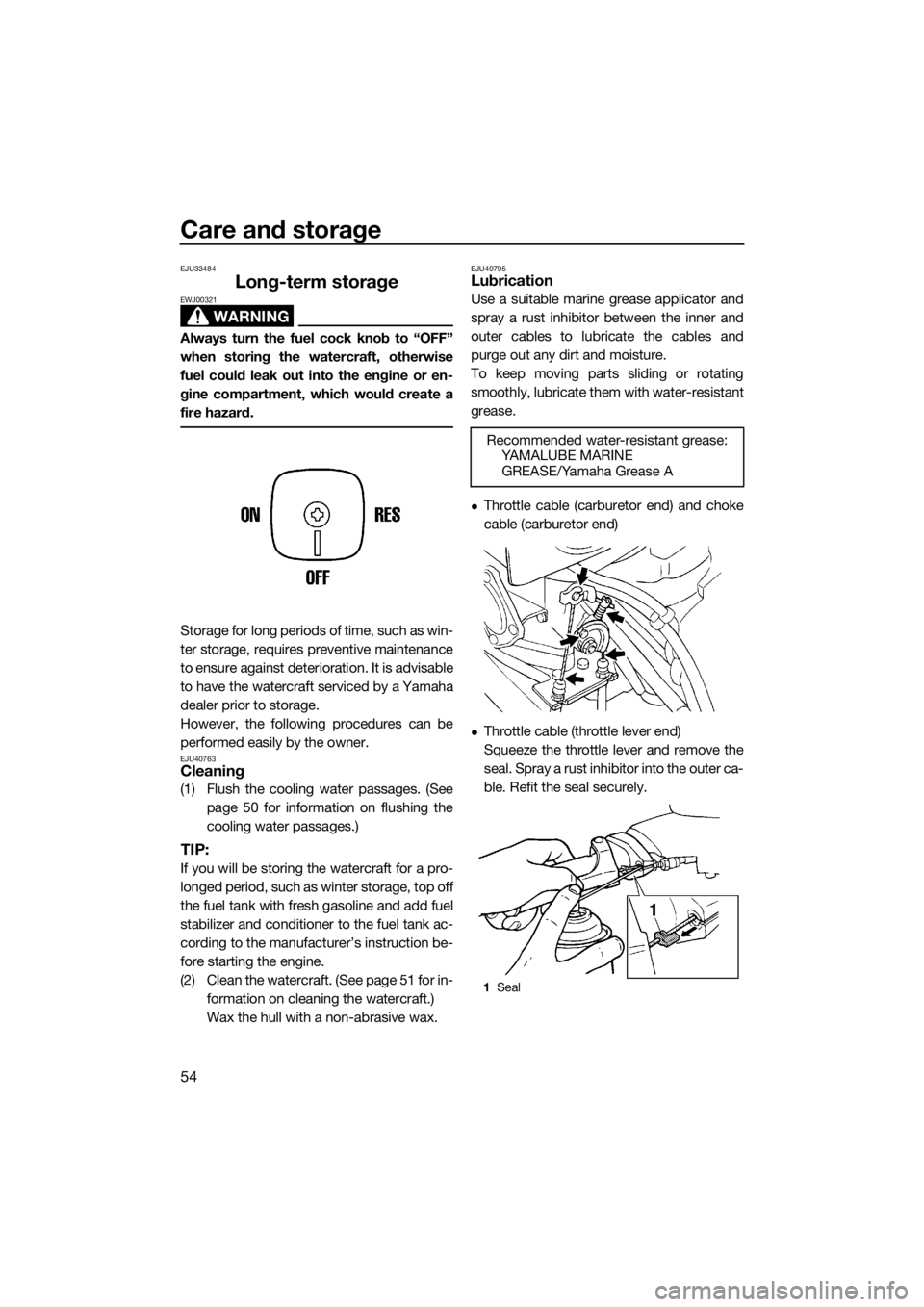
Use a suitable marine grease applicator and
spray a rust inhibitor between the inner and
outer cables to lubricate the cables and
purge out any dirt and moisture.
To keep moving parts sliding or rotating
smoothly, lubricate them with water-resistant
grease.
Throttle cable (carburetor end) and choke
cable (carburetor end)
Throttle cable (throttle lever end)
Squeeze the throttle lever and remove the
seal. Spray a rust inhibitor into the outer ca-
ble. Refit the seal securely.
Recommended water-resistant grease:
YAMALUBE MARINE
GREASE/Yamaha Grease A
1Seal
UF4D73E0.book Page 54 Wednesday, March 23, 2016 11:40 AM
Page 65 of 78

Maintenance
59
EJU40831Periodic maintenance chart
The periodic maintenance chart gives general guidelines for periodic maintenance. Have a
Yamaha dealer perform the checks in the following chart. However, maintenance may need
to be performed more frequently depending on your operating conditions. If you have any
questions, consult a Yamaha dealer.
This “ ” mark indicates maintenance that you may do yourself.
This “ ” mark indicates items to be checked and serviced by a Yamaha dealer.
Item OperationInitial Thereafter every
Page 10
hours50 hours100
hours200
hours
6
months12
months12
months24
months
Spark plugsCheck, clean, replace 60
Lubrication pointsLubricate 54
Intermediate
housingLubricate 61
Fuel systemCheck —
Fuel filterCheck 61
Check, replace —
Fuel tankCheck, clean —
CarburetorCheck, adjust —
Engine idling
speedCheck, adjust 62
Carburetor throttle
shaftCheck —
Bilge strainerClean —
ImpellerCheck —
Jet thrust nozzle
angleCheck, adjust —
Handlebar pivot
shaftCheck, adjust —
Steering frictionCheck, adjust —
Steering masterCheck, adjust —
Throttle cableCheck, adjust —
Choke cableCheck, adjust 61
BatteryCheck, charge —
Rubber couplingCheck —
Engine mountCheck —
Nuts and boltsCheck —
UF4D73E0.book Page 59 Wednesday, March 23, 2016 11:40 AM
Page 67 of 78
Maintenance
61
(4) Install the spark plug cap by pushing it
down until it is securely installed in its
original position.
(5) Securely install the hood in its original
position.
EJU41182Lubrication points
Lubricate moving parts with water-resistant
grease. (See page 54 for information on the
main lubrication points.)
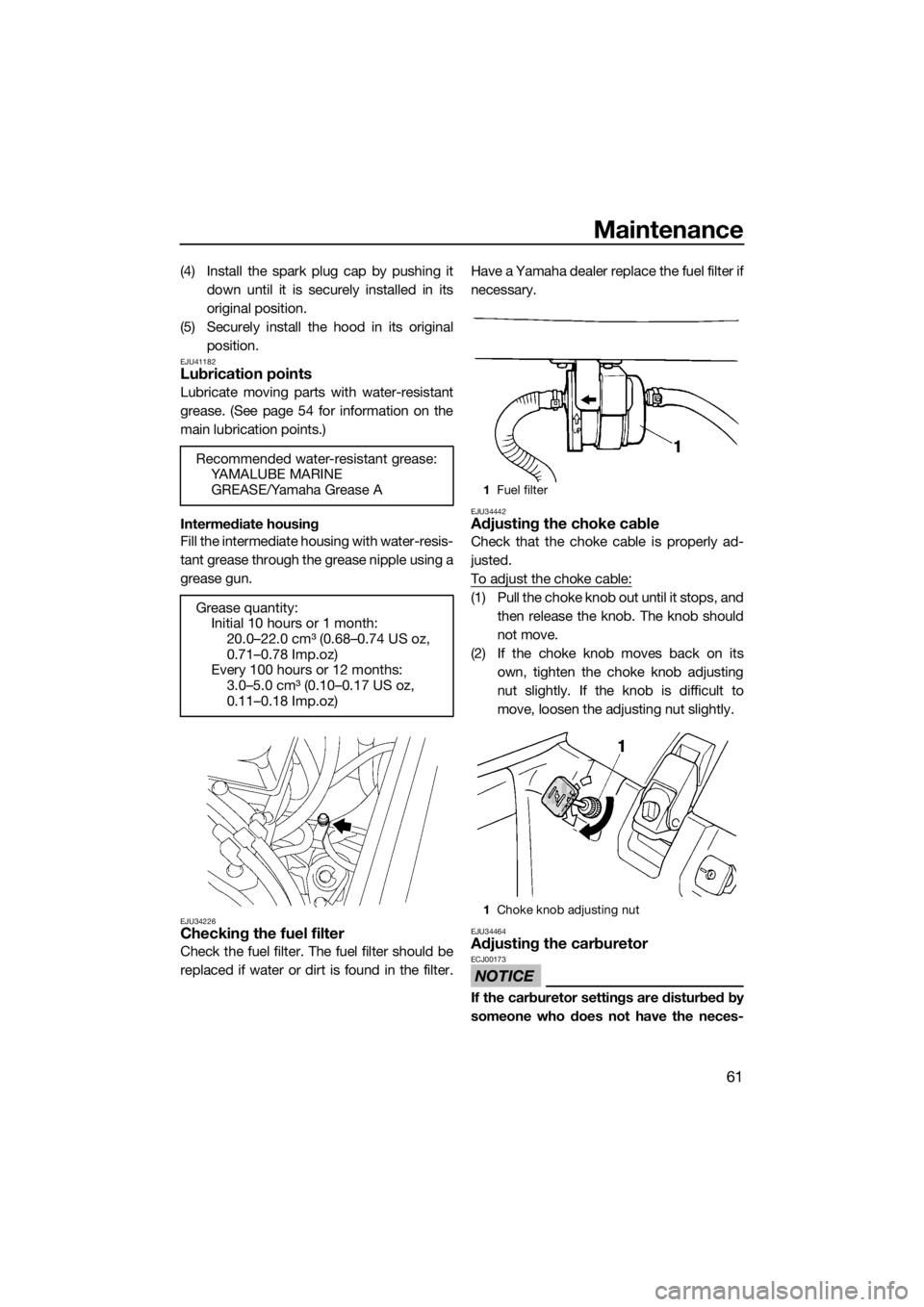
Intermediate housing
Fill the intermediate housing with water-resis-
tant grease through the grease nipple using a
grease gun.
EJU34226Checking the fuel filter
Check the fuel filter. The fuel filter should be
replaced if water or dirt is found in the filter.Have a Yamaha dealer replace the fuel filter if
necessary.
EJU34442Adjusting the choke cable
Check that the choke cable is properly ad-
justed.
To adjust the choke cable:
(1) Pull the choke knob out until it stops, and
then release the knob. The knob should
not move.
(2) If the choke knob moves back on its
own, tighten the choke knob adjusting
nut slightly. If the knob is difficult to
move, loosen the adjusting nut slightly.
EJU34464Adjusting the carburetor
NOTICE
ECJ00173
If the carburetor settings are disturbed by
someone who does not have the neces- Recommended water-resistant grease:
YAMALUBE MARINE
GREASE/Yamaha Grease A
Grease quantity:
Initial 10 hours or 1 month:
20.0–22.0 cm³ (0.68–0.74 US oz,
0.71–0.78 Imp.oz)
Every 100 hours or 12 months:
3.0–5.0 cm³ (0.10–0.17 US oz,
0.11–0.18 Imp.oz)
1Fuel filter
1Choke knob adjusting nut
UF4D73E0.book Page 61 Wednesday, March 23, 2016 11:40 AM
Page 69 of 78

Specifications
63
EJU34543
Specifications
Watercraft capacity:
Maximum people on board:
1 person
Dimensions and weight:
Length:
2240 mm (88.2 in)
Width:
680 mm (26.8 in)
Height:
660 mm (26.0 in)
Dry weight:
139 kg (306 lb)
Performance:
Maximum output (according to ISO 8665/SAE
J1228):
48.5 kW at 6250 r/min
Maximum fuel consumption:
29.0 L/h (7.7 US gal/h, 6.4 Imp.gal/h)
Cruising range at full throttle:
0.62 hour
Trolling speed:
1300 ±50 r/min
Engine:
Engine type:
2-stroke
Number of cylinders:
2
Engine displacement:
701 cm³ (42.8 c.i.)
Bore × stroke:
81.0 × 68.0 mm (3.19 × 2.68 in)
Compression ratio:
7.2 : 1
Lubrication system:
Pre-mixed fuel and oil
Cooling system:
Water
Starting system:
Electric
Ignition system:
C.D.I.
Spark plug (NGK):
BR7HS
Spark plug gap:
0.6–0.7 mm (0.024–0.028 in)
Battery capacity:
12 V, 19 AhCharging system:
Flywheel magneto
Drive unit:
Propulsion system:
Jet pump
Jet pump type:
Axial flow, single stage
Impeller rotation:
Counterclockwise
Jet thrust nozzle angle:
P1: 14.4+14.4°
P2: 17.3+17.3°
Fuel and oil:
Recommended fuel:
Regular unleaded gasoline
Minimum octane rating (PON):
86
Minimum octane rating (RON):
90
Recommended engine oil:
YAMALUBE 2-W or TC-W3 outboard motor
oil or equivalent
Fuel mixing ratio (fuel to oil):
50 : 1
Fuel tank total capacity:
18 L (4.8 US gal, 4.0 Imp.gal)
Fuel tank reserve capacity:
5.5 L (1.5 US gal, 1.2 Imp.gal)
UF4D73E0.book Page 63 Wednesday, March 23, 2016 11:40 AM
Page 70 of 78

Trouble recovery
64
EJU34562
Troubleshooting
If you have any trouble with your watercraft, use the troubleshooting chart to check for the
possible cause.
If you cannot find the cause, consult a Yamaha dealer.
EJU34576Troubleshooting chart
TROUBLE POSSIBLE CAUSE REMEDY PAGE
Engine does not
start (Starter motor
does not turn over)Engine shut-
off switchClip not in place Install clip
19
Fuse Burned out Replace fuse and
check wiring67
Battery Run down Recharge 51
Poor terminal con-
nectionsTighten as required
51
Terminal corroded Clean or replace 51
Starter motor Faulty Have serviced by
Yamaha dealer—
Engine does not
start (Starter motor
turns over)Fuel cock Turned to “OFF” Turn fuel cock knob
to “ON”21
Fuel Empty Refill as soon as pos-
sible29
Stale or contaminat-
edHave serviced by
Yamaha dealer—
Fuel tank Water or dirt present Have serviced by
Yamaha dealer—
Spark plug Fouled or defective Replace 60
Spark plug
capNot connected or
looseConnect properly
60
Crankcase Filled with water Have serviced by
Yamaha dealer69
Fuel filter Clogged or water
pooledHave serviced by
Yamaha dealer61
Choke Knob moves back on
its ownTighten choke knob
adjusting nut61
UF4D73E0.book Page 64 Wednesday, March 23, 2016 11:40 AM
Page 71 of 78

Trouble recovery
65
Engine runs irregu-
larly or stallsFuel Empty Refill as soon as pos-
sible29
Stale or contaminat-
edHave serviced by
Yamaha dealer—
Too much oil in fuel
mixing ratioCorrect fuel-to-oil ra-
tio to 50:128
Choke Knob is left pulled Push fully in 21
Fuel filter Clogged or water
pooledHave serviced by
Yamaha dealer61
Fuel tank Water or dirt present Have serviced by
Yamaha dealer—
Spark plug Fouled or defective Replace 60
Incorrect heat range Replace 60
Gap incorrect Replace 60
Spark plug
capNot connected or
looseConnect properly
60
Cracked, torn or
damagedHave serviced by
Yamaha dealer—
Electrical wir-
ingLoose electrical con-
nectionsHave serviced by
Yamaha dealer—
Carburetor Incorrect idle adjust-
mentHave serviced by
Yamaha dealer—
Clogged Have serviced by
Yamaha dealer61
Watercraft slow or
loses powerCavitation Jet intake clogged Clean 66
Impeller damaged or
wornHave serviced by
Yamaha dealer66
Engine over-
heatedJet intake clogged Clean
66
Fuel filter Clogged Have serviced by
Yamaha dealer61
Spark plug Fouled or defective Replace 60
Incorrect heat range Replace 60
Gap incorrect Replace 60
Spark plug
capsNot connected or
looseConnect properly
60
Fuel Stale or contaminat-
edHave serviced by
Yamaha dealer— TROUBLE POSSIBLE CAUSE REMEDY PAGE
UF4D73E0.book Page 65 Wednesday, March 23, 2016 11:40 AM
Page 75 of 78

Trouble recovery
69
EJU34735Submerged watercraft
If the watercraft is submerged or flooded with
water, drain the bilge water from the engine
compartment. Then, have a Yamaha dealer
service the watercraft as soon as possible.
(1) Remove the watercraft from the water,
and then remove the hood.
(2) Turn the fuel cock knob to “OFF”.
(3) Turn the watercraft over far enough to
drain the bilge water from the engine
compartment. NOTICE: Turning the
watercraft on its side with the hood
removed could cause damage to the
steering pole. Use two people to pro-
vide enough support to make sure
that the steering pole is not damaged.
[ECJ00702]
(4) Turn the watercraft upright again.
(5) Have the watercraft serviced by a
Yamaha dealer as soon as possible.
NOTICE: Be sure to have a Yamaha
dealer inspect the watercraft. Other-
wise, serious engine damage could
result.
[ECJ00792]
UF4D73E0.book Page 69 Wednesday, March 23, 2016 11:40 AM