2017 YAMAHA SUPERJET fuel
[x] Cancel search: fuelPage 34 of 78
Operation and handling requirements
28
EJU31793
Fuel and engine oil
requirements
EJU31834Fuel
WARNING
EWJ00283
Gasoline and gasoline vapors are ex-
tremely flammable. To avoid fires and
explosions and to reduce the risk of in-
jury when refueling, follow these in-
structions.
Gasoline is poisonous and can cause in-
jury or death. Handle gasoline with care.
Never siphon gasoline by mouth. If you
should swallow some gasoline, inhale a
lot of gasoline vapor, or get some gaso-
line in your eyes, see your doctor imme-
diately. If gasoline spills on your skin,
wash with soap and water. If gasoline
spills on your clothing, change your
clothes.
NOTICE
ECJ00322
Do not use leaded gasoline. Leaded
gasoline can seriously damage the en-
gine.
Avoid getting water and contaminants in
the fuel tank. Contaminated fuel can
cause poor performance and engine
damage. Use only fresh gasoline that
has been stored in clean containers.
Gasohol
There are two types of gasohol: gasohol con-
taining ethanol and that containing methanol.Gasohol containing ethanol can be used if
ethanol content does not exceed 10% and
the fuel meets the minimum octane ratings.
E-85 is a fuel blend containing 85% ethanol
and therefore must not be used in this water-
craft. All ethanol blends containing more than
10% ethanol can cause fuel system damage
or engine performance problems.
Yamaha does not recommend gasohol con-
taining methanol because it can cause fuel
system damage and engine performance
problems.
EJU318732-stroke engine oil
If YAMALUBE 2-W engine oil is not available,
another 2-stroke engine oil with an NMMA-
certified TC-W3 rating may be used.
EJU31903Mixing fuel and oil
NOTICE
ECJ00332
Make sure that the gasoline and oil are
thoroughly mixed in the correct ratio, oth-
erwise severe engine damage could re-
sult.
To mix gasoline and engine oil:
(1) Pour 2-stroke engine oil into a clean con-
tainer, and then add gasoline.
Recommended fuel:
Regular unleaded gasoline with a mi-
nimum octane rating of
86
(Pump octane number) = (R + M)/2
90 (Research octane number)
Recommended engine oil:
YAMALUBE 2-W or TC-W3 outboard
motor oil or equivalent
Fuel-to-oil ratios (gasoline to oil)
Break-in period (first two tankfuls):
25:1
After break-in:
50 : 1
UF4D73E0.book Page 28 Wednesday, March 23, 2016 11:40 AM
Page 35 of 78

Operation and handling requirements
29
(2) To mix them thoroughly, shake the con-
tainer from side to side.
EJU31917Filling the fuel tank
To fill the fuel tank:
(1) Before refueling, stop the engine. Do not
stand or sit on the watercraft. Never refu-
el while smoking, or while in the vicinity
of sparks, open flames, or other sources
of ignition.
(2) Place the watercraft in a well-ventilated
area and in a horizontal position.
(3) Remove the hood, and then check the
fuel level. (See page 24 for hood removal
and installation procedures.)
(4) Loosen the fuel filler cap and remove it.
(5) Slowly add fuel to the fuel tank.(6) Stop filling when the fuel level just reach-
es the bottom of the filler tube. Do not fill
up the filler tube. Because fuel expands
when it heats up, heat from the engine or
the sun can cause fuel to spill out of the
fuel tank. Do not leave the watercraft
with a full tank in direct sunlight.
(7) Wipe up any spilled fuel immediately with
a dry cloth.
(8) Securely install the fuel filler cap by tight-
ening it until it stops.
(9) Securely install the hood in its original
position.
12-stroke engine oil
2Gasoline
1Fuel filler cap
Fuel tank capacity:
To t a l :
18 L (4.8 US gal, 4.0 Imp.gal)
Reserve:
5.5 L (1.5 US gal, 1.2 Imp.gal)
UF4D73E0.book Page 29 Wednesday, March 23, 2016 11:40 AM
Page 37 of 78
Operation and handling requirements
31
EJU33424
Transporting
WARNING
EWJ00751
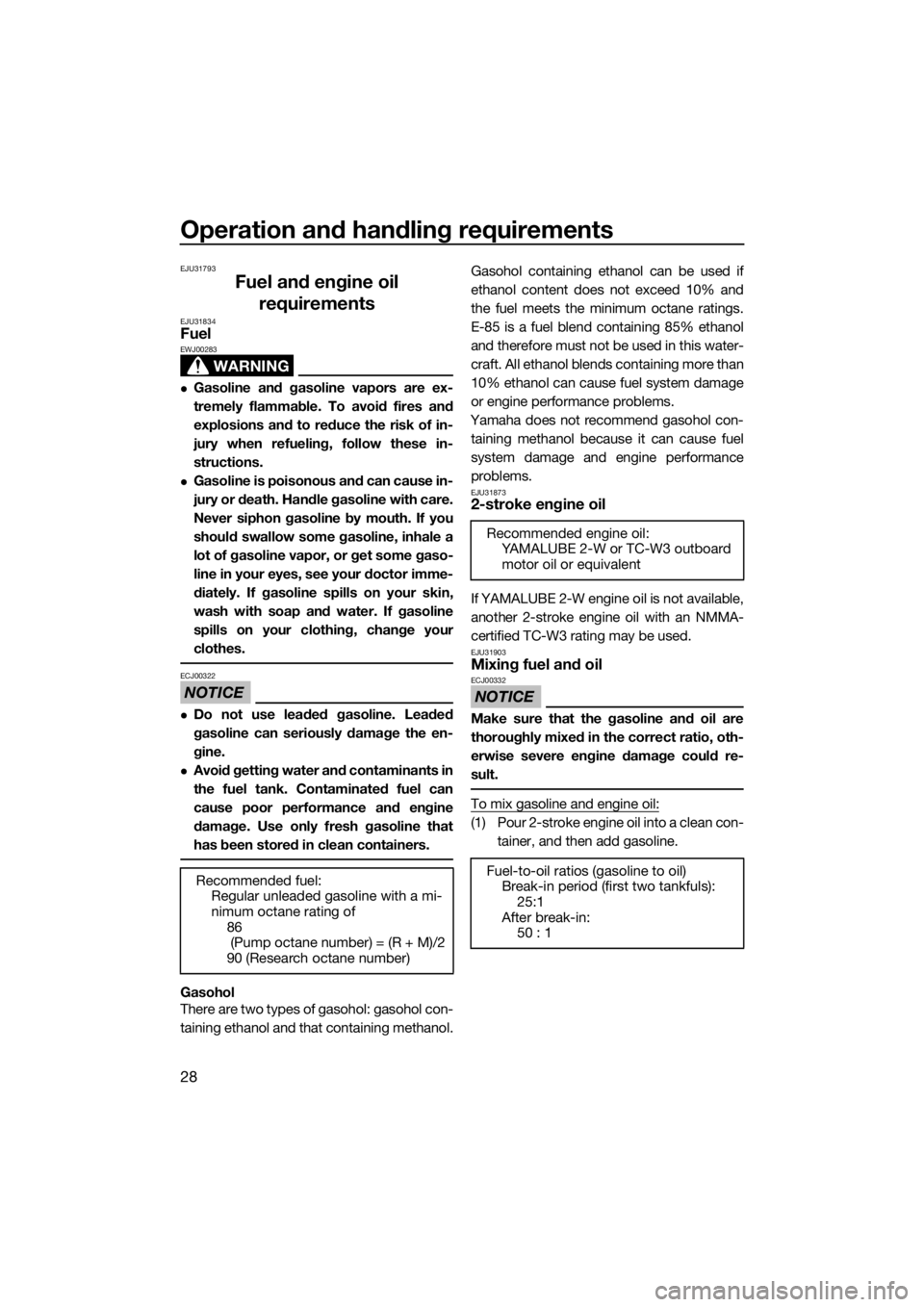
Always turn the fuel cock knob to “OFF”
when transporting the watercraft, other-
wise fuel could leak out into the engine or
engine compartment, which would create
a fire hazard.
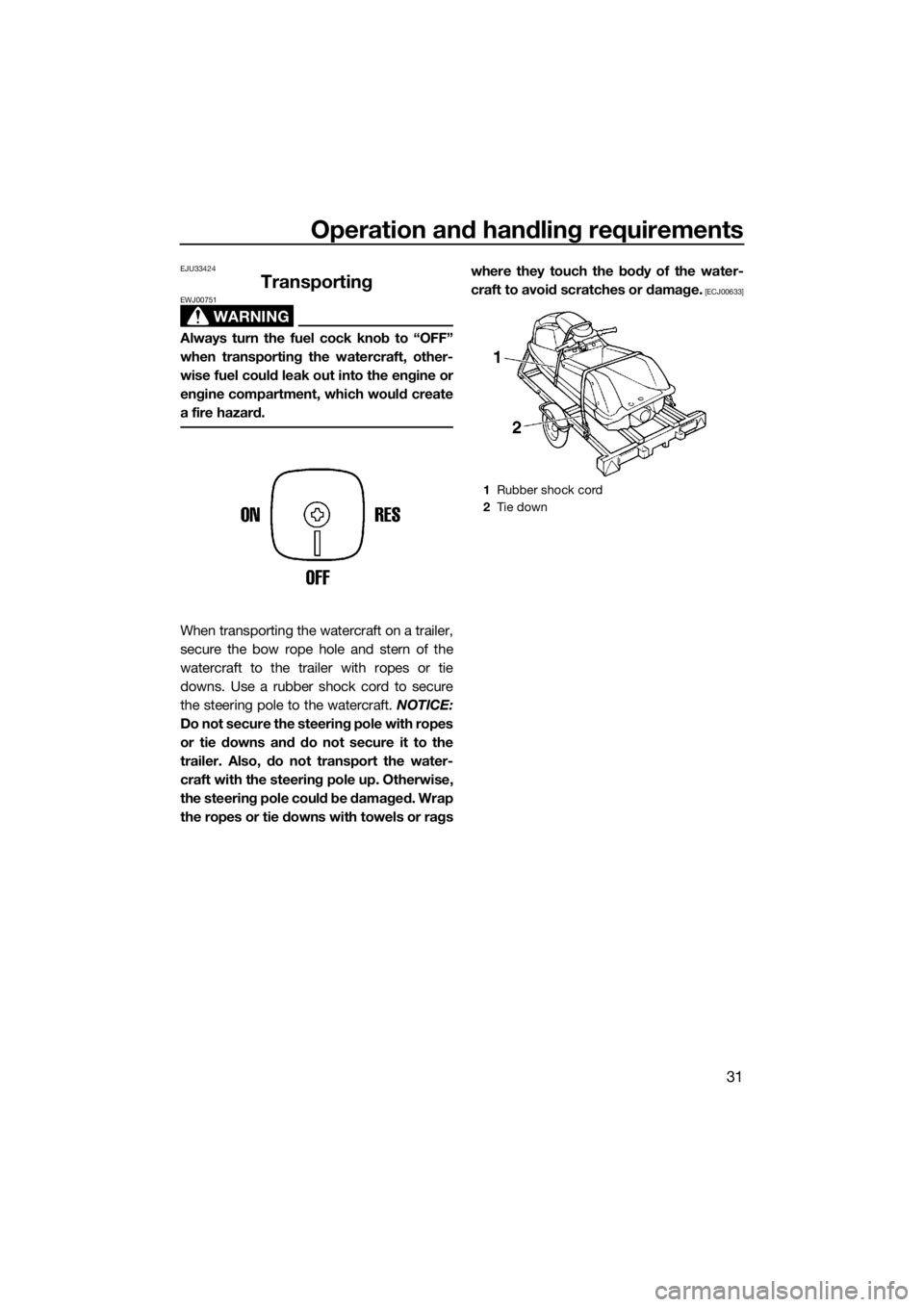
When transporting the watercraft on a trailer,
secure the bow rope hole and stern of the
watercraft to the trailer with ropes or tie
downs. Use a rubber shock cord to secure
the steering pole to the watercraft. NOTICE:
Do not secure the steering pole with ropes
or tie downs and do not secure it to the
trailer. Also, do not transport the water-
craft with the steering pole up. Otherwise,
the steering pole could be damaged. Wrap
the ropes or tie downs with towels or ragswhere they touch the body of the water-
craft to avoid scratches or damage.
[ECJ00633]
1Rubber shock cord
2Tie down
UF4D73E0.book Page 31 Wednesday, March 23, 2016 11:40 AM
Page 38 of 78

First-time operation
32
EJU32757
Engine break-in
NOTICE
ECJ00432
Failure to perform the engine break-in
could result in reduced engine life or even
severe engine damage.
The engine break-in is essential to allow the
various components of the engine to wear
and polish themselves to the correct operat-
ing clearances. This ensures proper perfor-
mance and promotes longer component life.
To perform the engine break-in:
(1) Fill the fuel tank with fuel in a fuel-to-oil
ratio of 25:1. (See page 28 “Mixing fuel
and oil” and “Filling the fuel tank” for in-
formation on filling the fuel tank.)
(2) Launch the watercraft and start the en-
gine. (See page 41 for information on
starting the engine.)
(3) For the first 5 minutes, operate with the
engine at idling speed.
(4) For the first tankful of fuel, squeeze the
throttle lever slowly and operate at 3/4
throttle or less.
(5) Fill the fuel tank once more with fuel in a
fuel-to-oil ratio of 25:1, and then operate
with the engine at any speed.
After the engine break-in is complete, fill the
fuel tank with fuel in a fuel-to-oil ratio of 50:1.
The watercraft can be operated normally.
UF4D73E0.book Page 32 Wednesday, March 23, 2016 11:40 AM
Page 39 of 78

Pre-operation checks
33
EJU31982
WARNING
EWJ00412
Failure to inspect or maintain the watercraft properly increases the possibility of an ac-
cident or damage to the watercraft. Do not operate the watercraft if you find any prob-
lem. If a problem cannot be corrected by the procedures provided in this manual, have
the watercraft inspected by a Yamaha dealer.
EJU41234Pre-operation checklist
Before using this watercraft, be sure to perform the checks in the following checklist.
ITEM ROUTINE PAGE
PRE-LAUNCH CHECKS
Engine compartmentVentilate the engine compartment.
Check inside the engine compartment for damage.35
Fuel systemCheck the fuel system for leakage.
Check the fuel level in the fuel tank.35
Water separatorCheck the water separator for water. 36
Engine unitCheck the exterior of the engine unit for damage. 36
Bilge waterCheck the engine compartment for bilge water. 36
BatteryCheck the battery connections and electrolyte level. 36
Steering systemCheck the steering system for proper operation. 36
Throttle leverCheck the throttle lever for proper operation.
Check the throttle lever free play.37
Engine shut-off cord (lan-
yard)Check the engine shut-off cord (lanyard) for dam-
age.38
SwitchesCheck the start switch, engine stop switch, and en-
gine shut-off switch for proper operation.38
Storage pouchCheck the storage pouch for damage and water.
Check that the storage pouch is securely installed.38
Fire extinguisher containerCheck the fire extinguisher container for damage. 39
Fire extinguisherCheck the condition of the fire extinguisher. 39
Safety equipmentCheck that safety equipment meeting the applica-
ble regulations is on board.39
Hull and deckCheck the hull and deck for damage. 39
Jet intakeCheck the jet intake for damage and clogging. 39
HoodCheck that the hood is securely closed. 39
UF4D73E0.book Page 33 Wednesday, March 23, 2016 11:40 AM
Page 41 of 78

Pre-operation checks
35
EJU32282
Pre-operation check pointsEJU40686Pre-launch checks
Perform the pre-launch checks in the pre-op-
eration checklist while the watercraft is on
land.
To perform the pre-launch checks:
(1) Remove the hood. (See page 24 for hood
removal and installation procedures.)
(2) Perform the checks and make sure that
there are no malfunctioning items or oth-
er problems.
(3) After completing these checks, install the
hood in its original position.
EJU32334Engine compartment check
WARNING
EWJ00462
Failure to ventilate the engine compart-
ment could result in a fire or explosion. Do
not start the engine if there is a fuel leak.
Ventilate the engine compartment. Leave the
engine compartment open for a few minutes
to allow any fuel vapors to escape.
Make sure that there is no damage inside the
engine compartment.
EJU34208Fuel system checks
WARNING
EWJ00382
Leaking fuel can result in fire or explosion.
Check for fuel leakage regularly.
If any fuel leakage is found, the fuel sys-
tem must be repaired by a qualified me-
chanic. Improper repairs can make the
watercraft unsafe to operate.
Make sure that there is no damage, leakage,
or other problem in the fuel system.
Check:
Carburetor for leakage
Fuel filler cap and seal for damage
Fuel in fuel tank for water and dirt
Fuel tank for damage and leakage
Fuel hoses and joints for damage and leak-
age
Fuel filter for leakage
Fuel cock for leakage
Fuel tank breather hose for damage and
leakage
Releasing the pressure in the fuel tank
Release the pressure in the fuel tank before
each use.
To release the pressure in the fuel tank:
(1) Loosen the fuel filler cap slowly and re-
move it to release any pressure in the fuel
tank.
(2) Securely install the fuel filler cap by tight-
ening it until it stops.
EJU32365Fuel level check
Check the fuel level in the fuel tank.
1Fuel filler cap
UF4D73E0.book Page 35 Wednesday, March 23, 2016 11:40 AM
Page 42 of 78

Pre-operation checks
36
Add fuel if necessary. (See page 29 for infor-
mation on filling the fuel tank.)
EJU32424Water separator check
Make sure that no water has collected in the
water separator. If water has collected in the
water separator, drain it. (See page 22 for in-
formation on draining the water separator.)
EJU40182Engine unit check
Check the exterior of the engine unit for dam-
age or other problem.
EJU41012Bilge water check
Make sure that no bilge water has collected in
the engine compartment. If bilge water has
collected in the engine compartment, wipe it
up with a dry cloth. NOTICE: Excessive wa-
ter in the engine compartment can splash
into the engine, which can result in severe
damage.
[ECJ00342]
EJU32485
Battery checks
Make sure that the battery terminals and
breather hose are not damaged and that the
battery leads and breather hose are connect-
ed properly. WARNING! Fire or explosion
could result if the breather hose is dam-aged, obstructed, or not connected prop-
erly.
[EWJ00452]
Make sure that the electrolyte level is be-
tween the minimum and maximum level
marks. WARNING! Never operate the wa-
tercraft if the battery does not have suffi-
cient power to start the engine or if it
shows any other signs of decreased pow-
er. Loss of battery power may leave you
stranded.
[EWJ01241]
Make sure that the battery is securely held in
place.
EJU32614Steering system checks
Turn the handlebars to the right and left sev-
eral times to make sure that operation is
smooth and unrestricted throughout the
1Water separator
1Positive (+) battery terminal: Red lead
2Negative (–) battery terminal: Black lead
3Breather hose
1Maximum level mark
2Minimum level mark
UF4D73E0.book Page 36 Wednesday, March 23, 2016 11:40 AM
Page 48 of 78

Operation
42
(2) Turn the fuel cock knob to “ON”.
(3) Attach the engine shut-off cord (lanyard)
to your left wrist, and then attach the clip
to the engine shut-off switch. (See page
19 for information on operating the en-
gine shut-off switch.) WARNING! Check
that the engine shut-off cord (lanyard)
is attached correctly. If the engine
shut-off cord (lanyard) is not attached
correctly, it may not pull free when the
operator falls off, allowing the water-
craft to continue to run and cause an
accident.
[EWJ00582]
(4) Pull the choke knob all the way out to
start a cold engine.
TIP:
The choke should not be used when the en-
gine is warm.
(5) While lightly squeezing the throttle lever,
push the start switch (green button) to
start the engine. (See page 19 for infor-
mation on operating the start switch.)
WARNING! Do not apply too much
throttle when starting the engine, oth-
erwise the watercraft will accelerate
unexpectedly. This could cause a col-
lision or cause the operator to be
thrown overboard.
[EWJ00592]
(6) After the engine has warmed up, push
the choke knob in to its original position.
TIP:
If the choke knob is left pulled out, the engine
will stall.
1Clip
2Engine shut-off switch
3Engine shut-off cord (lanyard)
12
3
START
UF4D73E0.book Page 42 Wednesday, March 23, 2016 11:40 AM