Page 46 of 178
4-14
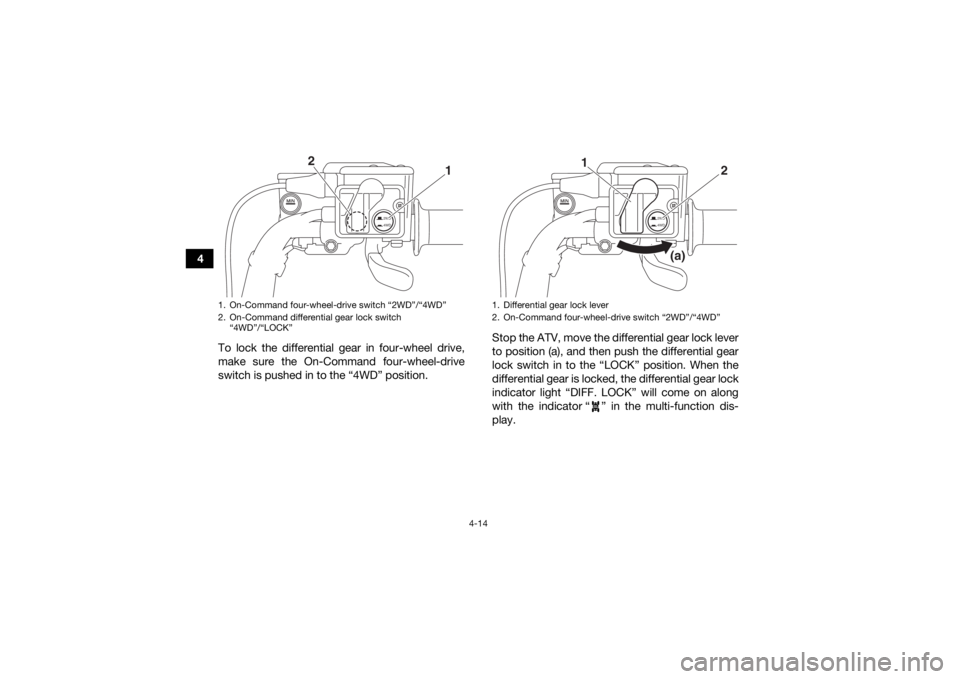
4To lock the differential gear in four-wheel drive,
make sure the On-Command four-wheel-drive
switch is pushed in to the “4WD” position. Stop the ATV, move the differential gear lock lever
to position (a), and then push the differential gear
lock switch in to the “LOCK” position. When the
differential gear is locked, the differential gear lock
indicator light “DIFF. LOCK” will come on along
with the indicator “ ” in the multi-function dis-
play.
1. On-Command four-wheel-drive switch “2WD”/“4WD”
2. On-Command differential gear lock switch
“4WD”/“LOCK”
2WD
4WD
1
2
1. Differential gear lock lever
2. On-Command four-wheel-drive switch “2WD”/“4WD”
2WD
4WD
2
1
(a)
UB1661E0.book Page 14 Thursday, May 12, 2016 2:47 PM
Page 47 of 178

4-15
4
To unlock the differential gear, stop the ATV and
push the switch to the “4WD” position.
TIP When the switch is set to “LOCK” or “4WD”, the
differential gear lock indicator and indicator light
will flash until the differential gear is completely
locked or unlocked.
When the indicator and indicator light are flash-
ing, turning the handlebar back and forth will
help the differential gear lock to engage or dis-
engage.
Riding before the differential gear is properly en-
gaged or disengaged (e.g., when the indicator
and indicator light are flashing) will cause the
vehicle speed to be limited until the differential
gear is completely engaged or disengaged.
When the ATV is in four-wheel-drive differential
gear lock, the maximum traveling speed is limit-
ed to 35 km/h (22 mi/h). However, if conditions
require full engine power to be available, push
and hold the override switch to disable the dif-
ferential gear lock speed limiter. (See page 4-11
for a detailed explanation of this switch.)
EBU34130Drive lever “2WD”/“4WD”
(YFM70KDXH / YFM70KPXH /
YFM70KPHH / YFM70KPAH)
WARNING
EWB00164Always stop the ATV before changing from
two-wheel drive to four-wheel drive and vice
versa. The ATV handles differently in two-
wheel drive than in four-wheel drive in some
circumstances. Changing from two-wheel
drive to four-wheel drive or vice versa while
moving may cause the ATV to unexpectedly
1. On-Command differential gear lock switch
“4WD”/“LOCK”
LOCK4WD
1
UB1661E0.book Page 15 Thursday, May 12, 2016 2:47 PM
Page 49 of 178

4-17
4
Before starting the engine, check the throttle to be
sure it is operating smoothly. Make sure it returns
to the idle position as soon as the lever is released.
EBU18324Speed limiterYour ATV is equipped with an adjustable speed
limiter. The speed limiter keeps the throttle from
fully opening, even when the throttle lever is
pushed to the maximum. 1. Loosen the locknut.
2. To increase the maximum engine power available and the maximum speed of the ATV,
turn the adjusting screw in direction (a). To decrease the maximum engine power avail-
able and the maximum speed of the ATV, turn
the adjusting screw in direction (b). Do not
turn the adjusting screw out more than 12
mm (0.47 in) or the throttle cable could be
damaged. Always make sure the throttle lever
free play is adjusted to 3.0–5.0 mm (0.12–
0.20 in). (See page 8-41.)
WARNING! Im-
proper adjustment of the speed limiter and
throttle could cause throttle cable damage
or improper throttle operation. You could
lose control, resulting in an accident.
[EWB00242]
1. Throttle lever
2WD
4WD
1
1. Locknut
2. Adjusting screw
3. No more than 12 mm (0.47 in)
2
1
3
(b)
(a)
UB1661E0.book Page 17 Thursday, May 12, 2016 2:47 PM
Page 50 of 178
4-18
43. Tighten the locknut.
EBU18392Front brake leverThe front brake lever is located on the right han-
dlebar. To apply the front brake, pull the brake le-
ver toward the handlebar grip.EBU18443Brake pedal and rear brake leverThe brake pedal is located on the right side of the
ATV and the rear brake lever is located on the left
handlebar. To apply the rear brake, push down on
the brake pedal or pull the brake lever toward the
handlebar grip.1. Front brake lever
1. Brake pedal
1. Rear brake lever
1
1
UB1661E0.book Page 18 Thursday, May 12, 2016 2:47 PM
Page 51 of 178
4-19
4
EBU18612Drive select leverThe drive select lever is used to shift your ATV into
the low-range, high-range, neutral, reverse and
park positions. See the “Operating the drive select
lever and driving in reverse” section on page 6-2
for the drive select lever operation.EBU18721Fuel tank capRemove the fuel tank cap by turning it counter-
clockwise.
EBU18757FuelMake sure there is sufficient gasoline in the tank.
WARNING
EWB02522Gasoline and gasoline vapors are extremely
flammable. To avoid fires and explosions and
to reduce the risk of injury when refueling, fol-
low these instructions. 1. Before refueling, turn off the engine and besure that no one is sitting on the vehicle. Nev-
er refuel while smoking, or while in the vicinity
1. Drive select lever
1
1. Fuel tank cap
1
UB1661E0.book Page 19 Thursday, May 12, 2016 2:47 PM
Page 52 of 178

4-20
4of sparks, open flames, or other sources of
ignition such as the pilot lights of water heat-
ers and clothes dryers.
2. Do not overfill the fuel tank. When refueling, be sure to insert the pump nozzle into the fuel
tank filler hole. Stop filling when the fuel
reaches the bottom of the filler tube. Because
fuel expands when it heats up, heat from the
engine or the sun can cause fuel to spill out of
the fuel tank.
3. Wipe up any spilled fuel immediately.NOTICE: Immediately wipe off spilled fuel
with a clean, dry, soft cloth, since fuel may
deteriorate painted surfaces or plastic
parts.
[ECB00982]
4. Turn the fuel tank cap fully clockwise to make sure it is securely closed.
WARNING
EWB02532Gasoline is poisonous and can cause injury or
death. Handle gasoline with care. Never siphon
gasoline by mouth. If you should swallow some
gasoline or inhale a lot of gasoline vapor, or get
some gasoline in your eyes, see your doctor
1. Fuel tank filler tube
2. Maximum fuel level
2
1
Recommended fuel:Regular unleaded gasoline only
For Europe: Regular unleaded gasoline only
with a research octane number of 95 or
higher
Fuel tank capacity: 18.0 L (4.75 US gal, 3.96 Imp.gal)
Fuel reserve amount: 4.0 L (1.06 US gal, 0.88 Imp.gal)
UB1661E0.book Page 20 Thursday, May 12, 2016 2:47 PM
Page 70 of 178

6-5
6
NOTICEECB00221If any engine trouble should occur during the
engine break-in period, immediately have a
Yamaha dealer check the ATV. EBU27322ParkingWhen parking the ATV, stop the engine, and shift
the drive select lever into the park position.EBU29901Parking on a slope
WARNING
EWB00861Avoid parking on hills or other inclines. Parking
on a hill or other incline could cause the ATV to
roll out of control, increasing the chance of an
accident. If you must park on an incline, place
the ATV transversely across the incline, stop
the engine, shift the drive select lever to the
park position, and then block the front and rear
wheels with rocks or other objects.
Do not park the ATV at all on hills that are so
steep you could not walk up them easily.
1. Bring the ATV to a stop by applying the brakes.
2. Stop the engine.
3. With the brake pedal applied, shift the drive select lever to the park position.EBU20911Accessories and loadingEBU20922Genuine Yamaha Accessories
Choosing accessories for your ATV is an impor-
tant decision. Genuine Yamaha Accessories,
which are available only from a Yamaha dealer,
have been designed, tested, and approved by
Yamaha for use on your ATV. Many companies with no connection to Yamaha manufacture parts
UB1661E0.book Page 5 Thursday, May 12, 2016 2:47 PM
Page 88 of 178

7-15
7Do not attempt to climb hills until you have mas-
tered basic maneuvers on flat ground. Always
check the terrain carefully before attempting any
hill. In all cases avoid inclines with slippery or
loose surfaces, or obstacles that might cause you
to lose control.
To climb a hill, you need traction, momentum, and
steady throttle. For more traction and control for
climbing steeper and/or rougher slopes, select
“4WD” or 4WD-LOCK (“DIFF. LOCK”)
(YFM70KPSH). Travel fast enough to maintain
momentum, but not so fast that you cannot react
to changes in the terrain as you climb.
It is important when climbing a hill to make sure
that your weight is transferred forward on the ATV.
This can be accomplished by leaning forward and,
on steeper inclines, standing on the footboards
and leaning forward over the handlebars. When-
ever possible, ride straight up hills.
Slow down when you reach the crest of the hill if
you cannot see clearly what is on the other side –
there could be another person, an obstacle, or a
sharp drop-off. Use common sense and remem-
ber that some hills are too steep for you to climb
or descend. If you are climbing a hill and you find that you have
not properly judged your ability to make it to the
top, you should turn the ATV around while you still
have forward motion (provided you have the room
to do so) and go down the hill.
If your ATV has stalled or stopped and you believe
you can continue up the hill, restart carefully to
make sure you do not lift the front wheels which
could cause you to lose control. If you are unable
to continue up the hill, dismount the ATV on the
uphill side. Physically turn the ATV around and
then descend the hill.
If you start to roll backwards, DO NOT apply either
brake abruptly. If you are in “2WD”, apply only the
front brake. When fully stopped, apply the rear
brake as well, and then shift to the park position. If
you are in “4WD”, because all wheels are inter-
connected by the drive train, applying either brake
will brake all wheels, therefore, avoid sudden ap-
plication of either the front or rear brake as the
wheels on the uphill side could come off the
ground. The ATV could easily tip over backwards.
Apply both the front and rear brakes gradually.
When fully stopped, lock shift to the park position
and dismount the ATV immediately on the uphill
side. Dismount on uphill side or to a side if pointed
UB1661E0.book Page 15 Thursday, May 12, 2016 2:47 PM