2017 VOLVO V90 warning
[x] Cancel search: warningPage 211 of 594

CLIMATE CONTROL
* Option/accessory.209
3.
Press
Add timer.
> A pop-up window is shown.
NOTE
It is not possible to add a time setting if there already are 8 settings entered for the timer.Delete a time setting in order to be able toadd a new one.
4. Tap on Date to set the time for a single date.
Tap on
Days to set the time for one or more
days of the week. With
Days: Activate/deactivate repetition by
ticking/unticking the box for Repeat
weekly.
5. With
Date: Select the date for precondition-
ing by scrolling the date list with the arrows. With
Days: Select the days of the week for
preconditioning by tapping on the buttons for the days of the week.
6. Set the time when the preconditioning should be finished by scrolling with thearrows.
7. Tap on
Confirm in order to add the time set-
ting.
> The time setting is added to the list and is activated.
WARNING
Do not use preconditioning if the car is equip- ped with a heater *:
• In unventilated spaces indoors. Exhaust gases are emitted if the heater starts.
• In locations with combustible or flamma-ble material nearby. Fuel, gas, long grass,sawdust, etc. may ignite.
• When there is a risk that the heater
Page 212 of 594

CLIMATE CONTROL
* Option/accessory.
210
Activating/deactivating the timer for preconditioning *
A time setting in the timer for preconditioning can be activated or deactivated based on need.
The timer buttons in the Parking climate tab in the cli-
mate view.
1. Open the climate view in the centre display. 2. Select the
Parking climate tab.
3. Activate/deactivate a time setting by tapping on the timer button to the right of the setting.
> The time setting is activated/deactivatedand the button illuminates/extinguishes.
WARNING
Do not use preconditioning if the car is equip- ped with a heater *:
• In unventilated spaces indoors. Exhaust gases are emitted if the heater starts.
• In locations with combustible or flamma-ble material nearby. Fuel, gas, long grass,sawdust, etc. may ignite.
• When there is a risk that the heater
Page 215 of 594

CLIMATE CONTROL
* Option/accessory.213
Heater*
The heater helps the engine and passenger compartment reach the correct temperaturebefore and during driving.
The heater has two subfunctions: • Parking heater - heats the engine and pas- senger compartment, if necessary, when the parking climate control's preconditioning
* is
activated.
• Additional heater - heats the passenger compartment and engine, if necessary, dur-ing driving.
The heater is fuel-driven and is fitted in the frontright-hand wheel housing.
This symbol illuminates in the driverdisplay when the heater is active.
NOTE
When the heater is running, smoke may be emitted from the right-hand front wheel hous-ing and a low hum may be heard. A tickingsound from the fuel pump may also be heardfrom the rear section of the car. This is per-fectly normal.
Battery and chargingThe heater is powered by the car's starter battery. If the charge level of the starter battery is too low,then the heater is switched off automatically andthe driver display shows a message.
NOTE
Make sure that there is enough charge in the battery if the heater needs to be used.
Fuel and refuelling 6
Warning label on fuel filler flap.
The heater uses fuel from the car's normal fuel tank. If the car is parked on a steep hill, the front of the car should point downhill to ensure that there is asupply of fuel to the heater. If the level in the fuel tank is too low then theheater is switched off automatically and the driverdisplay shows a message.
NOTE
Make sure there is enough fuel in the car's normal fuel tank if the heater needs to beused.
WARNING
Fuel which spills out could be ignited. Switch off the fuel-driven heater before starting torefuel. Check in the driver display that the heater is switched off. The heat symbol is shown whenit is operating.
Related information
•
Parking heater
* (p. 214)
• Additional heater
* (p. 215)
• Parking climate
* (p. 206)
6
Applies to fuel-driven heater.
Page 216 of 594
CLIMATE CONTROL
* Option/accessory.
214
Parking heater *
The parking heater helps the passenger com- partment reach the correct temperature beforedriving.
The parking heater is one of two subfunctions of the car's heater. The heater is fitted in the frontright-hand wheel housing.
NOTE
When the heater is running, smoke may be emitted from the right-hand front wheel hous-ing and a low hum may be heard. A tickingsound from the fuel pump may also be heardfrom the rear section of the car. This is per-fectly normal.
The parking heater starts automatically when extra heat is required if the parking climate con- trol's preconditioning * is activated.
It is then switched off automatically when the right temperature, the time of a set timer or theheater's maximum running time has beenreached. The heater's maximum running time is 40 minutes.
NOTE
Make sure there is enough fuel in the car's normal fuel tank if the heater needs to beused. Make sure that there is enough charge in the starter battery if the heater needs to be used.
IMPORTANT
Repeated use of the parking heater combined with short journeys may discharge the batteryand impair starting. If the heater is used on a regular basis, then the car should be driven for the same amountof time that the heater is used in order toensure that the car's battery is recharged withthe same amount of energy as consumed bythe parking heater. The parking heater is usedfor a maximum of 40 minutes each time.
WARNING
Do not use preconditioning if the car is equip- ped with a heater *:
• In unventilated spaces indoors. Exhaust gases are emitted if the heater starts.
• In locations with combustible or flamma-ble material nearby. Fuel, gas, long grass,sawdust, etc. may ignite.
• When there is a risk that the heater
Page 220 of 594

LOADING AND STORAGE
* Option/accessory.
218
Passenger compartment interior
Overview of the passenger compartment's inte- rior and storage locations.
Front seat
Storage compartment in the door panel and by the steering wheel, glovebox and sun visors.
Storage spaces with cup holder, ashtray *, electrical
socket and cigarette lighter *, mesh pocket *, as well as
an AUX/USB socket in the tunnel console.
Rear seat
Storage compartment and ashtray * in the door panel,
cup holder * in the centre seat backrest, storage pocket *
on the front seat backrest and also electrical sockets and cigarette lighter * in the tunnel console.
WARNING
Keep loose objects such as mobile phones, cameras, remote controls for accessories, etc.in the glove compartment or other compart-ments. Otherwise they may injure people inthe car in the event of sudden braking or acollision.
Related information
• Tunnel console (p. 219)
• Using the glovebox (p. 225)
• Sun visors (p. 226)
• Electrical sockets (p. 220)
• Emptying ashtrays
* (p. 224)
Page 222 of 594

LOADING AND STORAGE
* Option/accessory.
220
Electrical sockets In the tunnel console there are two 12 V electri- cal sockets and one 230 V electrical socket *, in
the cargo area there is one 12 V electricalsocket *.
For the sockets to supply current, the car's elec- trical system must be set in the lowest ignition position I. The sockets are then active as long as
the starter battery level does not become too low. If the engine is switched off and the car is locked, the sockets are deactivated. If the engine isswitched off and the car is not locked, or islocked with blocked lock position temporarilydeactivated, then the sockets continue to beactive for a further ten minutes.
NOTE
Remember that use of the electrical socket with the engine switched off entails a risk ofdischarging the starter battery, which can limitfunctionality.
230 V electrical socket *
230 V electrical socket in tunnel console, rear seat.
The socket can be used for various accessories requiring a 230 V supply, e.g. chargers and lap-top computers.
IMPORTANT
Maximum socket output is 150 W.
Using the socket
1. Pull down the socket cover and insert the
accessory's plug.
> The diode on the socket indicates its sta-tus.
2. Check that the diode is illuminated with a steady green light - only then is current avail- able at the socket. 3. Disconnect the accessory by pulling out the
plug - do not pull on the cable. Pull up the cover when the socket is not being used or the socket is left unattended.
IMPORTANT
• Do not use accessories with large or heavy connectors - they can damage thesocket or come loose when driving.
• Do not use accessories that can causeinterference to the car's radio receiver orelectrical system for example.
• Position the accessory so that it is not atrisk of injuring the driver or passengers inthe event of heavy braking or collision.
• Keep an eye on connected accessoriesas they can generate heat that can burnpassengers or the interior.
WARNING
•
Only use accessories that are undam- aged and fault-free. The accessoriesmust be rated for 230 V and 50 Hz withconnectors designed for the socket. Theaccessories must have a CE marking, ULmarking or an equivalent safety marking.
• Never allow sockets, connectors oraccessories to come into contact withwater or other liquids. Do not touch oruse the socket if it appears to be dam-
Page 224 of 594

||
LOADING AND STORAGE
* Option/accessory.
222
Status indication Reason Action
Diode not illuminated The socket does not sense that a plug has been inserted. Check that the plug is properly inserted into the socket.
The socket is not active. Switch the car's electrical system to the lowest igni- tion position I.
The socket has been active but is now deactivated. Start the engine and/or charge the starter battery.
If the problem persists, contact a workshop - an authorised Volvo workshop is recommended.
WARNING
Never modify or repair the 230 V electrical socket yourself. Volvo recommends that anauthorised Volvo workshop should be contac-ted.
12 V electrical socket
12 V electrical socket in tunnel console, front seat.
12 V electrical socket in tunnel console, rear seat.12 V electrical socket in cargo area *.
The sockets can be used for various accessories designed for 12 V, such as music players, coolerboxes and mobile phones. The socket in the tunnel console can be comple- mented with a cigarette lighter *.
IMPORTANT
Maximum socket output is 120 W per socket.
Page 228 of 594
||
LOADING AND STORAGE
* Option/accessory.
226
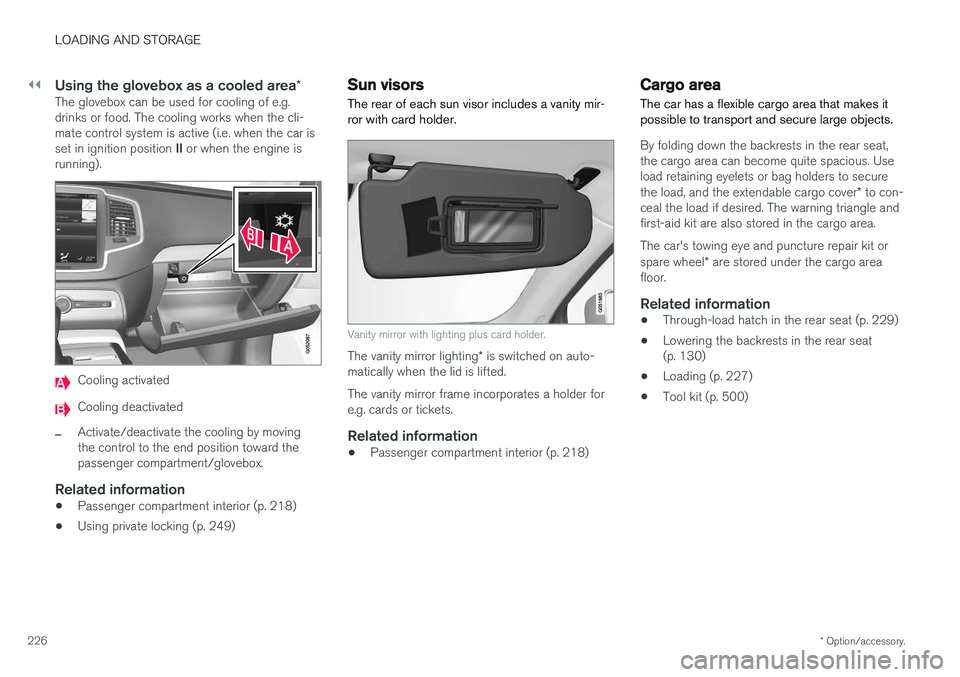
Using the glovebox as a cooled area *The glovebox can be used for cooling of e.g. drinks or food. The cooling works when the cli-mate control system is active (i.e. when the car is set in ignition position II or when the engine is
running).
Cooling activated
Cooling deactivated
–Activate/deactivate the cooling by moving the control to the end position toward thepassenger compartment/glovebox.
Related information
• Passenger compartment interior (p. 218)
• Using private locking (p. 249)
Sun visors The rear of each sun visor includes a vanity mir- ror with card holder.
Vanity mirror with lighting plus card holder.
The vanity mirror lighting
* is switched on auto-
matically when the lid is lifted. The vanity mirror frame incorporates a holder for e.g. cards or tickets.
Related information
• Passenger compartment interior (p. 218)
Cargo area
The car has a flexible cargo area that makes it possible to transport and secure large objects.
By folding down the backrests in the rear seat, the cargo area can become quite spacious. Useload retaining eyelets or bag holders to secure the load, and the extendable cargo cover * to con-
ceal the load if desired. The warning triangle and first-aid kit are also stored in the cargo area. The car's towing eye and puncture repair kit or spare wheel * are stored under the cargo area
floor.
Related information
• Through-load hatch in the rear seat (p. 229)
• Lowering the backrests in the rear seat (p. 130)
• Loading (p. 227)
• Tool kit (p. 500)