2017 VOLVO V90 ECU
[x] Cancel search: ECUPage 81 of 594

SAFETY
}}
79
WeightSize classA
Type of child seat Front seat (with deactivated air-
bag, only rear-facing child
seats)B Front seat (with activated air-
bag, only front-facing child
seats)B Outer rear seat
Centre rear seat
Group 1 9-18 kg A Front-facing child seat
XILB, E, F
, XD
ILF
, IUF F
X
B Front-facing child seat
B1 Front-facing child seat C Rear-facing child seat ILB, E
, XD
XILG
X
D Rear-facing child seat
IL: Suitable for particular ISOFIX child restraint systems. These child restraint systems are those of the specific vehicle, restricted or semi-universal catego-
ries.IUF: Suitable for ISOFIX forward child restraint systems of universal category approved for use in the mass group.X: Not suitable for ISOFIX child restraint systems.
A For child seats with the ISOFIX fixture system there is a size classification to help users choose the right type of child seat. The size class can be read on the child seat's label.
B Works for the installation of ISOFIX child seats that are semi-universally approved (IL) if the car is equipped with the ISOFIX console accessory (the accessory range varies depending on market).
C Volvo recommends: Volvo infant seat secured using the ISOFIX fixture system (type approval E1 04301146).
D Applicable if the car is not fitted with an ISOFIX bracket.
E Adjust the backrest so that the head restraint does not touch the child seat.
F Volvo recommends rear-facing child seat for children in this mass group.
G Volvo recommends: BeSafe iZi Kid X3 ISOfix (type approval E5 04200).
WARNING
Never use a rear-facing child seat on the front passenger seat if the passenger airbag isactivated.
NOTE
If an i-Size/ISOFIX child seat has no size classification, the car model must be includedon the vehicle list for the child seat.
NOTE
Volvo recommends contacting an authorised Volvo dealer for information about which i-Size/ISOFIX child seats Volvo recommends.
Page 103 of 594

INSTRUMENTS AND CONTROLS
}}
101
EXEMPLARY, OR CONSEQUENTIAL DAMAGES (INCLUDING, BUT NOT LIMITED TO,PROCUREMENT OF SUBSTITUTE GOODS ORSERVICES; LOSS OF USE, DATA, OR PROFITS;OR BUSINESS INTERRUPTION) HOWEVERCAUSED AND ON ANY THEORY OF LIABILITY,WHETHER IN CONTRACT, STRICT LIABILITY,OR TORT (INCLUDING NEGLIGENCE OROTHERWISE) ARISING IN ANY WAY OUT OFTHE USE OF THIS SOFTWARE, EVEN IFADVISED OF THE POSSIBILITY OF SUCHDAMAGE. The views and conclusions contained in the software and documentation are those of theauthors and should not be interpreted asrepresenting official policies, either expressed orimplied, of the FreeBSD Project.
FreeType Project License1. 1 Copyright 1996-1999 by David Turner,
Robert Wilhelm, and Werner LembergIntroduction The FreeType Project isdistributed in several archive packages; someof them may contain, in addition to theFreeType font engine, various tools andcontributions which rely on, or relate to, theFreeType Project. This license applies to allfiles found in such packages, and which donot fall under their own explicit license. Thelicense affects thus the FreeType fontengine, the test programs, documentationand makefiles, at the very least. This licensewas inspired by the BSD, Artistic, and IJG (Independent JPEG Group) licenses, whichall encourage inclusion and use of freesoftware in commercial and freewareproducts alike. As a consequence, its mainpoints are that: o We don't promise that thissoftware works. However, we are beinterested in any kind of bug reports. (`as is'distribution) o You can use this software forwhatever you want, in parts or full form,without having to pay us. (`royalty-free'usage) o You may not pretend that you wrotethis software. If you use it, or only parts of it,in a program, you must acknowledgesomewhere in your documentation thatyou've used the FreeType code. (`credits')We specifically permit and encourage theinclusion of this software, with or withoutmodifications, in commercial products,provided that all warranty or liability claimsare assumed by the product vendor. LegalTerms 0. Definitions Throughout this license,the terms `package', `FreeType Project', and`FreeType archive' refer to the set of filesoriginally distributed by the authors (DavidTurner, Robert Wilhelm, and WernerLemberg) as the `FreeType project', be theynamed as alpha, beta or final release. `You'refers to the licensee, or person using theproject, where `using' is a generic termincluding compiling the project's source codeas well as linking it to form a `program' or`executable'. This program is referred to as `aprogram using the FreeType engine'. This
license applies to all files distributed in theoriginal FreeType archive, including all sourcecode, binaries and documentation, unlessotherwise stated in the file in its original,unmodified form as distributed in the originalarchive. If you are unsure whether or not aparticular file is covered by this license, youmust contact us to verify this. The FreeTypeproject is copyright (C) 1996-1999 by DavidTurner, Robert Wilhelm, and WernerLemberg. All rights reserved except asspecified below. 1. No Warranty THEFREETYPE ARCHIVE IS PROVIDED `AS IS'WITHOUT WARRANTY OF ANY KIND,EITHER EXPRESSED OR IMPLIED,INCLUDING, BUT NOT LIMITED TO,WARRANTIES OF MERCHANTABILITY ANDFITNESS FOR A PARTICULAR PURPOSE.IN NO EVENT WILL ANY OF THEAUTHORS OR COPYRIGHT HOLDERS BELIABLE FOR ANY DAMAGES CAUSED BYTHE USE OR THE INABILITY TO USE, OFTHE FREETYPE PROJECT. As you have notsigned this license, you are not required toaccept it. However, as the FreeType projectis copyrighted material, only this license, oranother one contracted with the authors,grants you the right to use, distribute, andmodify it. Therefore, by using, distributing, ormodifying the FreeType project, you indicate
Page 135 of 594

INSTRUMENTS AND CONTROLS
133
Steering wheel adjustment can be made in differ- ent ways depending on whether or not the car is equipped with knee airbag
19
.
WARNING
Adjust the steering wheel and fix it before driving away.
With speed related power steering the level of steering force can be adjusted. Steering force isregulated according to the car's speed in order togive the driver enhanced road responsiveness.
With knee airbag
Adjusting the steering wheel.
1. Push the lever forwards to release the steer- ing wheel. 2. Adjust the steering wheel to the position that
suits you.
3. Pull the lever back to fix the steering wheel in place. If the lever is stiff, press the steering wheel lightly at the same time as you movethe lever back.
Without knee airbag
Adjusting the steering wheel.
1. Pull the lever backwards to release the steer-ing wheel.
2. Adjust the steering wheel to the position that suits you.
3. Push the lever forwards to secure the steer- ing wheel. If the lever is stiff, press the steer- ing wheel lightly at the same time as youmove the lever back.
Related information
• Steering wheel (p. 131)
• Speed-dependent steering force (p. 272)
19
The car is only equipped with knee airbag in certain markets.
Page 228 of 594
||
LOADING AND STORAGE
* Option/accessory.
226
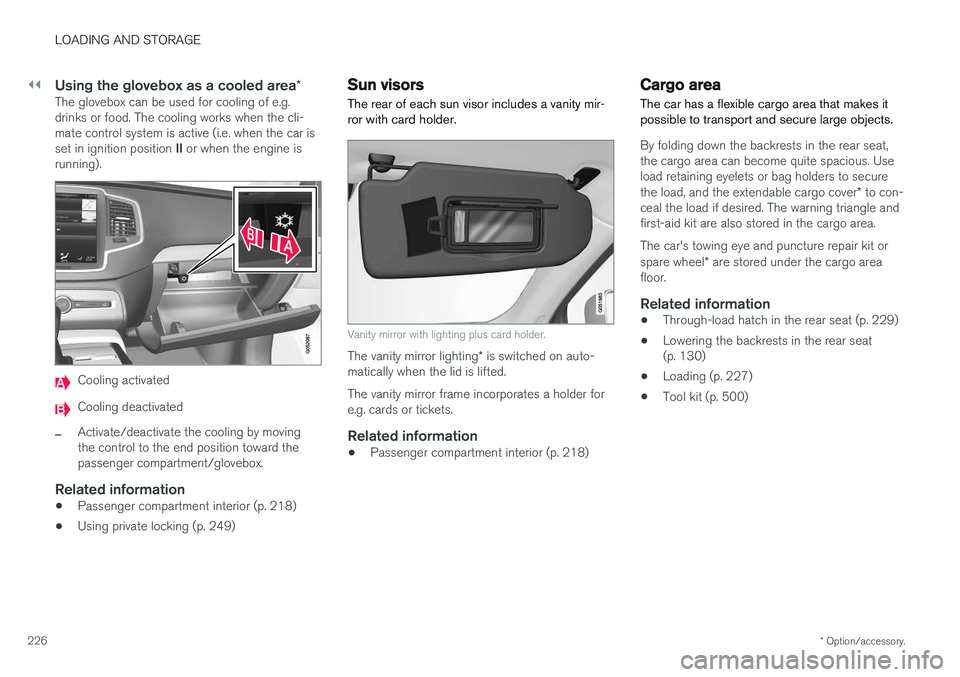
Using the glovebox as a cooled area *The glovebox can be used for cooling of e.g. drinks or food. The cooling works when the cli-mate control system is active (i.e. when the car is set in ignition position II or when the engine is
running).
Cooling activated
Cooling deactivated
–Activate/deactivate the cooling by moving the control to the end position toward thepassenger compartment/glovebox.
Related information
• Passenger compartment interior (p. 218)
• Using private locking (p. 249)
Sun visors The rear of each sun visor includes a vanity mir- ror with card holder.
Vanity mirror with lighting plus card holder.
The vanity mirror lighting
* is switched on auto-
matically when the lid is lifted. The vanity mirror frame incorporates a holder for e.g. cards or tickets.
Related information
• Passenger compartment interior (p. 218)
Cargo area
The car has a flexible cargo area that makes it possible to transport and secure large objects.
By folding down the backrests in the rear seat, the cargo area can become quite spacious. Useload retaining eyelets or bag holders to secure the load, and the extendable cargo cover * to con-
ceal the load if desired. The warning triangle and first-aid kit are also stored in the cargo area. The car's towing eye and puncture repair kit or spare wheel * are stored under the cargo area
floor.
Related information
• Through-load hatch in the rear seat (p. 229)
• Lowering the backrests in the rear seat (p. 130)
• Loading (p. 227)
• Tool kit (p. 500)
Page 230 of 594

||
LOADING AND STORAGE
* Option/accessory.
228
WARNING
The car's centre of gravity and driving charac- teristics are altered by roof loads. Read about maximum permitted roof load in the section on Weights.
Related information
• Load retaining eyelets (p. 228)
• Locking/unlocking the tailgate (p. 247)
• Through-load hatch in the rear seat (p. 229)
• Lowering the backrests in the rear seat (p. 130)
• Safety grille
* (p. 233)
• Safety net
* (p. 232)
• Cargo cover
* (p. 230)
• Weights (p. 563)
Load retaining eyelets
The folding load retaining eyelets are used to fasten straps in order to anchor items in thecargo area.
WARNING
Hard, sharp and/or heavy objects which pro- trude may cause injury under violent braking. Always secure large and heavy objects with a seatbelt or cargo retaining straps.
Related information
• Loading (p. 227)
• Bag hooks (p. 228)
• Safety grille
* (p. 233)
• Safety net
* (p. 232)
• Cargo cover
* (p. 230)
Bag hooks
Bag hooks, together with an elastic strap, hold bags in place and prevent them from falling overand spreading their contents across the cargoarea.
Under the floor hatch *
Page 232 of 594

LOADING AND STORAGE
* Option/accessory.
230
Cargo cover *
In the extended position, the cargo cover pre- vents visual access to the cargo area.
Installation
Insert one of the cargo cover's end pieces in the recess in the side panel in the cargoarea.
Then insert the other end piece in the recess in the side panel on the opposite side.
Press down the end pieces on both sides - one by one.
> When a "click" is heard and the red mark- ing on each end piece has disappeared, the cargo cover is attached - check that itis affixed securely.
4. Fold the cargo cover's front sealing disc for- ward to eliminate the space between the cargo cover and the rear seat's backrests.
If the safety net * shall be used at the same time
as the cargo cover then the safety net must befitted first.
UsageThere are two extended positions for the cargocover - a full-cover position and a loading posi-tion, where it is partially extended to make it eas-ier to reach further into the cargo area.
Full-cover position
1. Grip the handle and pull out the cargo cover so that it slides over the side panels in the cargo area. Pull to the end position.
2. Guide the cover's attachment pins into the grooves in the side panels. Release, while atthe same time angling the handle slightlyupwards so that the attachment pins hook in.
> The cargo cover is locked in the full-coverposition.
Page 234 of 594

LOADING AND STORAGE
* Option/accessory.
232 •
Safety net
* (p. 232)
• Load retaining eyelets (p. 228)
Safety net
*
The safety net prevents loads from being thrown forward in the passenger compartment in theevent of sudden braking.
The safety net is fitted into four mounting points.
For reasons of safety, the safety net must always be fastened and anchored as described below. The net is made of a strong nylon fabric and can be secured two different locations in the car:
• Rear fitting - behind the rear seat.
• Front fitting - behind the front seats.
WARNING
Loads in the luggage compartment must be anchored well, and also using a correctly fit-ted safety net.
Installation
Rear fitting
1. If necessary, fold the rear seat backrests for-
ward in order to facilitate installation.
2. Lower the safety net cassette's end pieces over the mounting eyelets in the recess of the side panels. Press down the end pieceone side at a time. Check that the cassette isproperly secured.
3. Pull up the net.
4. Hook one of the safety net's retaining hooks into the rear roof mounting and then press it forward to the end position.
5. Hook the other of the safety net's retaining hooks on the opposite side and press it for-ward to the end position.
Page 244 of 594

||
LOCKS AND ALARM
* Option/accessory.
242
Touch-sensitive surfaces
The outside of the door handles contains a recess for locking, while the inside contains atouch-sensitive surface for unlocking. The tail-gate handle has a rubberised pressure plate thatis only used for unlocking.
Touch-sensitive recess for locking
Touch-sensitive surface for unlocking
NOTE
It is important that only one touch-sensitive surface is activated at a time. Gripping thehandle while touching the lock surface risksgiving double commands. This means that therequested activity (locking/unlocking) will notbe executed, or will be executed with a delay.
Rubberised pressure plate on the boot lid used for unlocking only.
Keyless locking
All side doors must be closed to be able to lock the car. The tailgate, on the other hand, can beopen when locking the car with a side door han-dle.
–Touch the marked surface towards the rear on the outside of a door handle after thedoor has been closed, or press the lock but-ton on the bottom edge of the tailgate beforeclosing it.
> The lock indicator in the windscreen starts
to flash to indicate the car is locked.
To close all side windows and the panorama roof *
simultaneously - place a finger against the touch- sensitive recess on the outside of the door han- dle until all side windows and the panorama roof *
are closed.
Keyless entry
–Grasp a door handle or press the rubberised pressure plate beneath the tailgate handle tounlock the car.
> The lock indicator in the windscreen extin- guishes to confirm the car is unlocked - open the doors or tailgate as usual.
Settings for Keyless entry
It is possible to select different sequences for Keyless entry. 1. Tap on
Settings in the centre display's top
view.
2. Tap on
My CarLockingKeyless
Unlock
3. Select option:
•
All Doors
- unlocks all doors simultaneously.
•
Single Door
- unlocks selected door.
Automatic relockingIf none of the doors or the tailgate is opened within two minutes of unlocking, they are lockedautomatically. This function prevents the car frombeing left unlocked unintentionally.
Unlocking with Volvo On CallIt is possible to remotely unlock the car with the Volvo On Call * app.