Page 577 of 668

5
577
5-2. Steps to take in an emergency
When trouble arises
VERSO_EE_OM64517E
■ The compact spare tire (if equipped)
● The compact spare tire is identified by the label “TEMPORARY USE
ONLY” on the tire sidewall.
Use the compact spare tire temporarily only in an emergency.
● Make sure to check the tire inflation pressure of the compact spare tire.
( P. 639)
■ After completing the tire change (vehicles with the tire pressure warn-
ing system)
The tire pressure warning system must be reset. ( P. 469)
■ When using the spare tire (vehicles with the tire pressure warning sys-
tem)
As the spare tire is not equipped with a tire pressure warning valve and
transmitter, low inflation pressure of the spare tire will not be indicated by the
tire pressure warning system. Also, if you replace a flat tire with the spare
tire after the tire pressure warning light comes on, the light remains on.
■ If you have a flat front tire on a road covered with snow or ice (vehicles
with compact spare tire)
Install the compact spare tire on the rear of the vehicle. Perform the following
steps and fit tire chains to the front tires.
Replace a rear tire with the compact spare tire.
Replace the flat front tire with the tire removed from the rear of the
vehicle.
Fit tire chains to the front tires.
Page 582 of 668
582
5-2. Steps to take in an emergency
VERSO_EE_OM64517E
NOTICE
■ Do not drive the vehicle with a flat tire
Do not continue driving with a flat tire.
Driving even a short distance with a flat tire can damage the tire and the
wheel beyond repair.
■ Be careful when driving over bumps with the compact spare tire
installed on the vehicle
The vehicle becomes lower when driving with the compact spare tire com-
pared to when driving with standard tires. Be careful when driving over
uneven road surfaces.
■ Driving with tire chains and the compact spare tire
Do not fit tire chains to the compact spare tire.
Tire chains may damage the vehicle body and adversely affect driving per-
formance.
■ When replacing the tires (vehicles with the tire pressure warning sys-
tem)
When removing or fitting the wheels, tires or the tire pressure warning valve
and transmitter, contact any authorized Toyota dealer or repairer, or another
duly qualified and equipped professional as the tire pressure warning valve
and transmitter may be damaged if not handled correctly.
Page 585 of 668
5
585
5-2. Steps to take in an emergency
When trouble arises
VERSO_EE_OM64517E
*1: Use of the jack, jack handle and wheel nut wrench. (if equipped)
( P. 566)
A jack, jack handle and wheel nut wrench can be purchased at any
authorized Toyota dealer or repairer, or another duly qualified and
equipped professional.
*2: Use of the wheel cap clip. (if equipped) ( P. 482)
*3: The emergency tire puncture repair kit is located in the auxiliary box
(type C). ( P. 4 0 6 )
■Emergency tire puncture repair kit components
Compressor switch
Air pressure gauge
Power plug
Black case
Stickers
Pressure release
button
Nozzle
Hose
Page 586 of 668

586
5-2. Steps to take in an emergency
VERSO_EE_OM64517E
Before performing emergency repair
Check the degree of the tire
damage.
• Do not remove the nail or
screw from the tire. Removing
the object may widen the
opening and prevent emer-
gency repair with the repair kit.
• To avoid sealant leakage,
move the vehicle until the area
of the puncture, if known, is
positioned at the top of the
tire.
Taking out the emergency tire puncture repair kit
Open the auxiliary box (Type C) ( P. 406)
Take out the black case containing the emergency tire punc-
ture repair kit. ( P. 584)
■In the following cases, the tire cannot be repaired with the emergency
tire puncture repair kit. Contact any authorized Toyota dealer or
repairer, or another duly qualified and equipped professional.
● When the tire is damaged due to driving without sufficient air pressure
● When there are any cracks or damage at any location on the tire, such as
on the side wall, except the tread
● When the tire is visibly separated from the wheel
● When the cut or damage to the tread is 4 mm (0.16 in.) long or more
● When the wheel is damaged
● When two or more tires have been punctured
● When more than 2 sharp objects such as nails or screws have passed
through the tread on a single tire
● When the sealant has expired
Page 590 of 668
590
5-2. Steps to take in an emergency
VERSO_EE_OM64517E
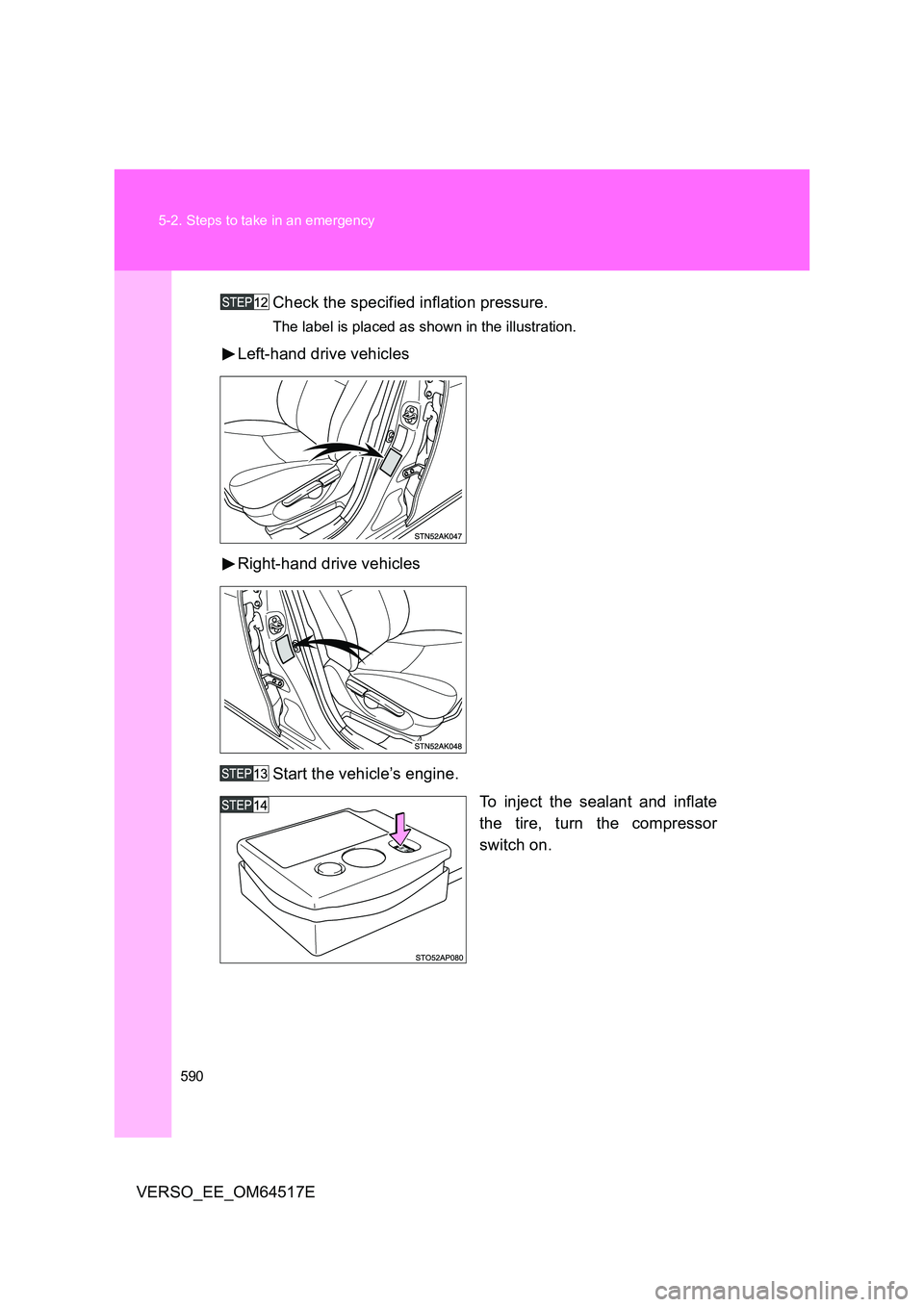
Check the specified inflation pressure.
The label is placed as shown in the illustration.
Left-hand drive vehicles
Right-hand drive vehicles
Start the vehicle’s engine.
To inject the sealant and inflate
the tire, turn the compressor
switch on.
Page 591 of 668
5
591
5-2. Steps to take in an emergency
When trouble arises
VERSO_EE_OM64517E
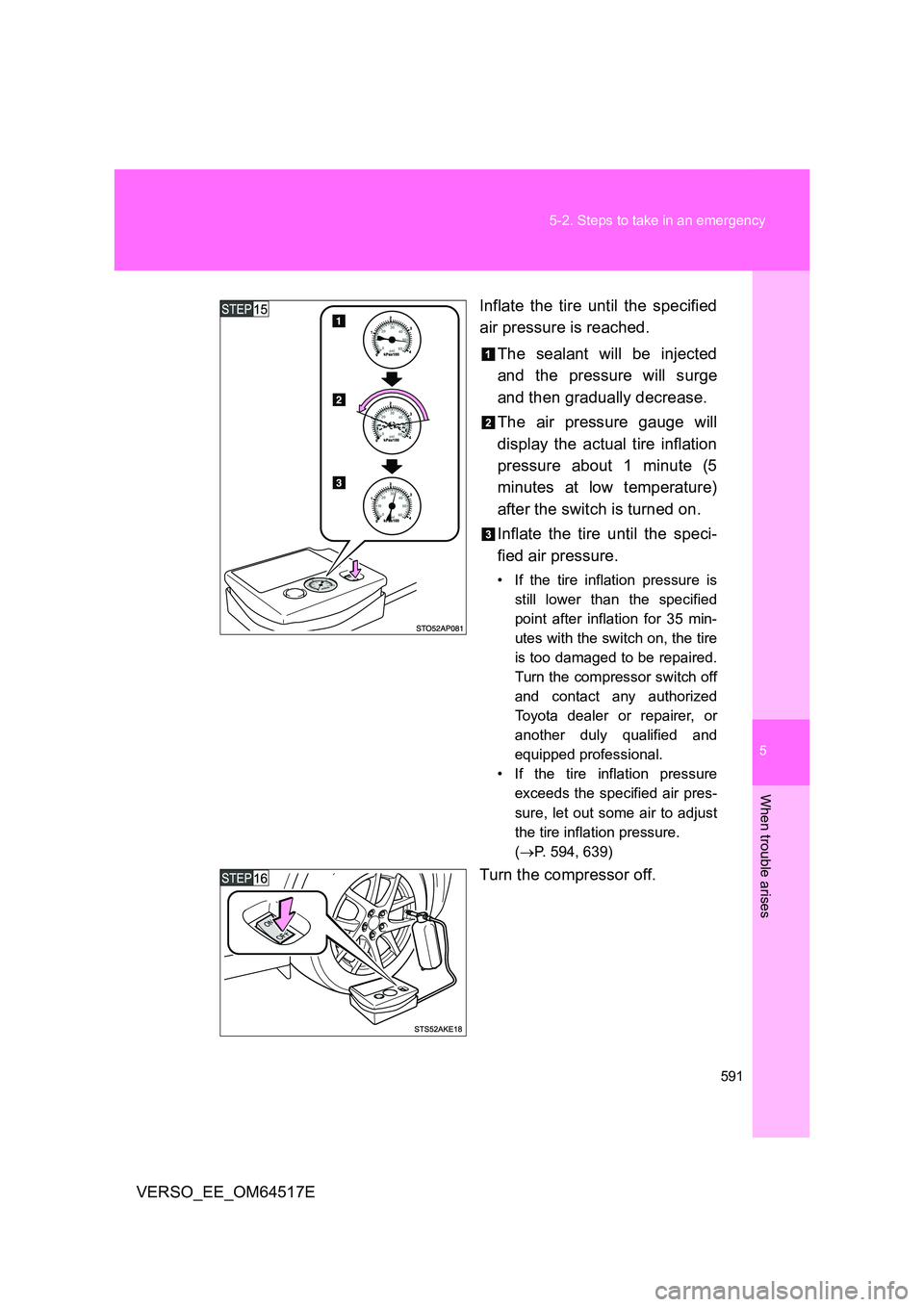
Inflate the tire until the specified
air pressure is reached.
The sealant will be injected
and the pressure will surge
and then gradually decrease.
The air pressure gauge will
display the actual tire inflation
pressure about 1 minute (5
minutes at low temperature)
after the switch is turned on.
Inflate the tire until the speci-
fied air pressure.
• If the tire inflation pressure is
still lower than the specified
point after inflation for 35 min-
utes with the switch on, the tire
is too damaged to be repaired.
Turn the compressor switch off
and contact any authorized
Toyota dealer or repairer, or
another duly qualified and
equipped professional.
• If the tire inflation pressure
exceeds the specified air pres-
sure, let out some air to adjust
the tire inflation pressure.
( P. 594, 639)
Turn the compressor off.
Page 593 of 668
5
593
5-2. Steps to take in an emergency
When trouble arises
VERSO_EE_OM64517E
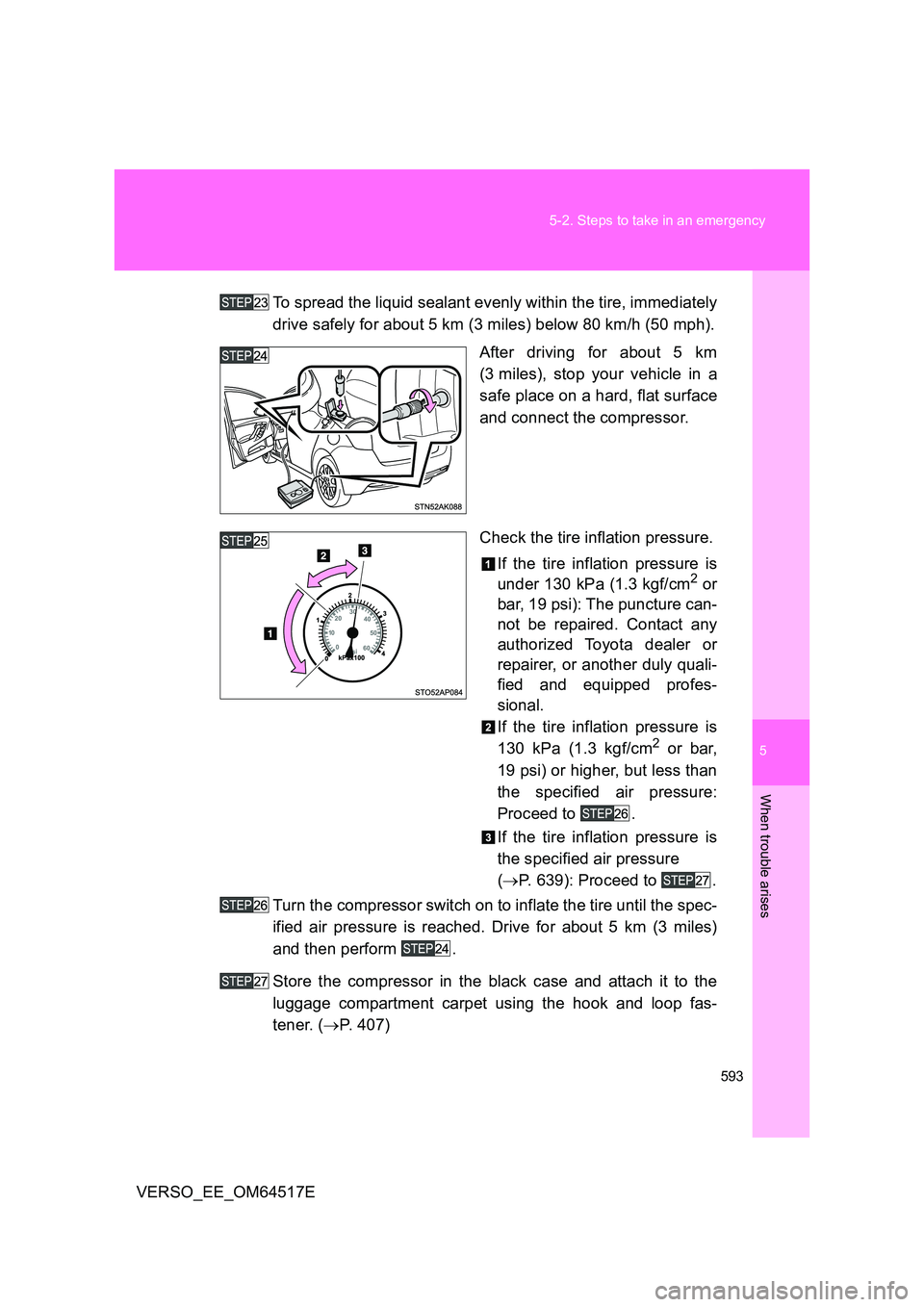
To spread the liquid sealant evenly within the tire, immediately
drive safely for about 5 km (3 miles) below 80 km/h (50 mph).
After driving for about 5 km
(3 miles), stop your vehicle in a
safe place on a hard, flat surface
and connect the compressor.
Check the tire inflation pressure.
If the tire inflation pressure is
under 130 kPa (1.3 kgf/cm2 or
bar, 19 psi): The puncture can-
not be repaired. Contact any
authorized Toyota dealer or
repairer, or another duly quali-
fied and equipped profes-
sional.
If the tire inflation pressure is
130 kPa (1.3 kgf/cm2 or bar,
19 psi) or higher, but less than
the specified air pressure:
Proceed to .
If the tire inflation pressure is
the specified air pressure
( P. 639): Proceed to .
Turn the compressor switch on to inflate the tire until the spec-
ified air pressure is reached. Drive for about 5 km (3 miles)
and then perform .
Store the compressor in the black case and attach it to the
luggage compartment carpet using the hook and loop fas-
tener. ( P. 407)
Page 594 of 668
594
5-2. Steps to take in an emergency
VERSO_EE_OM64517E
Taking precautions to avoid sudden braking, sudden accelera-
tion and sharp turns, drive carefully at under 80 km/h
(50 mph) to the nearest authorized Toyota dealer or repairer,
or another duly qualified and equipped professional for tire
repair or replacement.
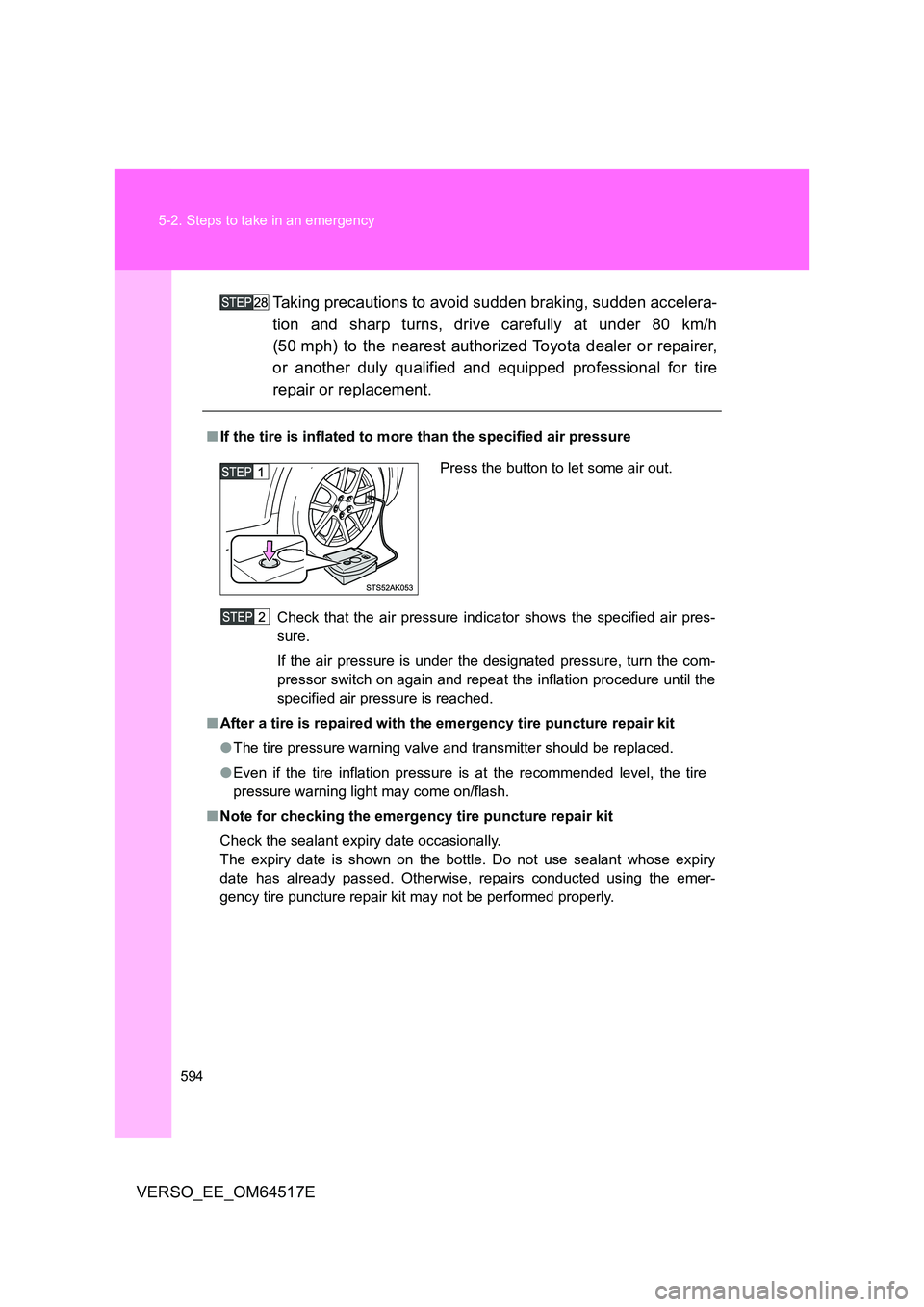
■ If the tire is inflated to more than the specified air pressure
Check that the air pressure indica tor shows the specified air pres-
sure.
If the air pressure is under the designated pressure, turn the com-
pressor switch on again and repeat the inflation procedure until the
specified air pressure is reached.
■ After a tire is repaired with the emergency tire puncture repair kit
● The tire pressure warning valve and transmitter should be replaced.
● Even if the tire inflation pressure is at the recommended level, the tire
pressure warning light may come on/flash.
■ Note for checking the emergency tire puncture repair kit
Check the sealant expiry date occasionally.
The expiry date is shown on the bottle. Do not use sealant whose expiry
date has already passed. Otherwise, repairs conducted using the emer-
gency tire puncture repair kit may not be performed properly.
Press the button to let some air out.