Page 179 of 588

1794-1. Before driving
4
Driving
CAUTION
■Trailer towing precautions
To tow a trailer safely, use extreme care and drive the vehicle in accordance
with the trailer’s characteristics and operating conditions. Failure to do so
could cause an accident resulting in death or serious injury. Vehicle stability
and braking performance are affected by trailer stability, brake setting and
performance, and the hitch. Your vehicle will handle differently when towing
a trailer.
■ To avoid accident or injury
● Do not exceed the TWR, unbraked TWR, GCWR, GVWR or GAWR.
● If the gross trailer weight is over 2000 lb. (907 kg), a sway control device
with sufficient capacity is required.
● If the gross trailer weight is over 5000 lb. (2268 kg), a weight distributing
hitch with sufficient capacity is required.
● Adjust the tongue weight within the appropriate range. Place heavier loads
as close to the trailer axle as possible.
● Do not exceed 65 mph (104 km/h), the posted towing speed limit or the
speed limit for your trailer as set forth in your trailer owner’s manual,
whichever is lowest. Slow down sufficiently before making a turn, in cross-
winds, on wet or slippery surface, etc., to help avoid an accident. If you
experience a vehicle-trailer instability from reducing a certain speed, slow
down and make sure you keep your vehicle speed under the speed of
which you experience the instability.
● Do not make jerky, abrupt or sharp turns.
● Do not apply the brakes suddenly as you may skid, resulting in jackknifing
and loss of vehicle control. This is especially true on wet or slippery sur-
faces.
● Do not exceed the trailer hitch assembly weight, gross vehicle weight,
gross axle weight and trailer tongue weight capacities.
● Do not use cruise control when towing.
● Slow down and downshift before descending steep or long downhill
grades. Do not make sudden downshifts while descending steep or long
downhill grades.
● Vehicle-trailer instability is more likely on steep long downhills. Before
descending steep or long downhill grades, slow down and downshift. Do
not make sudden downshifts when descending steep or long downhill
grades. Avoid holding the brake pedal down too long or applying the
brakes too frequently. This could cause the brakes to overheat and result
in reduced braking efficiency.
● Do not tow a trailer when the temporary spare tire is installed on your vehi-
cle.
Page 180 of 588

1804-1. Before driving
CAUTION
■Hitch
Trailer hitch assemblies have different weight capacities established by the
hitch manufacturer. Even though the vehicle may be physically capable of
towing a higher weight, the operator must determine the maximum weight
rating of the particular hitch assembly and never exceed the maximum
weight rating specified for the trailer-hitch. Exceeding the maximum weight
rating set by the trailer-hitch manufacturer can cause an accident resulting
in death or serious personal injuries.
■ When towing a trailer
Toyota recommends trailers with brakes that conform to any applicable fed-
eral and state/provincial regulations.
● If the gross trailer weight exceeds unbraked TWR, trailer brakes are
required. Toyota recommends trailers with brakes that conform to all appli-
cable federal and state/provincial regulations.
● Never tap into your vehicle’s hydraulic system, as this will lower the vehi-
cle’s braking effectiveness.
● Never tow a trailer without using a safety chain securely attached to both
the trailer and the vehicle. If damage occurs to the coupling unit or hitch
ball, there is danger of the trailer wandering into another lane.
NOTICE
■When installing a trailer hitch
Use only the position recommended by your Toyota dealer. Do not install
the trailer hitch on the bumper; this may cause body damage.
■ Do not directly splice trailer lights
Do not directly splice trailer lights. Directly splicing trailer lights may damage
your vehicle’s electrical system and cause a malfunction.
■ When towing a fifth wheel trailer
Be careful not to hit the cabin or bed with
the trailer while making a sharp turn.
Page 429 of 588
4297-3. Do-it-yourself maintenance
7
Maintenance and care
■When to replace your vehicle’s tires
Tires should be replaced if:
●The treadwear indicators are showing on a tire.
●You have tire damage such as cuts, splits, cracks deep enough to
expose the fabric, and bulges indicating internal damage
●A tire goes flat repeatedly or cannot be properly repaired due to the size
or location of a cut or other damage
If you are not sure, consult with your Toyota dealer.
■Replacing tires and wheels
If the ID code of the tire pressure warning valve and transmitter is not reg-
istered, the tire pressure warning system will not work properly. After driv-
ing for about 20 minutes, the tire pressure warning light blinks for 1
minute and stays on to indicate a system malfunction.
■Tire life
Any tire over 6 years old must be checked by a qualified technician even
if it has seldom or never been used or damage is not obvious.
■Routine tire inflation pressure checks
The tire pressure warning system does not replace routine tire inflation
pressure checks. Make su re to check tire inflation pressure as part of
your routine of daily vehicle checks.
■Maximum load of tire
Check that the number given by dividing the maximum load by 1.10 of the
replacement tire is greater than 1/ 2 of the Gross Axle Weight Ratings
(GAWR) of either the front axle or the rear axle, whichever is greater.
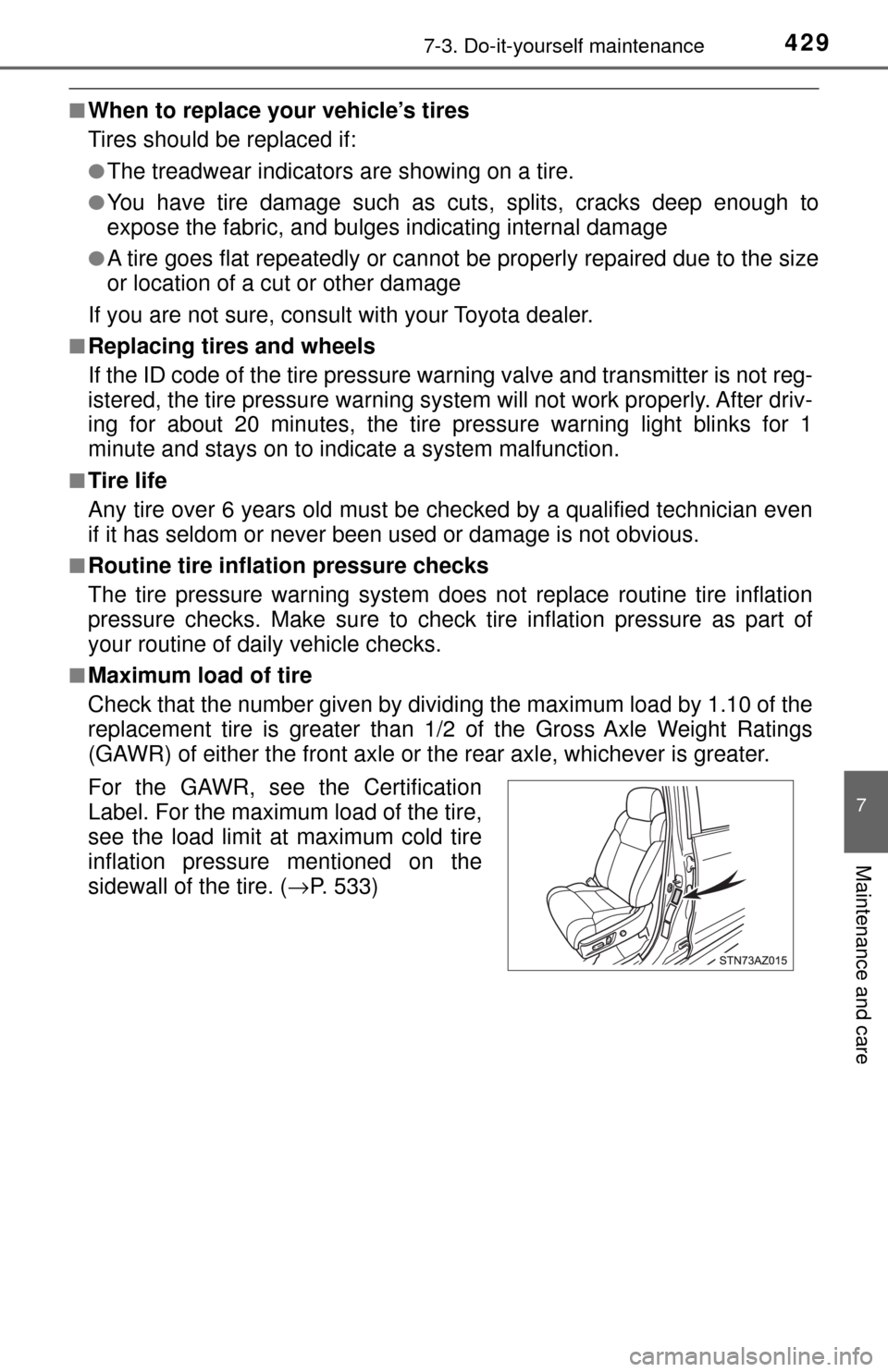
For the GAWR, see the Certification
Label. For the maximum load of the tire,
see the load limit at maximum cold tire
inflation pressure mentioned on the
sidewall of the tire. ( →P. 533)
Page 436 of 588

4367-3. Do-it-yourself maintenance
■Instructions for checking tire inflation pressure
When checking tire inflation pressure, observe the following:
●Check only when the tires are cold.
If your vehicle has been parked for at least 3 hours or has not been
driven for more than 1 mile or 1.5 km, you will get an accurate cold tire
inflation pressure reading.
●Always use a tire pressure gauge.
It is difficult to judge if a tire is properly inflated based only on its appear-
ance.
●It is normal for the tire inflation pressure to be higher after driving as
heat is generated in the tire. Do no t reduce tire inflation pressure after
driving.
●Passengers and luggage weight should be placed so that the vehicle is
balanced.
CAUTION
■Proper inflation is critical to save tire performance
Keep your tires properly inflated.
If the tires are not properly inflated, the following conditions may occur
which could lead to an accident resulting in death or serious injury:
●Excessive wear
●Uneven wear
●Poor handling
●Possibility of blowouts resu lting from overheated tires
●Air leaking from between tire and wheel
●Wheel deformation and/or tire damage
●Greater possibility of tire damage while driving (due to road hazards,
expansion joints, sharp edges in the road, etc.)
NOTICE
■When inspecting and adjusting tire inflation pressure
Be sure to put the tire valve caps back on.
If a valve cap is not installed, dirt or moisture may get into the valve and
cause an air leak, resulting in decreased tire inflation pressure.
Page 512 of 588
5129-1. Specifications
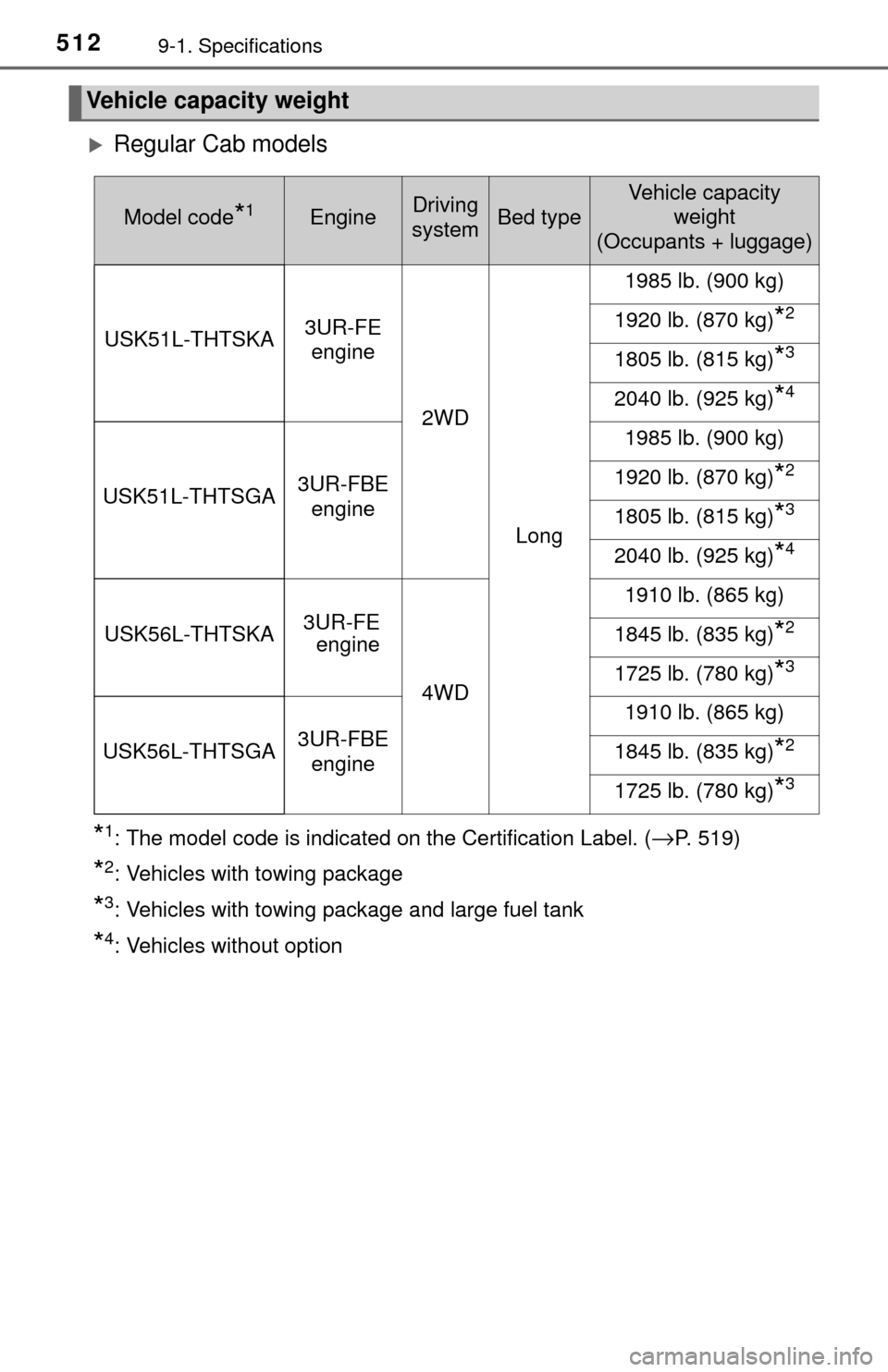
Regular Cab models
*1: The model code is indicated on the Certification Label. (→P. 519)
*2: Vehicles with towing package
*3: Vehicles with towing package and large fuel tank
*4: Vehicles without option
Vehicle capacity weight
Model code*1EngineDriving
systemBed type
Vehicle capacity weight
(Occupants + luggage)
USK51L-THTSKA 3UR-FE
engine
2WD
Long
1985 lb. (900 kg)
1920 lb. (870 kg)*2
1805 lb. (815 kg)*3
2040 lb. (925 kg)*4
USK51L-THTSGA 3UR-FBE
engine
1985 lb. (900 kg)
1920 lb. (870 kg)*2
1805 lb. (815 kg)*3
2040 lb. (925 kg)*4
USK56L-THTSKA 3UR-FE
engine
4WD
1910 lb. (865 kg)
1845 lb. (835 kg)*2
1725 lb. (780 kg)*3
USK56L-THTSGA 3UR-FBE
engine
1910 lb. (865 kg)
1845 lb. (835 kg)*2
1725 lb. (780 kg)*3
Page 513 of 588
5139-1. Specifications
9
Vehicle specifications
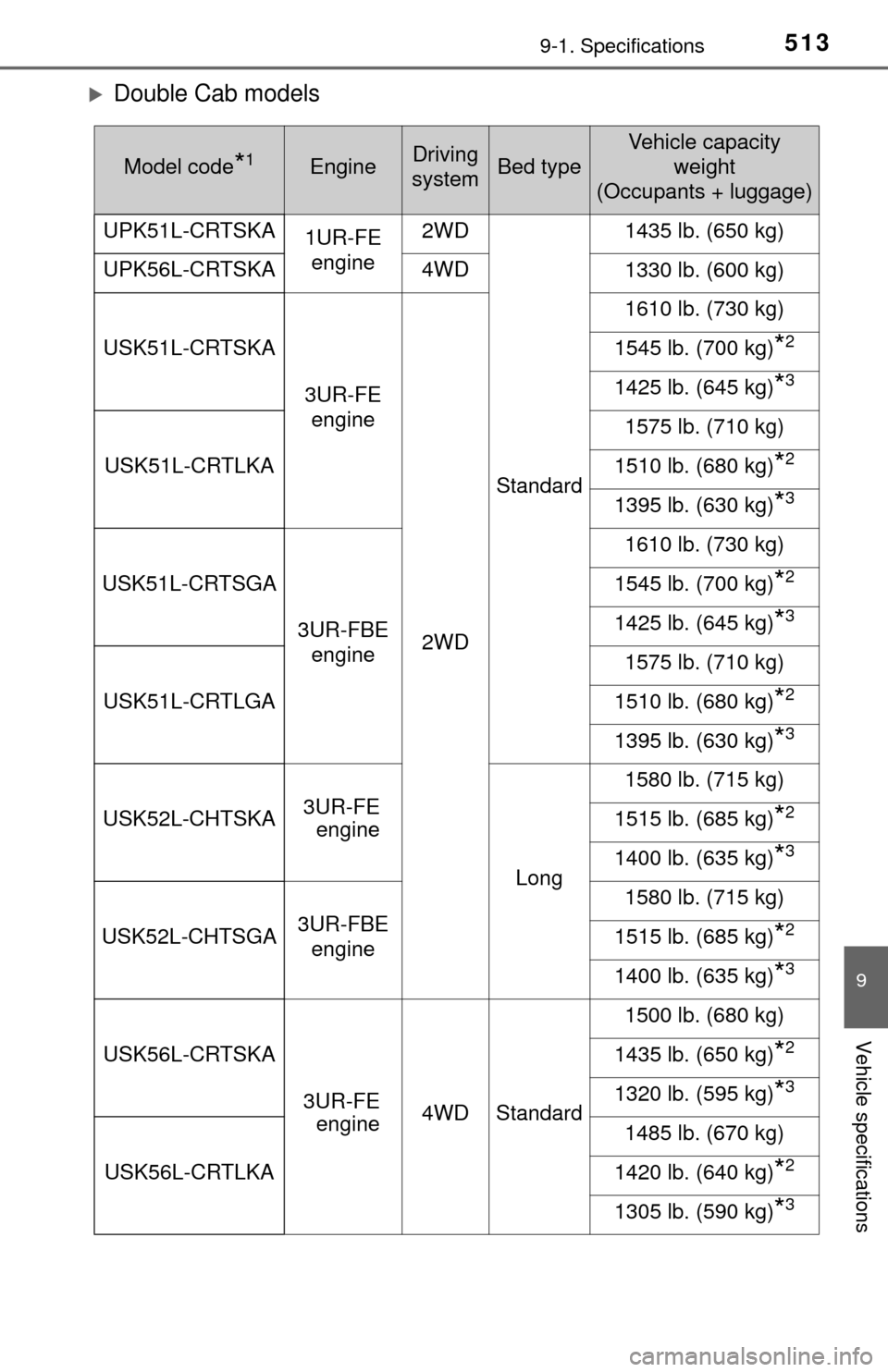
Double Cab models
Model code*1EngineDriving
systemBed type
Vehicle capacity weight
(Occupants + luggage)
UPK51L-CRTSKA 1UR-FE
engine 2WD
Standard
1435 lb. (650 kg)
UPK56L-CRTSKA 4WD
1330 lb. (600 kg)
USK51L-CRTSKA 3UR-FE engine
2WD
1610 lb. (730 kg)
1545 lb. (700 kg)*2
1425 lb. (645 kg)*3
USK51L-CRTLKA
1575 lb. (710 kg)
1510 lb. (680 kg)*2
1395 lb. (630 kg)*3
USK51L-CRTSGA 3UR-FBE engine
1610 lb. (730 kg)
1545 lb. (700 kg)*2
1425 lb. (645 kg)*3
USK51L-CRTLGA
1575 lb. (710 kg)
1510 lb. (680 kg)*2
1395 lb. (630 kg)*3
USK52L-CHTSKA 3UR-FE
engine
Long
1580 lb. (715 kg)
1515 lb. (685 kg)*2
1400 lb. (635 kg)*3
USK52L-CHTSGA3UR-FBE
engine
1580 lb. (715 kg)
1515 lb. (685 kg)*2
1400 lb. (635 kg)*3
USK56L-CRTSKA
3UR-FE engine 4WD Standard
1500 lb. (680 kg)
1435 lb. (650 kg)*2
1320 lb. (595 kg)*3
USK56L-CRTLKA
1485 lb. (670 kg)
1420 lb. (640 kg)*2
1305 lb. (590 kg)*3
Page 514 of 588
5149-1. Specifications
*1: The model code is indicated on the Certification Label. (→P. 519)
*2: Vehicles with towing package
*3: Vehicles with towing package and large fuel tank
Model code*1EngineDriving
systemBed type
Vehicle capacity
weight
(Occupants + luggage)
USK57L-CHTSKA 3UR-FE
engine
4WDLong
1475 lb. (665 kg)
1410 lb. (635 kg)*2
1295 lb. (585 kg)*3
USK56L-CRTSGA
3UR-FBE engine Standard
1500 lb. (680 kg)
1435 lb. (650 kg)*2
1320 lb. (595 kg)*3
USK56L-CRTLGA
1485 lb. (670 kg)
1420 lb. (640 kg)*2
1305 lb. (590 kg)*3
USK57L-CHTSGA
Long
1475 lb. (665 kg)
1410 lb. (635 kg)*2
1295 lb. (585 kg)*3
Page 515 of 588
5159-1. Specifications
9
Vehicle specifications
CrewMax models
Model code*1EngineDriving
systemBed type
Vehicle capacity weight
(Occupants + luggage)
UPK51L-PSTSKA 1UR-FE engine 2WD
Short
1390 lb. (630 kg)
1355 lb. (610 kg)*2
UPK56L-PSTSKA 4WD1280 lb. (580 kg)
1245 lb. (560 kg)*2
USK51L-PSTSKA
3UR-FE engine 2WD
1545 lb. (700 kg)
1510 lb. (680 kg)*2
1480 lb. (670 kg)*3
1360 lb. (615 kg)*4
1445 lb. (655 kg)*5
1325 lb. (600 kg)*6
USK51L-PSTLKA
1515 lb. (685 kg)
1480 lb. (670 kg)*2
1450 lb. (655 kg)*3
1335 lb. (605 kg)*4
1415 lb. (640 kg)*5
1300 lb. (585 kg)*6
USK51L-PSTZKA
1505 lb. (680 kg)
1470 lb. (665 kg)*2
1440 lb. (650 kg)*3
1320 lb. (595 kg)*4
1400 lb. (635 kg)*5
1285 lb. (580 kg)*6