Page 239 of 588

2394-5. Using the driving support systems
4
Driving
If the vehicle gets stuck in fresh snow or mud, A-TRAC system may
reduce power from the engine to the wheels. You may need to turn
the system off to enable you to rock the vehicle in order to free it.Stop the vehicle completely,
and press the VSC off switch
for more than 3 seconds.
The “TRACTION CONTROL
OFF” will be shown on the dis-
play.
Press the switch again to turn
the system back on.
■When the “TRAC OFF” indicator light comes on or the message is dis-
played on the multi-information disp lay showing that “TRACTION CON-
TROL OFF” has been disabled even if the VSC off switch has not been
pressed
TRAC cannot be operated. Contact your Toyota dealer.
■ Sounds and vibrations caused by the ABS, brake assist, VSC, TRAC, A-
TRAC and Trailer Sway Control systems
●A sound may be heard from the engine compartment when the brake pedal
is depressed repeatedly, when the engine is started or just after the vehicle
begins to move. This sound does not indicate that a malfunction has
occurred in any of these systems.
● Any of the following conditions may occur when the above systems are
operating. None of these indicates that a malfunction has occurred.
• Vibrations may be felt through the vehicle body and steering.
• A motor sound may be heard after the vehicle comes to a stop.
• The brake pedal may pulsate slightly after the ABS is activated.
• The brake pedal may move down slightly after the ABS is activated.
Disabling the A-TRAC system (4L mode on 4WD models)
Page 247 of 588
2474-6. Driving tips
4
Driving
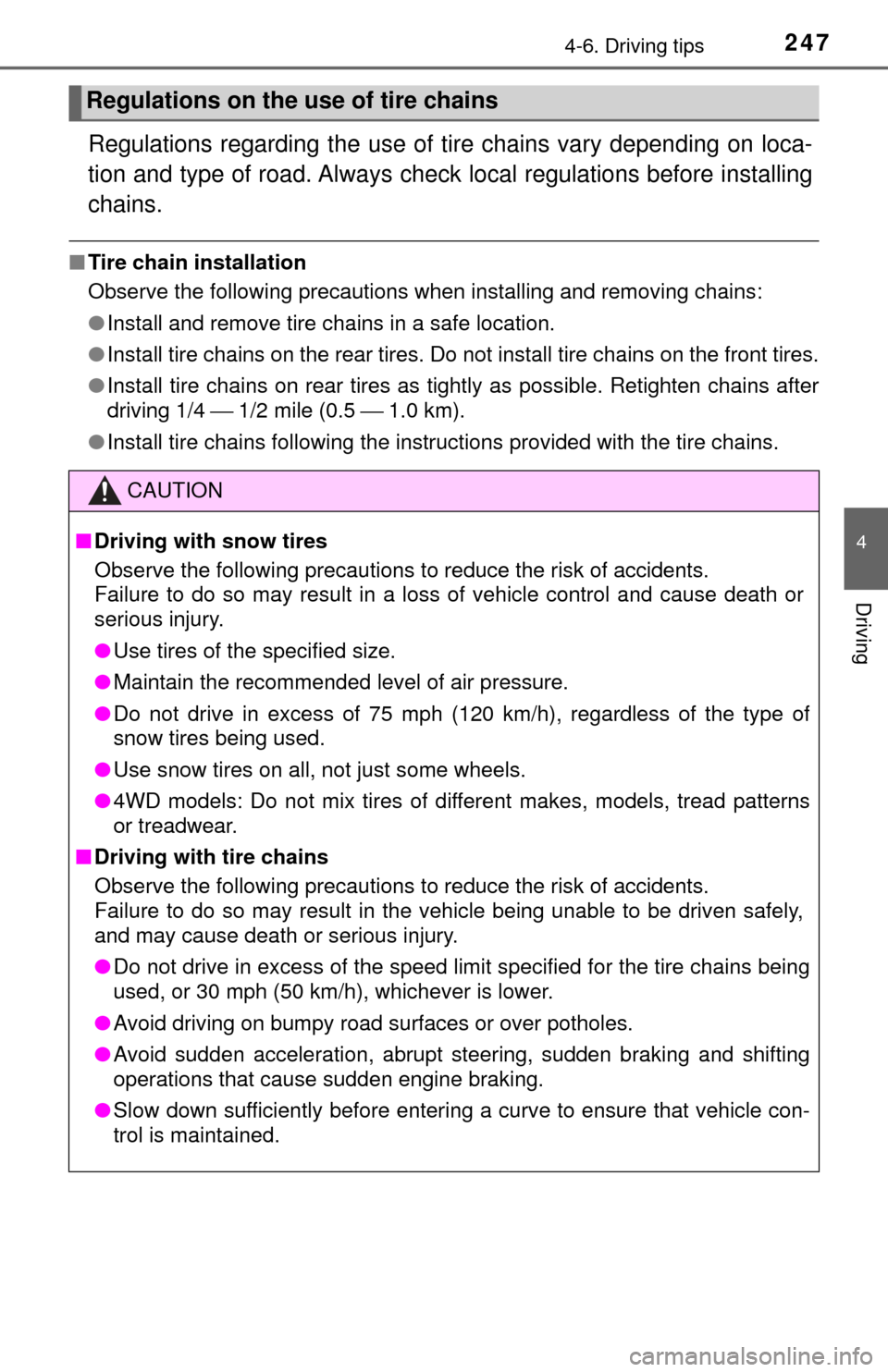
Regulations regarding the use of tire chains vary depending on loca-
tion and type of road. Always check local regulations before installing
chains.
■ Tire chain installation
Observe the following precautions when installing and removing chains:
●Install and remove tire chains in a safe location.
● Install tire chains on the rear tires. Do not install tire chains on the front tires.
● Install tire chains on rear tires as tightly as possible. Retighten chai\
ns after
driving 1/4 ⎯ 1/2 mile (0.5 ⎯ 1.0 km).
● Install tire chains following the instructions provided with the tire ch\
ains.
Regulations on the use of tire chains
CAUTION
■Driving with snow tires
Observe the following precautions to reduce the risk of accidents.
Failure to do so may result in a loss of vehicle control and cause death or
serious injury.
● Use tires of the specified size.
● Maintain the recommended level of air pressure.
● Do not drive in excess of 75 mph (120 km/h), regardless of the type of
snow tires being used.
● Use snow tires on all, not just some wheels.
● 4WD models: Do not mix tires of different makes, models, tread patterns
or treadwear.
■ Driving with tire chains
Observe the following precautions to reduce the risk of accidents.
Failure to do so may result in the vehicle being unable to be driven safely,
and may cause death or serious injury.
● Do not drive in excess of the speed limit specified for the tire chains being
used, or 30 mph (50 km/h), whichever is lower.
● Avoid driving on bumpy road surfaces or over potholes.
● Avoid sudden acceleration, abrupt steering, sudden braking and shifting
operations that cause sudden engine braking.
● Slow down sufficiently before entering a curve to ensure that vehicle con-
trol is maintained.
Page 470 of 588
4708-2. Steps to take in an emergency
If a tow truck is not available in an emergency, your vehicle may be
temporarily towed using cables or chains secured to the emergency
towing hooks. This should only be attempted on hard surfaced roads
for at most 50 miles (80 km) at under 18 mph (30km/h).
A driver must be in the vehicle to steer and operate the brakes. The
vehicle’s wheels, drive train, axles, steering and brakes must be in
good condition.
Securely attach cables or chains to the towing hooks.
Take care not to damage the vehicle body.
Enter the vehicle being towed and start the engine.
If the engine does not start, turn the engine switch to the “ON” position.
4WD models: Put the front-wheel drive control switch in “2WD”.
Shift the shift lever to N and release the parking brake.
When the shift lever cannot be shifted: (→P. 188)
Emergency towing
Emergency towing procedure
1
Ty p e AType B
2
3
4
Page 471 of 588

4718-2. Steps to take in an emergency
8
When trouble arises
CAUTION
Observe the following precautions.
Failure to do so may result in death or serious injury.
■When towing the vehicle
2WD models: Be sure to transport the
vehicle with all four wheels raised off the
ground. If the vehicle is towed with the
tires contacting the ground, the drivetrain
and related parts may be damaged or an
accident may occur due to a change in
direction of the vehicle.
4WD models: Be sure to transport the
vehicle with all four wheels raised off the
ground. If the vehicle is towed with the
tires contacting the ground, the drivetrain
or related parts may be damaged, the
vehicle may fly off the truck.
■ While towing
● When towing using cables or chains, avoid sudden starts, etc. which
place excessive stress on the towing hooks, cables or chains. The tow-
ing hooks, cables or chains may become damaged, broken debris may
hit people, and cause serious damage.
● Do not turn the engine switch to the “LOCK” position.
There is a possibility that the steering wheel is locked and cannot be
operated.
Page 499 of 588

4998-2. Steps to take in an emergency
8
When trouble arises
CAUTION
■When using the temporary spare tire
●Remember that the temporary spare tire provided is specifically
designed for use with your vehicle. Do not use your temporary spare
tire on another vehicle.
●Do not use more than one temporary spare tires simultaneously.
●Replace the temporary spare tire with a standard tire as soon as possi-
ble.
●Avoid sudden acceleration, abrupt steering, sudden braking and shift-
ing operations that cause sudden engine braking.
■When the spare tire is attached
The vehicle speed may not be correctly detected, and the following sys-
tems may not operate correctly:
●ABS & Brake assist
●VSC
●TRAC
●A-TRAC
●AUTO LSD
●Cruise control (if equipped)
●Navigation system (if equipped)
Also, not only can the following system not be utilized fully, but it may
even negatively affect the drive-train components:
●4WD system
■Speed limit when using the temporary spare tire
Do not drive at speeds in excess of 50 mph (80 km/h) when a temporary
spare tire is installed on the vehicle.
The temporary spare tire is not designed for driving at high speeds. Fail-
ure to observe this precaution may lead to an accident causing death or
serious injury.
Page 511 of 588
5119-1. Specifications
9
Vehicle specifications
4WD models
*1: Unladen vehicle
*2: P255/70R18 tires
*3: P275/65R18 tires
*4: P275/55R20 tires
Cab type Regular Cab Double CabCrewMax
Bed type Long Standard Long Short
Overall
length228.9 in. (5815 mm) 247.8 in.
(6295 mm) 228.9 in.
(5815 mm)
Overall
width 79.9 in. (2030 mm)
Overall
height
*1
76.1 in.
(1935 mm)
*276.3 in.
(1940 mm)
*276.1 in.
(1935 mm)
*2
75.9 in.
(1930 mm)
*376.1 in.
(1935 mm)
*3,*475.9 in.
(1930 mm)
*3,*4
Wheelbase 145.6 in. (3700 mm) 164.5 in.
(4180 mm) 145.6 in.
(3700 mm)
Front tread 67.9 in. (1725 mm)
Rear tread 67.9 in. (1725 mm)
Page 512 of 588
5129-1. Specifications
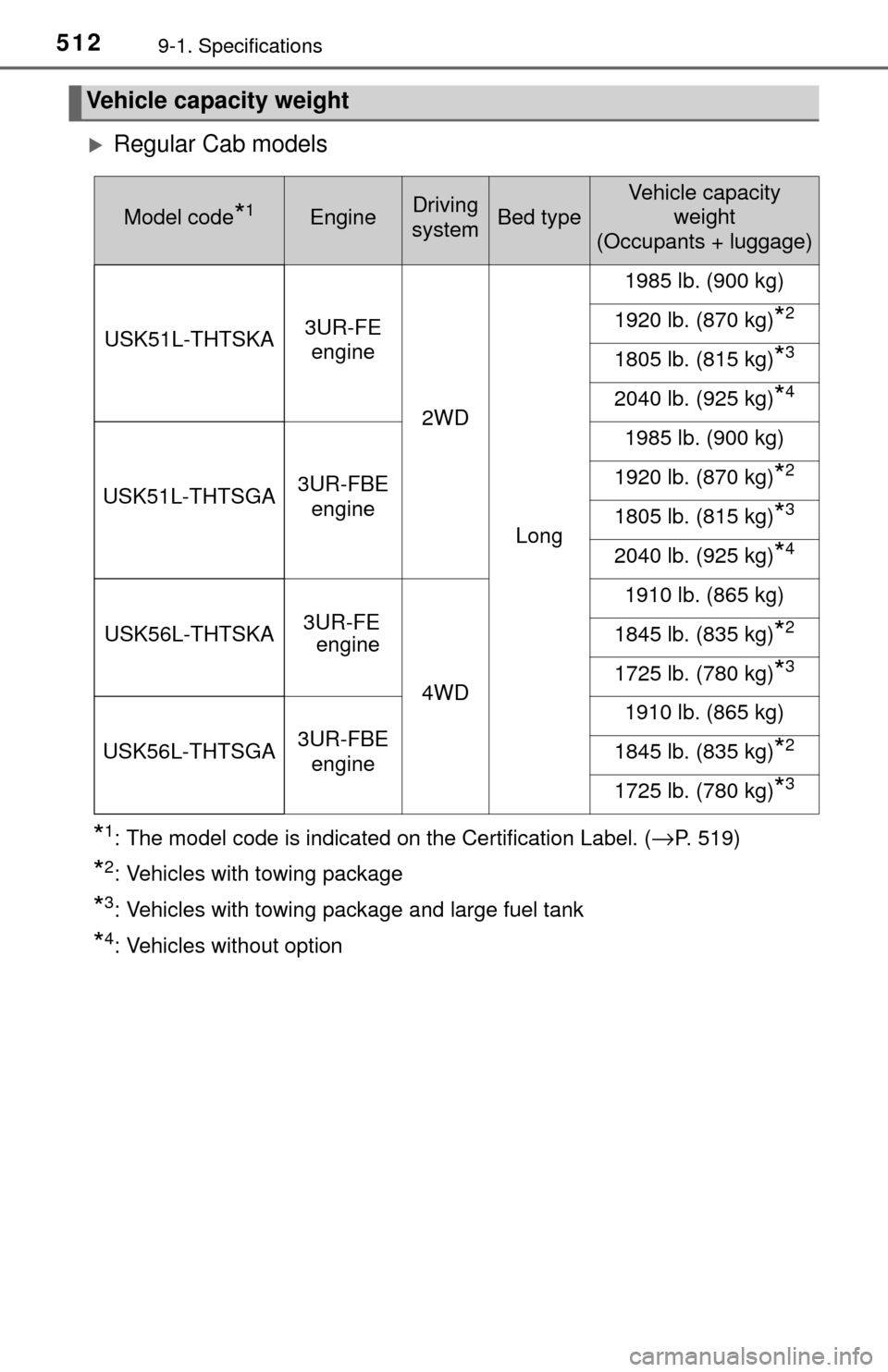
Regular Cab models
*1: The model code is indicated on the Certification Label. (→P. 519)
*2: Vehicles with towing package
*3: Vehicles with towing package and large fuel tank
*4: Vehicles without option
Vehicle capacity weight
Model code*1EngineDriving
systemBed type
Vehicle capacity weight
(Occupants + luggage)
USK51L-THTSKA 3UR-FE
engine
2WD
Long
1985 lb. (900 kg)
1920 lb. (870 kg)*2
1805 lb. (815 kg)*3
2040 lb. (925 kg)*4
USK51L-THTSGA 3UR-FBE
engine
1985 lb. (900 kg)
1920 lb. (870 kg)*2
1805 lb. (815 kg)*3
2040 lb. (925 kg)*4
USK56L-THTSKA 3UR-FE
engine
4WD
1910 lb. (865 kg)
1845 lb. (835 kg)*2
1725 lb. (780 kg)*3
USK56L-THTSGA 3UR-FBE
engine
1910 lb. (865 kg)
1845 lb. (835 kg)*2
1725 lb. (780 kg)*3
Page 513 of 588
5139-1. Specifications
9
Vehicle specifications
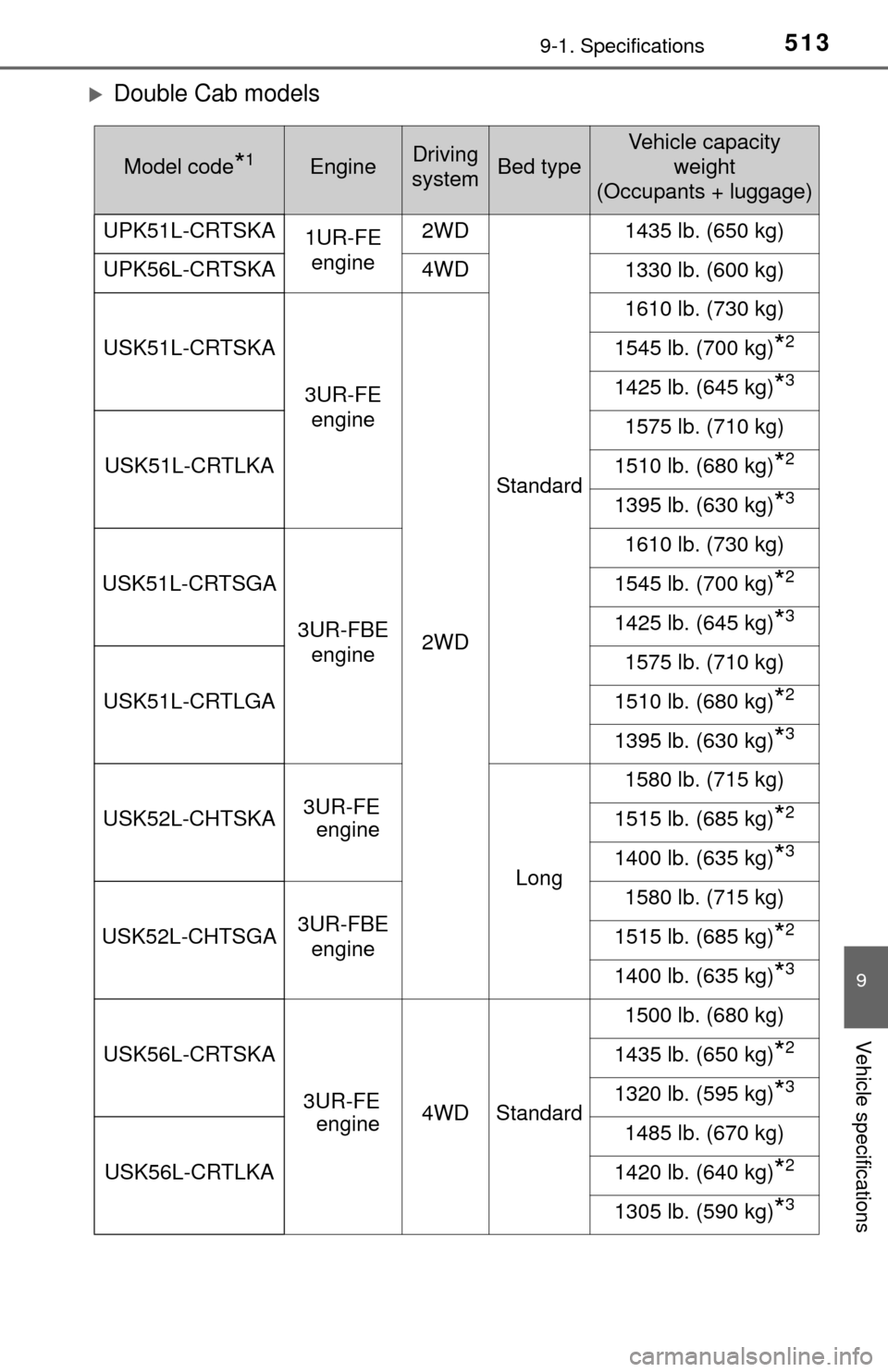
Double Cab models
Model code*1EngineDriving
systemBed type
Vehicle capacity weight
(Occupants + luggage)
UPK51L-CRTSKA 1UR-FE
engine 2WD
Standard
1435 lb. (650 kg)
UPK56L-CRTSKA 4WD
1330 lb. (600 kg)
USK51L-CRTSKA 3UR-FE engine
2WD
1610 lb. (730 kg)
1545 lb. (700 kg)*2
1425 lb. (645 kg)*3
USK51L-CRTLKA
1575 lb. (710 kg)
1510 lb. (680 kg)*2
1395 lb. (630 kg)*3
USK51L-CRTSGA 3UR-FBE engine
1610 lb. (730 kg)
1545 lb. (700 kg)*2
1425 lb. (645 kg)*3
USK51L-CRTLGA
1575 lb. (710 kg)
1510 lb. (680 kg)*2
1395 lb. (630 kg)*3
USK52L-CHTSKA 3UR-FE
engine
Long
1580 lb. (715 kg)
1515 lb. (685 kg)*2
1400 lb. (635 kg)*3
USK52L-CHTSGA3UR-FBE
engine
1580 lb. (715 kg)
1515 lb. (685 kg)*2
1400 lb. (635 kg)*3
USK56L-CRTSKA
3UR-FE engine 4WD Standard
1500 lb. (680 kg)
1435 lb. (650 kg)*2
1320 lb. (595 kg)*3
USK56L-CRTLKA
1485 lb. (670 kg)
1420 lb. (640 kg)*2
1305 lb. (590 kg)*3