2017 TOYOTA TUNDRA Interior
[x] Cancel search: InteriorPage 58 of 588

581-1. For safe use
CAUTION
■Child restraint precautions
● For effective protection in automobile accidents and sudden stops, a child
must be properly restrained, using a seat belt or child restraint system
depending on the age and size of the child. Holding a child in your arms is
not a substitute for a child restraint system. In an accident, the child can be
crushed against the windshield, or between you and the vehicle’s interior.
● Regular Cab models: Toyota strongly urges the use of a proper child
restraint system that conforms to the size of the child.
● Double Cab and CrewMax models: Toyota strongly urges the use of a
proper child restraint system that conforms to the size of the child, installed
on the rear seat. According to accident statistics, the child is safer when
properly restrained in the rear seat than in the front seat.
● Never install a rear-facing child restraint system on the front passenger
seat even if the “AIR BAG OFF” indicator light is illuminated.
In the event of an accident, the force of the rapid inflation of the front pas-
senger airbag can cause death or serious injury to the child if the rear-fac-
ing child restraint system is installed on the front passenger seat.
● Regular Cab models: A forward-facing child restraint system may be
installed on the front passenger seat only when it is unavoidable. Adjust
the seatback as upright as possible and always move the seat as far back
as possible even if the “AIR BAG OFF” indicator light is illuminat\
ed,
because the front passenger airbag could inflate with considerable speed
and force. Otherwise, the child may be killed or seriously injured.
● Double Cab and CrewMax models: A forward-facing child restraint system
may be installed on the front passenger seat only when it is unavoidable.
A child restraint system that requires a top tether strap should not be used
in the front passenger seat since there is no top tether strap anchor for the
front passenger seat. Adjust the seatback as upright as possible and
always move the seat as far back as possible even if the “AIR BAG OFF”
indicator light is illuminated, because the front passenger airbag could
inflate with considerable speed and force. Otherwise, the child may be
killed or seriously injured.
● Regular Cab models: Do not install a child restraint system on the center
seat if it interferes with driving operations such as changing the shift lever
position. In this case, install the child restraint system on the right passen-
ger seat.
Page 77 of 588

771-1. For safe use
1
For safety and security
Exhaust gas precautions
Harmful substance to the human body is included in exhaust
gases if inhale.
CAUTION
Exhaust gases include harmful carbon monoxide (CO), which is colorless and
odorless. Observe the following precautions.
Failure to do so may cause exhaust gases to enter the vehicle and may lead
to an accident caused by light-headedness, or may lead to death or a serious
health hazard.
■Important points while driving
● Double Cab and CrewMax models: Keep the back window closed.
● Double Cab and CrewMax models: If you smell exhaust gases in the vehi-
cle even when the back window is closed, open the windows and have the
vehicle inspected at your Toyota dealer as soon as possible.
● Toyota does not recommend occupying the rear cargo area when it is fitted
with a slide-in camper, camper shell or other type cover while the engine is
running. This caution applies to both driving and stopped or parked situa-
tions with the engine running. Particular care should be taken to prevent
exhaust gases from entering camper bodi es, trailers or other enclosures
on or around your vehicle. If exhaust fumes are detected, open all win-
dows and thoroughly ventilate the area.
■ When parking
● If the vehicle is in a poorly ventilated area or a closed area, such as a
garage, stop the engine.
● Do not leave the vehicle with the engine on for a long time.
If such a situation cannot be avoided, park the vehicle in an open space
and ensure that exhaust fumes do not enter the vehicle interior.
● Do not leave the engine running in an area with snow build-up, or where it
is snowing. If snowbanks build up around the vehicle while the engine is
running, exhaust gases may collect and enter the vehicle.
■ Exhaust pipe
The exhaust system needs to be checked periodically. If there is a hole or
crack caused by corrosion, damage to a joint or abnormal exhaust noise, be
sure to have the vehicle inspected and repaired by your Toyota dealer.
Page 95 of 588

952. Instrument cluster
2
Instrument cluster
■To select the units
Informationmiles (MPG US)km (L/100km)
Average fuel consumptionMPGL/100km
Driving rangemileskm
Outside temperature display°F°C
NOTICE
■The multi-information disp lay at low temperatures
Allow the interior of the vehicle to warm up before using the liquid crystal
information display. At extremely low temperatures, the information display
monitor may respond slowly, and display changes may be delayed.
Page 150 of 588

1504-1. Before driving
CAUTION
■If you hear a squealing or scrapi ng noise (brake pad wear limit indica-
tors)
Have the brake pads checked and replaced by your Toyota dealer as soon
as possible.
Rotor damage may result if the pads are not replaced when needed.
It is dangerous to drive the vehicle when the wear limits of the brake pads
and/or those of the brake discs are exceeded.
■ When the vehicle is stopped
● Do not race the engine.
If the vehicle is in any gear other than P or N, the vehicle may accelerate
suddenly and unexpectedly, causing an accident.
● In order to prevent accidents due to the vehicle rolling away, always keep
depressing the brake pedal while the engine is running, and apply the
parking brake as necessary.
● If the vehicle is stopped on an incline, in order to prevent accidents caused
by the vehicle rolling forward or backward, always depress the brake pedal
and securely apply the parking brake as needed.
● Avoid revving or racing the engine.
Running the engine at high speed while the vehicle is stopped may cause
the exhaust system to overheat, which could result in a fire if combusti\
ble
material is nearby.
■ When the vehicle is parked
● Do not leave glasses, cigarette lighters, spray cans, or soft drink cans in
the vehicle when it is in the sun.
Doing so may result in the following:
• Gas may leak from a cigarette lighter or spray can, and may lead to a
fire.
• The temperature inside the vehicle may cause the plastic lenses and plastic material of glasses to deform or crack.
• Soft drink cans may rupture, causing the contents to spray over the
interior of the vehicle, and may also cause a short circuit in the vehicle’s
electrical components.
● Do not leave cigarette lighters in the vehicle. If a cigarette lighter is in a
place such as the glove box or on the floor, it may be lit accidentally when
luggage is loaded or the seat is adjusted, causing a fire.
● Do not attach adhesive discs to the windshield or windows. Do not place
containers such as air fresheners on the instrument panel or dashboard.
Adhesive discs or containers may act as lenses, causing a fire in the vehi-
cle.
Page 345 of 588

345
6Interior features
6-1. Using the air conditioning system
Manual air conditioning system............................. 346
Automatic air conditioning system............................. 353
Seat heaters/ seat ventilators ................ 360
6-2. Using the interior lights Interior lights list ................ 363• Personal/interior lightsmain switch ................... 364
• Personal/interior
lights ............................. 364
• Cargo lamp main switch ............................ 365 6-3. Using the storage features
List of storage features ..... 366• Glove box...................... 368
• Console box (front separated type seat) ..... 369
• Card holder ................... 370
• Map holder (front bench type seat) ........... 372
• Pen holder .................... 373
• Tissue pocket................ 374
• Overhead console......... 375
• Cup holders .................. 376
• Bottle holders ................ 378
• Auxiliary boxes (front bench type seat) ........... 379
• Storage box .................. 381
Luggage compartment features ........................... 383
6-4. Using the other interior features Other interior features ....... 384• Sun visors ..................... 384
• Vanity mirrors................ 384
• Clock ............................. 385
• Outside temperature display........................... 386
• Power outlets ................ 387
• Armrest ......................... 389
• Assist grips ................... 390
Garage door opener.......... 391
Compass ........................... 397
Page 347 of 588
3476-1. Using the air conditioning system
6
Interior features
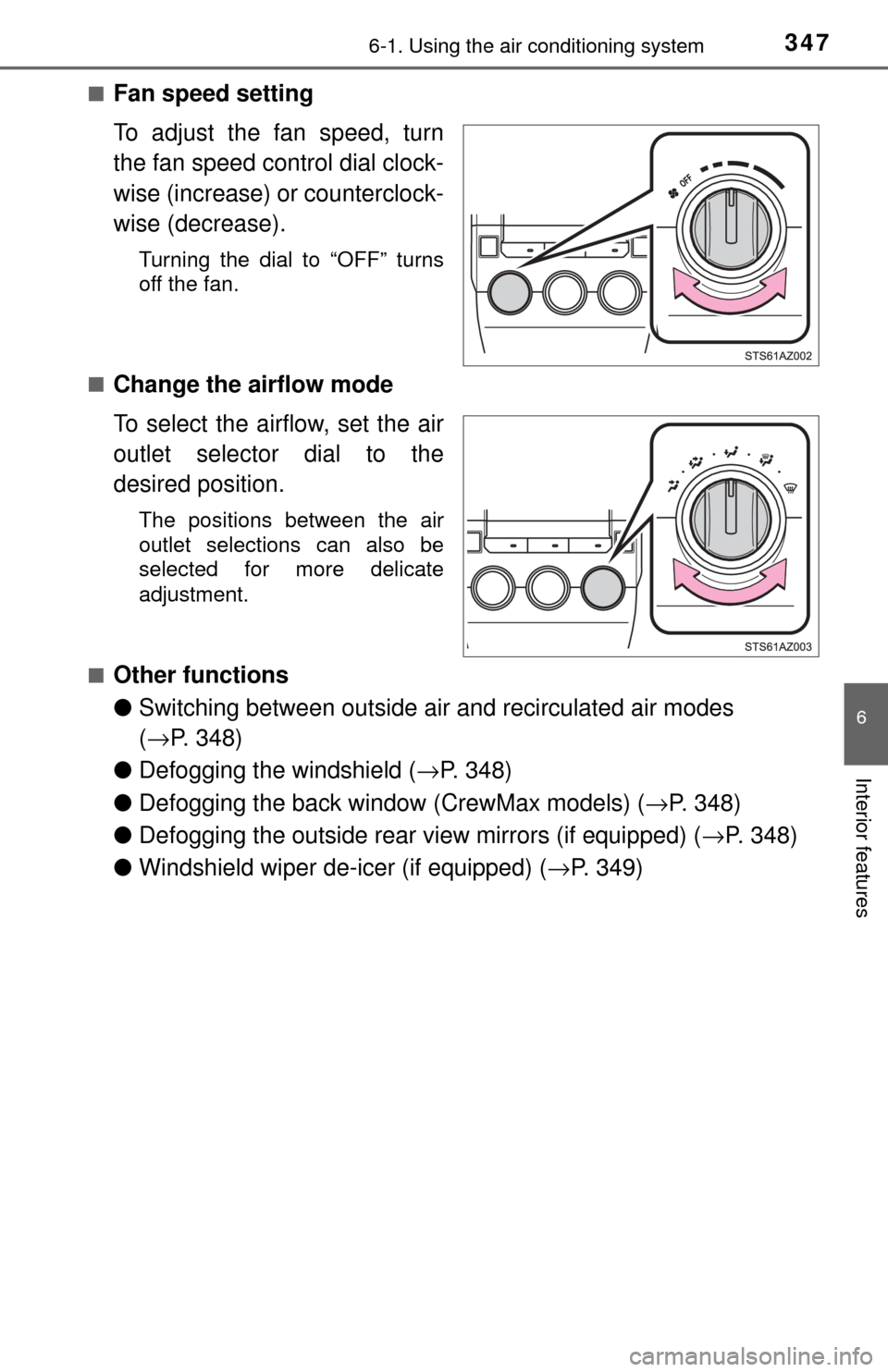
■Fan speed setting
To adjust the fan speed, turn
the fan speed control dial clock-
wise (increase) or counterclock-
wise (decrease).
Turning the dial to “OFF” turns
off the fan.
■
Change the airflow mode
To select the airflow, set the air
outlet selector dial to the
desired position.
The positions between the air
outlet selections can also be
selected for more delicate
adjustment.
■
Other functions
● Switching between outside ai r and recirculated air modes
( → P. 348)
● Defogging the windshield ( →P. 348)
● Defogging the back window (CrewMax models) ( →P. 348)
● Defogging the outside rear view mirrors (if equipped) ( →P. 348)
● Windshield wiper de-icer (if equipped) ( →P. 349)
Page 349 of 588

3496-1. Using the air conditioning system
6
Interior features
■Windshield wiper de-icer (if equipped)
This feature is used to prevent ice from building up on the wind-
shield and wiper blades.
Press or .
The defogger will automatically turn off after approximately 15 minutes.
Regular Cab and Double Cab models: Turning the outside rear view mirror
defoggers on will turn the windshield wiper de-icer on.
CrewMax models: Turning the back window defogger on will turn the wind-
shield wiper de-icer on.
■
Location of air outlets
Air outlets and air volume
changes according to the
selected airflow mode.
*1: Double Cab and CrewMax models
*2: CrewMax models
■
Adjusting the position and open ing and closing the air outlets
Front
Direct air flow to the left or right,
up or down.
Air outlets
*2
*1
*1
Page 351 of 588

3516-1. Using the air conditioning system
6
Interior features
■Fogging up of the windows
●The windows will easily fog up when the humidity in the vehicle is high.
Turning on will dehumidify the air from the outlets and defog the
windshield effectively.
● If you turn off, the windows may fog up more easily.
● The windows may fog up if the recirculated air mode is used.
■ Outside/recirculated air mode
When driving on dusty roads such as tunnels or in heavy traffic, set the out-
side/recirculated air mode button to the recirculated air mode. This is effective
in preventing outside air from entering the vehicle interior. During cooling
operation, setting the recirculated air mode will also cool the vehicle interior
effectively.
■ When the outside temperature exceeds 75 °F (24 °C) and air conditioning
system is on
● In order to reduce the air conditioning power consumption, the air condition-
ing system may switch to recirculated air mode automatically. This may also
reduce fuel consumption.
● Recirculated air mode is selected as a default mode when the engine switch
is in the “ON” position.
● It is possible to switch to outside air mode at any time by pressing .
■ When the outside temperat ure falls to nearly 32°F (0°C)
The dehumidification function may not operate even when is
pressed.
■ Ventilation and air conditioning odors
●To let fresh air in, set the air conditioning system to the outside air m\
ode.
● During use, various odors from inside and outside the vehicle may enter into
and accumulate in the air conditioning system. This may then cause odor to
be emitted from the vents.
● To reduce potential odors from occurring:
It is recommended that the air conditioning system be set to outside air
mode prior to turning the vehicle off.
■ Air conditioning filter
→P. 440