2017 TOYOTA TACOMA parking brake
[x] Cancel search: parking brakePage 3 of 640

3
1
9 8
7 5 4
3
2
10
6
4-1. Before drivingDriving the vehicle ............. 156
Cargo and luggage............ 165
Vehicle load limits ............. 169
Trailer towing..................... 170
Dinghy towing.................... 188
4-2. Driving procedures Engine (ignition) switch (vehicles without
a smart key system) ........ 189
Engine (ignition) switch (vehicles with a smart
key system) ..................... 192
Automatic transmission ..... 197
Manual transmission ......... 202
Turn signal lever................ 204
Parking brake .................... 205
4-3. Operating the lights and wipers
Headlight switch ................ 206
Fog light switch ................. 210
Windshield wipers and washer ............................ 211
4-4. Refueling Opening the fuel tank cap .................................. 214 4-5. Using the driving support
systems
Cruise control .................... 218
Intuitive parking assist ....... 223
Rear view monitor system ............................. 229
BSM (Blind Spot Monitor)......... 239
• The Blind Spot Monitor function.......................... 241
• The Rear Cross Traffic Alert function ................. 244
Four-wheel drive system ... 247
AUTO LSD system ............ 251
Rear differential lock system ............................. 253
Active traction control system ............................. 256
Multi-terrain Select............. 258
Crawl Control ..................... 262
Clutch start cancel switch .............................. 266
Driving assist systems ....... 267
4-6. Driving tips Winter driving tips .............. 273
Off-road precautions .......... 277
4Driving
Page 17 of 640
17Pictorial index
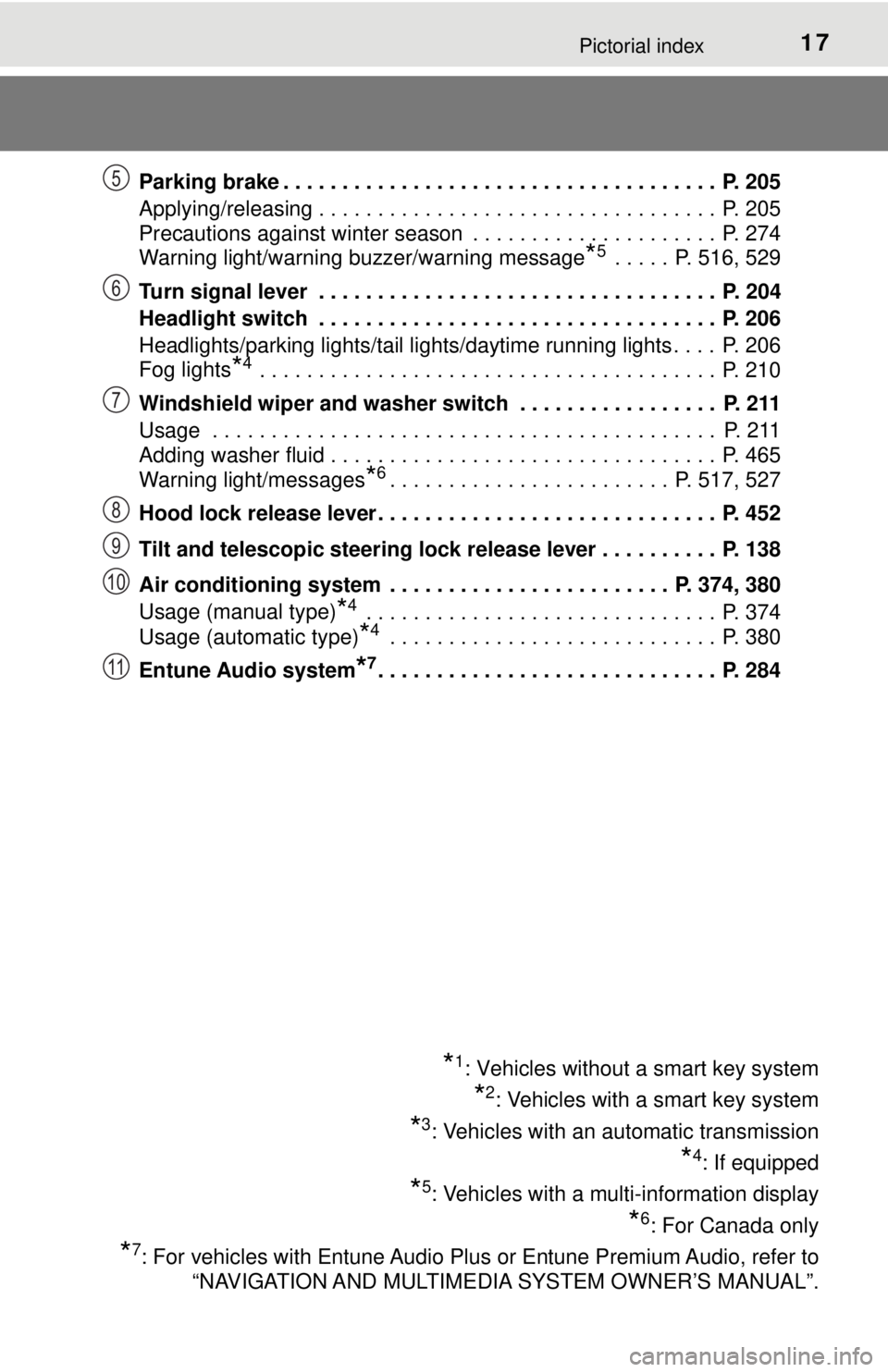
Parking brake . . . . . . . . . . . . . . . . . . . . . . . . . . . . . . . . . . . . . P. 205
Applying/releasing . . . . . . . . . . . . . . . . . . . . . . . . . . . . . . . . . . P. 205
Precautions against winter season . . . . . . . . . . . . . . . . . . . . . P. 274
Warning light/warning buzzer/warning message
*5 . . . . . P. 516, 529
Turn signal lever . . . . . . . . . . . . . . . . . . . . . . . . . . . . . . . . . . P. 204
Headlight switch . . . . . . . . . . . . . . . . . . . . . . . . . . . . . . . . . . P. 206
Headlights/parking lights/tail lights/daytime running lights . . . . P. 206
Fog lights
*4 . . . . . . . . . . . . . . . . . . . . . . . . . . . . . . . . . . . . . . . P. 210
Windshield wiper and washer switch . . . . . . . . . . . . . . . . . P. 211
Usage . . . . . . . . . . . . . . . . . . . . . . . . . . . . . . . . . . . . . . . . . . . P. 211
Adding washer fluid . . . . . . . . . . . . . . . . . . . . . . . . . . . . . . . . . P. 465
Warning light/messages
*6. . . . . . . . . . . . . . . . . . . . . . . . P. 517, 527
Hood lock release lever. . . . . . . . . . . . . . . . . . . . . . . . . . . . . P. 452
Tilt and telescopic steering lock release lever . . . . . . . . . . P. 138
Air conditioning system . . . . . . . . . . . . . . . . . . . . . . . . P. 374, 380
Usage (manual type)
*4 . . . . . . . . . . . . . . . . . . . . . . . . . . . . . . P. 374
Usage (automatic type)
*4 . . . . . . . . . . . . . . . . . . . . . . . . . . . . P. 380
Entune Audio system
*7. . . . . . . . . . . . . . . . . . . . . . . . . . . . . P. 284
*1: Vehicles without a smart key system
*2: Vehicles with a smart key system
*3: Vehicles with an automatic transmission
*4: If equipped
*5: Vehicles with a multi-information display
*6: For Canada only
*7: For vehicles with Entune Audio Plus or Entune Premium Audio, refer to “NAVIGATION AND MULTIMEDIA SYSTEM OWNER’S MANUAL”.
5
6
7
8
9
10
11
Page 84 of 640
842. Instrument cluster
*1: These lights turn on when the engine switch is turned to the “ON” position(vehicles without a smart key system) or IGNITION ON mode (vehicles
with a smart key system) to indicate that a system check is being per-
formed. They will turn off after the engine is started, or after a few seconds.
There may be a malfunction in a system if the lights do not come on, or if
the lights do not turn off. Have the vehicle inspected by your Toyota dealer
for details.
*2: Vehicles without a multi-information display.
*3: The light comes on to indicate a malfunction.
*4: Vehicles with an automatic transmission.
*5: Vehicles with a multi-information display.
*6: Vehicles without a multi-information display:
The light flashes rapidly in yellow to indicate a malfunction.
Vehicles with a multi-information display:
The light flashes to indicate a malfunction.
*7: 2GR-FKS engine only
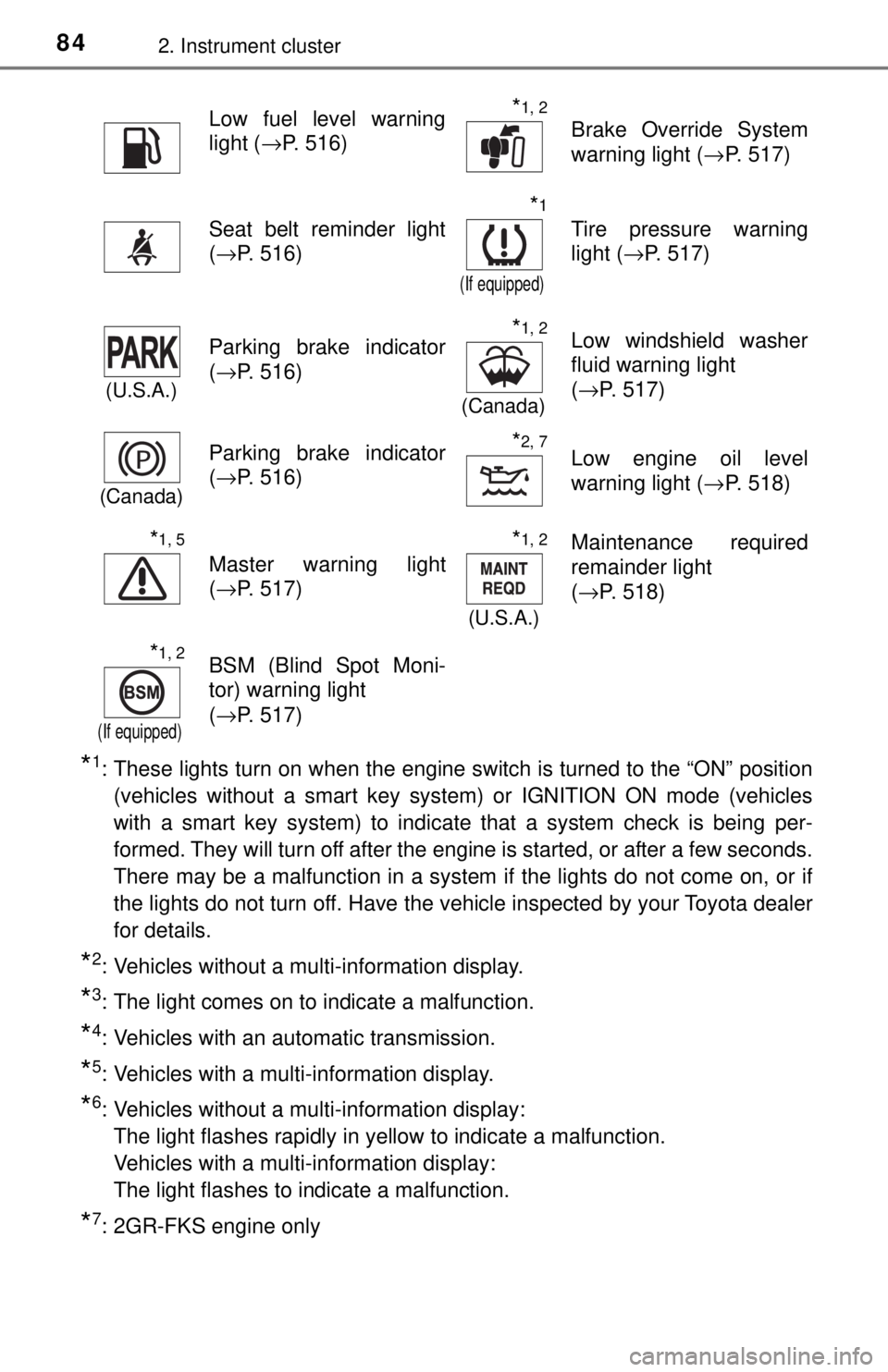
Low fuel level warning
light ( →P. 516)*1, 2
Brake Override System
warning light ( →P. 517)
Seat belt reminder light
(→P. 516)
*1
(If equipped)
Tire pressure warning
light ( →P. 517)
(U.S.A.)
Parking brake indicator
(→P. 516)*1, 2
(Canada)
Low windshield washer
fluid warning light
(→P. 517)
(Canada)
Parking brake indicator
(→P. 516)*2, 7Low engine oil level
warning light ( →P. 518)
*1, 5
Master warning light
(→P. 517)
*1, 2
(U.S.A.)
Maintenance required
remainder light
(→P. 518)
*1, 2
(If equipped)
BSM (Blind Spot Moni-
tor) warning light
(→P. 517)
Page 86 of 640
862. Instrument cluster
*1: Vehicles with an automatic transmission.
*2: For vehicles with a multi-information display, this light illuminates on themulti-information display.
*3: These lights turn on when the engine switch is turned to the “ON” position(vehicles without a smart key system) or IGNITION ON mode (vehicles
with a smart key system) to indicate that a system check is being per-
formed. They will turn off after the engine is started, or after a few seconds.
There may be a malfunction in a system if the lights do not come on, or if
the lights do not turn off. Have the vehicle inspected by your Toyota dealer
for details.
*4: The light flashes to indicate that the system is operating.
*5: This light illuminates on the multi-information display.
*6: When the outside temperature is approximately 37°F (3°C) or lower, theindicator will flash for 10 times, then comes on.
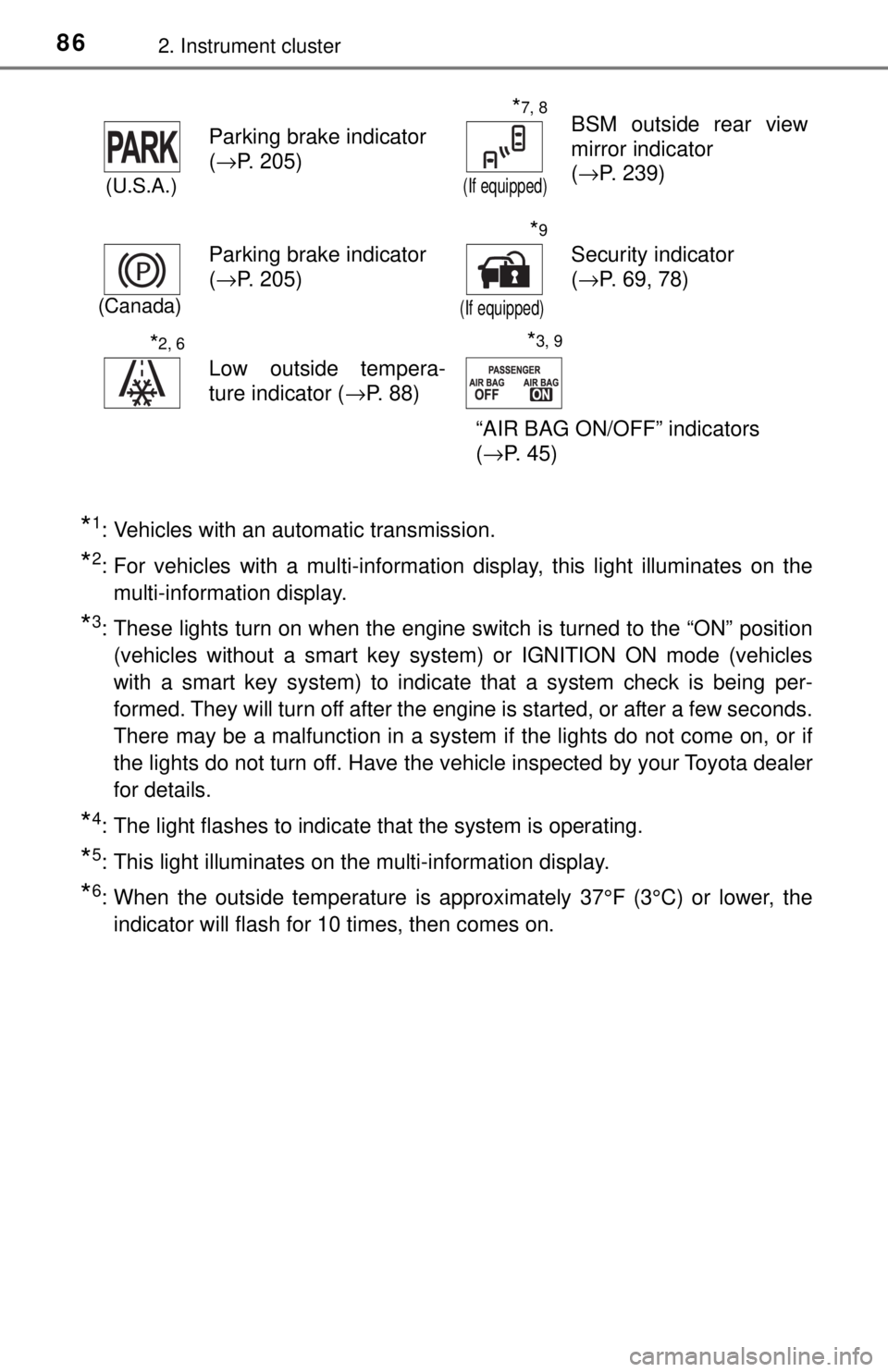
(U.S.A.)
Parking brake indicator
(→P. 205)
*7, 8
(If equipped)
BSM outside rear view
mirror indicator
(→P. 239)
(Canada)
Parking brake indicator
(→P. 205)
*9
(If equipped)
Security indicator
(→P. 69, 78)
*2, 6
Low outside tempera-
ture indicator ( →P. 88)
“AIR BAG ON/OFF” indicators
(→P. 45)
*3, 9
Page 133 of 640
1333-3. Adjusting the seats
3
Operation of each component
WARNING
■When raising the bottom cush ion or fold the seatbacks down
Observe the following precautions.
Failure to do so may result in death or serious injury.
● Stop the vehicle on level ground, set the parking brake and shift the shift
lever to P (automatic transmission) or N (manual transmission).
Access Cab models
● Do not allow anyone to raise the bottom cushion while driving.
● Do not allow anyone to sit on the auxiliary box
Double Cab models
● Do not allow anyone to fold the seatbacks down while driving.
● Do not allow anyone to sit on the folded seatbacks while driving.
■ When returning the seats to their original position
Observe the following precautions.
Failure to do so may result in death or serious injury.
● Be careful not to get your hands or feet pinched in the seat.
Access Cab models
● Make sure the bottom cushions are securely locked.
Double Cab models
● Make sure the seatback is securely locked by pushing it forward and rear-
ward on the top.
● Check that the seat belts are not twisted or caught in the seat.
● Arrange the seat belts in the proper positions for ready use.
NOTICE
■Stowing the seat belts
The seat belts and the buckles must be stowed before you raise the bottom
cushion or fold down the rear seatbacks.
Page 155 of 640

155
4Driving
4-1. Before drivingDriving the vehicle ............. 156
Cargo and luggage ........... 165
Vehicle load limits ............. 169
Trailer towing..................... 170
Dinghy towing ................... 188
4-2. Driving procedures Engine (ignition) switch (vehicles without
a smart key system) ........ 189
Engine (ignition) switch (vehicles with a smart
key system) ..................... 192
Automatic transmission ..... 197
Manual transmission ......... 202
Turn signal lever................ 204
Parking brake .................... 205
4-3. Operating the lights and wipers
Headlight switch ................ 206
Fog light switch ................. 210
Windshield wipers and washer ............................ 211
4-4. Refueling Opening the fuel tank cap .................................. 214 4-5. Using the driving support
systems
Cruise control .................... 218
Intuitive parking assist....... 223
Rear view monitor system ............................ 229
BSM (Blind Spot Monitor) ........ 239
• The Blind Spot Monitor function ......................... 241
• The Rear Cross Traffic Alert function ................. 244
Four-wheel drive system ... 247
AUTO LSD system............ 251
Rear differential lock system ............................ 253
Active traction control system ............................ 256
Multi-terrain Select ............ 258
Crawl Control .................... 262
Clutch start cancel switch .............................. 266
Driving assist systems ...... 267
4-6. Driving tips Winter driving tips ............. 273
Off-road precautions ......... 277
Page 156 of 640
1564-1. Before driving
Driving the vehicle
→P. 189, 192
Automatic transmission
With the brake pedal depressed, shift the shift lever to D. ( →P. 197)
Release the parking brake. ( →P. 205)
Gradually release the brake pedal and gently depress the accelera-
tor pedal to accelerate the vehicle.
Manual transmission
With the clutch pedal fully depressed, shift the shift lever to 1.
( → P. 202)
Release the parking brake. ( →P. 205)
Gradually release the clutch pedal. At the same time, gently
depress the accelerator pedal to accelerate the vehicle.
Automatic transmission
With the shift lever in D, depress the brake pedal.
If necessary, set the parking brake.
If the vehicle is to be stopped for an extended period of time, shift the shift
lever to P or N. ( →P. 197)
Manual transmission
While depressing the clutch pedal, depress the brake pedal.
If necessary, set the parking brake.
When the vehicle is stopped for an extended period of time, shift the shift
lever to N. (→P. 202)
The following procedures should be observed to ensure safe
driving:
Starting the engine
Driving
Stopping
1
2
3
1
2
3
1
2
1
2
Page 157 of 640
1574-1. Before driving
4
Driving
Automatic transmission
With the shift lever in D, depress the brake pedal.
Set the parking brake (→P. 205), and shift the shift lever to P
( → P. 197).
Vehicles without a smart key system: Turn the engine switch to the
“LOCK” position to stop the engine.
Vehicles with a smart key system : Press the engine switch to stop
the engine.
Lock the door, making sure that you have the key on your person.
If parking on a hill, block the wheels as needed.
Manual transmission
While depressing the clutch pedal, depress the brake pedal.
Set the parking brake. ( →P. 205)
Shift the shift lever to N. (→ P. 202)
If parking on a hill, shift the shift lever to 1 or R needed.
Turn the engine switch to the “LOC K” position to stop the engine.
Lock the door, making sure that you have the key on your person.
If parking on a hill, block the wheels as needed.
Automatic transmission
Make sure that the parking brake is set and shift the shift lever to D.
Gently depress the accelerator pedal.
Release the parking brake.
Manual transmission
With the parking brake firmly set and the clutch pedal fully
depressed, shift the shift lever to 1.
Lightly depress the accelerator pedal at the same time as gradually
releasing the clutch pedal.
Release the parking brake.
Parking the vehicle
Starting off on a steep uphill
1
2
3
4
1
2
3
4
5
1
2
3
1
2
3