Page 655 of 796

6558-2. Steps to take in an emergency
PRIUS_OM_OM47B54U_(U)
8
When trouble arises
Slip indicator lightIndicates a malfunction in:
• The VSC system;
• The TRAC system; or
• The hill-start assist control system
→ Have the vehicle inspected by your Toyota dealer
immediately.
The light will flash when the ABS, VSC or TRAC system is
operating.
High coolant temperat ure warning light
• When the light flashes:
Indicates that the engine coolant temperature is too high
The light changes from a flashing to a solid light when
the temperature further increases
→ Immediately stop the vehicle in a safe place. ( →P. 714)
• When the light comes on without flashing: Indicates a malfunction in the exhaust heat recirculator
system
→ Have the vehicle inspected by your Toyota dealer
immediately.
(Flashes)
(If equipped)
ICS OFF indicator
Indicates a malfunction in the Intelligent Clearance Sonar
function
→ Have the vehicle inspected by your Toyota dealer.
The warning light will operate as follows, even when the
system is not malfunctioning:
• The light will come on when the Intelligent Clearance Sonar function is turned off ( →P. 346)
• The light will come on when the Intelligent Clearance Sonar function is operating ( →P. 350)
• The light will flash when the system cannot be temporar- ily used ( →P. 354)
Open door warning light (warning buzzer)*3
Indicates that a door is not fully closed
→ Check that all the doors are closed.
Low fuel level warning light
Indicates that remaining fuel is approximately 1.7 gal.
(6.4 L, 1.4 Imp.gal.) or less
→ Refuel the vehicle.
Warning lightWarning light/Details/Actions
Page 658 of 796

6588-2. Steps to take in an emergency
PRIUS_OM_OM47B54U_(U)
■SRS warning light
This warning light system monitors the airbag sensor assembly, front impact
sensors, side impact sensors (front), side impact sensors (front door\
), side
impact sensors (rear), driver’s seat belt buckle switch, front passenger occu-
pant classification system (ECU and sens ors), “AIR BAG ON” indicator light,
“AIR BAG OFF” indicator light, front passenger’s seat belt buckle switch, seat
belt pretensioner assemblies, airbags, interconnecting wiring and power
sources. ( →P. 36)
■ Front passenger detection sensor, seat belt reminder and warning
buzzer
● If luggage is placed on the front passenger seat, the front passenger de\
tec-
tion sensor may cause the warning light to flash and the warning buzzer to
sound even if a passenger is not sitting in the seat.
● If a cushion is placed on the seat, the sensor may not detect a passenger,
and the warning light may not operate properly.
■ Electric power steering system warning light (warning buzzer)
When the 12-volt battery charge becomes insufficient or the voltage tempo-
rarily drops, the electric power steer ing system warning light may come on
and the warning buzzer may sound.
■ If the malfunction indicator la mp comes on while driving
First check the following:
● Is the fuel tank empty?
If it is, fill the fuel tank immediately.
● Is the fuel tank cap loose?
If it is, tighten it securely.
The malfunction indicator lamp will go off after several driving trips.
If the malfunction indicator lamp does not go off even after several trips, con-
tact your Toyota dealer as soon as possible.
Page 661 of 796

6618-2. Steps to take in an emergency
PRIUS_OM_OM47B54U_(U)
8
When trouble arises
WARNING
■Maintenance of the tires
Each tire, including the spare (if provided), should be checked monthly
when cold and inflated to the inflation pressure recommended by the
vehicle manufacturer on the vehicle placard or tire inflation pressure
label (tire and load information label). (If your vehicle has tires of a dif-
ferent size than the size indicated on the vehicle placard or tire inflation
pressure label [tire and load information label], you should determine
the proper tire inflation pressure for those tires.)
As an added safety feature, your vehicle has been equipped with a tire
pressure monitoring system (TPMS-ti re pressure warning system) that
illuminates a low tire pre ssure telltale (tire pressure warning light) when
one or more of your tires is significantly under-inflated. Accordingly,
when the low tire pressure telltale (tire pressure warning light) illumi-
nates, you should stop and check your tires as soon as possible, and
inflate them to the proper pressure. Driving on a significantly under-
inflated tire causes the tire to overheat and can lead to tire failure.
Under-inflation also reduces fuel effi ciency and tire tread life, and may
affect the vehicle’s handling and stopping ability.
Please note that the TPMS (tire pressure warning system) is not a sub-
stitute for proper ti re maintenance, and it is the driver’s responsibility to
maintain correct tire pressure, even if under-inflation has not reached
the level to trigger illumination of the TPMS low tire pressure telltale (tire
pressure warning light).
Your vehicle has also been equipped with a TPMS (tire pressure warn-
ing system) malfunction indicator to indicate when the system is not
operating properly. The TPMS (tire pressure warning system) malfunc-
tion indicator is combined with the lo w tire pressure telltale (tire pressure
warning light). When the system detects a malfunction, the telltale will
flash for approximately one minute and then remain continuously illumi-
nated. This sequence will continue upon subsequent vehicle start-ups as long as the malfunction exists. When the malfunction indicator is illu-
minated, the system may not be able to detect or signal low tire pres-
sure as intended.
TPMS (tire pressure warning system) malfunctions may occur for a vari-
ety of reasons, including the installation of replacement or alternate tires
or wheels on the vehicle that prevent the TPMS (tire pressure warning
system) from functioning properly. Always check the TPMS (tire pres-
sure warning system) malfunction te lltale after replacing one or more
tires or wheels on your vehicle to ensure that the replacement or alter-
nate tires and wheels allow the TPMS (tire pressure warning system) to
continue to function properly.
Page 701 of 796
7018-2. Steps to take in an emergency
PRIUS_OM_OM47B54U_(U)
8
When trouble arises
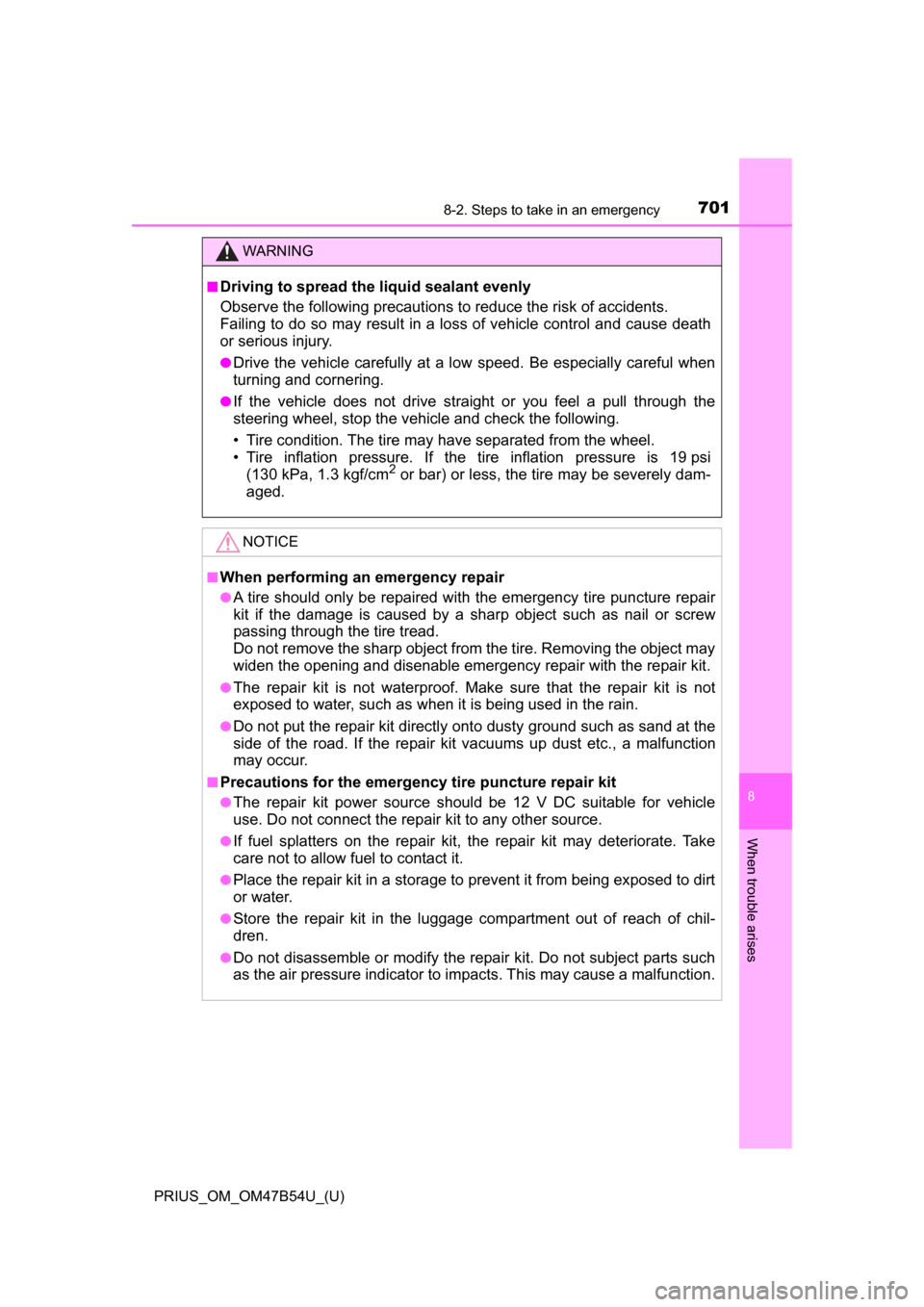
WARNING
■Driving to spread the liquid sealant evenly
Observe the following precautions to reduce the risk of accidents.
Failing to do so may result in a loss of vehicle control and cause death
or serious injury.
●Drive the vehicle carefully at a low speed. Be especially careful when
turning and cornering.
●If the vehicle does not drive straight or you feel a pull through the
steering wheel, stop the vehicle and check the following.
• Tire condition. The tire may have separated from the wheel.
• Tire inflation pressure. If the tire inflation pressure is 19 psi (130 kPa, 1.3 kgf/cm
2 or bar) or less, the tire may be severely dam-
aged.
NOTICE
■When performing an emergency repair
●A tire should only be repaired with the emergency tire puncture repair
kit if the damage is caused by a sharp object such as nail or screw
passing through the tire tread.
Do not remove the sharp object from the tire. Removing the object may
widen the opening and disenable emergency repair with the repair kit.
●The repair kit is not waterproof. Make sure that the repair kit is not
exposed to water, such as when it is being used in the rain.
●Do not put the repair kit directly onto dusty ground such as sand at the
side of the road. If the repair kit vacuums up dust etc., a malfunction
may occur.
■Precautions for the emergency tire puncture repair kit
●The repair kit power source should be 12 V DC suitable for vehicle
use. Do not connect the repair kit to any other source.
●If fuel splatters on the repair kit, the repair kit may deteriorate. Take
care not to allow fuel to contact it.
●Place the repair kit in a storage to prevent it from being exposed to dirt
or water.
●Store the repair kit in the luggage compartment out of reach of chil-
dren.
●Do not disassemble or modify the repair kit. Do not subject parts such
as the air pressure indicator to im pacts. This may cause a malfunction.
Page 703 of 796
703
PRIUS_OM_OM47B54U_(U)
8
When trouble arises
8-2. Steps to take in an emergency
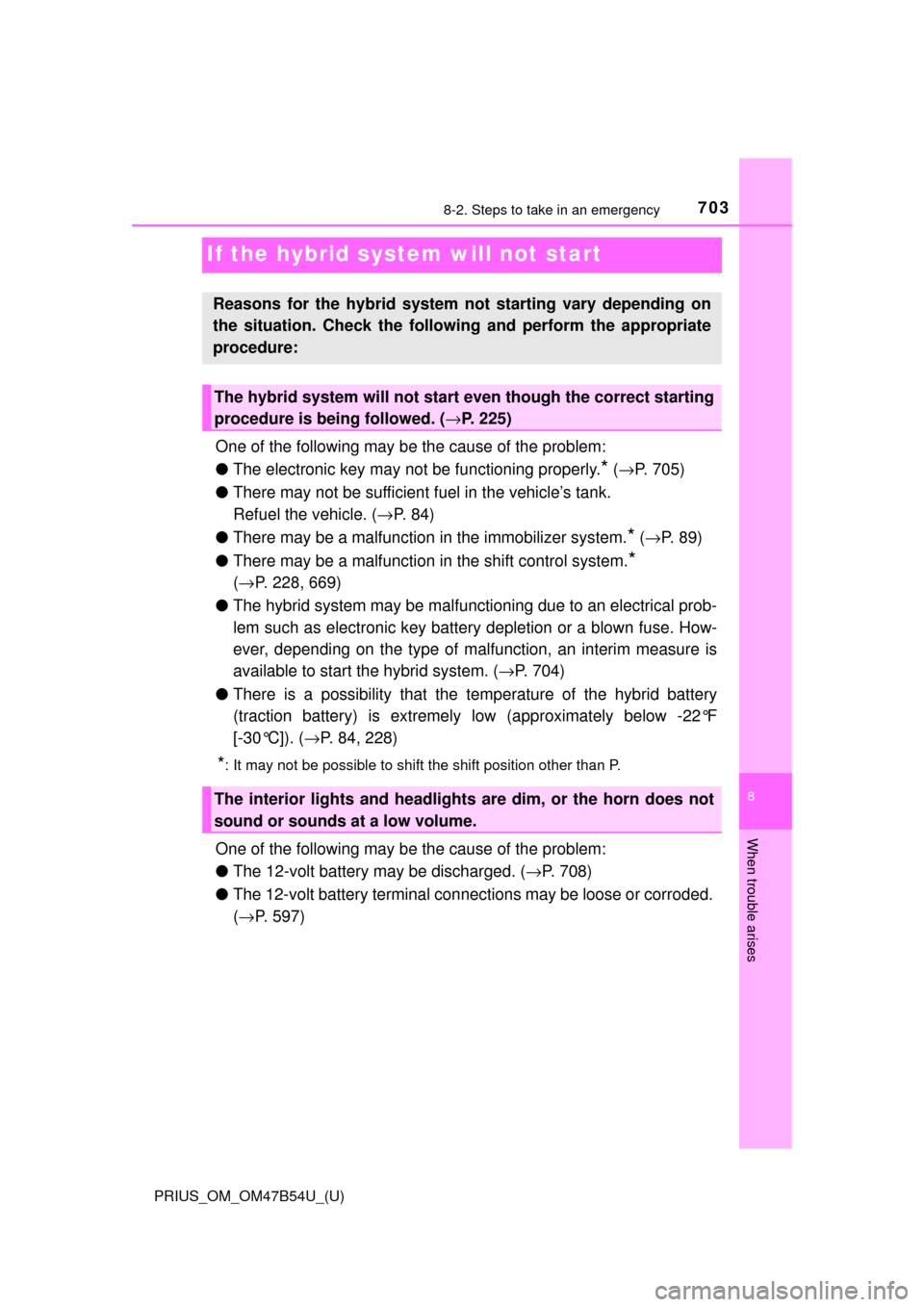
If the hybrid system will not start
One of the following may be the cause of the problem:
●The electronic key may not be functioning properly.
* (→ P. 705)
● There may not be sufficient fuel in the vehicle’s tank.
Refuel the vehicle. ( →P. 84)
● There may be a malfunction in the immobilizer system.
* (→ P. 8 9 )
● There may be a malfunction in the shift control system.
*
( → P. 228, 669)
● The hybrid system may be malfunctioning due to an electrical prob-
lem such as electronic key battery depletion or a blown fuse. How-
ever, depending on the type of malfunction, an interim measure is
available to start the hybrid system. (→ P. 704)
● There is a possibility that the temperature of the hybrid battery
(traction battery) is extremely low (approximately below -22°F
[-30°C]). ( →P. 84, 228)
*: It may not be possible to shift the shift position other than P.
One of the following may be the cause of the problem:
● The 12-volt battery may be discharged. ( →P. 708)
● The 12-volt battery terminal con nections may be loose or corroded.
( → P. 597)
Reasons for the hybrid system not starting vary depending on
the situation. Check the follo wing and perform the appropriate
procedure:
The hybrid system will not start even though the correct starting
procedure is being followed. ( →P. 225)
The interior lights and headlights are dim, or the horn does not
sound or sounds at a low volume.
Page 721 of 796
721
PRIUS_OM_OM47B54U_(U)
9Vehicle specifications
9-1. SpecificationsMaintenance data (fuel, oil level, etc.) .......... 722
Fuel information ................ 733
Tire information ................. 736
9-2. Customization Customizable features ...... 748
9-3. Initialization Items to initialize ............... 756
Page 722 of 796
722
PRIUS_OM_OM47B54U_(U)
9-1. Specifications
Maintenance data (fuel, oil level, etc.)
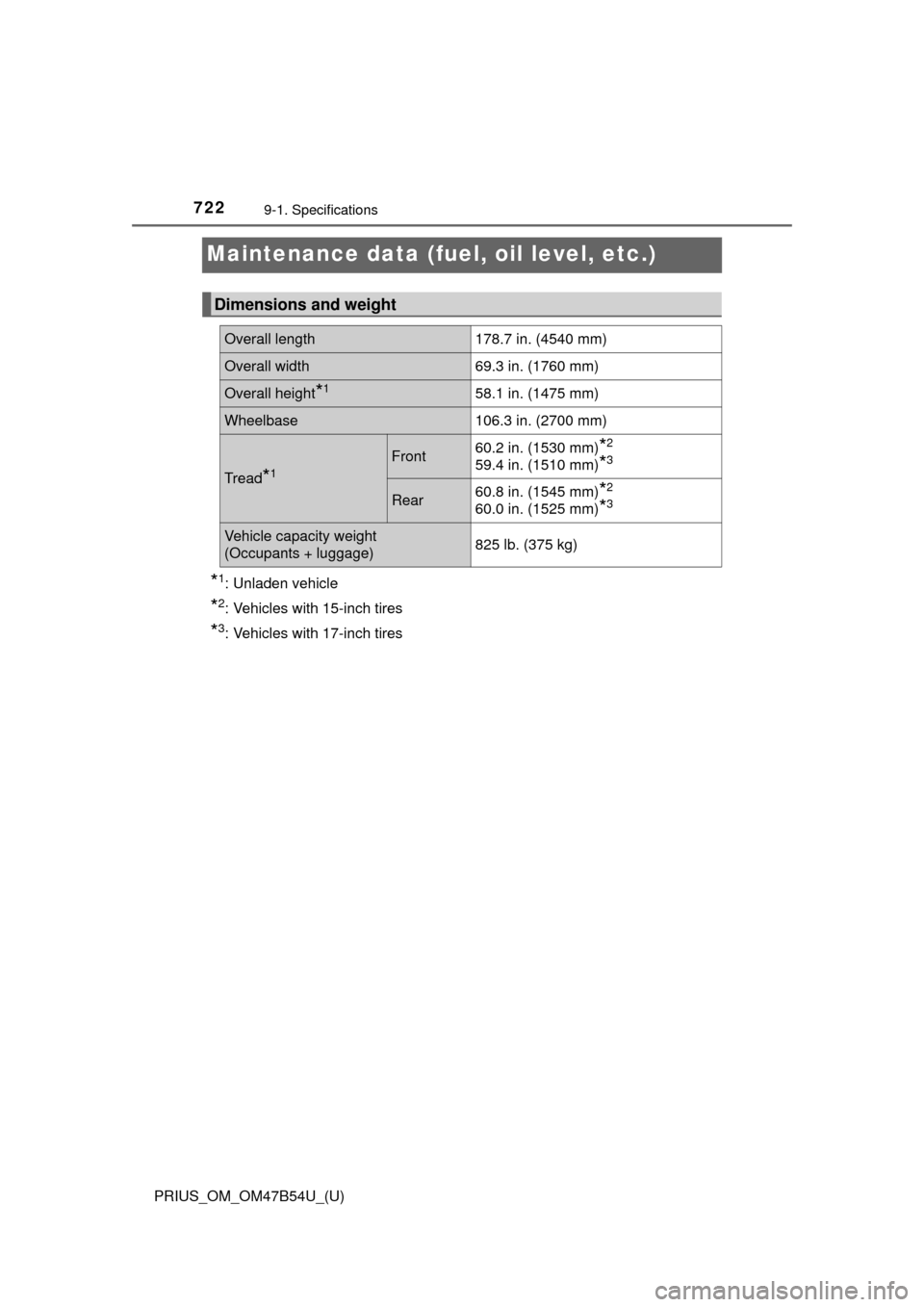
*1: Unladen vehicle
*2: Vehicles with 15-inch tires
*3: Vehicles with 17-inch tires
Dimensions and weight
Overall length178.7 in. (4540 mm)
Overall width69.3 in. (1760 mm)
Overall height*158.1 in. (1475 mm)
Wheelbase106.3 in. (2700 mm)
Tread*1
Front60.2 in. (1530 mm)*2
59.4 in. (1510 mm)*3
Rear60.8 in. (1545 mm)*2
60.0 in. (1525 mm)*3
Vehicle capacity weight
(Occupants + luggage)825 lb. (375 kg)
Page 725 of 796
PRIUS_OM_OM47B54U_(U)
7259-1. Specifications
9
Vehicle specifications
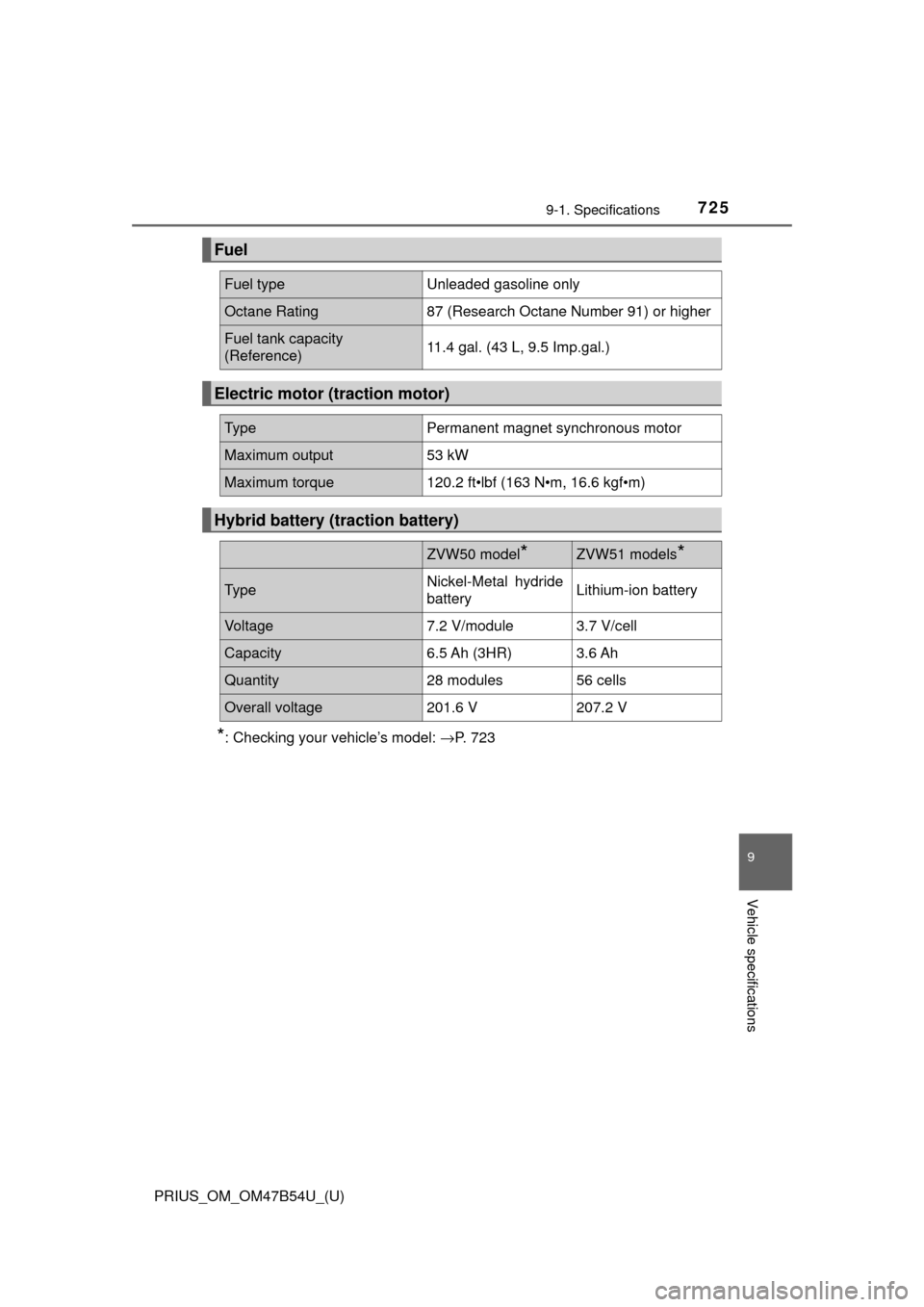
*: Checking your vehicle’s model: →P. 723
Fuel
Fuel typeUnleaded gasoline only
Octane Rating87 (Research Octane Number 91) or higher
Fuel tank capacity
(Reference)11.4 gal. (43 L, 9.5 Imp.gal.)
Electric motor (traction motor)
Ty p ePermanent magnet synchronous motor
Maximum output53 kW
Maximum torque120.2 ft•lbf (163 N•m, 16.6 kgf•m)
Hybrid battery (traction battery)
ZVW50 model*ZVW51 models*
Ty p eNickel-Metal hydride
batteryLithium-ion battery
Vol t a ge7.2 V/module3.7 V/cell
Capacity6.5 Ah (3HR)3.6 Ah
Quantity28 modules56 cells
Overall voltage201.6 V207.2 V