2017 TOYOTA HIGHLANDER battery
[x] Cancel search: batteryPage 226 of 732

2264-2. Driving procedures
HIGHLANDER_U (OM0E017U)
NOTICE
■To prevent battery discharge
● Do not leave the engine switch in ACCESSORY or IGNITION ON mode
for long periods of time without the engine running.
● If “ACCESSORY” or “IGNITION ON” is displayed on the multi-information
display while the engine is not running, the engine switch is not off. Exit the
vehicle after turning the engine switch off.
● Do not stop the engine when the shift lever is in a position other than P. If
the engine is stopped in another shift lever position, the engine switch will
not be turned off but instead be turned to ACCESSORY mode. If the vehi-
cle is left in ACCESSORY mode, battery discharge may occur.
■ When starting the engine
● Do not race a cold engine.
● If the engine becomes difficult to start or stalls frequently, have your vehi-
cle checked by your Toyota dealer immediately.
■ Symptoms indicating a malfunction with the engine switch
If the engine switch seems to be operating somewhat differently than usual,
such as the switch sticking slightly, there may be a malfunction. Contact
your Toyota dealer immediately.
Page 238 of 732

2384-3. Operating the lights and wipers
HIGHLANDER_U (OM0E017U)■
Light reminder buzzer
Vehicles without a smart key system
A buzzer sounds when the engine switch is turned to the “LOCK” or “ACC”
position and the driver’s door is opened while the lights are turned on.
Vehicles with a smart key system
A buzzer sounds when the engine switch is turned off or turned to ACCES-
SORY mode and the driver’s door is opened while the lights are turned on.
■ Battery-saving function
In the following conditions, the remaining lights will go off automatically after
20 minutes in order to prevent the vehicle battery from being discharged:
●The headlights and/or tail lights are on.
● Vehicles without a smart key system:
The engine switch is turned to the “ACC” or “LOCK” position.
Vehicles with a smart key system:
The engine switch is turned to ACCESSORY mode or turned off.
This function will be canceled in any of the following situations:
● Vehicles without a smart key system:
When the engine switch is turned to the “ON” position.
Vehicles with a smart key system:
When the engine switch is turned to IGNITION ON mode.
● When the light switch is operated.
● When any of the doors is opened or closed.
■ Customization
Settings (e.g. light sensor sensitivity) can be changed.
(Customizable features: →P. 689)
NOTICE
■To prevent battery discharge
Do not leave the lights on longer than necessary when the engine is not
running.
Page 266 of 732

■Operational conditions
Availability of the pedestrian detection function depends on the region i\
n
which the vehicle was sold. (Fo")
2664-5. Using the driving support systems
HIGHLANDER_U (OM0E017U)
■Operational conditions
Availability of the pedestrian detection function depends on the region i\
n
which the vehicle was sold. (For specific countries/areas:
→P. 261)
Read the following for details:
Region A
(The pedestrian detection function is available)
The pre-collision system is enabled and the system determines that the pos-
sibility of a frontal collision wi th a vehicle or pedestrian is high.
Each function is operational at the following speeds:
● Pre-collision warning:
• Vehicle speed is between approximately 7 and 110 mph (10 and 180 km/h).
(For detecting a pedestrian, vehicle speed is between approximately 7 and
50 mph [10 and 80 km/h].)
• The relative speed between your vehicle and the vehicle or pedestrian ahead is approximately 7 mph (10 km/h) or more.
● Pre-collision brake assist:
• Vehicle speed is between approximately 19 and 110 mph (30 and 180 km/h).
(For detecting a pedestrian, vehicle speed is between approximately 19 and
50 mph [30 and 80 km/h].)
• The relative speed between your vehicle and the vehicle or pedestrian
ahead is approximately 19 mph (30 km/h) or more.
● Pre-collision braking:
• Vehicle speed is between approximately 7 and 110 mph (10 and 180
km/h). (For detecting a pedestrian, vehicle speed is between approxi-
mately 7 and 50 mph [10 and 80 km/h].)
• The relative speed between your vehicle and the vehicle or pedestrian ahead is approximately 7 mph (10 km/h) or more.
The system may not operate in the following situations:
● If a battery terminal has been disconnected and reconnected and then the
vehicle has not been driven for a certain amount of time
● If the shift lever is in R
● If VSC is disabled (only the pre-collision warning function will be opera-
tional)
● If the PCS (Pre-Collision System) warning light is flashing or illuminated
Page 267 of 732

2674-5. Using the driving support systems
4
Driving
HIGHLANDER_U (OM0E017U)
Region B
(The pedestrian detection function is not available)
The pre-collision system is enabled and the system determines that the pos-
sibility of a frontal collision with a vehicle is high.
Each function is operational at the following speeds:
● Pre-collision warning:
• Vehicle speed is between approximately 10 and 110 mph (15 and 180
km/h).
• The relative speed between your vehicle and the vehicle ahead is approximately 7 mph (10 km/h) or more.
● Pre-collision brake assist:
• Vehicle speed is between approximately 19 and 110 mph (30 and 180
km/h).
• The relative speed between your vehicle and the vehicle ahead is
approximately 19 mph (30 km/h) or more.
● Pre-collision braking:
• Vehicle speed is between approximately 10 and 110 mph (15 and 180
km/h).
• The relative speed between your vehicle and the vehicle ahead is approximately 7 mph (10 km/h) or more.
The system may not operate in the following situations:
● If a battery terminal has been disconnected and reconnected and then the
vehicle has not been driven for a certain amount of time
● If the shift lever is in R
● If VSC is disabled (only the pre-collision warning function will be opera-
tional)
● If the PCS (Pre-Collision System) warning light is flashing or illuminated
Page 299 of 732

2994-5. Using the driving support systems
4
Driving
HIGHLANDER_U (OM0E017U)
■Operating conditions
●The Stop & Start system is operational when all of the following conditions
are met:
• The brake pedal is being depressed firmly.
• The engine is adequately warmed up.
• The outside temperature is 23°F (-5°C) or higher.
• The shift lever is in D.
• is off.
• The hood is closed.
• The driver's seat belt is fastened.
• The driver's door is closed.
• The accelerator pedal is not being depressed.
● In the following situations the engine may not be stopped by the Stop & Start
system. This is not a malfunction of the Stop & Start system.
• The air conditioning system is being used when the ambient temperature
is high or low.
• The battery is not sufficiently charged, such as if the vehicle has been
parked for a long time and the battery charge has decreased, the electric
load is large, the battery temperature is excessively low or the battery has
deteriorated, or is undergoing a periodic recharge.
• The brake booster vacuum is low.
• The vehicle is stopped on a steep incline.
• The steering wheel is being operated.
• Due to traffic or other circumstances the vehicle is being stopped repeat- edly.
• The vehicle is being driven in a high altitude area.
• Engine coolant temperature or transmission fluid temperature is extremely low or high.
• The battery fluid temperature is extremely low or high.
• For a while after the battery terminals have been disconnected and reconnected.
• For a while after the battery replacement.
• Power mode or snow mode is selected.
Page 300 of 732

3004-5. Using the driving support systems
HIGHLANDER_U (OM0E017U)●
In the following situations, the engine will restart automatically if the engine
is stopped by the Stop & Start system. (To enable stopping of the engine by
the Stop & Start system, drive the vehicle.)
• The air conditioning system is turned on.
• is turned on.
• The steering wheel is operated.
• The shift lever is shifted to a position other than D.
• The driver's seat belt is unfastened.
• The driver's door is opened.
• The accelerator pedal is depressed.
• The Stop & Start cancel switch is pressed.
• The vehicle starts to roll on an incline.
● In the following situations, the engine may restart automatically if the engine
is stopped by the Stop & Start system. (To enable stopping of the engine by
the Stop & Start system, drive the vehicle.)
• The brake pedal is pumped or strongly depressed.
• The air conditioning system is being used.
• The battery is not sufficiently charged.
■ Hood
●If the hood is opened while the engine is stopped by the Stop & Start sys-
tem, the engine will stall and will not be able to be restarted by the automatic
engine start function. In this case, restart the engine using the normal
engine starting procedure. ( →P. 218, 221)
● Even if the hood is closed after the engine is started with the hood open, the
Stop & Start system will not operate. Close the hood, turn the engine switch
off, wait 30 seconds or more, and then start the engine.
■ When to use the Stop & Start system
●When the system cannot operate, is canceled, or is malfunctioning, warning
messages and a warning buzzer are used to inform the driver. ( →P. 303)
● Vehicles with a smart key system: If the engine switch is pressed when the
engine is stopped by the Stop & Start system, the engine will stall and will
not be able to be restarted by the automatic engine start function. In this
case, restart the engine using the normal engine starting procedure.
(→P. 218, 221)
● When the engine is restarted by the Stop & Start system, the power outlets
may be temporarily unusable, but this is not a malfunction.
● Installation and removal of electrical components and wireless devices may
affect the Stop & Start system. Contact your Toyota dealer for details.
Page 302 of 732

3024-5. Using the driving support systems
HIGHLANDER_U (OM0E017U)■
The Stop & Start system protection function
●Vehicles without a smart key system: When an excessively loud sound is
being projected by the audio system, the audio system may be automati-
cally cut off in order to reduce battery consumption. If this occurs, turn the
engine switch off, wait for 3 seconds or longer and then turn it to the “ACC”
or “ON” position to re-enable the audio system.
Vehicles with a smart key system: When an excessively loud sound is being
projected by the audio system, the audio system may be automatically cut
off in order to reduce battery consumption. If this occurs, turn the engine
switch off, wait for 3 seconds or longer and then turn it to ACCESSORY
mode or IGNITION ON mode to re-enable the audio system.
● The audio system may not be activated when the battery terminals are dis-
connected and then reconnected. If this occurs, turn the engine switch off
and then repeat the following operation twice to activate the audio system
normally.
• Vehicles without a smart key system: Turn the engine switch to the “ON”
position and then to the “Lock” position.
• Vehicles with a smart key system: Turn the engine switch to IGNITION
ON mode and then to OFF.
■ Replacing the battery
→P. 642
■ Displaying the Stop & Start system status
→P. 9 8
Page 303 of 732
3034-5. Using the driving support systems
4
Driving
HIGHLANDER_U (OM0E017U)■
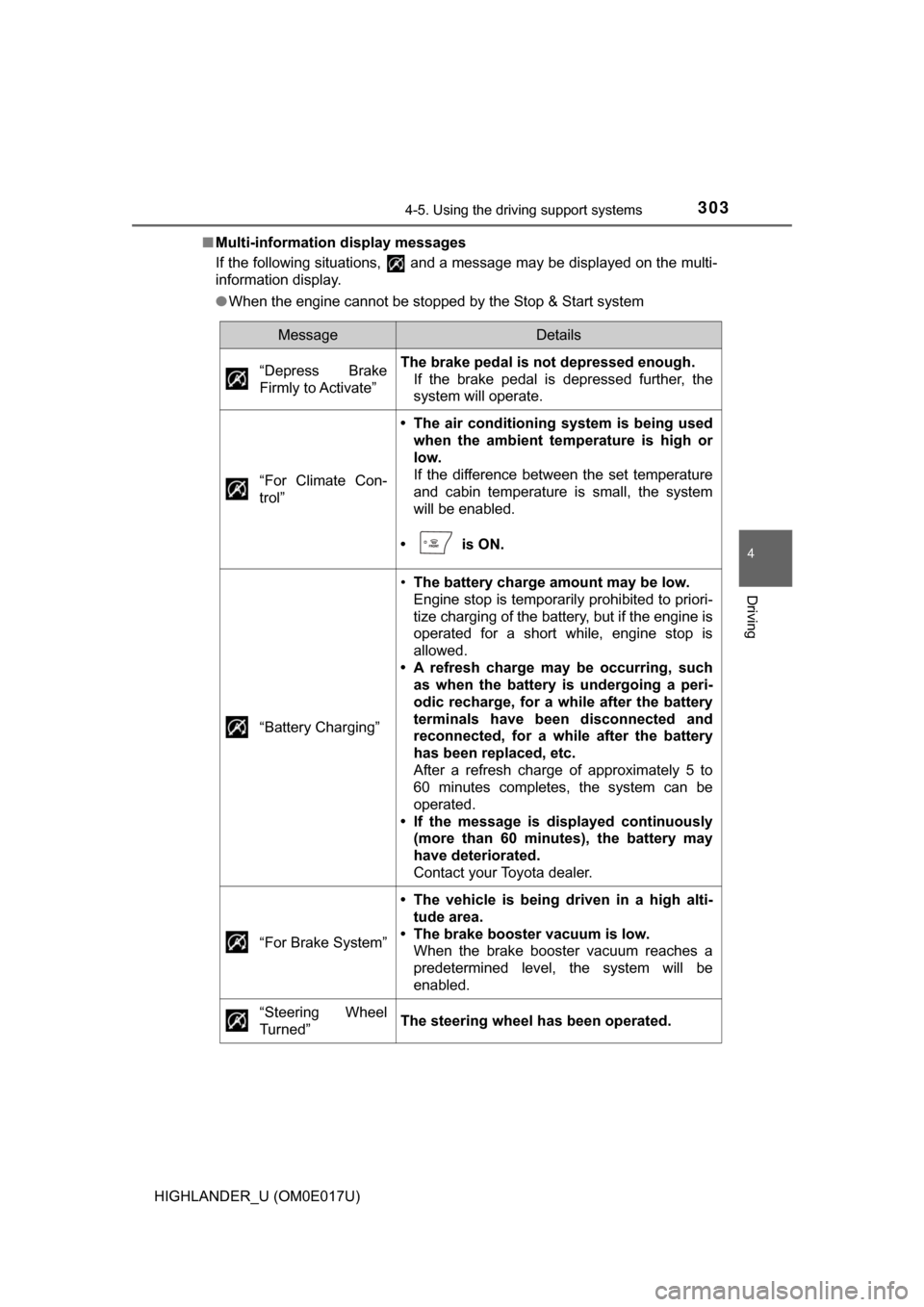
Multi-information display messages
If the following situations, and a message may be displayed on the multi-
information display.
●When the engine cannot be stopped by the Stop & Start system
MessageDetails
“Depress Brake
Firmly to Activate”
The brake pedal is not depressed enough. If the brake pedal is depressed further, the
system will operate.
“For Climate Con-
trol”
• The air conditioning system is being used when the ambient te mperature is high or
low.
If the difference between the set temperature
and cabin temperature is small, the system
will be enabled.
• is ON.
“Battery Charging”
• The battery charge amount may be low.
Engine stop is temporarily prohibited to priori-
tize charging of the battery, but if the engine is
operated for a short while, engine stop is
allowed.
• A refresh charge may be occurring, such as when the battery is undergoing a peri-
odic recharge, for a while after the battery
terminals have been disconnected and
reconnected, for a while after the battery
has been replaced, etc.
After a refresh charge of approximately 5 to
60 minutes completes, the system can be
operated.
• If the message is displayed continuously (more than 60 minutes), the battery may
have deteriorated.
Contact your Toyota dealer.
“For Brake System”
• The vehicle is being driven in a high alti- tude area.
• The brake booster vacuum is low. When the brake booster vacuum reaches a
predetermined level, the system will be
enabled.
“Steering Wheel
Turned”
The steering wheel has been operated.