Page 627 of 732
6278-2. Steps to take in an emergency
8
When trouble arises
HIGHLANDER_U (OM0E017U)
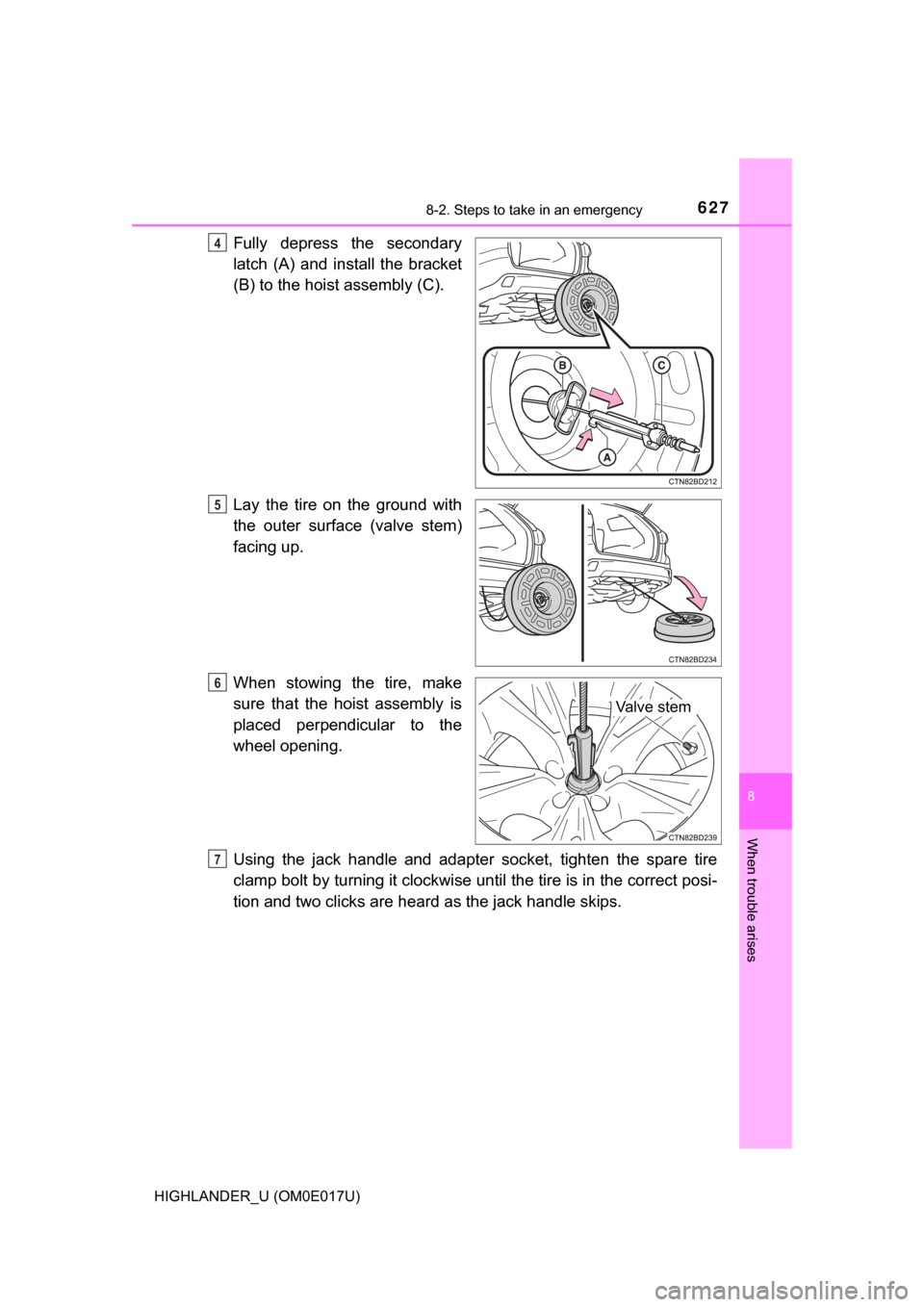
Fully depress the secondary
latch (A) and install the bracket
(B) to the hoist assembly (C).
Lay the tire on the ground with
the outer surface (valve stem)
facing up.
When stowing the tire, make
sure that the hoist assembly is
placed perpendicular to the
wheel opening.
Using the jack handle and adapter socket, tighten the spare tire
clamp bolt by turning it clockwise un til the tire is in the correct posi-
tion and two clicks are heard as the jack handle skips.4
5
Va l v e s t e m
6
7
Page 634 of 732
6348-2. Steps to take in an emergency
HIGHLANDER_U (OM0E017U)
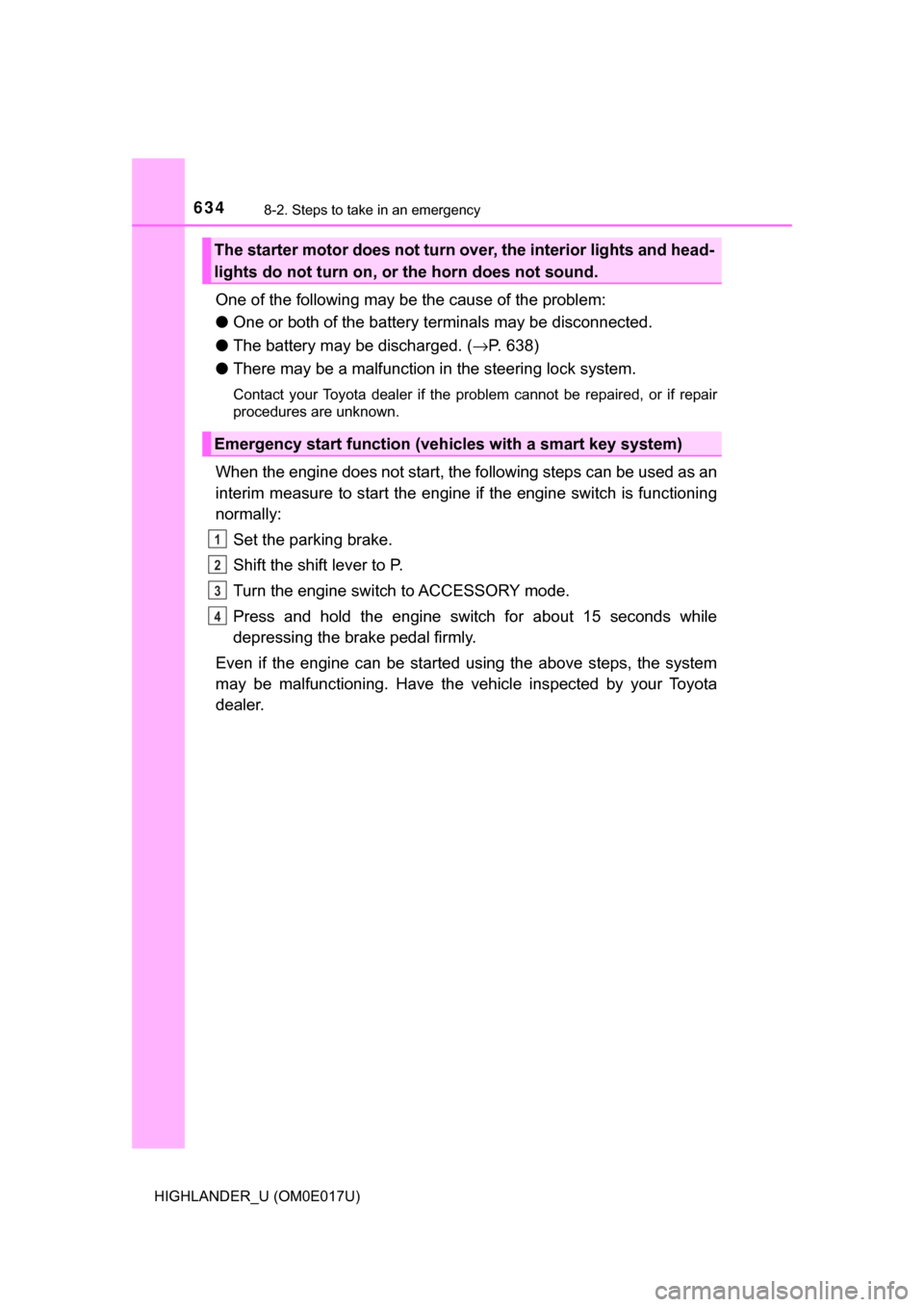
One of the following may be the cause of the problem:
●One or both of the battery terminals may be disconnected.
● The battery may be discharged. ( →P. 638)
● There may be a malfunction in the steering lock system.
Contact your Toyota dealer if the problem cannot be repaired, or if repair
procedures are unknown.
When the engine does not start, the following steps can be used as an
interim measure to start the engine if the engine switch is functioning
normally:
Set the parking brake.
Shift the shift lever to P.
Turn the engine switch to ACCESSORY mode.
Press and hold the engine switch for about 15 seconds while
depressing the brake pedal firmly.
Even if the engine can be started using the above steps, the system
may be malfunctioning. Have the ve hicle inspected by your Toyota
dealer.
The starter motor does not turn over, the interior lights and head-
lights do not turn on, or the horn does not sound.
Emergency start function (vehicles with a smart key system)
1
2
3
4
Page 635 of 732

6358-2. Steps to take in an emergency
8
When trouble arises
HIGHLANDER_U (OM0E017U)
Use the mechanical key (→P. 1 1 0 )
in order to perform the following
operations:
Locks all the doors
Closes the windows and moon
roof
*1 (turn and hold)*2
(→ P. 174, 177)
Unlocks the door
Turning the key rearward unlocks the driver’s door. Turning the key once
again within 5 seconds unlocks the other doors.
Opens the windows and moon roof*1 (turn and hold)*2
( → P. 174, 177)
*1: If equipped
*2: This setting must be customized at your Toyota dealer.
If the electronic key d oes not operate prop-
erly (vehicles with a smart key system)
If communication between the electronic key and vehicle is
interrupted ( →P. 144) or the electronic key cannot be used
because the battery is depleted, the smart key system and wire-
less remote control cannot be used. In such cases, the doors
can be opened and the engine ca n be started by following the
procedure below.
Locking and unlocking the doors and key linked functions
1
2
3
4
Page 638 of 732
6388-2. Steps to take in an emergency
HIGHLANDER_U (OM0E017U)
If you have a set of jumper (or booster) cables and a second vehicle
with a 12-volt battery, you can jump start your vehicle by following the
steps below.
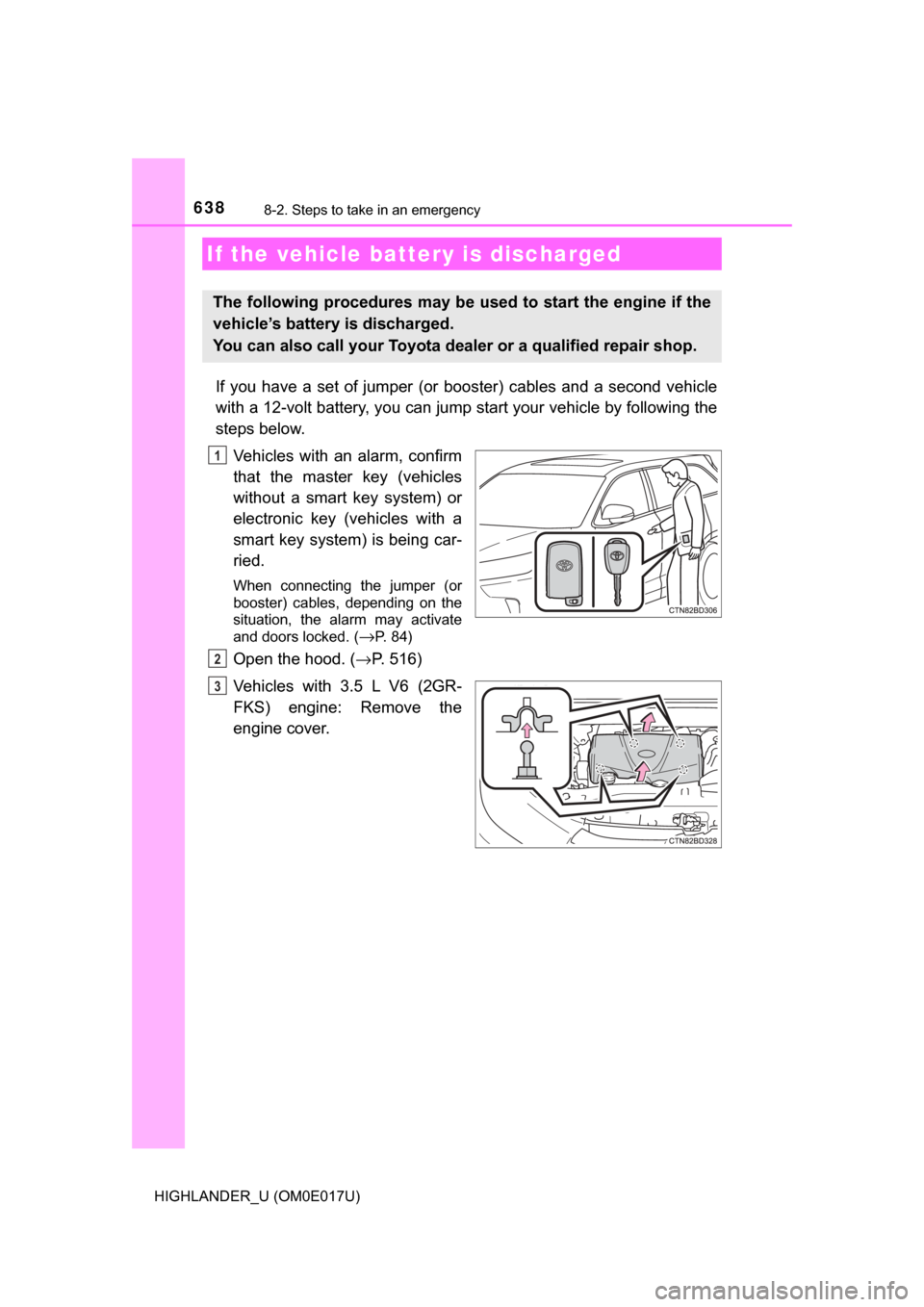
Vehicles with an alarm, confirm
that the master key (vehicles
without a smart key system) or
electronic key (vehicles with a
smart key system) is being car-
ried.
When connecting the jumper (or
booster) cables, depending on the
situation, the alarm may activate
and doors locked.
(→P. 84)
Open the hood. ( →P. 516)
Vehicles with 3.5 L V6 (2GR-
FKS) engine: Remove the
engine cover.
If the vehicle bat tery is discharged
The following procedures may be used to start the engine if the
vehicle’s battery is discharged.
You can also call your Toyota de aler or a qualified repair shop.
1
2
3
Page 642 of 732

6428-2. Steps to take in an emergency
HIGHLANDER_U (OM0E017U)
■Starting the engine when the battery is discharged
The engine cannot be started by push-starting.
■ To prevent battery discharge
●Turn off the headlights and the audio system while the engine is stopped.
(Vehicles with Stop & Start system: except when the engine is stopped by
the Stop & Start system.)
● Turn off any unnecessary electrical components when the vehicle is running
at a low speed for an extended period, such as in heavy traffic.
■ When recharging or replacing the battery
●Vehicles with a smart key system: In some cases, it may not be possible to
unlock the doors using the smart key system when the battery is dis-
charged. Use the wireless remote control or the mechanical key to lock or
unlock the doors.
● Vehicles with a smart key system: The engine may not start on the first
attempt after the battery has recharged but will start normally after the sec-
ond attempt. This is not a malfunction.
● Vehicles with a smart key system: The engine switch mode is memorized by
the vehicle. When the battery is reconnected, the system will return to the
mode it was in before the battery was discharged. Before disconnecting the
battery, turn the engine switch off.
If you are unsure what mode the engine switch was in before the battery dis-
charged, be especially careful when reconnecting the battery.
● Vehicle with power back door: The power back door must be initialized.
(→P. 692)
● Vehicles with Stop & Start system: After the battery terminals have been dis-
connected then reconnected or the battery has been replaced, the Stop &
Start system may not automatically stop the engine for approximately 5 to
60 minutes.
■ Charging the battery
The electricity stored in the battery will discharge gradually even when the
vehicle is not in use, due to natural discharge and the draining effects of cer-
tain electrical appliances. If the vehicle is left for a long time, the battery may
discharge, and the engine may be unable to start. (The battery recharges
automatically during driving.)
■ When exchanging the battery (veh icles with Stop & Start system)
Use a genuine battery specifically designed for use with a Stop & Start sys-
tem or equivalent. If an unsupported battery is used, Stop & Start system
functions may be restricted to protect the battery. Also, battery performance
may decrease and the engine may not be able to restart. Contact your Toyota
dealer for details.
Page 647 of 732
6478-2. Steps to take in an emergency
8
When trouble arises
HIGHLANDER_U (OM0E017U)
Stop the engine. Set the parking brake and shift the shift lever to P.
Remove the mud, snow or sand from around the front wheels.
Place wood, stones or some other material under the front wheels
to help provide traction.
Restart the engine.
AWD models: Activate all-wheel drive lock mode. ( →P. 330)
Shift the shift lever to D or R and release the parking brake. Then,
while exercising caution, depress the accelerator pedal.
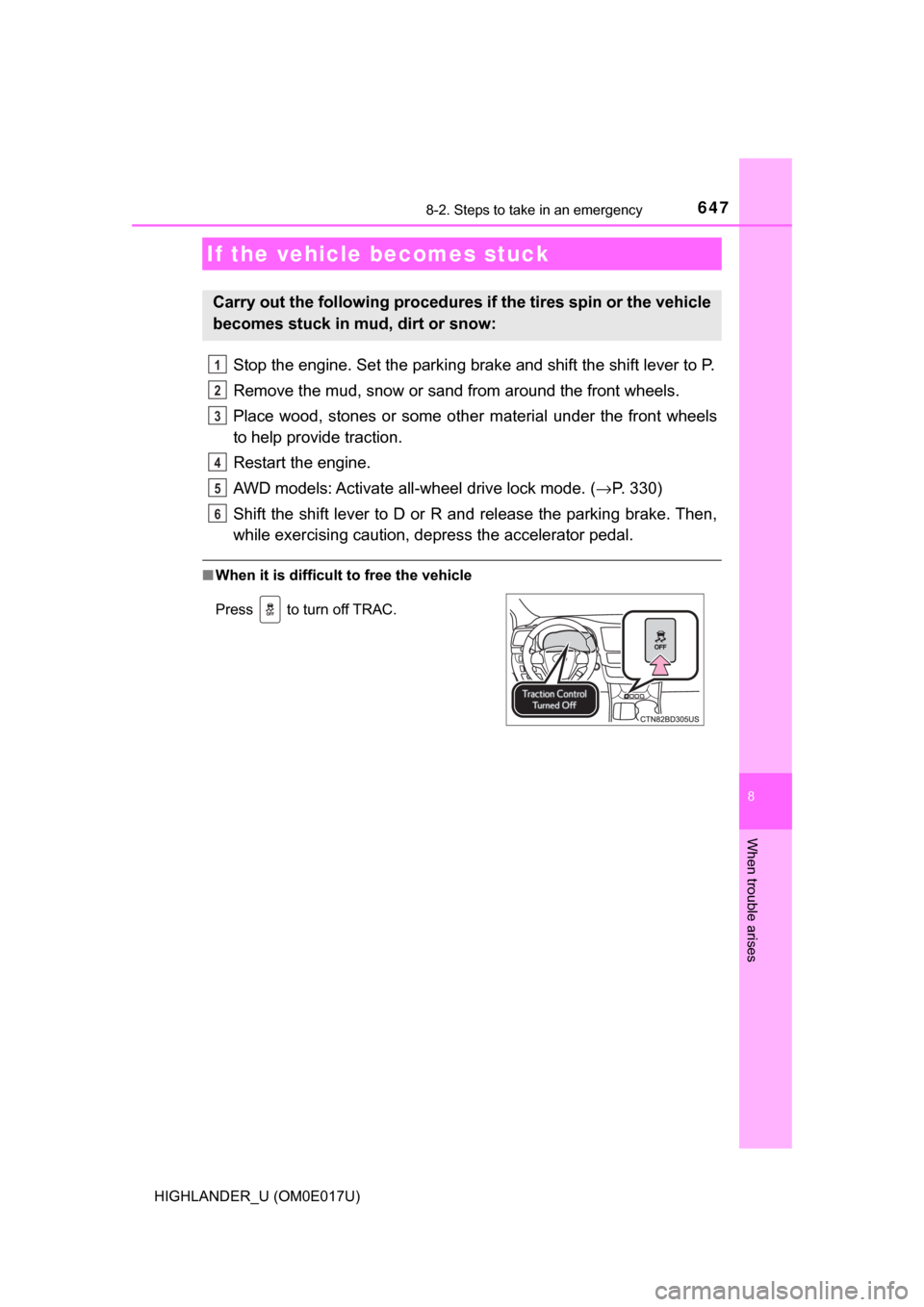
■ When it is difficult to free the vehicle
If the vehicle becomes stuck
Carry out the following procedures if the tires spin or the vehicle
becomes stuck in mud, dirt or snow:
Press to turn off TRAC.
1
2
3
4
5
6
Page 652 of 732
6529-1. Specifications
HIGHLANDER_U (OM0E017U)■
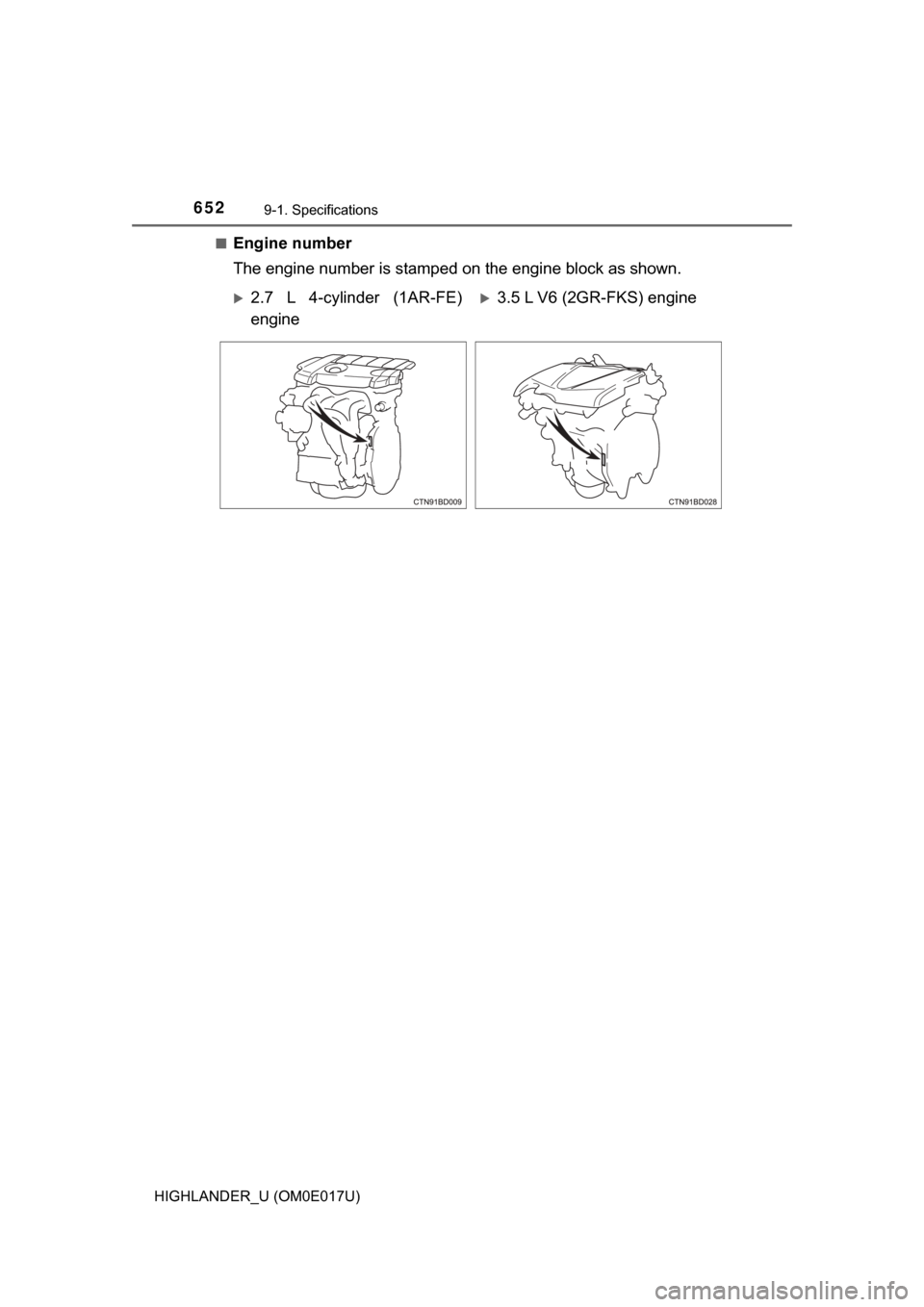
Engine number
The engine number is stampe
d on the engine block as shown.
2.7 L 4-cylinder (1AR-FE)
engine3.5 L V6 (2GR-FKS) engine
Page 657 of 732
6579-1. Specifications
9
Vehicle specifications
HIGHLANDER_U (OM0E017U)
*: The fluid capacity is a reference quantity. If replacement is necessary, contact your Toyota dealer.
Electrical system
Battery
Open voltage at 68 °F
(20° C): 12.3 V or More
If the voltage is lower than the standard value,
charge the battery.
(Voltage is checked 20 minutes after the engine
and all lights are turned off.)
Charging rates5 A max.
Automatic transaxle
Fluid capacity*
2.7 L 4-cylinder (1AR-FE) engine
6.9 qt. (6.5 L, 5.7 Imp. qt.)
3.5 L V6 (2GR-FKS) engine
2WD models:
8.0 qt. (7.58 L, 6.7 Imp. qt.)
AWD models:
8.0 qt. (7.58 L, 6.7 Imp. qt.)
Fluid typeToyota Genuine ATF WS
NOTICE
■ Automatic transmission fluid type
Using automatic transmission fluid other than “Toyota Genuine ATF WS”
may cause deterioration in shift quality, locking up of your transmission
accompanied by vibration, and ultimately damage the automatic transmis-
sion of your vehicle.