2017 TOYOTA HIGHLANDER fuel cap
[x] Cancel search: fuel capPage 543 of 732

5437-3. Do-it-yourself maintenance
7
Maintenance and care
HIGHLANDER_U (OM0E017U)
■Tire inflation pressure check interval
You should check tire inflation pressure every two weeks, or at least once
a month.
Do not forget to check the spare.
■Effects of incorrect tire inflation pressure
Driving with incorrect tire inflation pressure may result in the following:
●Reduced fuel economy
●Reduced driving comfort and poor handling
●Reduced tire life due to wear
●Reduced safety
●Damage to the drive train
If a tire needs frequent inflating, have it checked by your Toyota dealer.
■Instructions for checking tire inflation pressure
When checking tire inflation pressure, observe the following:
●Check only when the tires are cold.
If your vehicle has been parked for at least 3 hours or has not been
driven for more than 1 mile or 1.5 km, you will get an accurate cold tire
inflation pressure reading.
●Always use a tire pressure gauge.
It is difficult to judge if a tire is properly inflated based only on its appear-
ance.
●It is normal for the tire inflation pressure to be higher after driving as
heat is generated in the tire. Do no t reduce tire inflation pressure after
driving.
●Never exceed the vehicle capacity weight.
Passengers and luggage weight should be placed so that the vehicle is
balanced.
Page 586 of 732

5868-2. Steps to take in an emergency
HIGHLANDER_U (OM0E017U)■
SRS warning light
This warning light system monitors the airbag sensor assembly, front impact
sensors, side impact sensors (front door), side impact sensors (rear), driver’s
seat position sensor, driver’s seat belt buckle switch, front passenger occu-
pant classification system (ECU and sens ors), “AIR BAG ON” indicator light,
“AIR BAG OFF” indicator light, front passenger’s seat belt buckle switch,
driver’s seat belt pretensioner, front passenger’s seat belt pretensioner and
force limiter, airbags, interconnecting wiring and power sources. ( →P. 42)
■ Front passenger detection sensor, seat belt reminder and warning
buzzer
If luggage is placed on the front passenger seat, the front passenger detec-
tion sensor may cause the warning light to flash and the warning buzzer to
sound even if a passenger is not sitting in the seat.
■ If the malfunction indicator la mp comes on while driving
First check the following:
● Is the fuel tank empty?
If it is, fill the fuel tank immediately.
● Is the fuel tank cap loose?
If it is, tighten it securely.
The light will go off after several driving trips.
If the light does not go off even after several trips, contact your Toyota dealer
as soon as possible.
■ Electric power steering system warning light (warning buzzer)
When the battery charge becomes insufficient or the voltage temporarily
drops, the electric power steering system warning light may come on and \
the
warning buzzer may sound.
■
When the tire pressure warning light comes on
Check the tire inflation pressure and adjust to the appropriate level. Push-
ing the tire pressure warning reset switch will not turn off the tire pressure
warning light.
■The tire pressure warning light may come on due to natural causes
The tire pressure warning light may come on due to natural causes such
as natural air leaks and tire inflat ion pressure changes caused by tem-
perature. In this case, adjusting the ti re inflation pressure will turn off the
warning light (afte r a few minutes).
Page 650 of 732

650
HIGHLANDER_U (OM0E017U)
9-1. Specifications
*1: Unladen vehicles
*2: The model code is indicated on the Certification Label. (→P. 651)
*3: With a seating capacity of 7 occupants
*4: With a seating capacity of 8 occupants
Maintenance data (fuel, oil level, etc.)
Dimensions
Overall length 192.5 in. (4890 mm)
Overall width 75.8 in. (1925 mm)
Overall height*1
Without roof antenna
68.1 in. (1730 mm)
With roof antenna
70.1 in. (1780 mm)
Wheelbase 109.8 in. (2790 mm)
Front tread64.4 in. (1635 mm)
Rear tread 64.2 in. (1630 mm)
Weights
Model code *2
Vehicle capacity
weight
(Occupant + lug-
gage)Trailer Weight Rating
(Trailer weight + cargo
weight)
ASU50L-ARTNKA 1460 lb. (660 kg) 1500 lb. (680 kg)
GSU50L-ARZNHA 1370 lb. (620 kg)
5000 lb. (2200 kg)
GSU50L-ARZMHA
1300 lb. (590 kg)
*3
1370 lb. (620 kg)*4
GSU50L-ARZGHA
1300 lb. (590 kg)*3
1370 lb. (620 kg)*4
GSU55L-ARZNHA 1370 lb. (620 kg)
GSU55L-ARZMHA1300 lb. (590 kg)
*3
1340 lb. (610 kg)*4
GSU55L-ARZGHA 1280 lb. (580 kg)
Page 653 of 732
6539-1. Specifications
9
Vehicle specifications
HIGHLANDER_U (OM0E017U)
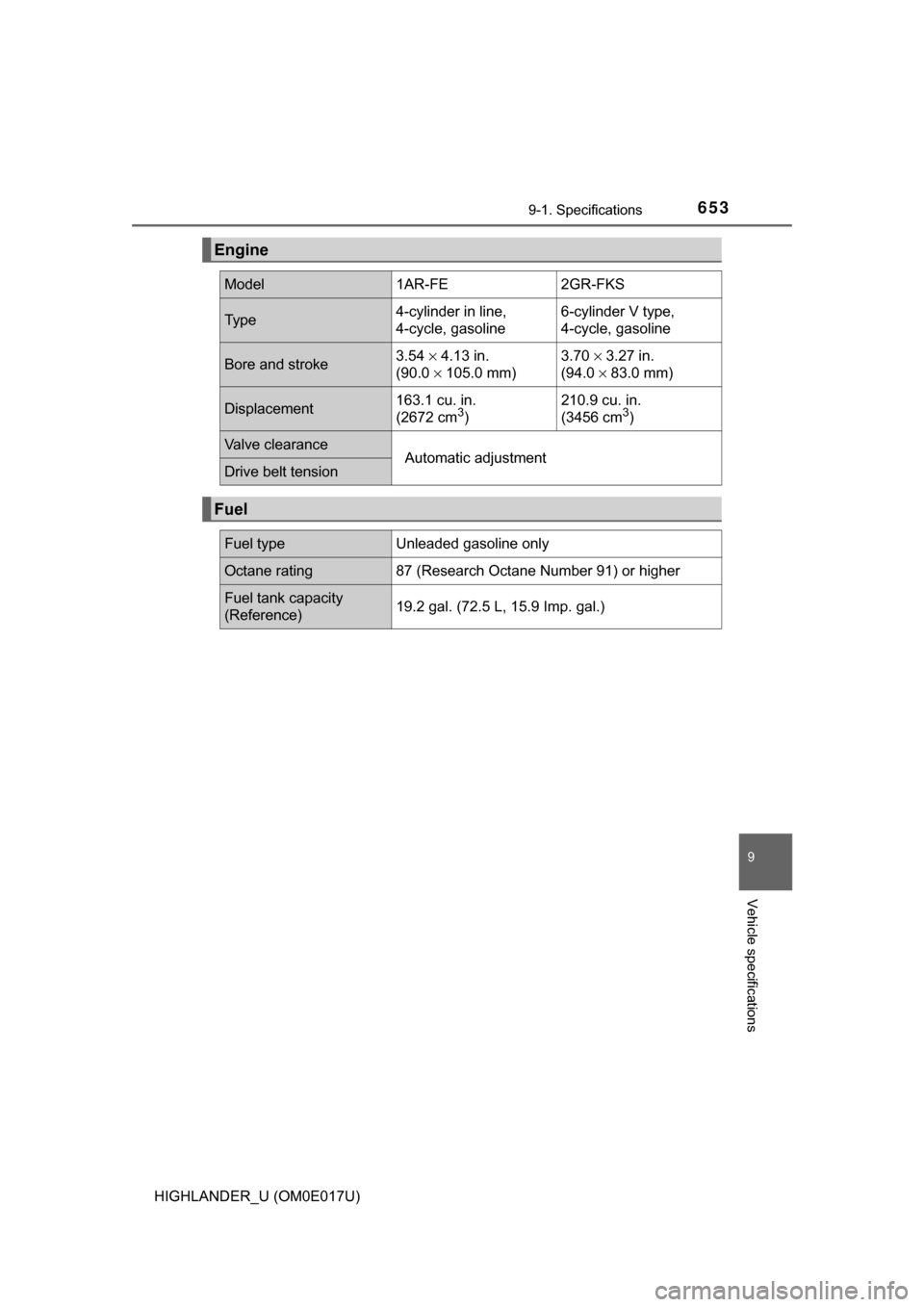
Engine
Model1AR-FE2GR-FKS
Ty p e 4-cylinder in line,
4-cycle, gasoline6-cylinder V type,
4-cycle, gasoline
Bore and stroke
3.54 ×
4.13 in.
(90.0 × 105.0 mm) 3.70 ×
3.27 in.
(94.0 × 83.0 mm)
Displacement 163.1 cu. in.
(2672 cm3)210.9 cu. in.
(3456 cm3)
Valve clearance
Automatic adjustment
Drive belt tension
Fuel
Fuel typeUnleaded gasoline only
Octane rating87 (Research Octane Number 91) or higher
Fuel tank capacity
(Reference)19.2 gal. (72.5 L, 15.9 Imp. gal.)
Page 654 of 732

6549-1. Specifications
HIGHLANDER_U (OM0E017U)
*: The engine oil capacity is a reference quantity to be used when changingthe engine oil. Warm up and turn off the engine, wait more than 5 minutes,
and check the oil level on the dipstick.
■
Engine oil selection
“Toyota Genuine Motor Oil” is us ed in your Toyota vehicle. Use
Toyota approved “Toyota Genuine Motor Oil” or equivalent to satisfy
the following grade and viscosity.
Oil grade: ILSAC GF-5 multigrade engine oil
Recommended viscosity: SAE 0W-20
SAE 0W-20 is the best choice
for good fuel economy and
good starting in cold weather.
If SAE 0W-20 is not available,
SAE 5W-20 oil may be used.
However, it must be replaced
with SAE 0W-20 at the next oil
change.
Lubrication system
Oil capacity
(Drain and refill ⎯ reference
*)
With filter
2.7 L 4-cylinder (1AR-FE) engine
4.6 qt. (4.4 L, 3.9 Imp. qt.)
3.5 L V6 (2GR-FKS) engine
5.8 qt. (5.5 L, 4.8 Imp. qt.)
Without filter2.7 L 4-cylinder (1AR-FE) engine
4.2 qt. (4.0 L, 3.5 Imp. qt.)
3.5 L V6 (2GR-FKS) engine
5.6 qt. (5.3 L, 4.7 Imp. qt.)
Outside temperature
Page 674 of 732
6749-1. Specifications
HIGHLANDER_U (OM0E017U)
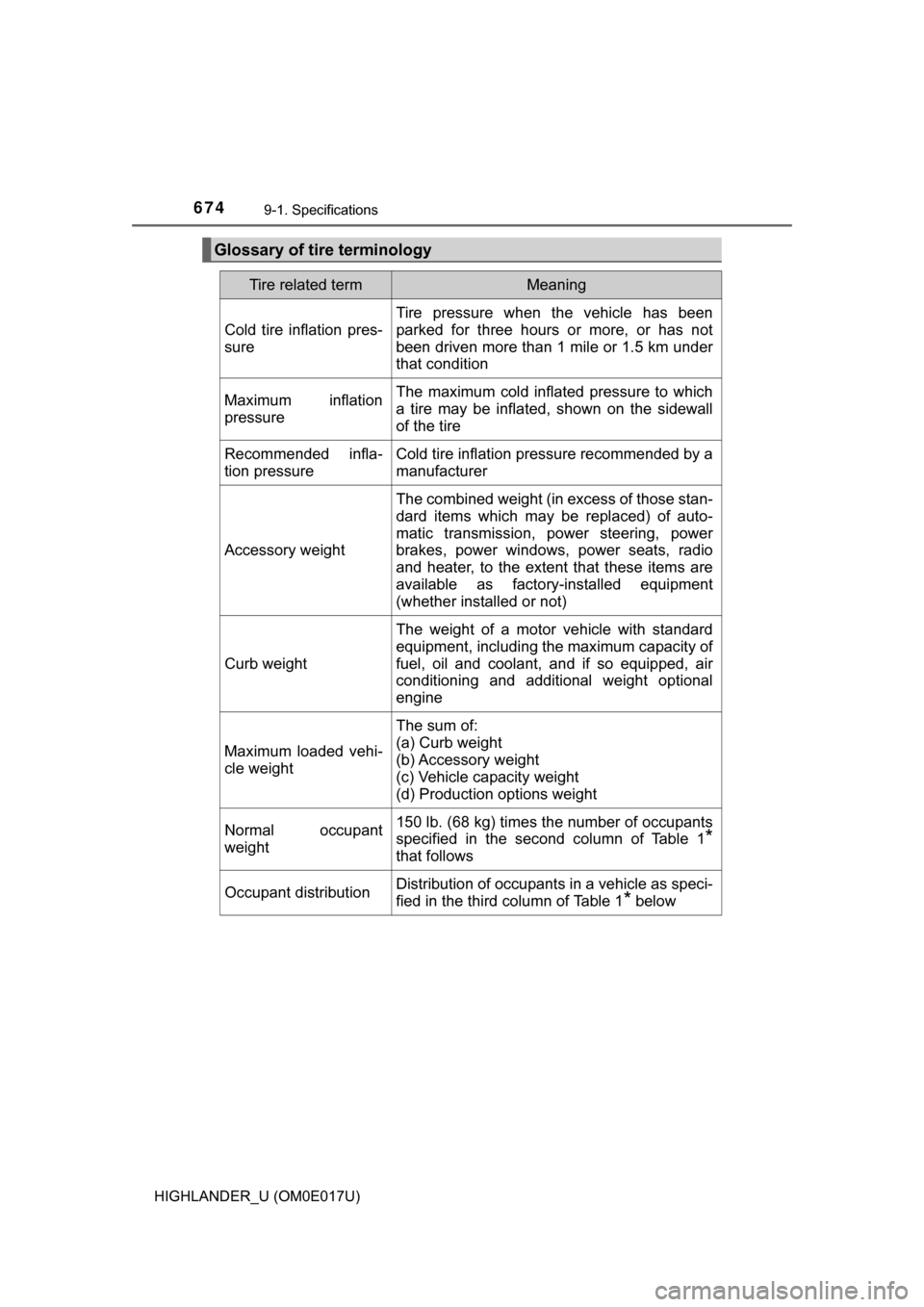
Glossary of tire terminology
Tire related termMeaning
Cold tire inflation pres-
sure
Tire pressure when the vehicle has been
parked for three hours or more, or has not
been driven more than 1 mile or 1.5 km under
that condition
Maximum inflation
pressureThe maximum cold inflated pressure to which
a tire may be inflated, shown on the sidewall
of the tire
Recommended infla-
tion pressureCold tire inflation pressure recommended by a
manufacturer
Accessory weight
The combined weight (in excess of those stan-
dard items which may be replaced) of auto-
matic transmission, power steering, power
brakes, power windows, power seats, radio
and heater, to the extent that these items are
available as factory-installed equipment
(whether installed or not)
Curb weight
The weight of a motor vehicle with standard
equipment, including the maximum capacity of
fuel, oil and coolant, and if so equipped, air
conditioning and additional weight optional
engine
Maximum loaded vehi-
cle weight
The sum of:
(a) Curb weight
(b) Accessory weight
(c) Vehicle capacity weight
(d) Production options weight
Normal occupant
weight150 lb. (68 kg) times the number of occupants
specified in the second column of Table 1
*
that follows
Occupant distributionDistribution of occupants in a vehicle as speci-
fied in the third column of Table 1
* below
Page 720 of 732

720Alphabetical index
HIGHLANDER_U (OM0E017U)
Flat tire...................................... 608
Floor mats .................................. 26
FluidAutomatic transaxle .............. 657
Brake .................................... 659
Washer ................................. 530
Fog lights ................................. 243 Replacing light bulbs............. 556
Switch ................................... 243
Wattage ................................ 663
Front automatic air
conditioning system ............. 442
Front door courtesy lights Location ................................ 458
Wattage ................................ 663
Front fog lights ........................ 243 Replacing light bulbs............. 556
Switch ................................... 243
Wattage ................................ 663
Front manual air
conditioning system ............. 436
Front passenger occupant classification system .............. 53
Front personal lights ............... 459 Wattage ................................ 663
Front seats ............................... 149 Adjustment ............................ 149
Cleaning................................ 504
Correct driving posture ........... 28
Driving position memory ....... 158
Head restraints ..................... 162
Seat heaters ......................... 456
Seat position memory ........... 158
Seat ventilators ..................... 456 Front side marker lights ......... 235
Light switch ........................... 235
Replacing light bulbs ............ 556
Wattage ................................ 663
Front turn signal lights ........... 233
Replacing light bulbs ............ 556
Turn signal lever ................... 233
Wattage ................................ 663
Fuel ........................................... 250 Capacity................................ 653
Fuel gauge.............................. 92
Fuel pump shut off system ... 580
Information............................ 664
Refueling .............................. 250
Type...................................... 653
Warning light......................... 582
Fuel consumption
Average fuel economy ............ 97
Current fuel consumption ......................... 97
Fuel filler door ......................... 250 If the fuel filler door cannot be opened .............. 252
Refueling .............................. 250
Fuel pump shut off system..... 580
Fuses ........................................ 552
Garage door opener ................ 481
Gauges ....................................... 92
Glass hatch .............................. 136
Glove box ................................. 461
Grocery bag hooks.................. 467
F
G
Page 726 of 732

726Alphabetical index
HIGHLANDER_U (OM0E017U)
Rear window defogger ......................... 438, 444
Rear window wiper .................. 248
Refueling .................................. 250 Capacity ................................ 653
Fuel types ............................. 653
If the fuel filler door cannot be opened............... 252
Opening the fuel tank cap ..... 252
Replacing Electronic key battery ........... 549
Fuses .................................... 552
Light bulbs ............................ 556
Tires ...................................... 608
Wireless remote control
battery ................................ 549
Reporting safety defects
for U.S. owners ...................... 694
Resetting the message indicating maintenance is
required .................................. 508
Roof rails .................................. 198 Safety Connect ........................ 488
Seat belt reminder light .......... 582
Seat belts ................................... 30
Adjusting the seat belt ............ 33
Automatic Locking Retractor .............................. 35
Child restra int system
installation ............................ 69
Cleaning and maintaining the seat belt........................ 505
Emergency Locking
Retractor .............................. 35
How to wear your seat belt ..... 28
How your child should wear the seat belt.......................... 36
Pregnant women, proper seat belt use ......................... 37
Reminder light and buzzer.... 582
Seat belt extender .................. 36
Seat belt pretensioners........... 34
SRS warning light ................. 581
Seat heaters ............................. 456
Seat position memory ............. 158
Seat ventilators........................ 456
Seating capacity ...................... 200
Seats ................................. 149, 151 Adjustment.................... 149, 151
Adjustment
precautions................. 150, 157
Child seats/child restraint
system installation ................ 65
Cleaning ............................... 505
Driving position memory ....... 158
Head restraints ..................... 162
Properly sitting in the seat ...... 28
Seat heaters ......................... 456
Seat position memory ........... 158
Seat ventilators ..................... 456S