Page 573 of 716

5738-2. Steps to take in an emergency
8
When trouble arises
HIGHLANDER_HV_U (OM48F12U)■
When a tire is replaced with a spare tire
Vehicles with a compact spare tire
The compact spare tire is not equipped with a tire pressure warning valve
and transmitter. If a tire goes flat, the tire pressure warning light will not
turn off even though the flat tire ha s been replaced with the spare tire.
Replace the spare tire with the repair ed tire and adjust the tire inflation
pressure. The tire pressu re warning light will go off after a few minutes.
Vehicles with a full-size spare tire
The spare tire is also equipped with the tire pressure warning valve and
transmitter. The tire pres sure warning light will turn on if the tire inflation
pressure of the spare tire is low. If a tire goes flat, even though the flat tire
is replaced with the spare tire, the tire pressure warning light does not
turn off. Replace the spare tire with the repaired tire and adjust to the
proper tire inflatio n pressure. The tire pressure warning light will turn off
after a few minutes.
■Conditions that the tire pressure warning system may not function
properly
→ P. 5 2 8
■If the tire pressure warning light frequently comes on after blinking
for 1 minute
If the tire pressure warning light frequently comes on after blinking for 1
minute when the power switch is turn ed to ON mode, have it checked by
your Toyota dealer.
■ Customization that can be co nfigured at Toyota dealer
The vehicle speed linked seat belt reminder buzzer can be disabled.
(Customizable features →P. 675) However, Toyota recommends that the seat
belt reminder buzzer be operational to alert the driver and front passenger
when seat belts are not fastened.
■ Warning buzzer
In some cases, the buzzer may not be heard because of noisy place or an
audio sound.
Page 575 of 716

5758-2. Steps to take in an emergency
8
When trouble arises
HIGHLANDER_HV_U (OM48F12U)
WARNING
■Maintenance of the tires
Each tire, including the spare (if provided), should be checked monthly
when cold and inflated to the inflation pressure recommended by the
vehicle manufacturer on the vehicle placard or tire inflation pressure
label (tire and load information label). (If your vehicle has tires of a dif-
ferent size than the size indicated on the vehicle placard or tire inflation
pressure label [tire and load information label], you should determine
the proper tire inflation pressure for those tires.)
As an added safety feature, your vehicle has been equipped with a tire
pressure monitoring system (TPMS-ti re pressure warning system) that
illuminates a low tire pre ssure telltale (tire pressure warning light) when
one or more of your tires is significantly under-inflated. Accordingly,
when the low tire pressure telltale (tire pressure warning light) illumi-
nates, you should stop and check your tires as soon as possible, and
inflate them to the proper pressure. Driving on a significantly under-
inflated tire causes the tire to overheat and can lead to tire failure.
Under-inflation also reduces fuel effi ciency and tire tread life, and may
affect the vehicle’s hand ling and stopping ability.
Please note that the TPMS (tire pressure warning system) is not a sub-
stitute for proper ti re maintenance, and it is the driver’s responsibility to
maintain correct tire pressure, even if under-inflation has not reached
the level to trigger illumination of the TPMS low tire pressure telltale (tire
pressure warning light).
Your vehicle has also been equipped with a TPMS (tire pressure warn-
ing system) malfunction indicator to indicate when the system is not
operating properly. The TPMS (tire pressure warning system) malfunc-
tion indicator is combined with the lo w tire pressure telltale (tire pressure
warning light). When the system detects a malfunction, the telltale will
flash for approximately one minute and then remain continuously illumi-
nated. This sequence w ill continue upon subsequ ent vehicle start-ups
as long as the malfunction exists. When the malfunction indicator is illu-
minated, the system may not be able to detect or signal low tire pres-
sure as intended.
TPMS (tire pressure warning system) malfunctions may occur for a vari-
ety of reasons, including the installation of replacement or alternate tires
or wheels on the vehicle that prevent the TPMS (tire pressure warning
system) from functioning properly. Always check the TPMS (tire pres-
sure warning system) malfunction te lltale after replacing one or more
tires or wheels on your vehicle to ensure that the replacement or alter-
nate tires and wheels allow the TPMS (tire pressure warning system) to
continue to function properly.
Page 603 of 716
6038-2. Steps to take in an emergency
8
When trouble arises
HIGHLANDER_HV_U (OM48F12U)
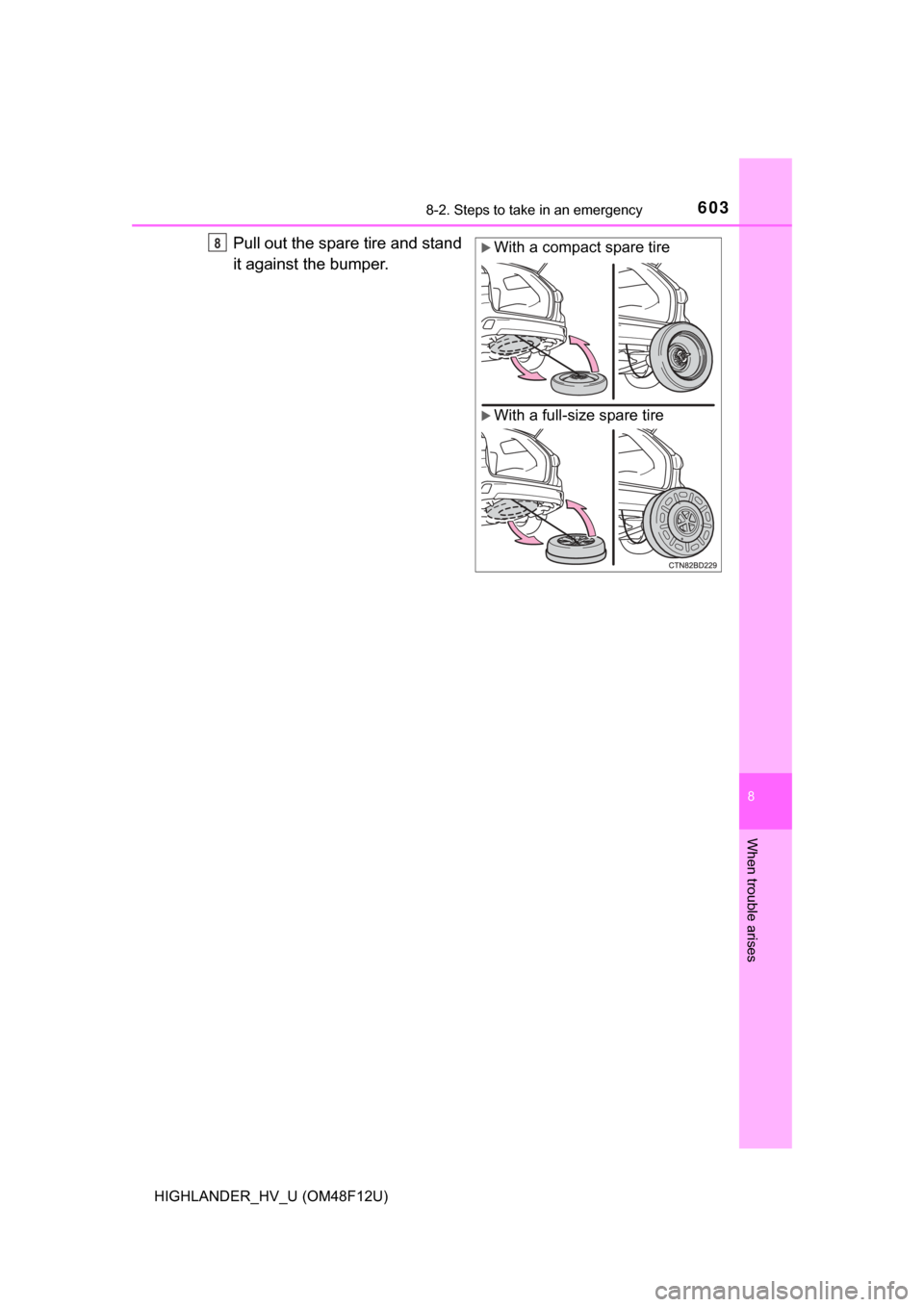
Pull out the spare tire and stand
it against the bumper.With a compact spare tire
With a full-size spare tire
8
Page 605 of 716
6058-2. Steps to take in an emergency
8
When trouble arises
HIGHLANDER_HV_U (OM48F12U)
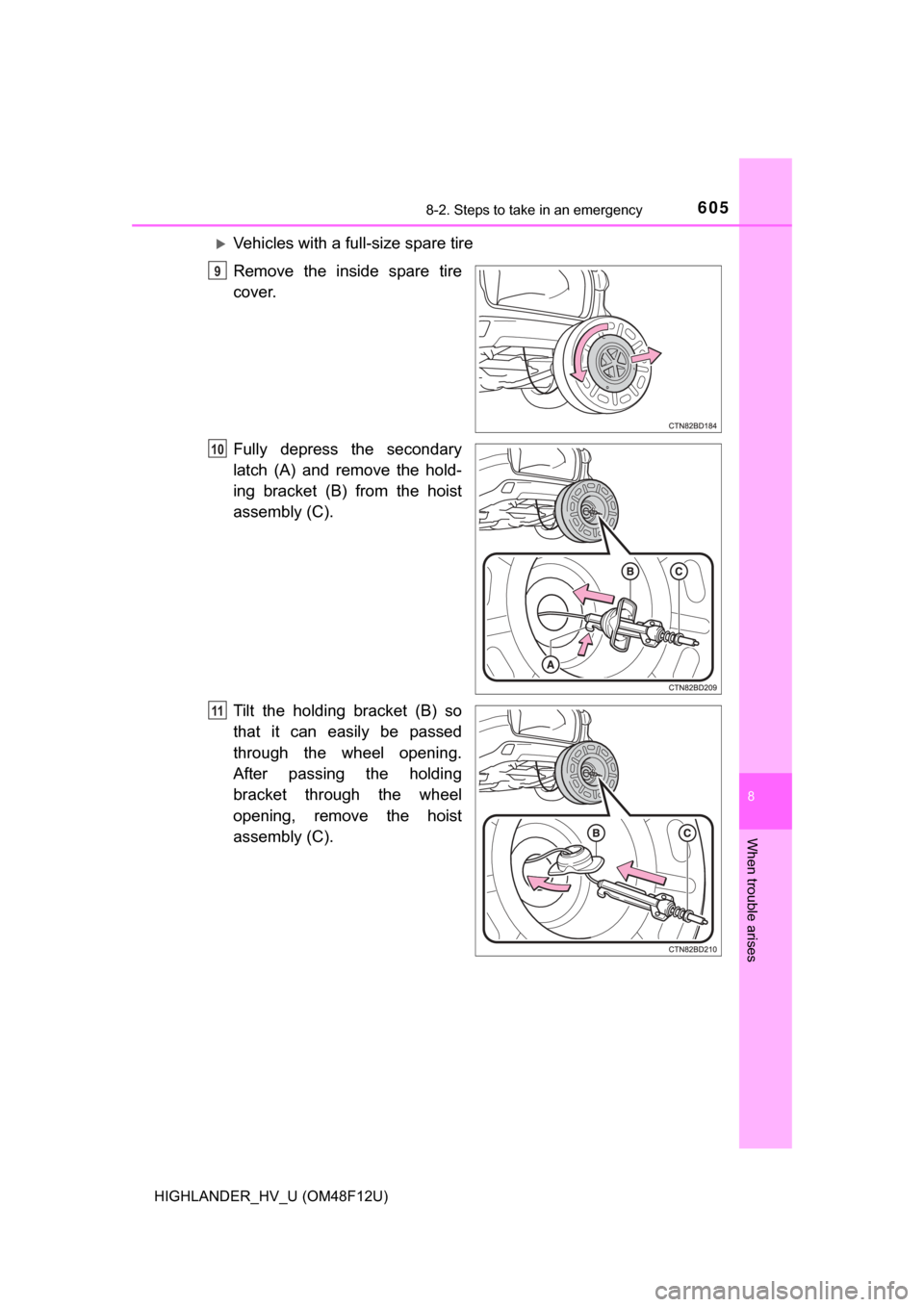
Vehicles with a full-size spare tire
Remove the inside spare tire
cover.
Fully depress the secondary
latch (A) and remove the hold-
ing bracket (B) from the hoist
assembly (C).
Tilt the holding bracket (B) so
that it can easily be passed
through the wheel opening.
After passing the holding
bracket through the wheel
opening, remove the hoist
assembly (C).
9
10
11
Page 611 of 716
6118-2. Steps to take in an emergency
8
When trouble arises
HIGHLANDER_HV_U (OM48F12U)
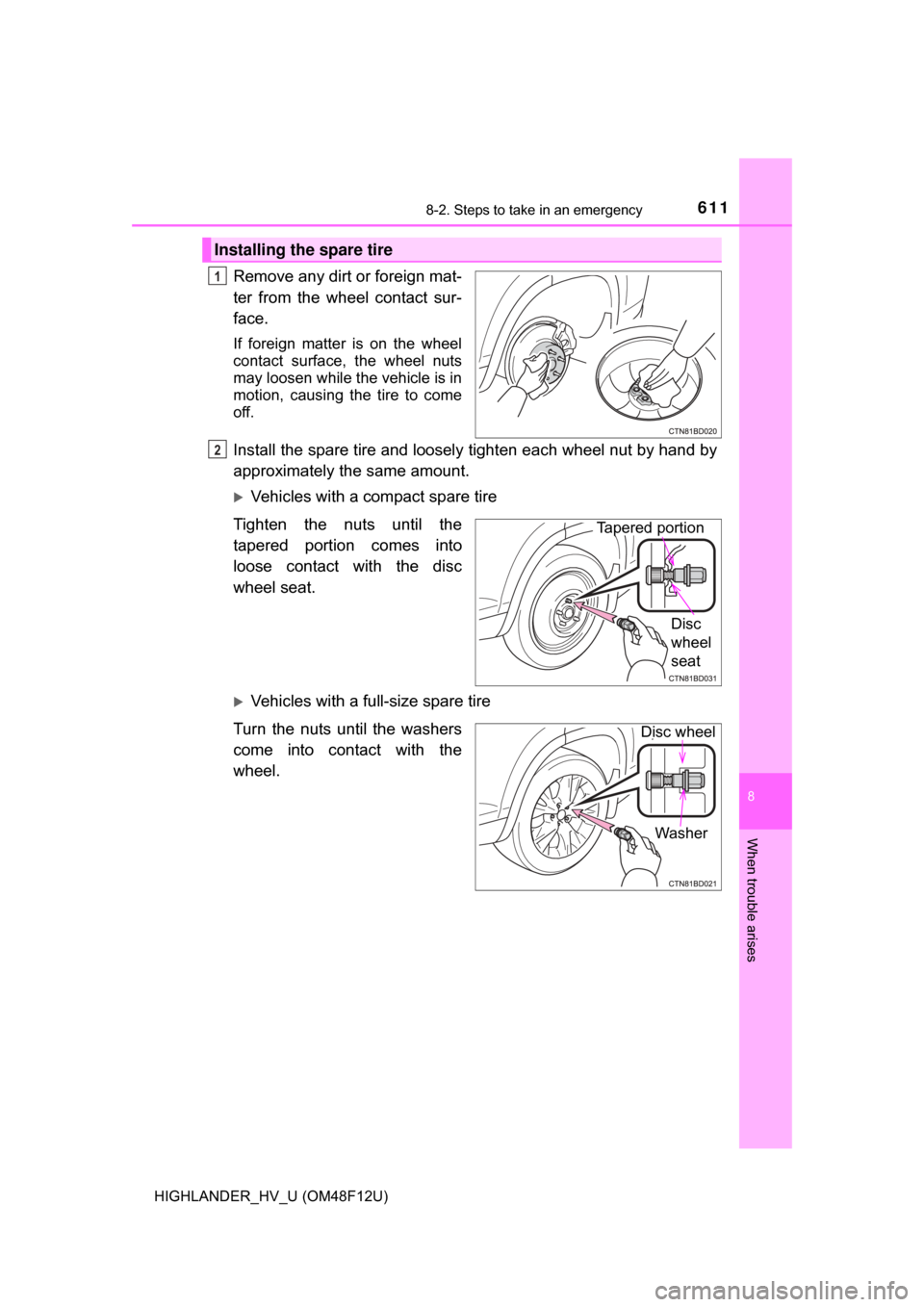
Remove any dirt or foreign mat-
ter from the wheel contact sur-
face.
If foreign matter is on the wheel
contact surface, the wheel nuts
may loosen while the vehicle is in
motion, causing the tire to come
off.
Install the spare tire and loosely tighten each wheel nut by hand by
approximately the same amount.
Vehicles with a compact spare tire
Tighten the nuts until the
tapered portion comes into
loose contact with the disc
wheel seat.
Vehicles with a full-size spare tire
Turn the nuts until the washers
come into contact with the
wheel.
Installing the spare tire
1
2
Tapered portion
Disc
wheel
seat
Washer
Disc wheel
Page 615 of 716
6158-2. Steps to take in an emergency
8
When trouble arises
HIGHLANDER_HV_U (OM48F12U)
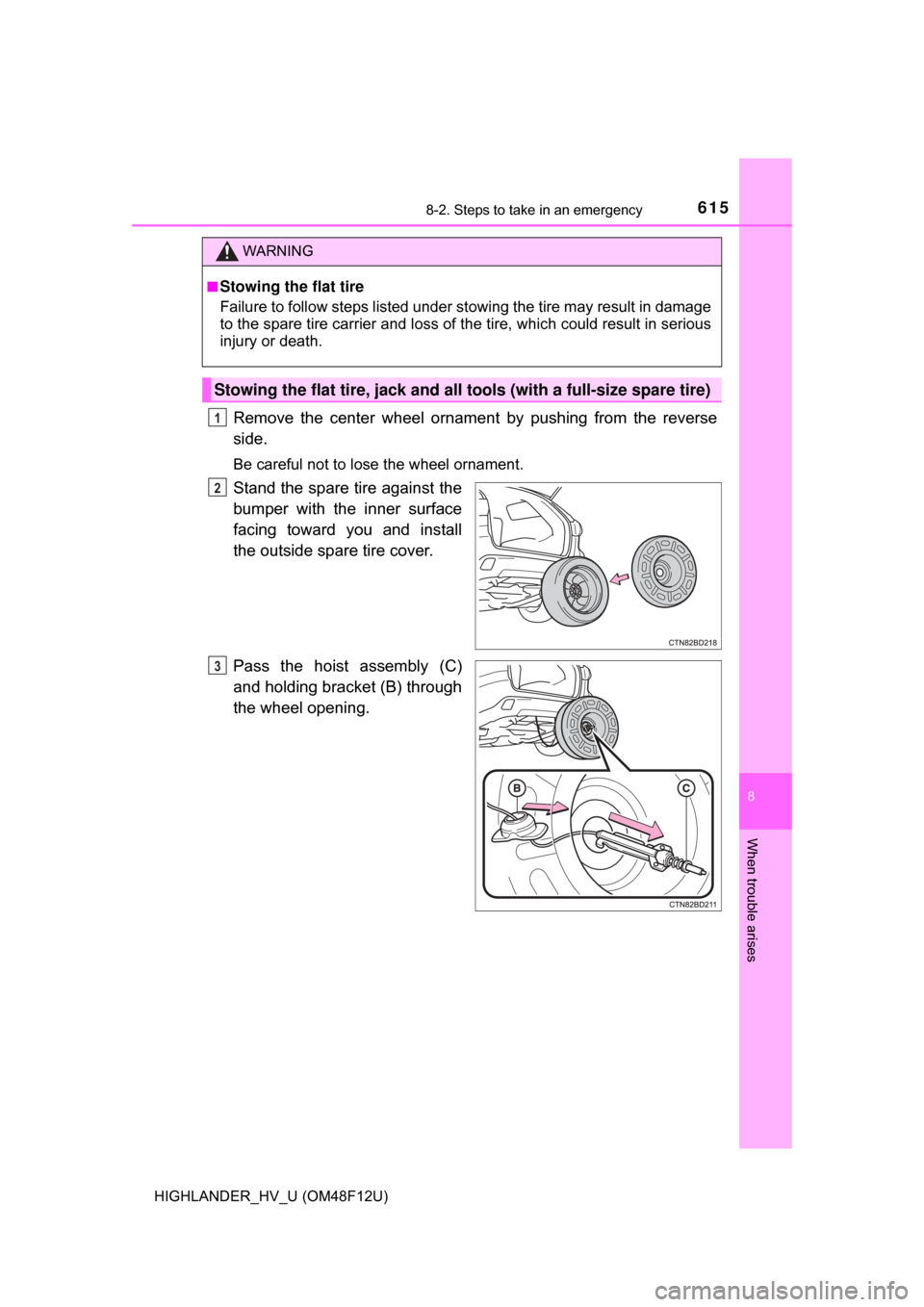
Remove the center wheel ornament by pushing from the reverse
side.
Be careful not to lose the wheel ornament.
Stand the spare tire against the
bumper with the inner surface
facing toward you and install
the outside spare tire cover.
Pass the hoist assembly (C)
and holding bracket (B) through
the wheel opening.
WARNING
■Stowing the flat tire
Failure to follow steps listed under st owing the tire may result in damage
to the spare tire carrier and loss of the tire, which could result in serious
injury or death.
Stowing the flat tire, jack and all tools (with a full-size spare tire)
1
2
3
Page 646 of 716
6469-1. Specifications
HIGHLANDER_HV_U (OM48F12U)
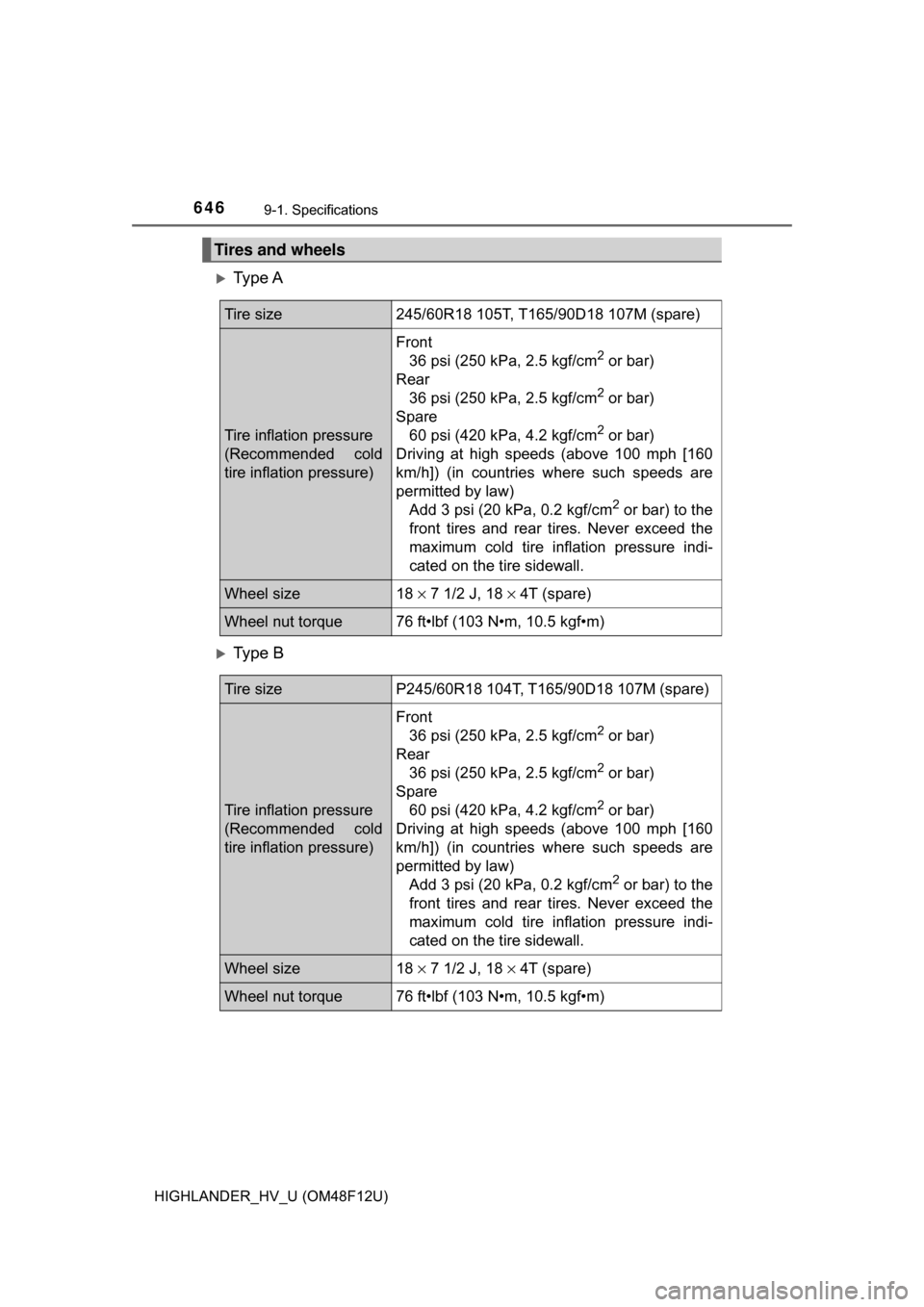
Ty p e A
Ty p e B
Tires and wheels
Tire size245/60R18 105T, T165/90D18 107M (spare)
Tire inflation pressure
(Recommended cold
tire inflation pressure)
Front36 psi (250 kPa, 2.5 kgf/cm2 or bar)
Rear 36 psi (250 kPa, 2.5 kgf/cm
2 or bar)
Spare 60 psi (420 kPa, 4.2 kgf/cm
2 or bar)
Driving at high speeds (above 100 mph [160
km/h]) (in countries where such speeds are
permitted by law) Add 3 psi (20 kPa, 0.2 kgf/cm
2 or bar) to the
front tires and rear tires. Never exceed the
maximum cold tire inflation pressure indi-
cated on the tire sidewall.
Wheel size18 × 7 1/2 J, 18 × 4T (spare)
Wheel nut torque76 ft•lbf (103 N•m, 10.5 kgf•m)
Tire sizeP245/60R18 104T, T165/90D18 107M (spare)
Tire inflation pressure
(Recommended cold
tire inflation pressure)
Front
36 psi (250 kPa, 2.5 kgf/cm2 or bar)
Rear 36 psi (250 kPa, 2.5 kgf/cm
2 or bar)
Spare 60 psi (420 kPa, 4.2 kgf/cm
2 or bar)
Driving at high speeds (above 100 mph [160
km/h]) (in countries where such speeds are
permitted by law) Add 3 psi (20 kPa, 0.2 kgf/cm
2 or bar) to the
front tires and rear tires. Never exceed the
maximum cold tire inflation pressure indi-
cated on the tire sidewall.
Wheel size18 × 7 1/2 J, 18 × 4T (spare)
Wheel nut torque76 ft•lbf (103 N•m, 10.5 kgf•m)
Page 647 of 716
6479-1. Specifications
9
Vehicle specifications
HIGHLANDER_HV_U (OM48F12U)
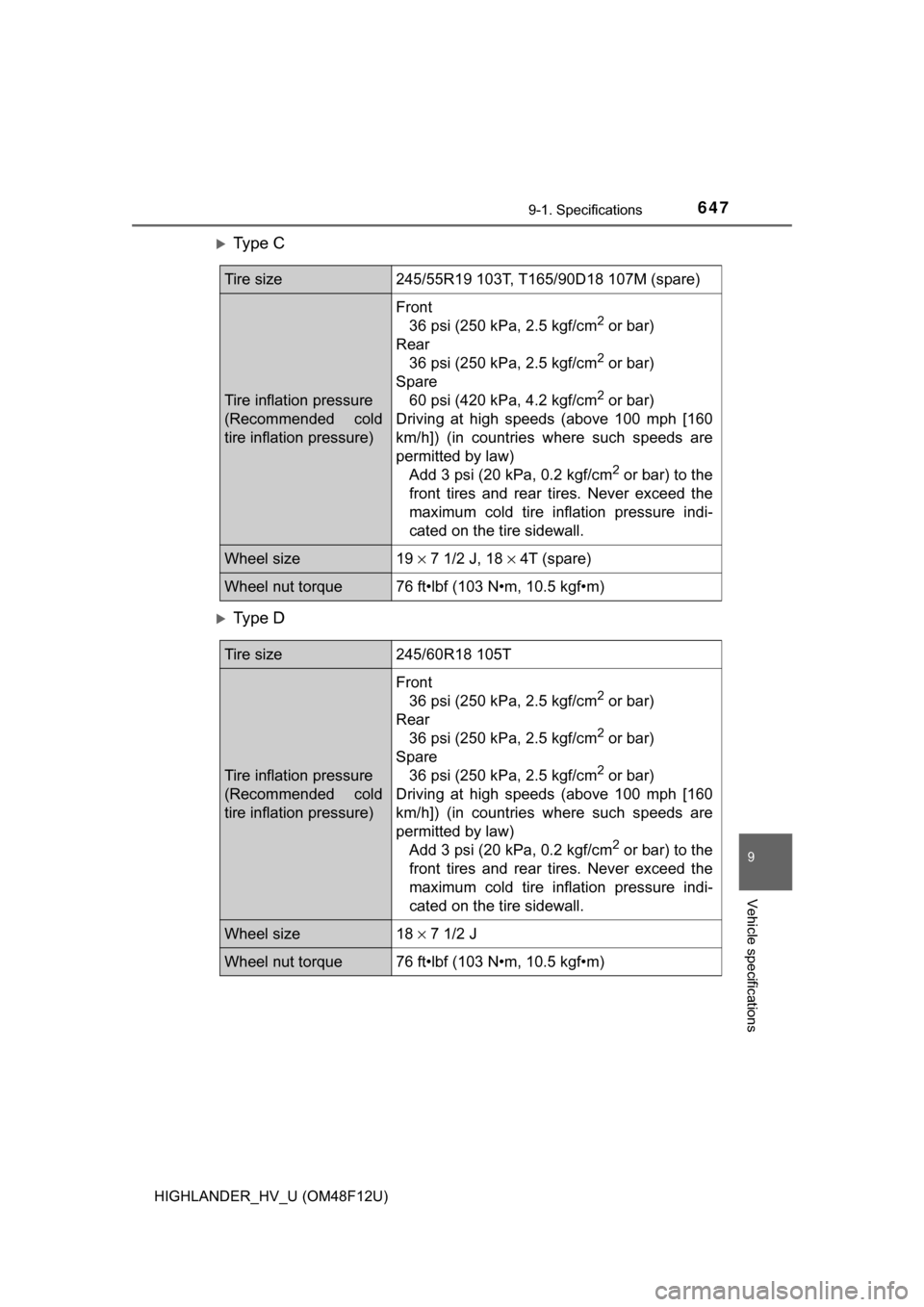
Ty p e C
Ty p e D
Tire size245/55R19 103T, T165/90D18 107M (spare)
Tire inflation pressure
(Recommended cold
tire inflation pressure)
Front36 psi (250 kPa, 2.5 kgf/cm2 or bar)
Rear 36 psi (250 kPa, 2.5 kgf/cm
2 or bar)
Spare 60 psi (420 kPa, 4.2 kgf/cm
2 or bar)
Driving at high speeds (above 100 mph [160
km/h]) (in countries where such speeds are
permitted by law) Add 3 psi (20 kPa, 0.2 kgf/cm
2 or bar) to the
front tires and rear tires. Never exceed the
maximum cold tire inflation pressure indi-
cated on the tire sidewall.
Wheel size19 × 7 1/2 J, 18 × 4T (spare)
Wheel nut torque76 ft•lbf (103 N•m, 10.5 kgf•m)
Tire size245/60R18 105T
Tire inflation pressure
(Recommended cold
tire inflation pressure)
Front
36 psi (250 kPa, 2.5 kgf/cm2 or bar)
Rear 36 psi (250 kPa, 2.5 kgf/cm
2 or bar)
Spare 36 psi (250 kPa, 2.5 kgf/cm
2 or bar)
Driving at high speeds (above 100 mph [160
km/h]) (in countries where such speeds are
permitted by law) Add 3 psi (20 kPa, 0.2 kgf/cm
2 or bar) to the
front tires and rear tires. Never exceed the
maximum cold tire inflation pressure indi-
cated on the tire sidewall.
Wheel size18 × 7 1/2 J
Wheel nut torque76 ft•lbf (103 N•m, 10.5 kgf•m)