Page 322 of 505
322
4-3. Do-it-yourself maintenance
86_EE (OM18071E)
WARNING
The engine compartment contains many mechanisms and fluids that may
move suddenly, become hot, or become electrically energized. To avoid death
or serious injury, observe the following precautions.
■
When working on the engine compartment
●Keep hands, clothing, and tools away from the moving fan and engine
drive belt.
● Be careful not to touch the engine, radiator, exhaust manifold, etc. right
after driving as they may be hot. Oil and other fluids may also be hot.
● Do not leave anything that may burn easily, such as paper or rags, in the
engine compartment.
● Do not smoke, cause sparks or expose an open flame to fuel or the bat-
tery. Fuel and battery fumes are flammable.
● Be extremely cautious when working on the battery. It contains poisonous
and corrosive sulfuric acid.
● Take care because brake fluid can harm your hands or eyes and damage
painted surfaces.
If fluid gets on your hands or in your eyes, flush the affected area with
clean water immediately.
If you still experience discomfort, see a doctor.
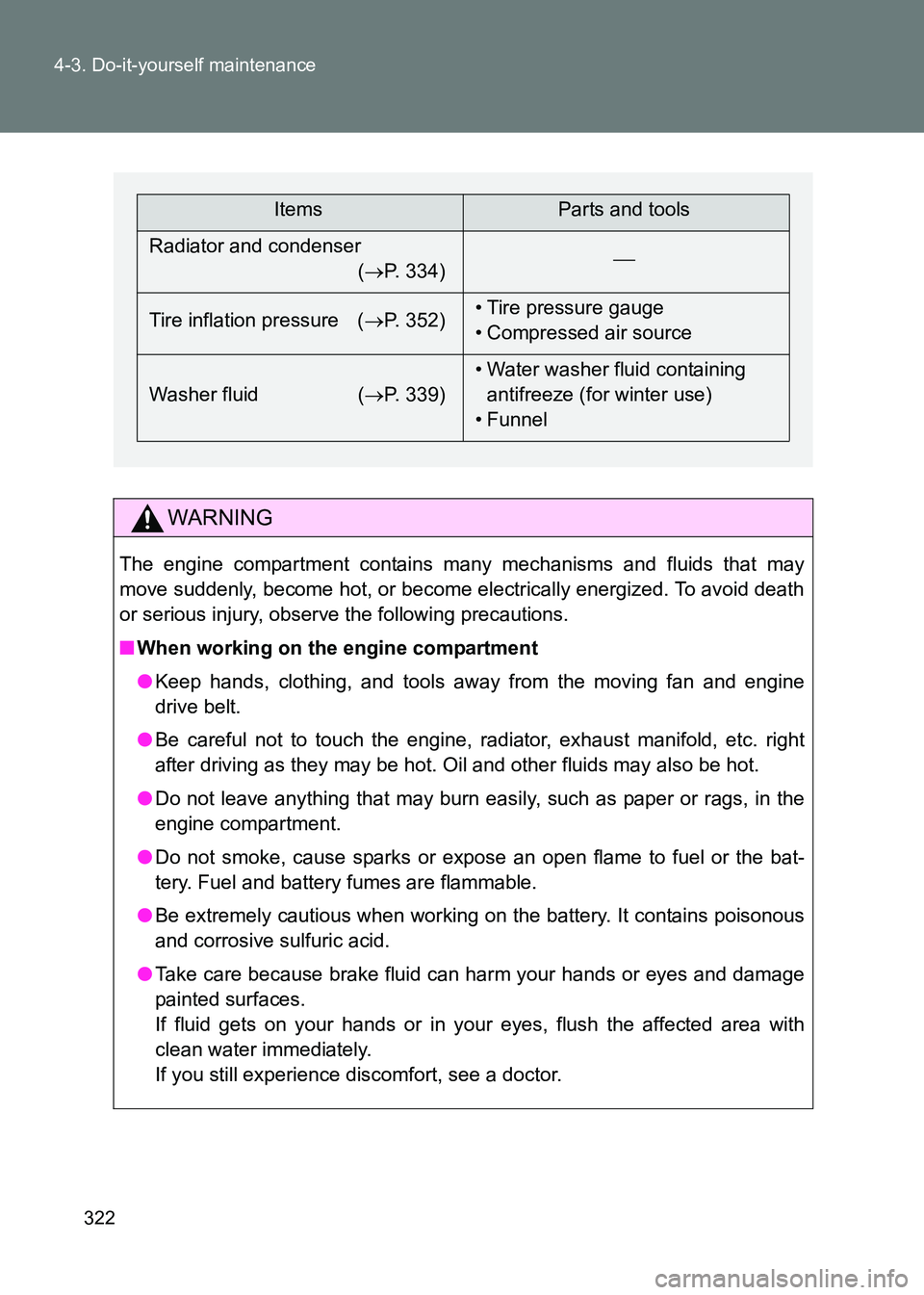
ItemsParts and tools
Radiator and condenser (→ P. 334)
Tire inflation pressure ( →P. 352) • Tire pressure gauge
• Compressed air source
Washer fluid ( →P. 339) • Water washer fluid containing
antifreeze (for winter use)
• Funnel
Page 342 of 505
342
4-3. Do-it-yourself maintenance
86_EE (OM18071E)
■
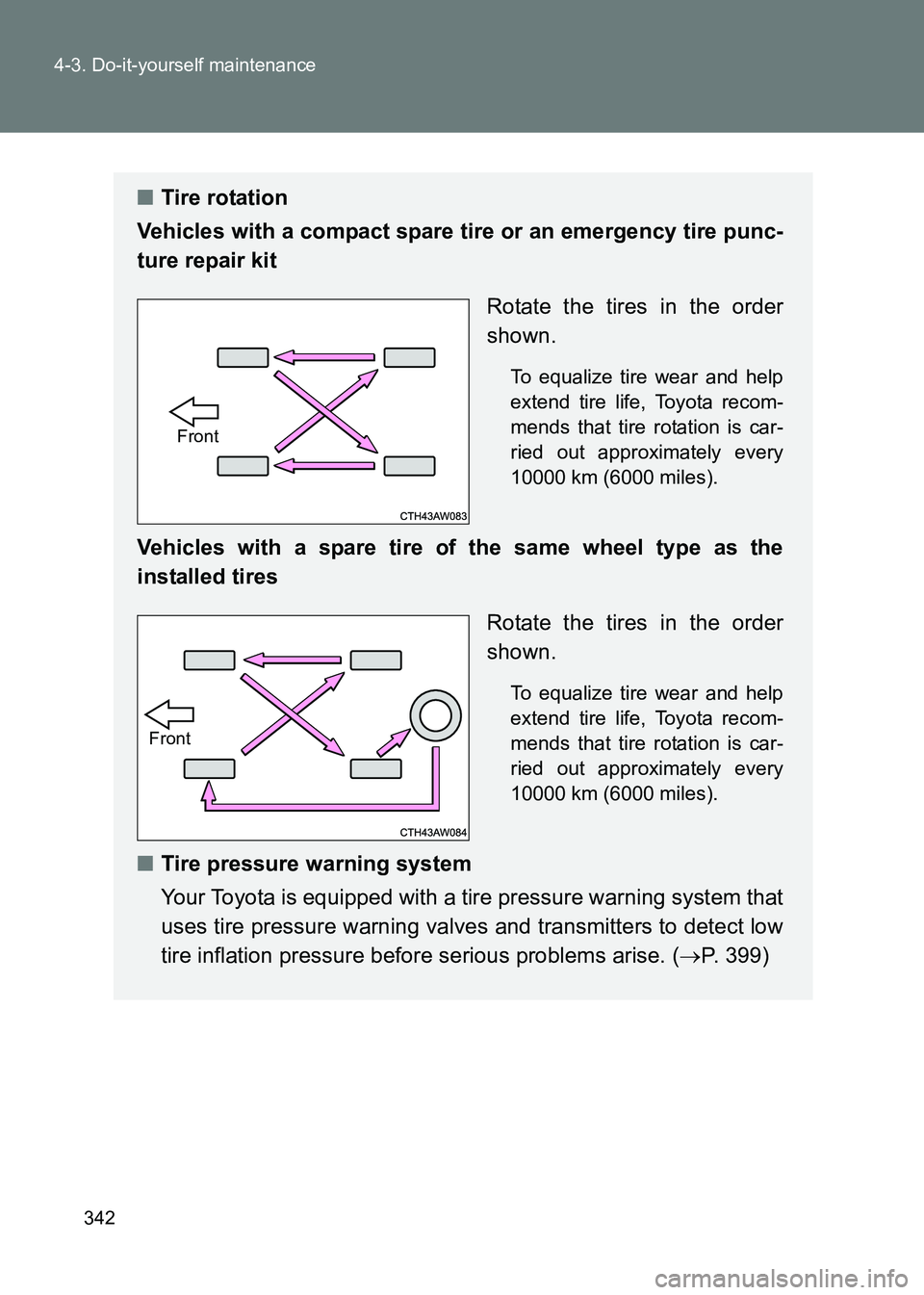
Tire rotation
Vehicles with a compact spare tire or an emergency tire punc-
ture repair kit
Rotate the tires in the order
shown.
To equalize tire wear and help
extend tire life, Toyota recom-
mends that tire rotation is car-
ried out approximately every
10000 km (6000 miles).
Vehicles with a spare tire of the same wheel type as the
installed tiresRotate the tires in the order
shown.
To equalize tire wear and help
extend tire life, Toyota recom-
mends that tire rotation is car-
ried out approximately every
10000 km (6000 miles).
■Tire pressure warning system
Your Toyota is equipped with a tire pressure warning system that
uses tire pressure warning valves and transmitters to detect low
tire inflation pressure before serious problems arise. ( →P. 399)
Front
Front
Page 344 of 505
344
4-3. Do-it-yourself maintenance
86_EE (OM18071E)
■
How to initialize the tire pressure warning system
Park the vehicle in a safe place and turn the “ENGINE START
STOP” switch (vehicles with a smart entry & start system) or
the engine switch (vehicles without a smart entry & start sys-
tem) off.
Initialization cannot be performed while the vehicle is moving.
Adjust the tire inflation pressure to the specified cold tire infla-
tion pressure level. ( →P. 483)
Make sure to adjust the tire pressure to the specified cold tire infla-
tion pressure level. The tire pressure warning system will operate
based on this pressure level.
Turn the “ENGINE START STOP” switch to IGNITION ON
mode (vehicles with a smart entry & start system) or engine
switch to the “ON” position (vehicles without a smart entry &
start system).
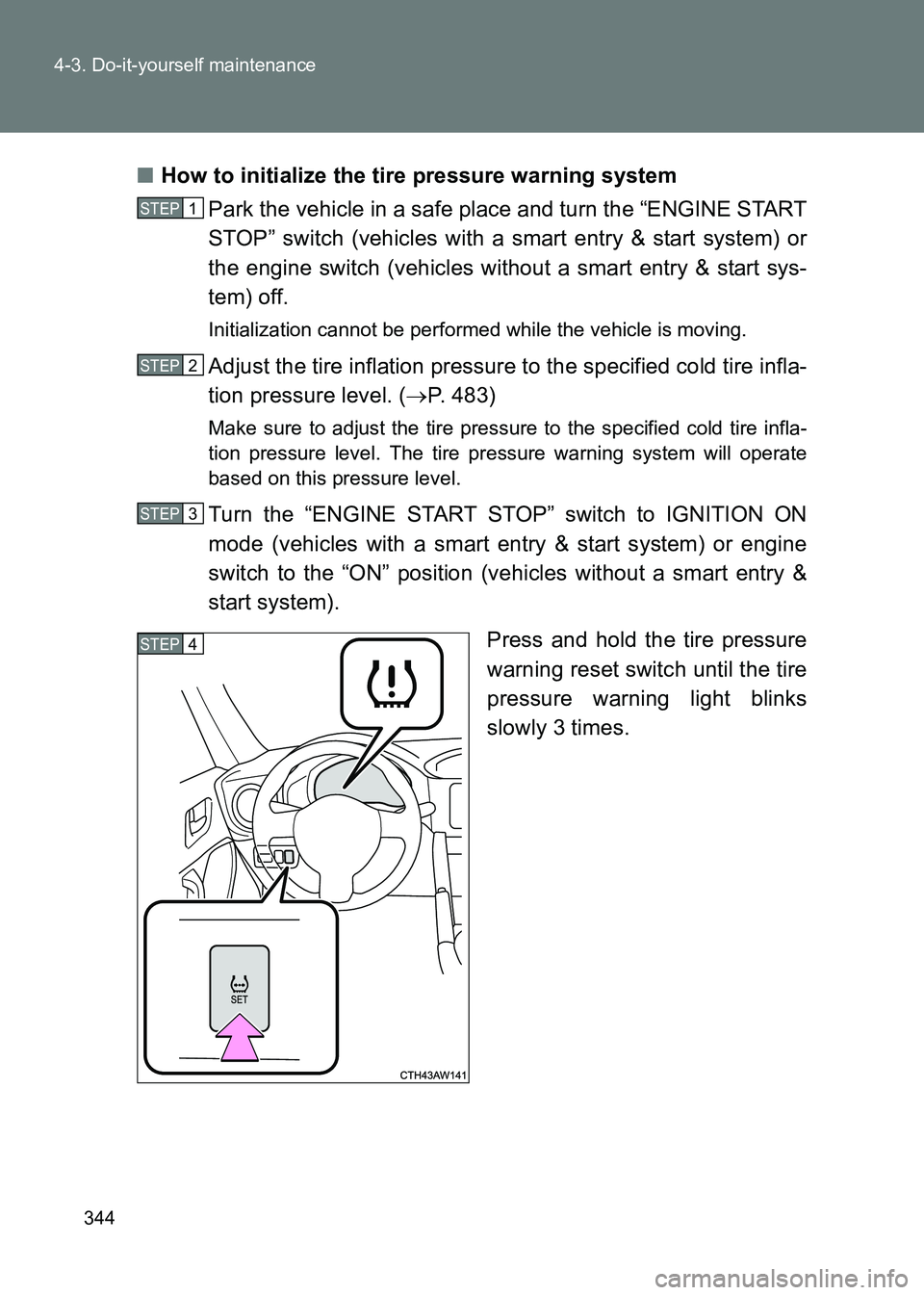
Press and hold the tire pressure
warning reset switch until the tire
pressure warning light blinks
slowly 3 times.
STEP1
STEP2
STEP3
STEP4
Page 346 of 505

346
4-3. Do-it-yourself maintenance
86_EE (OM18071E)
■
When to replace your vehicle’s tires
Tires should be replaced if:
●The treadwear indicators are showing on a tire.
● You have tire damage such as cuts, splits, cracks deep enough to
expose the fabric or bulges indicating internal damage
● A tire goes flat repeatedly or cannot be properly repaired due to the size
or location of a cut or other damage
If you are not sure, consult with any authorized Toyota dealer or repairer, or
another duly qualified and equipped professional.
■ Replacing tires and wheels
If the ID code of the tire pressure warning valve and transmitter is not regis-
tered, the tire pressure warning system will not work properly. After driving
for about 10 minutes, the tire pressure warning light comes on after blinking
for 1 minute to indicate a system malfunction.
■ Tire life
Any tires over 6 years old must be checked by a qualified technician even if
they have seldom or never been used or damage is not obvious.
■ Routine tire inflation pressure checks
The tire pressure warning system does no t replace routine tire inflation pres-
sure checks. Make sure to check tire inflation pressure as part of your rou-
tine of daily vehicle checks.
■ If the tread on snow tires wears down 4 mm (0.16 in.)
The effectiveness of snow tires is lost.
■ Low profile tires (vehicles with 17-inch tires)
Generally, low profile tires will wear more rapidly and tire grip performance
will be reduced on snowy and/or icy roads when compared to standard tires.
Be sure to use snow tires or tire chains on snowy and/or icy roads and drive
carefully at a speed appropriate for road and weather conditions.
■ If you press the tire pressure wa rning reset switch accidentally
If initialization is performed, adjust the ti re inflation pressure to the specified
level and initialize the tire pressure warning system again.
Page 349 of 505

349
4-3. Do-it-yourself maintenance
4
Maintenance and care
86_EE (OM18071E)
WARNING
■
Tire pressure warning system operation
The tire pressure warning system may not provide warning immediately if a
tire bursts or if sudden air leakage occurs.
■ When inspecting or replacing tires
Observe the following precautions to prevent accidents.
Failure to do so may cause damage to parts of the drive train, as well as
dangerous handling characteristics, which may lead to an accident resulting
in death or serious injury.
●Make sure to install 4 tires that are of the specified size, and that all 4 tires
are the same size, same maker, same brand and tread pattern.
● Do not use tire sizes other than those recommended by Toyota.
● Only use radial tires.
● Do not mix summer, all season and snow tires.
● Do not use tires that have been used on another vehicle.
Do not use tires if you do not know how they were used previously.
■ When initializing the tire pressure warning system
Do not operate the tire pressure warning reset switch without first adjusting
the tire inflation pressure to the specified level. Otherwise, the tire pressure
warning light may not come on even if the tire inflation pressure is low, or it
may come on when the tire inflation pressure is actually normal.
Page 351 of 505
351
4-3. Do-it-yourself maintenance
4
Maintenance and care
86_EE (OM18071E)
NOTICE
■
Low profile tires and wheels (vehicles with 17-inch tires)
Low profile tires may cause greater damage than usual to the tire wheel
when receiving impact from the road surface. Therefore pay attention to the
following:
●Be sure to use proper tire inflation pressure. If tires are under-inflated, they
may be damaged more severely.
● Avoid pot holes, uneven pavement, curbs and other road hazards. Failure
to do so can lead to severe tire and wheel damage.
■ If tire pressures become low while driving
Do not continue driving, or your tires and/or wheels may be ruined.
Page 352 of 505
352
4-3. Do-it-yourself maintenance
86_EE (OM18071E)
Tire inflation pressure
■Effects of incorrect tire inflation pressure
Driving with incorrect tire inflation pressure may result in the following:
● Reduced fuel economy
● Reduced driving comfort and poor handling
● Reduced tire life due to wear
● Reduced safety
● Damage to the drive train
If a tire needs frequent refilling, have it checked by any authorized Toyota
dealer or repairer, or another duly qualified and equipped professional.
■ Instructions for checking tire pressure
When checking tire inflation pressure, observe the following:
●Check only when the tires are cold.
If your vehicle has been parked for at least 3 hours and has not been
driven for more than 1.5 km or 1 mile, you will get an accurate cold tire
inflation pressure reading.
● Always use a tire pressure gauge.
It is difficult to judge if a tire is properly inflated based only on its appear-
ance.
● It is normal for the tire inflation pressure to be higher after driving as heat
is generated in the tire. Do not reduce tire inflation pressure after driving.
● Passengers and luggage weight should be placed so that the vehicle is
balanced.
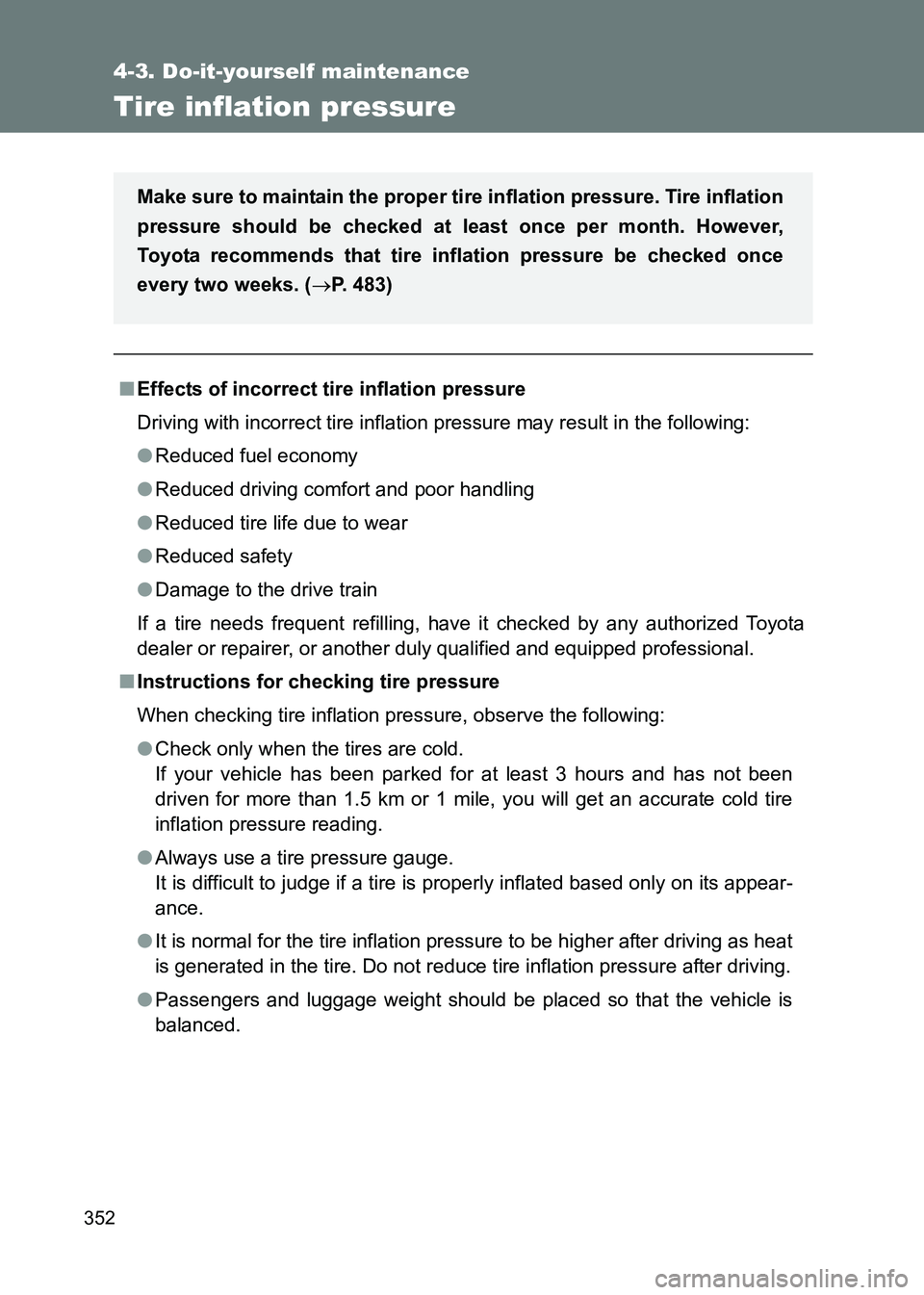
Make sure to maintain the proper ti
re inflation pressure. Tire inflation
pressure should be checked at least once per month. However,
Toyota recommends that tire inflation pressure be checked once
every two weeks. ( →P. 483)
Page 353 of 505
353
4-3. Do-it-yourself maintenance
4
Maintenance and care
86_EE (OM18071E)
WARNING
■
Proper inflation is critical to save tire performance
Keep your tires properly inflated.
If the tires are not properly inflated, the following conditions may occur which
could lead to an accident resulting in death or serious injury:
●Excessive wear
● Uneven wear
● Poor handling
● Possibility of blowouts resulting from overheated tires
● Air leaking from between tire and wheel
● Wheel deformation and/or tire damage
● Greater possibility of tire damage while driving (due to road hazards,
expansion joints, sharp edges in the road, etc.)
NOTICE
■When inspecting and adjusting tire pressure
Be sure to reinstall the tire valve caps.
If a valve cap is not installed, dirt or moisture may get into the valve and
cause an air leak, resulting in decreased tire inflation pressure.