Page 423 of 568
4237-3. Do-it-yourself maintenance
7
Maintenance and care
CAMRY_U (OM33C64U)
■Use a CR2016 (vehicles without a smart key system) or CR2032 (vehicles
with a smart key system) lithium battery
●Batteries can be purchased at your Toyota dealer, local electrical appliance
shops or camera stores.
● Replace the battery only with the same or equivalent type recommended by
the manufacturer.
● Dispose of used batteries according to local laws.
■ If the key battery is depleted
The following symptoms may occur:
●The smart key system (if equipped) and wireless remote control will not
function properly.
● The operational range will be reduced.
WARNING
■ Removed battery and other parts
These parts are small and if swallowed by a child, they can cause choking.
Keep away from children. Failure to do so could result in death or serious
injury.
NOTICE
■For normal operation after replacing the battery
Observe the following precautions to prevent accidents:
● Always work with dry hands.
Moisture may cause the battery to rust.
● Do not touch or move any other component inside the remote control.
● Do not bend either of the battery terminals.
Page 424 of 568
4247-3. Do-it-yourself maintenance
CAMRY_U (OM33C64U)
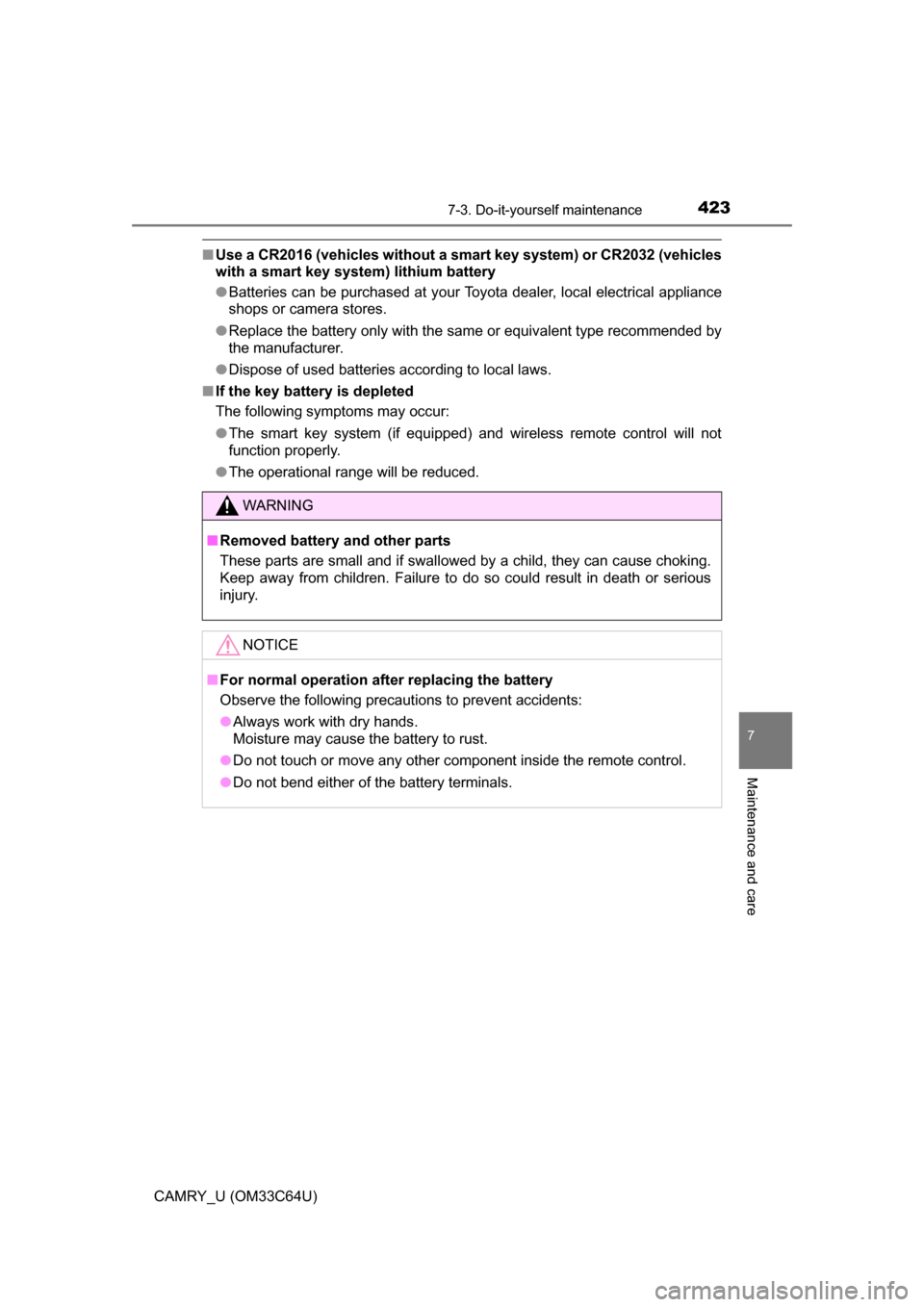
Turn the engine switch off.
Open the fuse box cover.
Checking and replacing fuses
If any of the electrical components do not operate, a fuse may
have blown. If this happens, check and replace the fuses as nec-
essary.
1
2
Engine compartment (type A)Engine compartment (type B)
(if equipped)
Push the tabs in and lift the lid off. Push the tabs in and lift the lid off.
Under the driver’s side instru-
ment panel
Remove the lid.
Page 426 of 568

4267-3. Do-it-yourself maintenance
CAMRY_U (OM33C64U)
■After a fuse is replaced
●If the lights do not turn on even after the fuse has been replaced, a bulb may
need replacement. ( P. 427)
● If the replaced fuse blows again, have the vehicle inspected by your Toyota
dealer.
■ If there is an overload in a circuit
The fuses are designed to blow, protecting the wiring harness from damage.
■ When replacing light bulbs
Toyota recommends that you use genuine Toyota products designed for this
vehicle. Because certain bulbs are connected to circuits designed to prevent
overload, non-genuine parts or parts not designed for this vehicle may be
unusable.
WARNING
■ To prevent system breakdowns and vehicle fire
Observe the following precautions.
Failure to do so may cause damage to the vehicle, and possibly a fire or
injury.
● Never use a fuse of a higher amperage rating than that indicated, or use
any other object in place of a fuse.
● Always use a genuine Toyota fuse or equivalent.
Never replace a fuse with a wire, even as a temporary fix.
● Do not modify the fuses or fuse boxes.
NOTICE
■ Before replacing fuses
Have the cause of electrical overload determined and repaired by your
Toyota dealer as soon as possible.
Page 482 of 568
4828-2. Steps to take in an emergency
CAMRY_U (OM33C64U)
One of the following may be the cause of the problem:
●There may not be sufficient fuel in the vehicle’s tank.
Refuel the vehicle.
● The engine may be flooded.
Try to restart the engine again following correct starting procedures.
( P. 153, 155)
● There may be a malfunction in the engine immobilizer system.
( P. 67)
One of the following may be the cause of the problem:
● The battery may be discharged. ( P. 488)
● The battery terminal connections may be loose or corroded.
The engine starting system may be malfunctioning due to an electrical
problem such as electronic key battery depletion or a blown fuse.
However, an interim measure is available to start the engine.
( P. 483)
If the engine w ill not start
If the engine will not start eve n though correct starting proce-
dures are being followed ( P. 153, 155), consider each of the fol-
lowing points:
The engine will not start even though the starter motor operates
normally.
The starter motor turns over slowly, the interior lights and head-
lights are dim, or the horn does not sound or sounds at a low
volume.
The starter motor does not turn over (vehicles with a smart key
system)
Page 490 of 568
4908-2. Steps to take in an emergency
CAMRY_U (OM33C64U)
Start the engine of the second vehicle. Increase the engine speed
slightly and maintain at that level for approximately 5 minutes to
recharge the batter y of your vehicle.
Vehicles with a smart key system: Open and close any of the doors
of your vehicle with the engine switch off.
Vehicles without a smart key system:
Maintain the engine speed of the second vehicle and turn the
engine switch to the “ON” position, then start the vehicle's engine.
Vehicles with a smart key system:
Maintain the engine speed of the second vehicle and turn the
engine switch to IGNITION ON mode, then start the vehicle's
engine.
Once the vehicle’s engine has star ted, remove the jumper cables in
the exact reverse order from which they were connected.
Once the engine starts, have the v ehicle inspected at your Toyota
dealer as soon as possible.
■ Starting the engine when the battery is discharged
The engine cannot be started by push-starting.
■ To prevent battery discharge
●Turn off the headlights and the audio system while the engine is off.
● Turn off any unnecessary electrical components when the vehicle is running
at a low speed for an extended period, such as in heavy traffic.
■ Charging the battery
The electricity stored in the battery will discharge gradually even when the
vehicle is not in use, due to natural discharge and the draining effects of cer-
tain electrical appliances. If the vehicle is left for a long time, the battery may
discharge, and the engine may be unable to start. (The battery recharges
automatically during driving.)
■ When recharging or replacing the battery
●Vehicles with a smart key system: In some cases, it may not be possible to
unlock the doors using the smart key system when the battery is dis-
charged. Use the wireless remote control or the mechanical key to lock or
unlock the doors.
● Vehicles with a smart key system: The engine may not start on the first
attempt after the battery has recharged but will start normally after the sec-
ond attempt. This is not a malfunction.
5
6
7
8
Page 502 of 568
5029-1. Specifications
CAMRY_U (OM33C64U)
Cooling system
Capacity (Reference)
2.5 L 4-cylinder (2AR-FE) engine
7.7 qt. (7.3 L, 6.4 Imp. qt.)
3.5 L V6 (2GR-FE) engine
9.6 qt. (9.1 L, 8.0 Imp. qt.)
Coolant type Use either of the following:
• “Toyota Super Long Life Coolant”
• A similar high-quality ethylene glycol-based
non-silicate, non-amine, non-nitrite, and
non-borate coolant with long-life hybrid
organic acid technology
Do not use plain water alone.
Ignition system
Spark plug
Make2.5 L 4-cylinder (2AR-FE) engine
DENSO SK16HR11
3.5 L V6 (2GR-FE) engine
DENSO FK20HR11
Gap0.043 in. (1.1 mm)
NOTICE
■ Iridium-tipped spark plugs
Use only iridium-tipped spark plugs. Do not adjust spark plug gap.
Electrical system
Battery
Open voltage at
68 F (20 C):
12.6 12.8 V Fully charged
12.2 12.4 V Half charged
11.8 12.0 V Discharged
(Voltage checked 20 minutes after the engine
and all the lights turned off)
Charging rates5 A max.
Page:
< prev 1-8 9-16 17-24