Page 67 of 492

671-1. For safe use
1
For safety and security
WARNING
■When installing a booster seat
To prevent the belt from going into ALR lock mode, do not fully extend the
shoulder belt. ALR mode causes the belt to tighten only. This could cause
injury or discomfort to the child. ( →P. 32)
■ When installing a ch ild restraint system
Follow the directions given in the child restraint system installation manual
and fix the child restraint system securely in place.
If the child restraint system is not correctly fixed in place, the child or other
passengers may be seriously injured or even killed in the event of a sudden
braking or an accident.
● If the driver’s seat interferes with the
child restraint system and prevents it
from being attached correctly, attach the
child restraint system to the right-hand
rear seat.
● Adjust the front passenger seat so that
it does not interfere with the child
restraint system.
● Only put a forward-facing child restraint
system on the front seat when unavoid-
able. When installing a forward-facing
child restraint system on the front pas-
senger seat, move the seat as far back
as possible even if the “AIR BAG OFF”
indicator light is illuminated. Failure to
do so may result in death or serious
injury if the airbags deploy (inflate).
Page 69 of 492

691-1. For safe use
1
For safety and security
Exhaust gas precautions
Harmful substance to the human body is included in exhaust
gases if inhaled.
WARNING
Exhaust gases include harmful carbon monoxide (CO), which is colorless and
odorless. Observe the following precautions.
Failure to do so may cause exhaust gases to enter the vehicle and may lead
to an accident caused by light-headedness, or may lead to death or a serious
health hazard.
■Important points while driving
● Keep the trunk lid closed.
● If you smell exhaust gases in the vehicle even when the trunk lid is closed,
open the windows and have the vehicle inspected at your Toyota dealer as
soon as possible.
■ When parking
● If the vehicle is in a poorly ventilated area or a closed area, such as a
garage, stop the hybrid system.
● Do not leave the vehicle with the hybrid system on for a long time.
If such a situation cannot be avoided, park the vehicle in an open space
and ensure that exhaust fumes do not enter the vehicle interior.
● Do not leave the hybrid system operating in an area with snow build-up, or
where it is snowing. If snowbanks build up around the vehicle while the
hybrid system is operating, exhaust gases may collect and enter the vehi\
-
cle.
■ Exhaust pipe
The exhaust system needs to be checked periodically. If there is a hole or
crack caused by corrosion, damage to a joint or abnormal exhaust noise, be
sure to have the vehicle inspected and repaired by your Toyota dealer.
Page 76 of 492

761-2. Hybrid system
■If a warning light comes on, a warn ing message is displayed, or the 12-
volt battery is disconnected
The hybrid system may not start. In this case, try to start the system again. If
the “READY” indicator does not come on, contact your Toyota dealer.
■ Running out of fuel
When the vehicle has run out of fuel and the hybrid system cannot be started,
refuel the vehicle with at least enough gasoline to make the low fuel le\
vel
warning light ( →P. 401) go off. If there is only a small amount of fuel, the
hybrid system may not be able to start. (The standard amount of fuel about
3.0 gal. [11.3 L, 2.5 Imp. gal.], when the vehicle is on a level surface. This
value may vary when the vehicle is on a slope. Add extra fuel when the vehi-
cle is inclined.)
■ Electromagnetic waves
●High voltage parts and cables on hybrid vehicles incorporate electromag-
netic shielding, and therefore emit approximately the same amount of elec-
tromagnetic waves as conventional gasoline powered vehicles or home
electronic appliances.
● Your vehicle may cause sound interference in some third party-produced
radio parts.
■ Hybrid battery (traction battery)
The hybrid battery (traction battery) has a limited service life. The lifespan of
the hybrid battery (traction battery) can change in accordance with driving
style and driving conditions.
Page 79 of 492

79
1
For safety and security
1-3. Theft deterrent system
The indicator light flashes after
the power switch has been turned
off to indicate that the system is
operating.
The indicator light stops flashing
after the power switch has been
turned to ACCESSORY or ON
mode to indicate that the system
has been canceled.
■System maintenance
The vehicle has a maintenance-free type immobilizer system.
■ Conditions that may cause the system to malfunction
●If the grip portion of the key is in contact with a metallic object
● If the key is in close proximity to or touching a key to the security system
(key with a built-in transponder chip) of another vehicle
Immobilizer system
The vehicle’s keys have built-in transponder chips that prevent
the hybrid system from starting if a key has not been previously
registered in the vehi cle’s on-board computer.
Never leave the keys inside the vehicle when you leave the vehi-
cle.
This system is designed to help prevent vehicle theft but does
not guarantee absolute security against all vehicle thefts.
Page 81 of 492
811-3. Theft deterrent system
1
For safety and security
The alarm uses light and sound to give an alert when an intrusion is
detected.
The alarm is triggered in the following situations when the alarm is
set:
●A locked door or trunk is unlocked or opened in any way other than
using the entry function, wireless remote control or mechanical key.
● The hood is opened.
● Some models: The window is tapped or broken.
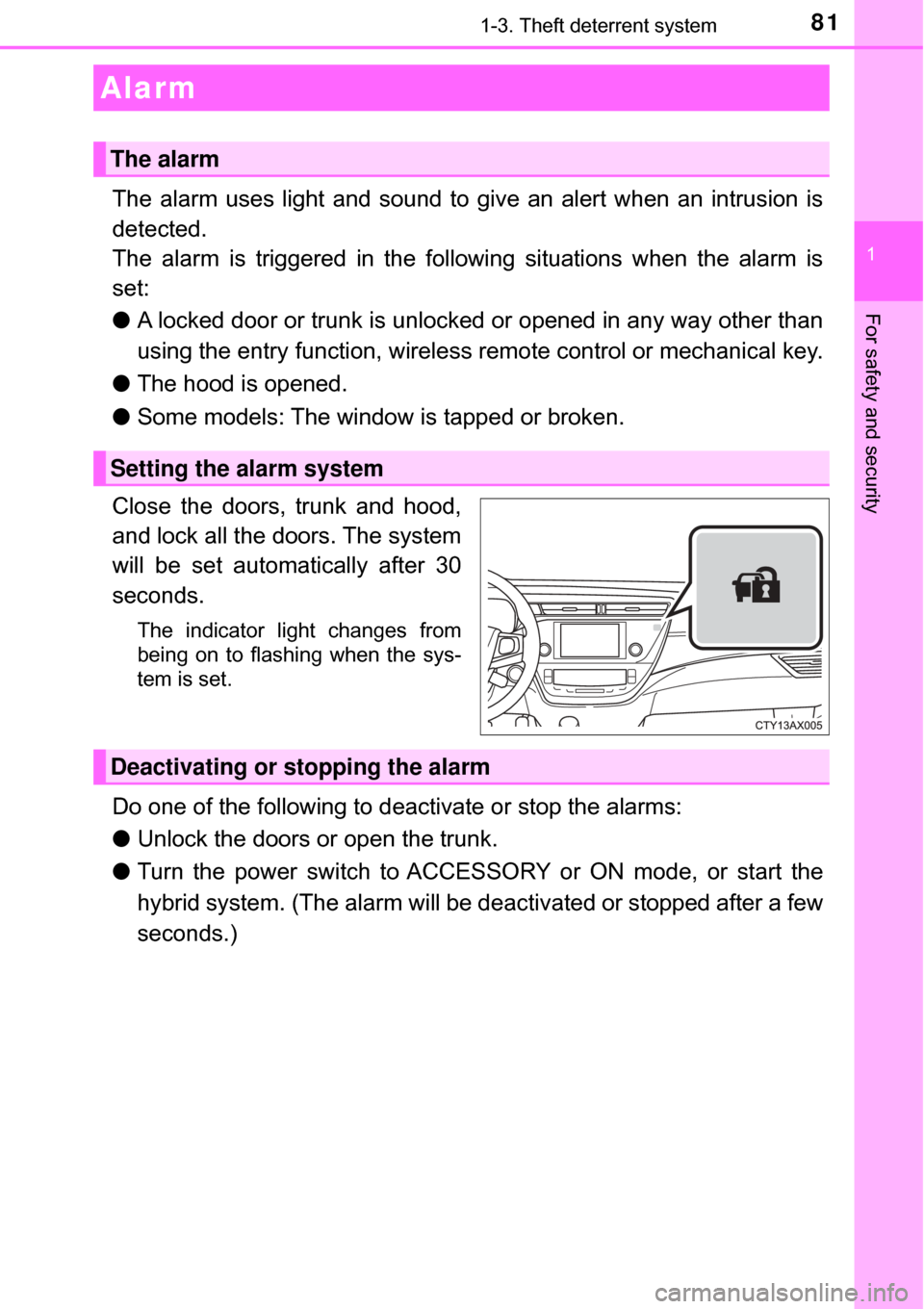
Close the doors, trunk and hood,
and lock all the doors. The system
will be set automatically after 30
seconds.
The indicator light changes from
being on to flashing when the sys-
tem is set.
Do one of the following to d eactivate or stop the alarms:
● Unlock the doors or open the trunk.
● Turn the power switch to ACCESSORY or ON mode, or start the
hybrid system. (The alarm will be deactivated or stopped after a few
seconds.)
Alarm
The alarm
Setting the alarm system
Deactivating or stopping the alarm
Page 85 of 492
85
Instrument cluster2
2. Instrument clusterWarning lights and indicators .......................... 86
Gauges and meters ............ 90
Multi-information display............................... 94
Energy monitor/ consumption screen ........ 100
Page 86 of 492
862. Instrument cluster
Warning lights and indicators
The warning lights and indicators on the instrument cluster and
center panel inform the driver of the status of the vehicle’s vari-
ous systems.
For the purpose of explanation, the following illustration dis-
plays all warning lights a nd indicators illuminated.
Page 87 of 492

872. Instrument cluster
2
Instrument cluster
Warning lights inform the driver of malfunctions in the indicated vehi-
cle’s systems.
*1: These lights turn on when the power switch is turned to ON mode to indi- cate that a system check is being performed. They will turn off after the
hybrid system is on, or after a few seconds. There may be a malfunction in
a system if a light does not come on, or turn off. Have the vehicle
inspected by your Toyota dealer.
*2: If equipped
*3: The light flashes to indicate a malfunction.
*4: This light illuminates on the multi-information display.
Warning lights
*1Brake system warning
light ( →P. 398)*1
Slip indicator ( →P. 399)
*1Charging system warn-
ing light (→P. 398)*1Brake system warning
light (→P. 401)
*1Malfunction indicator
lamp ( →P. 398)Open door warning light
(→P. 401)
*1SRS warning light
(→P. 399)Low fuel level warning
light ( →P. 401)
*1ABS warning light
(→P. 399)Seat belt reminder light
(→P. 401)
*1Electric power steering
system warning light
(→P. 399)*1Master warning light
(→P. 401)
*1Low engine oil pressure
warning light ( →P. 398)*1Tire pressure warning
light ( →P. 401)
*1, 2, 3PCS warning light
(→P. 400)*2, 4LDA (Lane Departure
Alert with steering con-
trol) indicator
(→P. 400)