2017 TOYOTA AURIS TOURING SPORTS tow
[x] Cancel search: towPage 260 of 664
2604-5. Toyota Safety Sense
AURIS Touring Sports_EE (12L13E)
WARNING
●While driving, such as when driving through a railway crossing, the system
may determine that the possibility of a collision with an object, such as rail-
way crossing barrier, is high and operate the pre-crash braking function.
To move the vehicle in an emergency, such as if the system operates in a
railway crossing, perform the following operations and then take the nec-
essary measures to ensure your safety.
• If the vehicle has been stopped, depress the accelerator pedal.
• If the vehicle is decelerating, fully depress the accelerator pedal.
(P. 262)
• Disable the pre-crash safety system. (P. 261)
■When to disable the pre-crash safety system
In the following situations, disable the system, as it may not operate prop-
erly, possibly leading to an accident resulting in death or serious injury:
●When the vehicle is being towed
●When your vehicle is towing another vehicle
●When transporting the vehicle via truck, boat, train or similar means of
transportation
●When the vehicle is raised on a lift with the engine running and the tires
are allowed to rotate freely
●When inspecting the vehicle using a drum tester such as a chassis dyna-
mometer or speedometer tester, or when using an on vehicle wheel bal-
ancer
●If the vehicle cannot be driven in a stable manner, such as when the vehi-
cle has been in an accident or is malfunctioning
●When the vehicle is driven in a sporty manner or off-road
●When the condition of the tires is poor and they do not perform well
(P. 490, 505)
●When tires of a size other than specified are installed
●When tire chains are installed
●When a compact spare tire or an emergency tire puncture repair kit is used
AURIS Touring Sports_OM_Europe_OM12L13E.book 260 ページ 2016年6月27日 月曜日 午後5時21分
Page 279 of 664

2794-5. Toyota Safety Sense
AURIS Touring Sports_EE (12L13E)
4
Driving
●In the situations shown below, the system may not be able to accurately
detect surrounding brightness levels. This may cause the low beams to
remain on or the high beams to cause problems for pedestrians, vehicles
ahead or other parties. In these cases, manually switch between the high
and low beams.
• In bad weather (rain, snow, fog, sandstorms, etc.)
• The windshield is obscured by fog, mist, ice, dirt, etc.
• The windshield is cracked or damaged.
• The front sensor is deformed or dirty.
• The front sensor temperature is extremely high.
• Surrounding brightness levels are equal to those of headlights, tail lights
or fog lights.
• Vehicles ahead have headlights or tail lights that are either switched off,
dirty, are changing color, or are not aimed properly.
• When driving through an area of intermittently changing brightness and
darkness.
• When frequently and repeatedly driving ascending/descending roads, or
roads with rough, bumpy or uneven surfaces (such as stone-paved
roads, gravel tracks, etc.).
• When frequently and repeatedly taking curves or driving on a winding
road.
• There is a highly reflective object ahead of the vehicle, such as a sign or
a mirror.
• The back of a vehicle ahead is highly reflective, such as a container on a
truck.
• The vehicle’s headlights are damaged or dirty, or are not aimed properly.
• The vehicle is listing or titling due to a flat tire, a trailer being towed, etc.
• The high beam and low beam are repeatedly being switched between in
an abnormal manner.
• The driver believes that the high beam may be causing problems or dis-
tress to other drivers or pedestrians nearby.
AURIS Touring Sports_OM_Europe_OM12L13E.book 279 ページ 2016年6月27日 月曜日 午後5時21分
Page 301 of 664
3014-6. Using the driving support systems
AURIS Touring Sports_EE (12L13E)
4
Driving
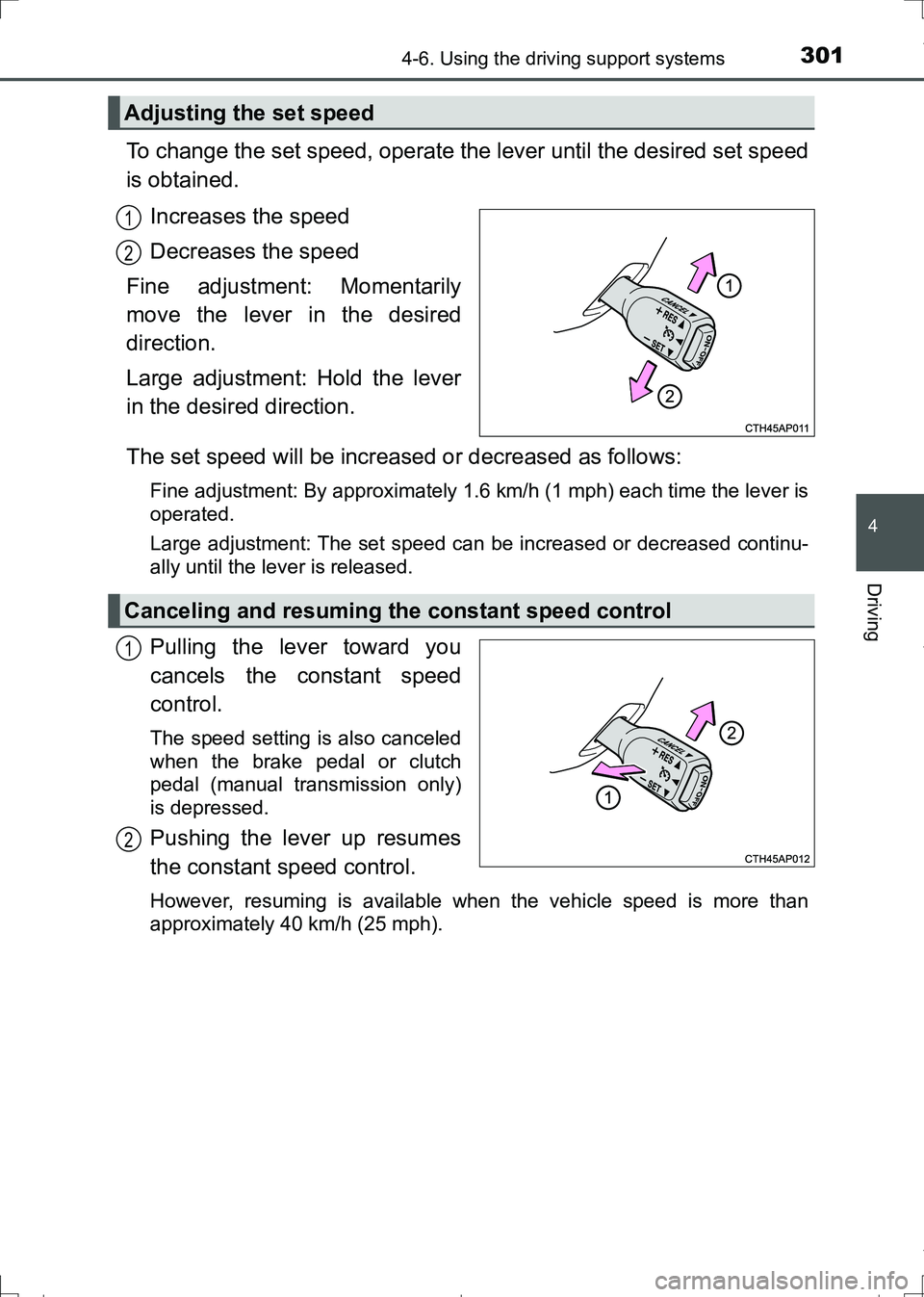
To change the set speed, operate the lever until the desired set speed
is obtained.
Increases the speed
Decreases the speed
Fine adjustment: Momentarily
move the lever in the desired
direction.
Large adjustment: Hold the lever
in the desired direction.
The set speed will be increased or decreased as follows:
Fine adjustment: By approximately 1.6 km/h (1 mph) each time the lever is
operated.
Large adjustment: The set speed can be increased or decreased continu-
ally until the lever is released.
Pulling the lever toward you
cancels the constant speed
control.
The speed setting is also canceled
when the brake pedal or clutch
pedal (manual transmission only)
is depressed.
Pushing the lever up resumes
the constant speed control.
However, resuming is available when the vehicle speed is more than
approximately 40 km/h (25 mph).
Adjusting the set speed
1
2
Canceling and resuming the constant speed control
1
2
AURIS Touring Sports_OM_Europe_OM12L13E.book 301 ページ 2016年6月27日 月曜日 午後5時21分
Page 303 of 664
3034-6. Using the driving support systems
AURIS Touring Sports_EE (12L13E)
4
Driving
WARNING
■To avoid operating the cruise control by mistake
Switch the cruise control off using the “ON-OFF” button when not in use.
■Situations unsuitable for cruise control
Do not use cruise control in any of the following situations.
Doing so may result in loss of control and could cause an accident resulting
in death or serious injury.
●In heavy traffic
●On roads with sharp bends
●On winding roads
●On slippery roads, such as those covered with rain, ice or snow
●On steep hills
Vehicle speed may exceed the set speed when driving down a steep hill.
●When your vehicle is towing a trailer or during emergency towing
AURIS Touring Sports_OM_Europe_OM12L13E.book 303 ページ 2016年6月27日 月曜日 午後5時21分
Page 306 of 664

3064-6. Using the driving support systems
AURIS Touring Sports_EE (12L13E)
Cancel
Pull the lever towards you to can-
cel the speed limiter.
Resume
To resume use of the speed limiter,
push the lever up.
■Exceeding the set speed
In the following situations, the vehicle speed exceeds the set speed and dis-
play characters will flash:
●When fully depressing the accelerator pedal
●When driving down a slope
■Automatic speed limiter cancelation
The speed limiter is automatically canceled in any of the following situations:
●Cruise control is activated.
●8NR-FTS engine only: When the VSC system and/or TRC system is turned
off by pressing the VSC OFF switch.
■If the speed limiter indicator comes on in yellow (vehicles with a 3-ring
meter) or “Check speed limiter system.” is displayed on the multi-infor-
mation display (vehicles with a 2-ring meter)
Stop the engine and then restart the engine. After restarting the engine, set
the speed limiter. If the speed limiter cannot be set, there may be a malfunc-
tion in the speed limiter. Have the vehicle inspected by any authorized Toyota
dealer or repairer, or another duly qualified and equipped professional.
Canceling and resuming the speed limiter
1
2
AURIS Touring Sports_OM_Europe_OM12L13E.book 306 ページ 2016年6月27日 月曜日 午後5時21分
Page 307 of 664
3074-6. Using the driving support systems
AURIS Touring Sports_EE (12L13E)
4
Driving
WARNING
■To avoid operating the speed limiter by mistake
Keep the speed limiter button off when not in use.
■Situations unsuitable for speed limiter
Do not use speed limiter in either of the following situations.
Doing so may result in control of the vehicle being lost and could cause an
accident resulting in death or serious injury.
●On slippery roads, such as those covered with rain, ice or snow
●On steep hills
●When your vehicle is towing a trailer
AURIS Touring Sports_OM_Europe_OM12L13E.book 307 ページ 2016年6月27日 月曜日 午後5時21分
Page 313 of 664

3134-6. Using the driving support systems
AURIS Touring Sports_EE (12L13E)
4
Driving
■The Toyota parking assist-sensor can be operated when
Vehicles without a smart entry & start system:
The engine switch is in the “ON” position.
Vehicles with a smart entry & start system:
The engine switch is in IGNITION ON mode.
●Front sensors:
• Vehicles with a Multidrive:
The shift lever is in a position other than P.
• Vehicles with a manual transmission:
The parking brake is not applied.
• The vehicle speed is less than about 10 km/h (6 mph).
(At any speed when the shift lever is in R)
●Rear sensors:
The shift lever is in R.
■Sensor detection information
●Certain vehicle conditions and the surrounding environment may affect the
ability of the sensor to correctly detect obstacles. Particular instances where
this may occur are listed below.
• There is dirt, snow or ice on the sensor.
• A sensor is frozen.
• A sensor is covered in any way.
• The vehicle is leaning considerably to one side.
• On an extremely bumpy road, on an incline, on gravel, or on grass.
• The vicinity of the vehicle is noisy due to vehicle horns, motorcycle
engines, air brakes of large vehicles, or other loud noises producing ultra-
sonic waves.
• There is another vehicle equipped with parking assist sensors in the
vicinity.
• A sensor is coated with a sheet of spray or heavy rain.
• The vehicle is equipped with a fender pole or wireless antenna.
• Towing eyelet is installed.
• A bumper or sensor receives a strong impact.
• The vehicle is approaching a tall or curved curb.
• In harsh sunlight or intense cold weather.
• A non-genuine Toyota suspension (lowered suspension etc.) is installed.
In addition to the examples above, there are instances in which, because of
their shapes, signs and other objects may be judged by the sensor to be
closer than they are.
AURIS Touring Sports_OM_Europe_OM12L13E.book 313 ページ 2016年6月27日 月曜日 午後5時21分
Page 327 of 664
3274-6. Using the driving support systems
AURIS Touring Sports_EE (12L13E)
4
Driving
WARNING
■Cautions regarding the use of Simple-IPA
●Never depend on the Simple-IPA entirely when parking. The driver is
responsible for safety. Use caution, just as you would when parking any
vehicle.
●Back up slowly, using the brake pedal to control the vehicle's speed.
●If it seems likely to hit nearby vehicles, obstacles, or people, depress the
brake pedal to stop the vehicle, and the disable the system.
■Conditions in which the use of Simple-IPA is prohibited
Do not use Simple-IPA under the following conditions.
Doing so may cause improper operation and lead to an unexpected acci-
dent.
●On sharp bends or slopes.
●On slippery or icy roads, or in snow.
●On uneven road surfaces such as gravel.
●During bad weather such as heavy rain, fog, snow, or a sandstorm.
●When the tires are extremely worn or tire pressure is low.
●When the vehicle has improper wheel alignment due to tires having
received a strong impact such as bumping against a curb.
●When the compact spare tire (if equipped) or snow chains are installed.
●When the tires slid while attempting to park.
●When fallen leaves or snow is in a parking space.
●When items such as a towing bracket, trailer, bicycle carrier, etc. are
installed on the rear of the vehicle.
●When a vehicle of which the front/rear end is above the detection area,
such as a truck, bus or vehicle with a towing bracket, trailer, bicycle carrier,
etc., is parked at the front or rear of the parking space.
●If the front bumper has been damaged.
●If the sensor is covered by the front bumper cover, etc.
●If a vehicle or obstacle is not in a suitable position at the front or rear of the
parking space.
■Automatic steering precautions
As the steering wheel moves automatically in the parking assist function, be
aware of the following point.
●Keep clothing such as neckties, scarves and long sleeves away from the
steering wheel, as they may become entangled. Also, keep children away
from the steering wheel.
●If you have long fingernails, be careful not to injure yourself when the
steering wheel moves.
AURIS Touring Sports_OM_Europe_OM12L13E.book 327 ページ 2016年6月27日 月曜日 午後5時21分