Page 294 of 428
2944-3. Do-it-yourself maintenance
16
SPARE See note. Spare fuse17
SPARE See note. Spare fuse18
SPARE See note. Spare fuse19
SPARE See note. Spare fuse20
SPARE See note. Spare fuse21
ST 7.5 A Starting system22
ALT-S 7.5 A
⎯23
(STR LOCK) 7.5 A
⎯24
D/L 20 A Power door lock25
ETCS 15 A Engine control unit26
(AT+B) 7.5 A Transmission
27
(AM2 NO. 2) 7.5 A
⎯28
EFI (CTRL) 15 A Engine control unit
29
EFI (HTR) 15 A Multiport fuel injection system/
sequential multiport fuel injection
system
30
EFI (IGN) 15 A Starting system
31
EFI (+B) 7.5 A Engine control unit
32
HAZ 15 A Turn signal lights, emergency
flashers
33
MPX-B 7.5 A Gauge and meters
34
F/PMP 20 A Multiport fuel injection system/
sequential multiport fuel injection
system
35
IG2 MAIN 30 A SRS airbag system, engine control
unit
36
DCC 30 A Interior light, wireless remote con-
trol, main body ECUFuse Ampere Circuit
Page 295 of 428
2954-3. Do-it-yourself maintenance
4
Maintenance and care
Note
One of each of the following spare fuses are provided: 7.5 A, 10 A, 15
A, 20 A, 25 A, 30 A. 37
HORN NO. 2 7.5 A Horn38
HORN NO. 1 7.5 A Horn39
H-LP LH LO 15 A Left-hand headlight (low beam)40
H-LP RH LO 15 A Right-hand headlight (low beam)41
H-LP LH HI 10 A Left-hand headlight (high beam)42
H-LP RH HI 10 A Right-hand headlight (high beam)
43
INJ 30 A Multiport fuel injection system/
sequential multiport fuel injection
system44
H-LP WASHER 30 A
⎯45
AM2 NO. 1 40 A Starting system, engine control unit
46
EPS 80 A Electric power steering
47
A/B MAIN 15 A SRS airbag system
48
ECU-B 7.5 A Wireless remote control, main body
ECU
49
DOME 20 A Interior light
50
IG2 7.5 A Engine control unitFuse Ampere Circuit
Page 305 of 428
When trouble arises
5
3055-1. Essential information
Emergency flashers ......... 306
If your vehicle needs
to be towed .................... 307
If you think something
is wrong ......................... 315
Fuel pump shut off
system ........................... 316 5-2. Steps to take in an
emergency
If a warning light turns
on or a warning
buzzer sounds... ............ 317
If you have a flat tire......... 327
If the engine will not
start ................................ 338
If the shift lever cannot be
shifted from P................. 339
If you lose your keys ........ 340
If the battery is
discharged ..................... 341
If your vehicle
overheats ....................... 345
If the vehicle becomes
stuck .............................. 348
If your vehicle has to be
stopped in an
emergency ..................... 350
Page 312 of 428
3125-1. Essential information
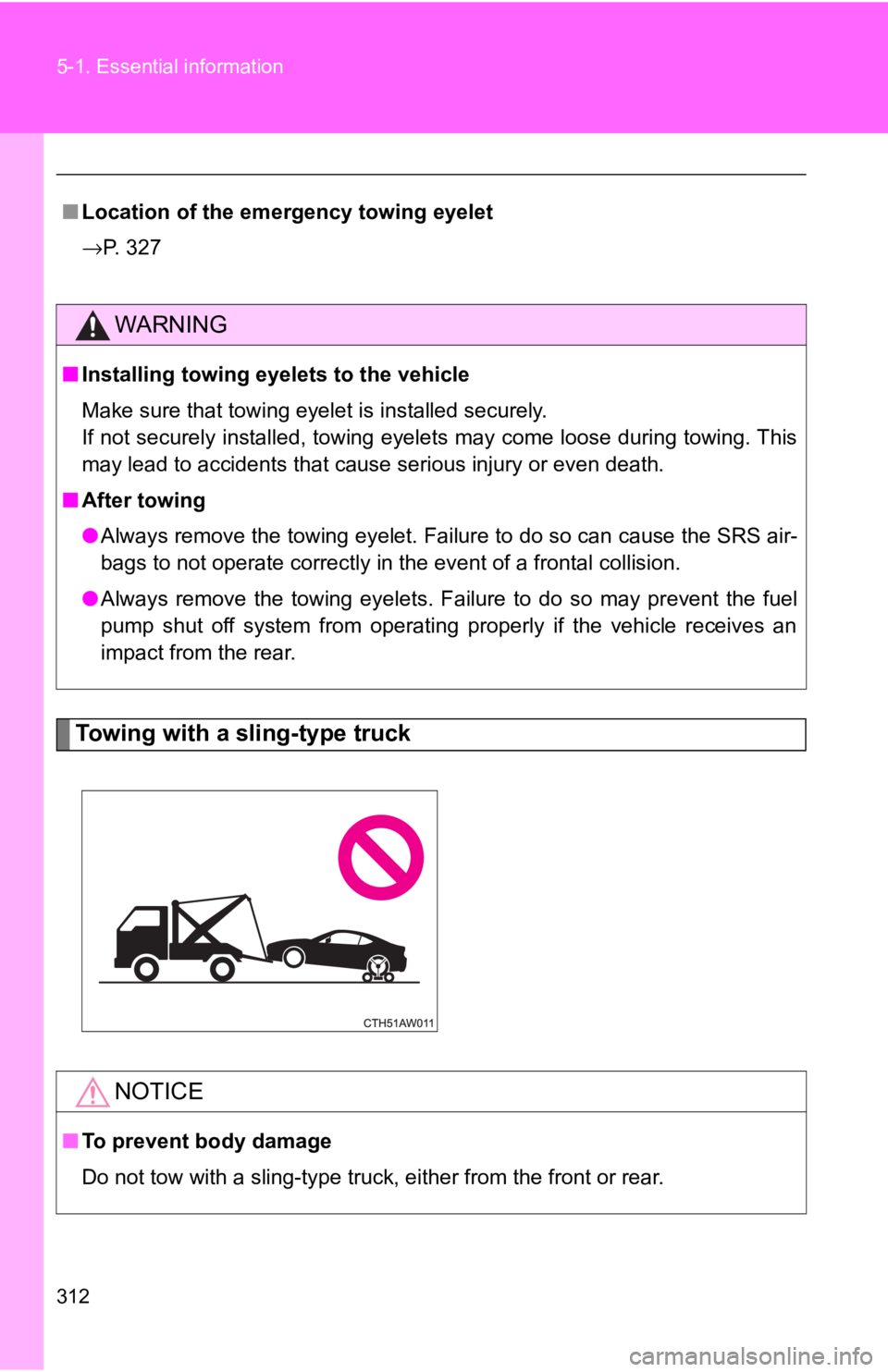
Towing with a sling-type truck■ Location of the emergency towing eyelet
→ P. 327
WARNING■ Installing towing eyelets to the vehicle
Make sure that towing eyelet is installed securely.
If not securely installed, towing eyelets may come loose during towing. This
may lead to accidents that cause serious injury or even death.
■ After towing
● Always remove the towing eyelet. Failure to do so can cause the SRS air-
bags to not operate correctly in the event of a frontal collision.
● Always remove the towing eyelets. Failure to do so may prevent the fuel
pump shut off system from operating properly if the vehicle receives an
impact from the rear.
NOTICE
■ To prevent body damage
Do not tow with a sling-type truck, either from the front or rear.
Page 316 of 428
3165-1. Essential information
Fuel pump shut off system Follow the procedure below to restar t the engine after the system is
activated.
Turn the engine switch to the “ACC” or “LOCK” position.
Restart the engine.
NOTICE■ Before starting the engine
Inspect the ground under the vehicle.
If you find that fuel has leaked on to the ground, the fuel system has been
damaged and is in need of repair. Do not restart the engine.When the vehicle sustains an impa ct in an accident, etc., the fuel
pump shut off system operates to stop supplying fuel in order to
minimize fuel leakage.STEP 1
STEP 2
Page 319 of 428

5
When trouble arises
3195-2. Steps to take in an emergency
(Comes on in
yellow) Cruise control indicator light
Indicates a malfunction in the cruise control system.
■ If the malfunction indicator lamp comes on while driving
First check the following:
● Is the fuel tank empty?
If it is, fill the fuel tank immediately.
● Is the fuel tank cap loose?
If it is, tighten it securely.
The malfunction indicator lamp will go off after several driving trips.
If the malfunction indicator lamp does not go off even after several trips, con-
tact your Toyota dealer as soon as possible.
■ SRS warning light
→ P. 102
■ Electric power steering warning light (warning buzzer)
The electric power steering warning light may come on and the warning
buzzer may sound when the voltage is low or the voltage drops.
WARNING
■ When the electric power steering warning light comes on
The steering wheel may become extremely heavy.
If the steering wheel becomes heavier than usual when operating, hold
firmly and operate using more force than usual.Warning light Warning light/Details
Page 320 of 428
3205-2. Steps to take in an emergency
Follow the correction procedures.
After taking the specif ied steps to correct the suspected problem,
check that the warning light turns off. Warning light Warning light/Details Correction procedure
Open door warning light
Indicates that a door or the
trunk is not fully closed. Check that both side doors
and the trunk are closed.
Low fuel level warning
light
Remaining fuel
(Approximately 1.8 gal.
[7.0 L, 1.5 Imp. gal.] or
less) Refuel the vehicle.
(On the instru-
ment cluster) Driver’s seat belt
reminder light
(warning buzzer)* 1
Warns the driver to fasten
his/her seat belt. Fasten the seat belt.
(On the center
panel) Front passenger’s seat
belt reminder light
(warning buzzer)* 2
Warns the front passenger
to fasten his or her seat
belt. Fasten the seat belt.
Page 325 of 428
5
When trouble arises
3255-2. Steps to take in an emergency
WARNING■
Maintenance of the tires
Each tire, including the spare (if provided), should be checked monthly
when cold and inflated to the inflation pressure recommended by the
vehicle manufacturer on the vehicle placard or tire inflation pressure
label (tire and load information label). (If your vehicle has tires of a differ-
ent size than the size indicated on the vehicle placard or tire inflation
pressure label [tire and load information label], you should determine the
proper tire inflation pr essure for those tires.)
As an added safety feature, your vehicle has been equipped with a tire
pressure monitoring system (TPMS-ti re pressure warning system) that
illuminates a low tire pressure telltal e (tire pressure warning light) when
one or more of your tires is sign ificantly under-inflated. Accordingly,
when the low tire pressu re telltale (tire pressure warning light) illumi-
nates, you should stop and check your tires as soon as possible, and
inflate them to the proper pressure. Driving on a significantly under-
inflated tire causes the tire to overheat and can lead to tire failure.
Under-inflation also reduces fuel effi ciency and tire tread life, and may
affect the vehicle's handling and stopping ability.
Please note that the TPMS (tire pressure warning system) is not a sub-
stitute for proper ti re maintenance, an d it is the driver's responsibility to
maintain correct tire pressure, even if under-inflation has not reached the
level to trigger illumination of the TP MS low tire pressure telltale (tire
pressure warning light).
Your vehicle has also been equipped with a TPMS (tire pressure warning
system) malfunction indicator to indi cate when the system is not operat-
ing properly. The TPMS (tire pressure warning system) malfunction indi-
cator is combined with the low tire pressure telltale (tire pressure
warning light). When the system detects a malfunctio n, the telltale will
flash for approximately one minute an d then remain continuously illumi-
nated. This sequence will continue upon subsequent vehicle start-ups as
long as the malfunction exists. When the malfunction indicator is illumi-
nated, the system may not be able to detect or signal low tire pressure
as intended.