Page 293 of 428
2934-3. Do-it-yourself maintenance
4
Maintenance and care Fuse layout and amperage ratings
■ Engine compartment
Fuse Ampere Circuit
1
MIR HTR 7.5 A Outside rear view mirror defoggers
2
RDI 25 A Electric cooling fan
3
(PUSH-AT) 7.5 A Engine control unit
4
ABS NO. 1 40 A ABS
5
HEATER 50 A Air conditioning system
6
WASHER 10 A Windshield washer
7
WIPER 30 A Windshield wipers
8
RR DEF 30 A Rear window defogger
9
(RR FOG) 10 A
⎯
10
D FR DOOR 25 A Power window (driver’s side)
11
(CDS) 25 A Electric cooling fan
12
D-OP 25 A
⎯
13
ABS NO. 2 25 A ABS
14
D FL DOOR 25 A Power window (passenger’s side)
15
SPARE See note. Spare fuse
Page 296 of 428
2964-3. Do-it-yourself maintenance
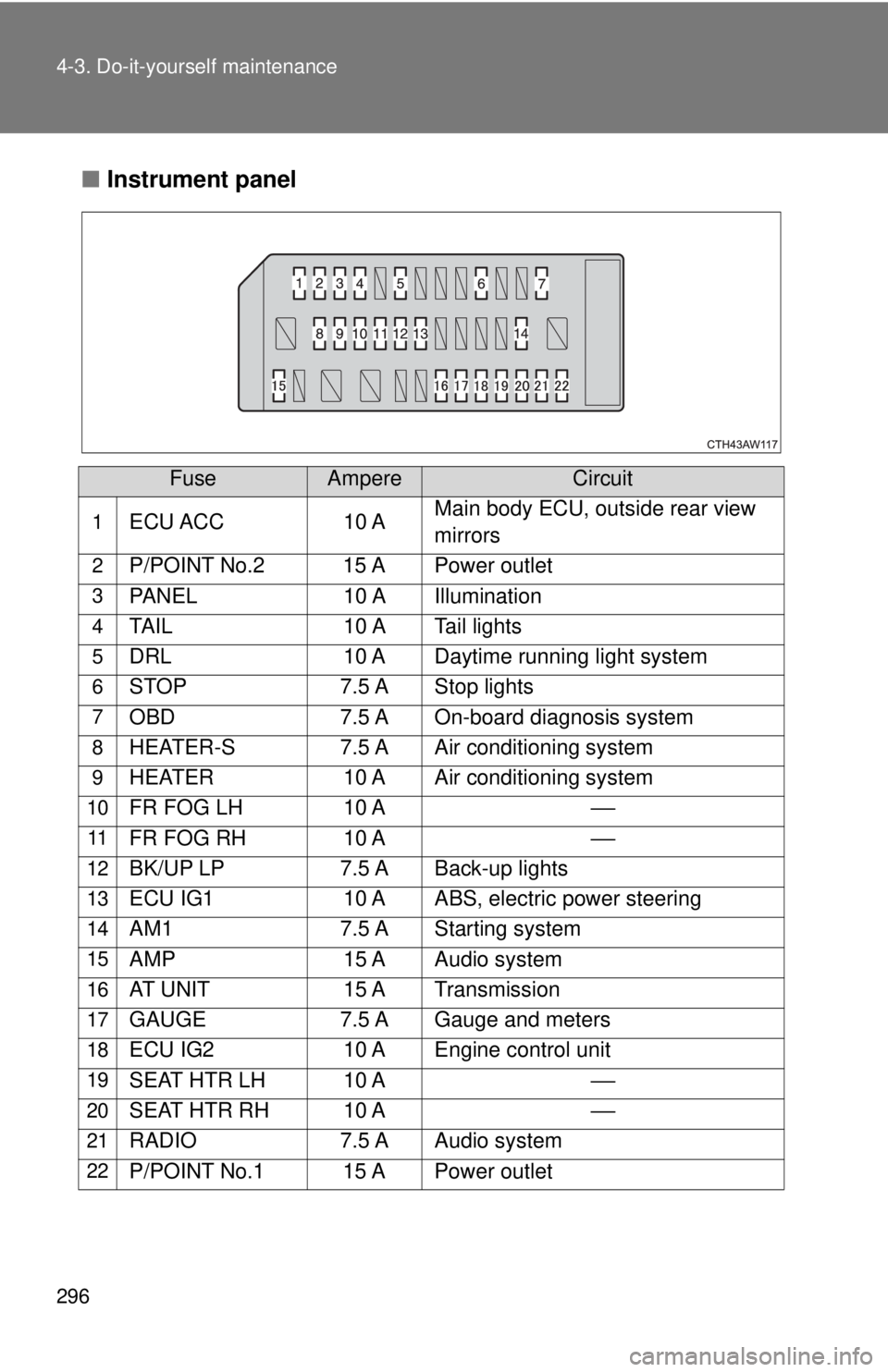
■ Instrument panel
Fuse Ampere Circuit1
ECU ACC 10 A Main body ECU, outside rear view
mirrors2
P/POINT No.2 15 A Power outlet3
PANEL 10 A Illumination4
TAIL 10 A Tail lights5
DRL 10 A Daytime running light system6
STOP 7.5 A Stop lights7
OBD 7.5 A On-board diagnosis system8
HEATER-S 7.5 A Air conditioning system9
HEATER 10 A Air conditioning system
10
FR FOG LH 10 A
⎯11
FR FOG RH 10 A
⎯12
BK/UP LP 7.5 A Back-up lights
13
ECU IG1 10 A ABS, electric power steering
14
AM1 7.5 A Starting system
15
AMP 15 A Audio system
16
AT UNIT 15 A Transmission
17
GAUGE 7.5 A Gauge and meters
18
ECU IG2 10 A Engine control unit
19
SEAT HTR LH 10 A
⎯
20
SEAT HTR RH 10 A
⎯
21
RADIO 7.5 A Audio system
22
P/POINT No.1 15 A Power outlet
Page 342 of 428
3425-2. Steps to take in an emergency
■ Starting the engine when the battery is discharged
The engine cannot be started by push-starting.
■ Avoiding a discharged battery
● Turn off the headlights and the air conditioning system while the engine is
off.
● Turn off any unnecessary electrical components when the vehicle is run-
ning at a low speed for an extended period, such as in heavy traffic, etc.
■ Charging the battery
The electricity stored in the battery will discharge gradually even when the
vehicle is not in use, due to natural discharge and the draining effects of cer-
tain electrical appliances. If the vehicle is left for a long time, the battery may
discharge, and the engine may be unable to start. (The battery recharges
automatically during driving.) Maintain the engine speed of the second vehicle and turn
the engine switch to the “ON” position, then start the vehi-
cle's engine.
Once the vehicle’s engine has started, remove the jumper
cables in the exact reverse order in which they were con-
nected.
Once the engine starts, have th e vehicle checked at your Toyota
dealer as soon as possible. STEP 3
STEP 4
Page 346 of 428
3465-2. Steps to take in an emergency
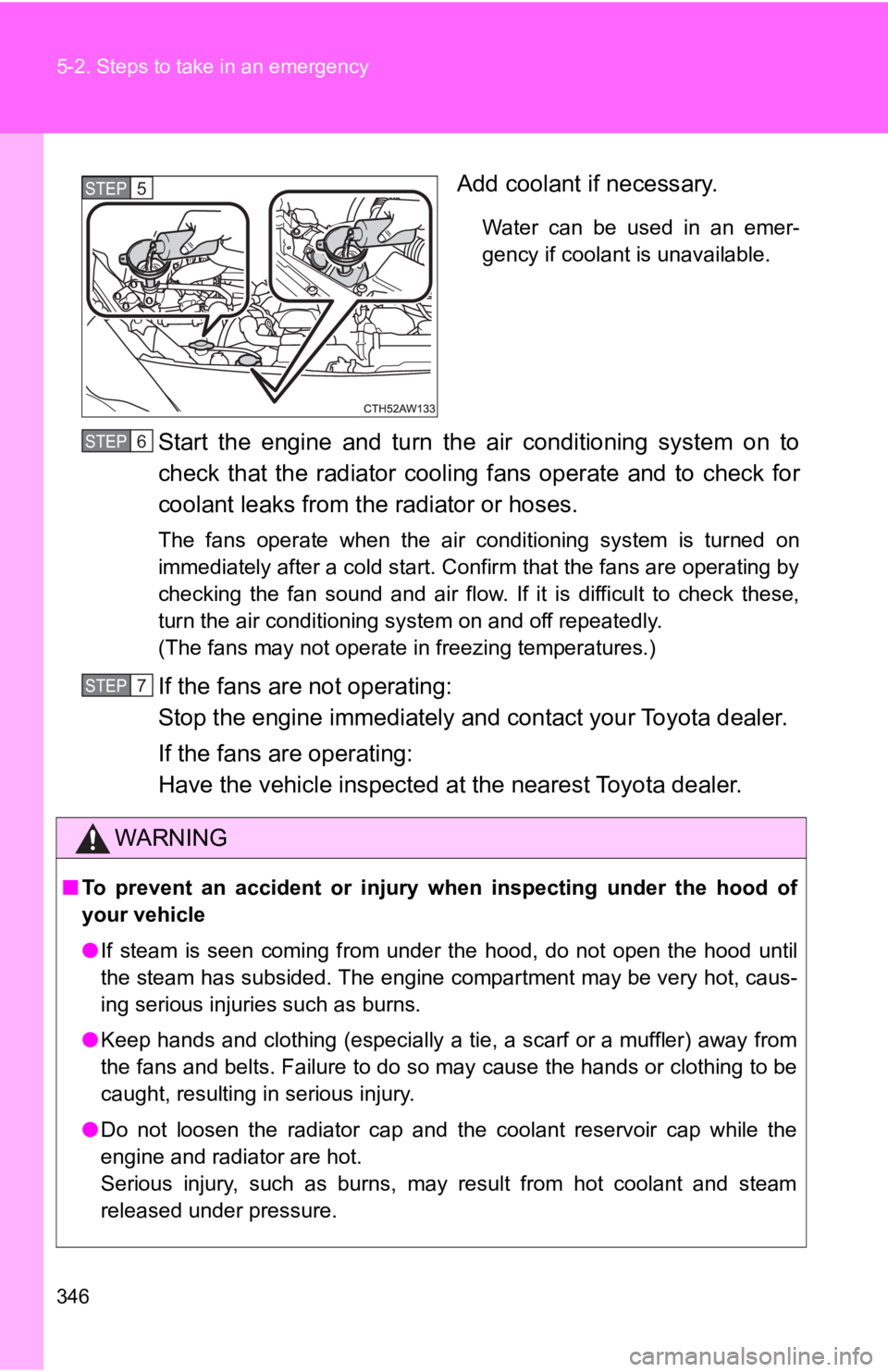
Add coolant if necessary. Water can be used in an emer-
gency if coolant is unavailable.
Start the engine and turn the air conditioning system on to
check that the radiator cooling fans operate and to check for
coolant leaks from the radiator or hoses. The fans operate when the air conditioning system is turned on
immediately after a cold start. Confirm that the fans are operating by
checking the fan sound and air flow. If it is difficult to check these,
turn the air conditioning system on and off repeatedly.
(The fans may not operate in freezing temperatures.)
If the fans are not operating:
Stop the engine immediately and contact your Toyota dealer.
If the fans are operating:
Have the vehicle inspected at the nearest Toyota dealer.STEP 5
WARNING■ To prevent an accident or injury when inspecting under the hood of
your vehicle
● If steam is seen coming from under the hood, do not open the hood until
the steam has subsided. The engine compartment may be very hot, caus-
ing serious injuries such as burns.
● Keep hands and clothing (especially a tie, a scarf or a muffler) away from
the fans and belts. Failure to do so may cause the hands or clothing to be
caught, resulting in serious injury.
● Do not loosen the radiator cap and the coolant reservoir cap while the
engine and radiator are hot.
Serious injury, such as burns, may result from hot coolant and steam
released under pressure. STEP 6
STEP 7
Page 376 of 428

3766-1. Specifications
Warning: The temperature grades of a tire assume that it is properly
inflated and not overloaded.
Excessive speed, underinflation, or excessive loading, either sepa-
rately or in combinatio n, can cause heat buildup and possible tire fail-
ure.
Glossary of tire terminology
Tire related term Meaning
Cold tire inflation
pressure Tire pressure when the vehicle has been
parked for three hours or more, or has not
been driven more than 1 mile or 1.5 km under
that condition
Maximum inflation
pressure The maximum cold inflated pressure to which a
tire may be inflated, s hown on the sidewall of
the tire
Recommended
inflation pressure Cold tire inflation pressure recommended by a
manufacturer.
Accessory weight The combined weight (in excess of those stan-
dard items which may be replaced) of auto-
matic transmission, power steering, power
brakes, power windows, power seats, radio
and heater, to the extent that these items are
available as factory-installed equipment
(whether installed or not)
Curb weight The weight of a motor vehicle with standard
equipment, including the maximum capacity of
fuel, oil and coolant, and if so equipped, air
conditioning and additional weight optional
engine
Maximum loaded
vehicle weight The sum of:
(a) Curb weight
(b) Accessory weight
(c) Vehicle capacity weight
(d) Production options weight
Page 415 of 428

415Alphabetical index
Alphabetical index A/C ............................................ 208
ABS........................................... 184
Air conditioning filter .............. 284
Air conditioning system
Air conditioning filter ............. 284
Manual air conditioning
system................................ 208
Airbags
Airbag operating
conditions ....................... 80, 88
Airbag precautions for
your child.............................. 97
Airbag warning light .............. 318
Curtain shield airbag
operating conditions ............. 88
Curtain shield airbag
precautions .......................... 97
Front passenger occupant
classification system .......... 104
General airbag
precautions .......................... 97
Locations of airbags ............... 66
Modification and
disposal of airbags ............. 101
Proper driving
posture ........................... 64, 97 Side airbag operating
conditions..............................88
Side airbag
precautions ...........................97
Side and curtain shield
airbags operating
conditions..............................88
Side and curtain shield
airbags precautions ..............97
SRS airbag instructions for
Canadian owners ................390
SRS airbags ............................66
Anti-lock brake system............184
Audio input ...............................217
Audio system
Audio input ............................217
AUX port................................217
iPod .......................................217
Portable music player............217
Steering wheel audio
switches ..............................218
USB memory .........................217
USB port................................217
Automatic headlight leveling
system ....................................174
Automatic light control
system ....................................172A
Page 420 of 428

420Alphabetical index
Jack
Positioning a floor jack .......... 255
Vehicle-equipped
jack ..................................... 327
Jack handle .............................. 327
Jam protection function
Power windows .......................55
Keyless entry..............................24
Keys
Engine switch ........................ 142
If you lose your keys ............. 340
Key number .............................22
Keyless entry...........................24
Keys ........................................22
Wireless remote
control key ............................24
License plate lights
Replacing light bulbs ............. 298
Wattage ................................. 365
Light bulbs
Replacing .............................. 298
Wattage ................................. 365 Lights
Emergency flasher switch ..... 306
Engine switch light ................ 220
Hazard light switch ................ 306
Headlights switch .................. 172
Interior light switch ................ 221
Replacing light bulbs ............. 298
Trunk light ............................... 31
Turn signal lever ................... 155
Wattage................................. 365
Load capacity ........................... 199
Maintenance
Do-it-yourself
maintenance ....................... 250
General maintenance............ 246
Maintenance data ................. 354
Maintenance requirements ... 244
Manual air conditioning
system .................................... 208
Manual transmission ............... 152
Meter
Indicators .............................. 161
Instrument panel
light control ......................... 159
Meters ................................... 158
Multi-information display ....... 165
Settings ................................. 165
Warning lights ....................... 317J
K
L M
Page:
< prev 1-8 9-16 17-24