Page 44 of 428

441-3. Adjustable components (s eats, mirrors, steering wheel)
■ Emergency locking retractor (ELR)
The retractor will lock the belt during a sudden stop or on impact. It may also
lock if you lean forward too quickly. A slow, easy motion will allow the belt to
extend so that you can move around fully.
■ Automatic locking retractor (ALR)
When a passenger's shoulder belt is completely extended and then
retracted even slightly, the belt is locked in that position and cannot be
extended. This feature is used to hold the child restraint system (CRS) firmly.
To free the belt again, fully retract the belt and then pull the belt out once
more. ( → P. 116)
■ Child seat belt usage
The seat belts of your vehicle are principally designed for persons of adult
size.
● Use a child restraint system appropriate for the child, until the child
becomes large enough to properly w ear the vehicle's seat belt.
( → P. 11 2 )
● When the child becomes large enough to properly wear the vehicle's seat
belt, follow the instructions on P. 42 regarding seat belt usage.
■ Seat belt pretensioners
● Seatbelt pretensioners are not designed to activate in a rear impact or
minor frontal or side impact.
● The following four components operate simultaneously when the vehicle
is involved in a rollover accident.
• Seat belt pretensioner for driver
• Seat belt pretensioner for front passenger
• SRS curtain shield airbag for driver’s seat side
• SRS curtain shield airbag for front passenger’s seat side
Page 45 of 428

451-3. Adjustable components (s eats, mirrors, steering wheel)
1
Before driving ● The following four components operate simultaneously when the vehicle
is subjected to a severe frontal collision.
• Seat belt pretensioner for driver
• Seat belt pretensioner for front passenger
• SRS front airbag for driver
• SRS front airbag for front passenger*
*: This does not operate while the occupant classification system deter-
mines to deactivate the airbag operation. For details, refer to “Front pas-
senger’s SRS frontal airbag” ( → P. 74)
● The following two components operate simultaneously when the vehicle
is subjected to a severe collision on the driver’s seat side of the vehicle.
• Seat belt pretensioner for driver
• Side airbag for driver
● The following two components operate simultaneously when the vehicle
is subjected to a severe collision on the front passenger’s seat side of the
vehicle.
• Seat belt pretensioner for front passenger
• Side airbag for front passenger
● Pretensioners are designed to function on a one-time-only basis. In the
event that a pretensioner is activated, both the driver’s and front passen-
ger’s seat belt retractor assemblies must be replaced only by Toyota
dealer. When replacing seat belt retractor assemblies for the front seat-
ing positions, use only genuine Toyota parts equipped with a force limiter.
● If either front seat belt does not retract or cannot be pulled out due to a
malfunction or activation of the pretensioner, contact your Toyota dealer
as soon as possible.
● If the front seat belt retractor assembly or surrounding area has been
damaged, contact your Toyota dealer as soon as possible.
● When you sell your vehicle, we urge you to explain to the buyer that it
has seat belt pretensioners by alerting the buyer to the contents of this
section.
■ Replacing the belt after the pr etensioner has been activated
If the vehicle is involved in multiple collisions, the pretensioner will activate
for the first collision, but will not activate for the second or subsequent colli-
sions.
Page 66 of 428
661-7. Safety information
SRS airbag (Supplemental Restraint System airbag)The SRS airbags inflat e when the vehicle is subjected to certain
types of severe impacts that may cause significant injury to the
occupants. They work together with the seat belts to help reduce the
risk of death or serious injury.
SRS: This stands for supplement al restraint system. This name is
used because the airbag system supplements the vehicle’s seat
belts.
Models with SRS airbags and se at belts for driver, front pas-
senger, and rear passengers
Your vehicle is equipped with a s upplemental rest raint system in
addition to a seat belt at each fr ont seating positions and each rear
seating positions. The supplementa l restraint system (SRS) con-
sists of six airbags. The c onfigurations are as follows.
Page 67 of 428
671-7. Safety information
1
Before driving
■ When you sell your vehicle
When you sell your vehicle, we urge you to explain to the buyer that it is
equipped with SRS airbags by alerting t he buyer to the applicable section in
this Owner’s Manual. Driver’s and front passenger’s frontal airbags
Driver’s and front passenger’s side airbags
Curtain shield airbags (for driver, front passenger, and rear pas-
sengers)
These SRS airbags are designed only as a supplement to the pri-
mary protection provid ed by the seat belt.
The system also controls front s eat belt pretensioners. For opera-
tion instructions and precautions concerning the seat belt preten-
sioner, refer to “Seat belt pretensioners”. ( →
P. 43)
Page 68 of 428

681-7. Safety information
WARNING■ SRS airbag
● To obtain maximum protection in the event of an accident, the driver and
all passengers in the vehicle should always wear seat belts when the vehi-
cle is moving. The SRS airbag is designed only to be a supplement to the
primary protection provided by the seat belt. It does not eliminate the need
to fasten seat belts. In combination with the seat belts, it offers the best
combined protection in case of a serious accident.
Not wearing a seat belt increases the chance of severe injury or death in a
crash even when the vehicle has the SRS airbag.
For instructions and precautions concerning the seat belt system, refer to
“Seat belts”. ( → P. 42)
● Do not sit or lean unnecessarily close to the SRS airbag. Because the
SRS airbag deploys with considerable speed - faster than the blink of an
eye - and force to protect in high speed collisions, the force of an airbag
can injure an occupant whose body is too close to SRS airbag.
It is also important to wear your seat belt to help avoid injuries that can
result when the SRS airbag contacts an occupant not in proper position
such as one thrown forward during pre-accident braking.
Even when properly positioned, there remains a possibility that an occu-
pant may suffer minor injury such as abrasions and bruises to the face or
arms because of the SRS airbag deployment force.
● The SRS airbags deploy with considerable speed and force. Occupants
who are out of proper position when the SRS airbag deploys could suffer
very serious injuries. Because the SRS airbag needs enough space for
deployment, the driver should always sit upright and well back in the seat
as far from the steering wheel as practical while still maintaining full vehi-
cle control and the front passenger should move the seat as far back as
possible and sit upright and well back in the seat.
● Do not place any objects over or near the SRS airbag cover or between
you and the SRS airbag. If the SRS airbag deploys, those objects could
interfere with its proper operation and could be propelled inside the vehicle
and cause injury.
Page 69 of 428
691-7. Safety information
1
Before driving WARNING■ SRS airbag
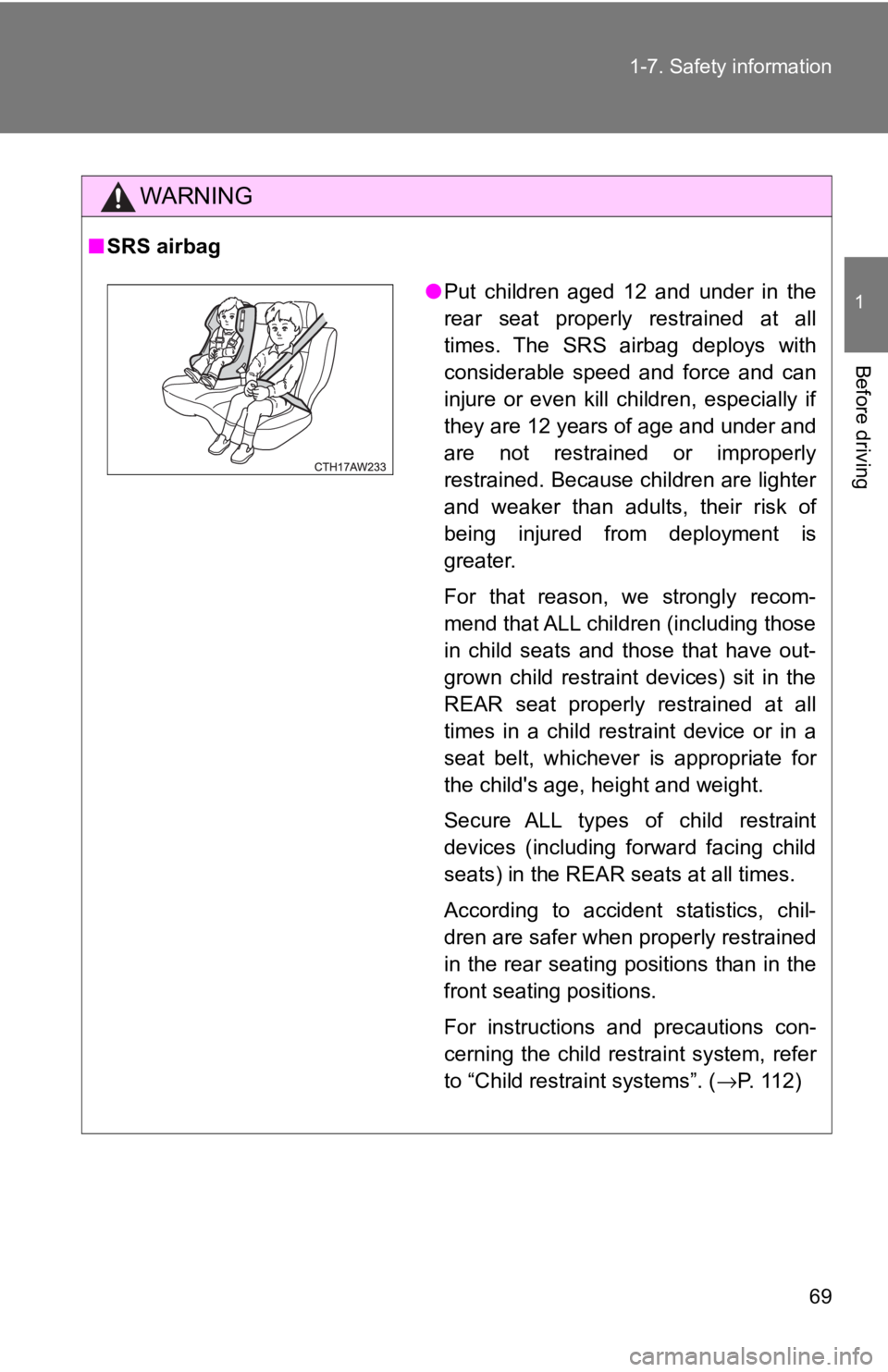
● Put children aged 12 and under in the
rear seat properly restrained at all
times. The SRS airbag deploys with
considerable speed and force and can
injure or even kill children, especially if
they are 12 years of age and under and
are not restrained or improperly
restrained. Because children are lighter
and weaker than adults, their risk of
being injured from deployment is
greater.
For that reason, we strongly recom-
mend that ALL children (including those
in child seats and those that have out-
grown child restraint devices) sit in the
REAR seat properly restrained at all
times in a child restraint device or in a
seat belt, whichever is appropriate for
the child's age, height and weight.
Secure ALL types of child restraint
devices (including forward facing child
seats) in the REAR seats at all times.
According to accident statistics, chil-
dren are safer when properly restrained
in the rear seating positions than in the
front seating positions.
For instructions and precautions con-
cerning the child restraint system, refer
to “Child restraint systems”. ( → P. 112)
Page 70 of 428
701-7. Safety information
WARNING■ SRS airbag
● NEVER INSTALL A REARWARD FACING CHILD SEAT IN THE FRONT
SEAT. DOING SO RISKS SERIOUS INJURY OR DEATH TO THE CHILD
BY PLACING THE CHILD’S HEAD TOO CLOSE TO THE SRS AIRBAG.
● Never allow a child to stand up, or to kneel on the front passenger’s seat,
or never hold a child on your lap or in your arms. The SRS airbag deploys
with considerable force and can injure or even kill the child.
● When the SRS airbag deploys, some smoke will be released. This smoke
could cause breathing problems for people with a history of asthma or
other breathing trouble. If you or your passengers have breathing prob-
lems after SRS airbag deploys, get fresh air promptly.
● A deploying SRS airbag releases hot gas. Occupants could get burned if
they come into direct contact with the hot gas.
Page 71 of 428
711-7. Safety information
1
Before driving SRS airbag system components
Front sub sensor (right-hand
side)
SRS warning light
Frontal airbag module
(driver's side) (two-stage)
Front passenger’s frontal air-
bag ON and OFF indicator
(center of instrument panel)
Frontal airbag module (front
passenger’s side) (two-
stage)
Front passenger’s occupant
detection control module
Door impact sensor (right-
hand side)
Curtain shield airbag mod-
ule (right-hand side)
Airbag wiring
Side airbag module (front
passenger’s side) Side airbag sensor (center
pillar right-hand side)
Curtain shield airbag sensor
(rear wheel house right-hand
side)
Seat belt pretensioner (front
passenger’s side)
Satellite safing sensor
(under the center of the rear
seats)
Front passenger’s occupant
classification system sensor
Seat belt buckle switch (front
passenger’s side)
Seat belt pretensioner
(driver’s side)
Curtain shield airbag sensor
(rear wheel house left-hand
side)


