2017 TOYOTA 86 ECU
[x] Cancel search: ECUPage 61 of 428

61 1
Before driving 1-6. Theft deterrent system
Engine immobilizer system
■ When the vehicle cannot be started with the registered key
Remove the key and try again.
■ System maintenance
The vehicle has a maintenance-free type engine immobilizer system.
■ Conditions that may cause the system to malfunction
● If the key is in contact with a metallic object
● If the key is in close proximity to or touching a key to the security system
(key with a built-in transponder chip) of another vehicleThe vehicle's keys have built-in tran sponder chips that prevent the
engine from starting if the key has not been previously registered in
the vehicle's on-board computer.
Never leave the keys inside the vehicle when you leave the vehicle.
This system is designed to help prevent vehicle theft but does not
guarantee absolute security against all vehicle thefts.
The indicator light flashes after
the key has been removed
from the engine switch to indi-
cate that the system is operat-
ing.
The indicator light stops flash-
ing after the registered key
has been inserted into the
engine switch to indicate that
the system has been can-
celed.
Page 69 of 428
691-7. Safety information
1
Before driving WARNING■ SRS airbag
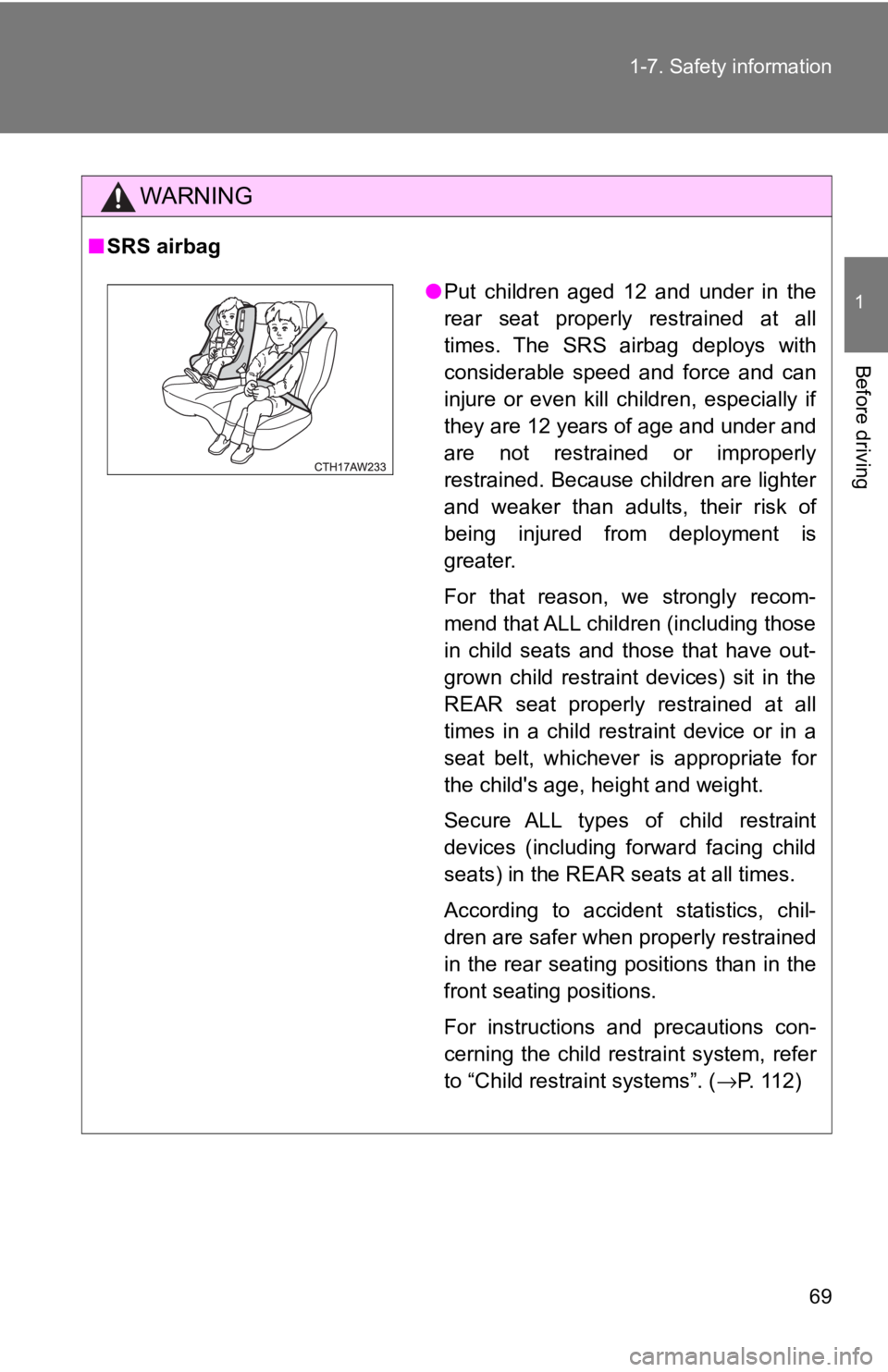
● Put children aged 12 and under in the
rear seat properly restrained at all
times. The SRS airbag deploys with
considerable speed and force and can
injure or even kill children, especially if
they are 12 years of age and under and
are not restrained or improperly
restrained. Because children are lighter
and weaker than adults, their risk of
being injured from deployment is
greater.
For that reason, we strongly recom-
mend that ALL children (including those
in child seats and those that have out-
grown child restraint devices) sit in the
REAR seat properly restrained at all
times in a child restraint device or in a
seat belt, whichever is appropriate for
the child's age, height and weight.
Secure ALL types of child restraint
devices (including forward facing child
seats) in the REAR seats at all times.
According to accident statistics, chil-
dren are safer when properly restrained
in the rear seating positions than in the
front seating positions.
For instructions and precautions con-
cerning the child restraint system, refer
to “Child restraint systems”. ( → P. 112)
Page 77 of 428

771-7. Safety information
1
Before driving ■ If the front passenger’s frontal airbag ON indi cator illuminates and the
OFF indicator turns off even when an in fant or a small child is in a child
restraint system (inc luding booster seat)
Turn the engine switch to the “LOCK” position if the front passenger’s frontal
airbag ON indicator illuminates and the OFF indicator turns off even when an
infant or a small child is in a child restraint system (including booster seat).
Remove the child restraint system from the seat. By referring to the child
restraint manufacturer’s recommendations as well as the child restraint sys-
tem installation procedures in “Child restraint systems” ( → P. 112), correctly
install the child restraint system. Turn the engine switch to the “ON” position
and make sure that the front passenger’s frontal airbag ON indicator turns
off and the OFF indicator illuminates.
If still the ON indicator remains illuminated while the OFF indicator turns off,
take the following actions.
● Ensure that no article is placed on the seat other than the child restraint
system and the child occupant.
● Ensure that the backward-forward position and seatback of front passen-
ger’s seat are locked into place securely by moving the seat back and
forth.
If the ON indicator still remains illuminated while the OFF indicator turns off
after taking relevant corrective actions described above, relocate the child
restraint system to the rear seat and immediately contact your Toyota dealer
for an inspection.
NOTE
When a child who has outgrown a child restraint system or a small adult is
seated in the front passenger’s seat, the Toyota advanced frontal airbag sys-
tem may or may not activate the front passenger’s SRS frontal airbag
depending on the occupant’s seating posture. The child should always wear
the seat belt when sitting in the seat irrespective of whether the airbag is
deactivated or activated. If the front passenger’s SRS frontal airbag is acti-
vated (the ON indicator remains illuminated while the OFF indicator turns
off), take the following actions.
Page 98 of 428
981-7. Safety information
WARNING■ SRS airbag precautions
● The SRS driver airbag deploys with considerable force, and can cause
death or serious injury especially if the driver is very close to the airbag.
The National Highway Traffic Safety Administration (“NHTSA”) advises:
Since the risk zone for the driver’s airbag is the first 2 - 3 in. (50 - 75 mm)
of inflation, placing yourself 10 in. (250 mm) from your driver airbag pro-
vides you with a clear margin of safety. This distance is measured from the
center of the steering wheel to your breastbone. If you sit less than 10 in.
(250 mm) away now, you can change your driving position in several
ways:
• Move your seat to the rear as far as you can while still reaching the
pedals comfortably.
• Slightly recline the back of the seat. Although vehicle designs vary,
many drivers can achieve the 10 in. (250 mm) distance, even with the
driver seat all the way forward, simply by reclining the back of the seat
somewhat. If reclining the back of your seat makes it hard to see the
road, raise yourself by using a firm, non-slippery cushion, or raise the
seat if your vehicle has that feature.
• If your steering wheel is adjustable, tilt it downward. This points the air-
bag toward your chest instead of your head and neck.
The seat should be adjusted as recommended by NHTSA above, while
still maintaining control of the foot pedals, steering wheel, and your view of
the instrument panel controls.
● The SRS front passenger airbag also deploys with considerable force, and
can cause death or serious injury especially if the front passenger is very
close to the airbag. The front passenger seat should be as far from the air-
bag as possible with the seatback adjusted, so the front passenger sits
upright.
● Improperly seated and/or restrained infants and children can be killed or
seriously injured by a deploying airbag. An infant or child who is too small
to use a seat belt should be properly secured using a child restraint sys-
tem. Toyota strongly recommends that all infants and children be placed in
the rear seats of the vehicle and properly restrained. The rear seats are
safer for infants and children than the front passenger seat. ( → P. 112)
Page 109 of 428
1091-7. Safety information
1
Before driving If the front passenger’s frontal airbag ON indicator illuminates and the OFF indicator turns off
even when an infant or a small child is in a child restraint system (including booster seat)
This can be caused by the child restraint system being installed incor-
rectly. Perform the following.
The engine switch is turned to the “LOCK” position.
Remove the child restraint syst em from the seat. By referring
to the child restraint manufact urer’s recommendations as well
as the child restraint system in stallation procedure in “child
restraint system”, correctly rein stall the child re straint system.
The engine switch is turned to the “ON” position and make
sure that the front passenger’s frontal airbag ON indicator
turns off and the OFF indicator illuminates.
If the ON indicator still remain s illuminated while the OFF indi-
cator turns off, perform the following.
• Ensure that no article is pl aced on the seat other than the
child restraint system and the child occupant.
• Ensure that the backward-for ward position and seatback of
front passenger seat are locked into place securely by mov-
ing the seat back and forth.
If the ON indicator still remain s illuminated while the OFF indi-
cator turns off after taking the relevant corrective actions
described above, relocate the ch ild restraint system to the
rear seat and immedi ately contact your Toyota dealer for an
inspection.STEP 1
STEP 2
STEP 3
STEP 4
STEP 5
Page 115 of 428
1151-7. Safety information
1
Before driving WARNING■ Child restraint precautions
● Do not allow the child to lean his/her head or any part of his/her body
against the door or the area of the seat, front and rear pillars or roof side
rails from which the SRS side airbags or SRS curtain shield airbags deploy
even if the child is seated in the child restraint system. It is dangerous if
the SRS side airbags and curtain shield airbags inflate, and the impact
could cause death or serious injury to the child.
● Make sure you have complied with all installation instructions provided by
the child restraint manufacturer and that the system is properly secured. If
it is not secured properly, it may cause death or serious injury to the child
in the event of a sudden stop, sudden swerve or an accident.
■ When children are in the vehicle
Do not allow children to play with the seat belt. If the seat belt becomes
twisted around a child’s neck, it may lead to choking or other serious injuries
that could result in death.
If this occurs and the buckle cannot be unfastened, scissors should be used
to cut the belt.
■ When the child restraint system is not in use
● Keep the child restraint system properly secured on the seat even if it is
not in use. Do not store the restraint unsecured in the passenger compart-
ment.
● If it is necessary to detach the child restraint system, remove it from the
vehicle or store it securely in the trunk. This will prevent it from injuring
passengers in the event of a sudden stop, sudden swerve or accident.
Page 116 of 428
1161-7. Safety information
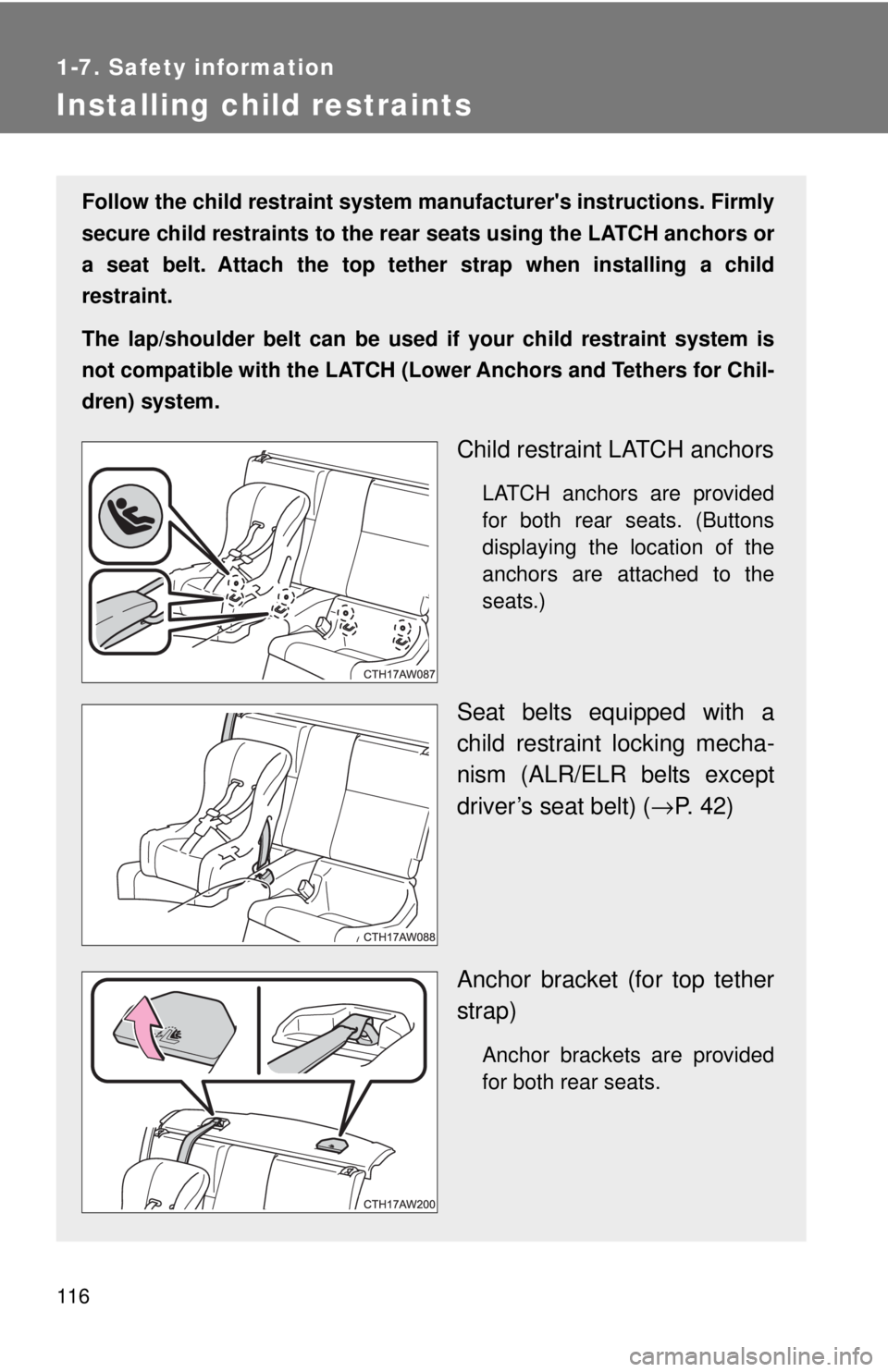
Installing child restraints Follow the child restraint system ma nufacturer's inst ructions. Firmly
secure child restraints to the rear seats using the LATCH anchors or
a seat belt. Attach the top tether strap when installing a child
restraint.
The lap/shoulder belt can be used if your child restraint system is
not compatible with the LATCH (Low er Anchors and Tethers for Chil-
dren) system.
Child restraint LATCH anchors LATCH anchors are provided
for both rear seats. (Buttons
displaying the location of the
anchors are attached to the
seats.)
Seat belts equipped with a
child restraint locking mecha-
nism (ALR/ELR belts except
driver’s seat belt) ( → P. 42)
Anchor bracket (for top tether
strap)
Anchor brackets are provided
for both rear seats.
Page 120 of 428

1201-7. Safety information
While pushing the child restraint
system down into the rear seat,
allow the shoulder belt to retract
until the child restraint system is
securely in place. After the shoulder belt has
retracted to a point where there is
no slack in the belt, pull the belt to
check that it cannot be extended.
■ Forward facing ⎯ Convertible seat
Place the child restraint system
on the seat facing the front of the
vehicle.
Run the seat belt through the
child restraint system and insert
the plate into the buckle. Make
sure that the belt is not twisted.
Fully extend the shoulder belt
and allow it to retract to put it in
lock mode. In lock mode, the belt
cannot be extended.STEP 4
STEP 1
STEP 2
STEP 3