2017 SUBARU FORESTER brake fluid
[x] Cancel search: brake fluidPage 539 of 634

Maintenance and service/Engine compartment overview
Engine compartment overview
&Non-turbo models
1) Brake fluid reservoir/Clutch fluid reservoir
(MT) (page 11-18)
2) Fuse box (page 11-37)
3) Battery (page 11-36)
4) Windshield washer tank (page 11-30)
5) Engine oil filler cap (page 11-10)
6) Engine coolant reservoir (page 11-13)
7) Radiator cap (page 11-13)
8) Engine oil filter (page 11-11)
9) Engine oil level gauge (page 11-10)
10) Air cleaner case (page 11-14)
11-8
Page 540 of 634

&Turbo models1) Brake fluid reservoir (page 11-18)
2) Fuse box (page 11-37)
3) Battery (page 11-36)
4) Windshield washer tank (page 11-30)
5) Engine oil filler cap (page 11-10)
6) Engine coolant reservoir (page 11-13)
7) Radiator cap (page 11-13)
8) Engine oil filter (page 11-11)
9) Engine oil level gauge (page 11-10)
10) Air cleaner case (page 11-14)
Maintenance and service/Engine compartment overview
11-9
Page 549 of 634
Maintenance and service/Brake fluid
Brake fluid
&Checking the fluid level
WARNING
. Never let brake fluid contact your
eyes because brake fluid can be
harmful to your eyes. If brake
fluid gets in your eyes, immedi-
ately flush them thoroughly with
clean water. For safety, when
performing this work, wearing
eye protection is advisable.
. Brake fluid absorbs moisture
from the air. Any absorbed moist-
ure can cause a dangerous loss
of braking performance.
. If the vehicle requires frequent
refilling, there may be a leak. If
you suspect a problem, have the
vehicle checked at your SUBARU
dealer.
CAUTION
. When adding brake fluid, be care-
ful not to allow any dirt into the
reservoir.
. Never splash the brake fluid over
painted surfaces or rubber parts. Alcohol contained in the brake
fluid may damage them.
. Be careful not to spill brake fluid
when adding it. If brake fluid
touches the exhaust pipe, it may
cause a bad smell, smoke, and/or
a fire. If brake fluid gets on the
exhaust pipe, be sure to wipe it
off.
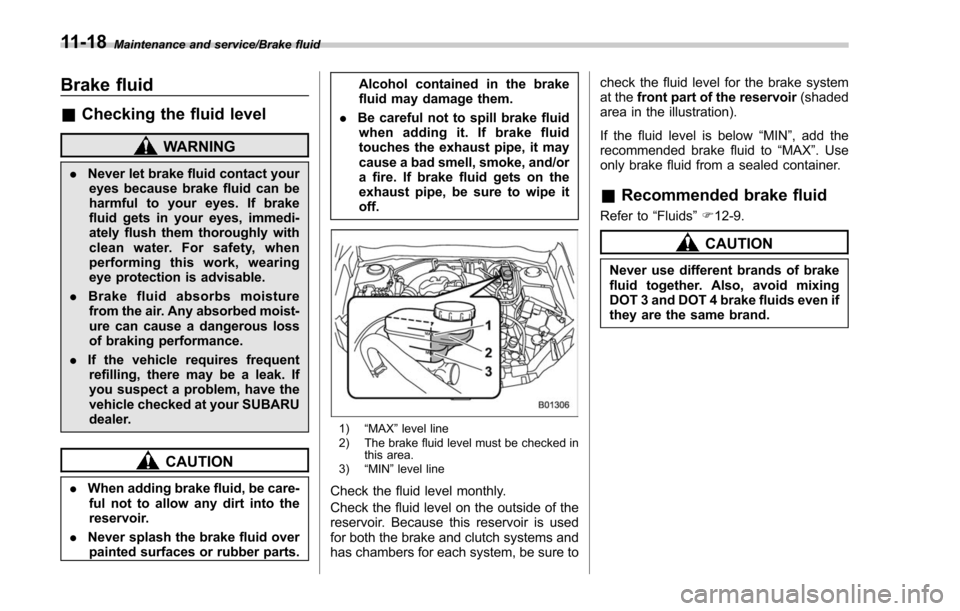
1) “MAX ”level line
2) The brake fluid level must be checked in this area.
3) “MIN ”level line
Check the fluid level monthly.
Check the fluid level on the outside of the
reservoir. Because this reservoir is used
for both the brake and clutch systems and
has chambers for each system, be sure to check the fluid level for the brake system
at the
front part of the reservoir (shaded
area in the illustration).
If the fluid level is below “MIN”, add the
recommended brake fluid to “MAX ”. Use
only brake fluid from a sealed container.
& Recommended brake fluid
Refer to “Fluids ”F 12-9.
CAUTION
Never use different brands of brake
fluid together. Also, avoid mixing
DOT 3 and DOT 4 brake fluids even if
they are the same brand.
11-18
Page 550 of 634
Clutch fluid (MT models)
&Checking the fluid level
WARNING
Never let clutch fluid contact your
eyes because clutch fluid can be
harmful to your eyes. If clutch fluid
gets in your eyes, immediately flush
them thoroughly with clean water.
For safety, when performing this
work, wearing eye protection is
advisable.
CAUTION
. Clutch fluid absorbs moisture
from the air. Any absorbed moist-
ure can cause improper clutch
operation.
. If the vehicle requires frequent
refilling, there may be a leak. If
you suspect a problem, have the
vehicle checked at your SUBARU
dealer.
. When clutch fluid is added, be
careful not to allow any dirt into
the tank.
. Never splash the clutch fluid over
painted surfaces or rubber parts. Alcohol contained in the clutch
fluid may damage them.
. Be careful not to spill clutch fluid
when adding it. If clutch fluid
touches the exhaust pipe, it may
cause a bad smell, smoke, and/or
a fire. If clutch fluid gets on the
exhaust pipe, be sure to wipe it
off.
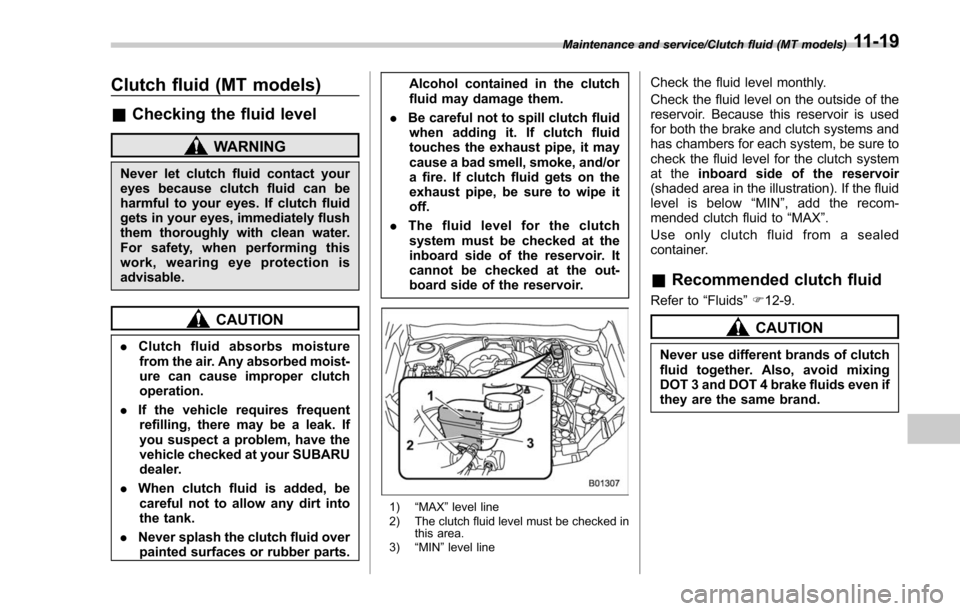
. The fluid level for the clutch
system must be checked at the
inboard side of the reservoir. It
cannot be checked at the out-
board side of the reservoir.
1) “MAX ”level line
2) The clutch fluid level must be checked in this area.
3) “MIN ”level line
Check the fluid level monthly.
Check the fluid level on the outside of the
reservoir. Because this reservoir is used
for both the brake and clutch systems and
has chambers for each system, be sure to
check the fluid level for the clutch system
at the inboard side of the reservoir
(shaded area in the illustration). If the fluid
level is below “MIN ”,addtherecom-
mended clutch fluid to “MAX ”.
Use only clutch fluid from a sealed
container.
& Recommended clutch fluid
Refer to “Fluids ”F 12-9.
CAUTION
Never use different brands of clutch
fluid together. Also, avoid mixing
DOT 3 and DOT 4 brake fluids even if
they are the same brand.
Maintenance and service/Clutch fluid (MT models)11-19
Page 561 of 634

Maintenance and service/Aluminum wheels
&Wheel replacement
When replacing wheels due, for example,
to damage, make sure the replacement
wheels match the specifications of the
wheels that are fitted as standard equip-
ment. Replacement wheels are available
from SUBARU dealers.
WARNING
Use only those wheels that are
specified for your vehicle. Wheels
not meeting specifications could
interfere with brake caliper opera-
tion and may cause the tires to rub
against the wheel well housing dur-
ing turns. The resulting loss of
vehicle control could lead to an
accident.
NOTE
When any of the wheels are removed
and replaced for tire rotation or to
change a flat tire, always check the
tightness of the wheel nuts after driv-
ing approximately 600 miles (1,000 km).
If any nut is loose, tighten it to the
specified torque.
Aluminum wheels
Aluminum wheels can be scratched and
damaged easily. Handle them carefully to
maintain their appearance, performance,
and safety.
. When any of the wheels are removed
and replaced for tire rotation or to change
a flat tire, always check the tightness of
the wheel nuts after driving approximately
600 miles (1,000 km). If any nut is loose,
tighten it to the specified torque.
. Never apply oil to the threaded parts,
wheel nuts, or tapered surface of the
wheel.
. Never let the wheel rub against sharp
protrusions or curbs.
. When wheel nuts, balance weights, or
the center cap is replaced, be sure to
replace them with genuine SUBARU parts
designed for aluminum wheels.
Windshield washer fluid
CAUTION
Never use engine coolant as washer
fluid because it could cause paint
damage.
Windshield washer fluid warning light
(type A)
11-30
Page 580 of 634

Specifications..................................................... 12-2Dimensions........................................................ 12-2
Engine ............................................................... 12-3
Fuel ................................................................... 12-3
Engine oil .......................................................... 12-4
Manual transmission, front differential and rear differential gear oil ........................................... 12-7
Fluids ................................................................ 12-9
Engine coolant ................................................... 12-9
Electrical system .............................................. 12-10
Tires ................................................................ 12-10 Temporary spare tires
...................................... 12-10
Brake disc ....................................................... 12-11Fuses and circuits ........................................... 12-12Fuse panel located in the passenger
compartment ................................................. 12-12
Fuse panel located in the engine compartment ................................................. 12-14
Bulb chart......................................................... 12-16
Vehicle identification ....................................... 12-19
Specifications
12
Page 588 of 634
&Fluids
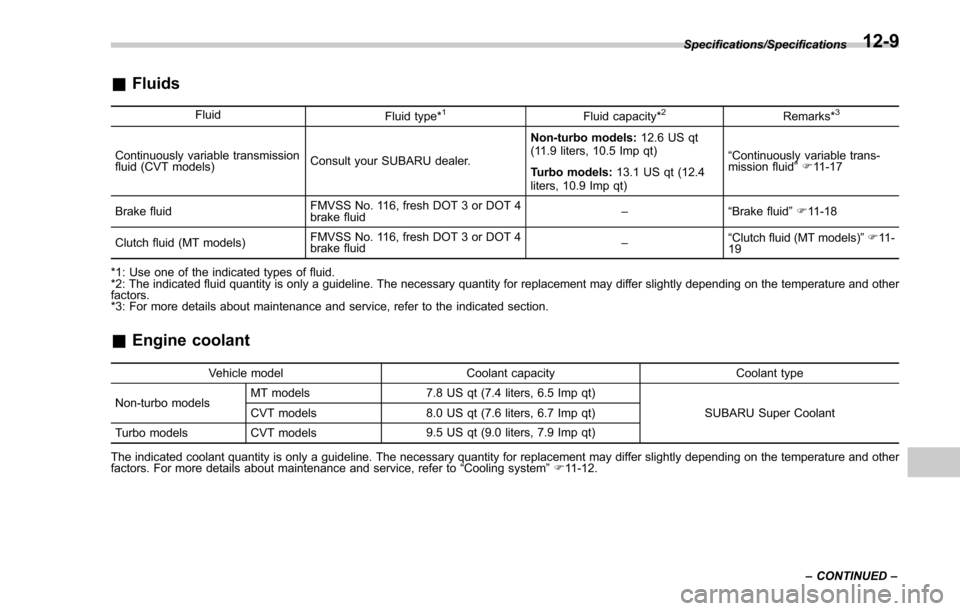
Fluid
Fluid type*1Fluid capacity*2Remarks*3
Continuously variable transmission
fluid (CVT models) Consult your SUBARU dealer. Non-turbo models:
12.6 US qt
(11.9 liters, 10.5 Imp qt)
Turbo models: 13.1 US qt (12.4
liters, 10.9 Imp qt) “
Continuously variable trans-
mission fluid ”F 11-17
Brake fluid FMVSS No. 116, fresh DOT 3 or DOT 4
brake fluid –“
Brake fluid”F 11-18
Clutch fluid (MT models) FMVSS No. 116, fresh DOT 3 or DOT 4
brake fluid
–
“
Clutch fluid (MT models) ”F 11 -
19
*1: Use one of the indicated types of fluid.
*2: The indicated fluid quantity is only a guideline. The necessary quantity for replacement may differ slightly depending on the temperature and other
factors.
*3: For more details about maintenance and service, refer to the indicated section.
& Engine coolant
Vehicle model Coolant capacity Coolant type
Non-turbo models MT models
7.8 US qt (7.4 liters, 6.5 Imp qt)
SUBARU Super Coolant
CVT models 8.0 US qt (7.6 liters, 6.7 Imp qt)
Turbo models CVT models 9.5 US qt (9.0 liters, 7.9 Imp qt)
The indicated coolant quantity is only a guideline. The necessary quantity for replacement may differ slightly depending on the temperature and other
factors. For more details about maintenance and service, refer to “Cooling system ”F 11-12. Specifications/Specifications
–CONTINUED –
12-9
Page 606 of 634
.Passenger car tire
A tire intended for use on passen-
ger cars, multipurpose passenger
vehicles, and trucks, that have a
gross vehicle weight rating (GVWR)
of 10,000 lbs (4,535 kg) or less.
.Ply
A layer of rubber-coated parallel
cords.
.Ply separation
A parting of rubber compound
between adjacent plies.
.Pneumatic tire
A mechanical device made of rub-
ber, chemicals, fabric and steel or
other materials, that, when
mounted on an automotive wheel,
provides the traction and contains
the gas or fluid that sustains the
load.
.Production options weight
The combined weight of those
installed regular production options
weighing over 5.1 lbs (2.3 kg) in
excess of those standard items
which they replace, not previously
considered in curb weight or acces-sory weight, including heavy duty
brakes, ride levelers, roof rack,
heavy duty battery, and special
trim.
.Radial ply tire
A pneumatic tire in which the ply
cords that extend to the beads are
laid at substantially 90 degrees to
the centerline of the tread.
.Recommended inflation pres-
sure
The cold inflation pressure recom-
mended by a vehicle manufacturer.
.Reinforced tire
A tire designed to operate at higher
loads and at higher inflation pres-
sures than the corresponding stan-
dard tire.
.Rim
A metal support for a tire or a tire
and tube assembly upon which the
tire beads are seated.
.Rim diameter
Nominal diameter of the bead seat.
.Rim size designation
Rim diameter and width.
.Rim type designation
The industry of manufacturer ’s des-
ignation for a rim by style or code.
.Rim width
Nominal distance between rim
flanges.
.Section width
The linear distance between the
exteriors of the sidewalls of an
inflated tire, excluding elevations
due to labeling, decoration, or
protective bands.
.Sidewall
That portion of a tire between the
tread and bead.
.Sidewall separation
The parting of the rubber com-
pound from the cord material in
the sidewall.
.Test rim
The rim on which a tire is fitted for
testing, and it may be any rim listed
as appropriate for use with that tire.
.Tread
That portion of a tire that comes
into contact with the road.
Consumer information and Reporting safety defects/Tire information
–CONTINUED –13-7