2017 SUBARU CROSSTREK towing
[x] Cancel search: towingPage 451 of 572

!Driving on grades
.Before going down a steep hill, slow
down and shift into lower gear (if neces-
sary, use 1st gear) in order to utilize the
engine braking effect and prevent over-
heating of your vehicle’s brakes. Do not
make sudden downshifts.
.When driving uphill in hot weather, the
air conditioner may turn off automatically
to protect the engine from overheating.
.When driving uphill in hot weather, pay
attention to the following indicators be-
cause the engine and transmission are
relatively prone to overheating.
: Coolant temperature high warning light
: AT OIL TEMP warning light
(CVT models)
If the coolant temperature high warning
light and/or the AT OIL TEMP warning light
illuminates, immediately turn off the air
conditioner and stop the vehicle in the
nearest safe location. For further instruc-
tions and additional information, refer to
the following sections.
–“If you park your vehicle in case of
an emergency”F9-2
–“Engine overheating”F9-12
–“Coolant temperature low indicator
light/Coolant temperature high warn-
ing light”F3-17
–“AT OIL TEMP warning light (CVTmodels)”F3-19
.For CVT models, avoid using the
accelerator pedal to stay stationary on
an uphill slope instead of using the
parking brake or foot brake. That may
cause the transmission fluid to overheat.
!Parking on a grade
Always block the wheels under both
vehicle and trailer when parking. Apply
the parking brake firmly. You should not
park on a hill or slope. If parking on a hill or
slope cannot be avoided, you should take
the following steps:
1. Apply the brakes and hold the pedal
down.
2. Have someone place wheel blocks
under both the vehicle and trailer wheels.
3. When the wheel blocks are in place,
release the regular brakes slowly until the
blocks absorb the load.
4. Apply the regular brakes and then
apply the parking brake; slowly release
the regular brakes.
5. Shift into 1st or reverse gear (MT
models) or“P”position (CVT models)
and shut off the engine.
Driving tips/Trailer towing8-25
Page 453 of 572

If you park your vehicle in case of an
emergency........................................................ 9-2
Temporary spare tire........................................... 9-2
Maintenance tools............................................... 9-3
Tool locations..................................................... 9-4
Using the jack..................................................... 9-4
Flat tires............................................................... 9-5Changing a flat tire.............................................. 9-5
Tire pressure monitoring system (TPMS)
(U.S.-spec. models)........................................... 9-8
Jump starting..................................................... 9-10How to jump start............................................... 9-10
Engine overheating............................................ 9-12
If steam is coming from the engine
compartment.................................................... 9-12If no steam is coming from the engine
compartment................................................... 9-12
Towing................................................................ 9-13Towing hooks and tie-down hooks/holes............ 9-13
Using a flat-bed truck......................................... 9-15
Towing with all wheels on the ground................. 9-16
Access key–if access key does not
operate properly............................................. 9-17
Locking and unlocking....................................... 9-17
Switching power status...................................... 9-17
Starting engine.................................................. 9-18
Rear gate–if the rear gate cannot be
opened............................................................. 9-18
If your vehicle is involved in an accident........ 9-19
In case of emergency
9
Page 454 of 572

In case of emergency/If you park your vehicle in case of an emergency
If you park your vehicle in
case of an emergency
1) Models with multi function display
2) Models without multi function display
The hazard warning flasher should beused in day or night to warn other drivers
when you have to park your vehicle under
emergency conditions.
Avoid stopping on the road. It is best to
safely pull off the road if a problem occurs.
The hazard warning flasher can be acti-
vated regardless of the ignition switch
position.
Turn on the hazard warning by pushing
the hazard warning flasher switch. Turn it
off by pushing the switch again.
NOTE
When the hazard warning flasher is on,
the turn signals do not work.
Temporary spare tire
WARNING
.Never tow a trailer when the
temporary spare tire is used.
The temporary spare tire is not
designed to sustain the towing
load. Use of the temporary spare
tire when towing can result in
failure of the spare tire and/or
less stability of the vehicle and
may lead to an accident.
.When a spare tire is mounted or a
wheel rim is replaced without the
original pressure sensor/trans-
mitter being transferred, the low
tire pressure warning light will
illuminate steadily after blinking
for approximately one minute.
This indicates the tire pressure
monitoring system (TPMS) is un-
able to monitor all four road
wheels. Contact your SUBARU
dealer as soon as possible for
tire and sensor replacement and/
or system resetting.
9-2
Page 455 of 572

CAUTION
Never use any temporary spare tire
other than the original. Using other
sizes may result in severe mechan-
ical damage to the drive train of your
vehicle.
The temporary spare tire is smaller and
lighter than a conventional tire and is
designed for emergency use only. Re-
move the temporary spare tire and re-
install the conventional tire as soon as
possible because the spare tire is de-
signed only for temporary use.
Check the inflation pressure of the tem-
porary spare tire periodically to keep the
tire ready for use. The correct pressure is
60 psi (420 kPa, 4.2 kg/cm
2).
When using the temporary spare tire, note
the following.
.Do not exceed 50 mph (80 km/h).
.Do not put a tire chain on the temporary
spare tire. Because of the smaller tire size,
a tire chain will not fit properly.
.Do not use two or more temporary
spare tires at the same time.
.Do not drive over obstacles. This tire
has a smaller diameter, so road clearance
is reduced.
1) Tread wear indicator bar
2) Indicator location mark
.When the wear indicator appears on
the tread, replace the tire.
.The temporary spare tire must be used
only on a rear wheel. If a front wheel tire
gets punctured, replace the wheel with a
rear wheel and install the temporary spare
tire in place of the removed rear wheel.
Maintenance tools
Your vehicle is equipped with the following
maintenance tools.
.Jack
.Jack handle
.Screwdriver
.Towing hook (eye bolt)
.Wheel nut wrench
In case of emergency/Maintenance tools
–CONTINUED–9-3
Page 456 of 572
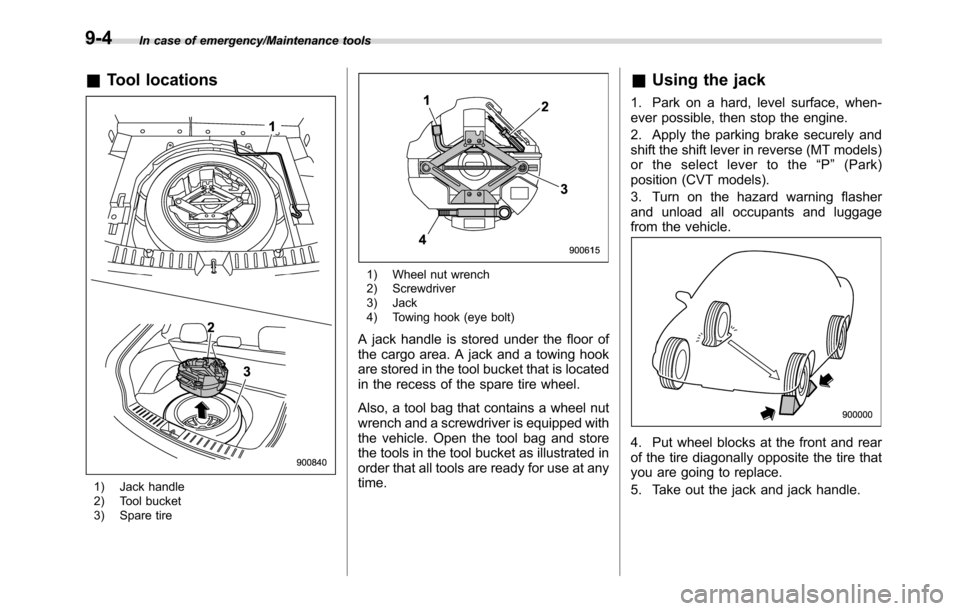
In case of emergency/Maintenance tools
&Tool locations
1) Jack handle
2) Tool bucket
3) Spare tire
1) Wheel nut wrench
2) Screwdriver
3) Jack
4) Towing hook (eye bolt)
A jack handle is stored under the floor of
the cargo area. A jack and a towing hook
are stored in the tool bucket that is located
in the recess of the spare tire wheel.
Also, a tool bag that contains a wheel nut
wrench and a screwdriver is equipped with
the vehicle. Open the tool bag and store
the tools in the tool bucket as illustrated in
order that all tools are ready for use at any
time.
&Using the jack
1. Park on a hard, level surface, when-
ever possible, then stop the engine.
2. Apply the parking brake securely and
shift the shift lever in reverse (MT models)
or the select lever to the“P”(Park)
position (CVT models).
3. Turn on the hazard warning flasher
and unload all occupants and luggage
from the vehicle.
4. Put wheel blocks at the front and rear
of the tire diagonally opposite the tire that
you are going to replace.
5. Take out the jack and jack handle.
9-4
Page 465 of 572

Towing
If towing is necessary, it is best done by
your SUBARU dealer or a commercial
towing service. Observe the following
procedures for safety.
WARNING
Never tow AWD models with the
front wheels raised off the ground
while the rear wheels are on the
ground, or with the rear wheels
raised off the ground while the front
wheels are on the ground. This will
cause the vehicle to spin away due
to the operation or deterioration of
the center differential.
&Towing hooks and tie-down
hooks/holes
The towing hooks should be used only in
an emergency (e.g., to free a stuck vehicle
from mud, sand or snow).
CAUTION
.Use only the specified towing
hooks and tie-down hooks/holes.
Never use suspension parts or
other parts of the body for towing
or tie-down purposes.
.To prevent deformation to the
front bumper and the towing
hook, do not apply excessive
lateral load to the towing hooks.
!Front towing hook
1. Take the towing hook and screwdriver
out of the tool bucket. Take the jack
handle out of the cargo area.
2. Cover the tip of a flat-head screwdriver
with vinyl tape or cloth so that it will not
scratch the bumper. Insert the flat-head
screwdriver into the cutout of the cover
and pry open the cover.
3. Screw the towing hook into the thread
In case of emergency/Towing
–CONTINUED–9-13
Page 466 of 572

In case of emergency/Towing
hole until its thread can no longer be seen.
4. Tighten the towing hook securely
using the jack handle.
After towing, remove the towing hook from
the vehicle and stow it in the tool bucket.
Fit the towing hook cover on the bumper.
WARNING
.Do not use the towing hook for
purposes other than towing your
vehicle..Be sure to remove the towing
hook after towing. Leaving the
towing hook mounted on the
vehicle could interfere with prop-
er operation of the SRS airbag
system in a frontal collision.
!Rear towing hook
1. Take the towing hook and screwdriver
out of the tool bucket. Take the jack
handle out of the cargo area.
2. Pry off the cover on the rear bumper
using a screwdriver, and you will find a
threaded hole for attaching the towing
hook.
3. Screw the towing hook into the thread
hole until its thread can no longer be seen.
4. Tighten the towing hook securely
using the jack handle.
After towing, remove the towing hook from
9-14
Page 467 of 572

the vehicle and stow it in the tool bucket.
Fit the towing hook cover on the bumper.
WARNING
.Do not use the towing hook for
purposes other than towing your
vehicle.
.Be sure to remove the towing
hook after towing. Leaving the
towing hook mounted on the
vehicle could interfere with prop-
er operation of the fuel pump
shut off function when the vehi-
cle is struck from behind.
!Front tie-down hooks
The front tie-down hooks are located
between each of the front tires and thefront bumper.
!Rear tie-down holes
1) Rear tie-down hole
The rear tie-down holes are located near
each of the jack-up reinforcements.
There is a plug in each rear tie-down hole.To use the rear tie-down holes, remove
the plugs. After using the rear tie-down
holes, return the plugs to their original
places.
WARNING
Use the rear tie-down holes only for
downward anchoring. If they are
used to anchor the vehicle in any
other direction, cables may slip out
of the holes, possibly causing a
dangerous situation.
&Using a flat-bed truck
This is the best way to transport your
vehicle. Use the following procedures to
ensure safe transportation.
1. Shift the select lever into the“P”
In case of emergency/Towing
–CONTINUED–9-15