Page 423 of 572

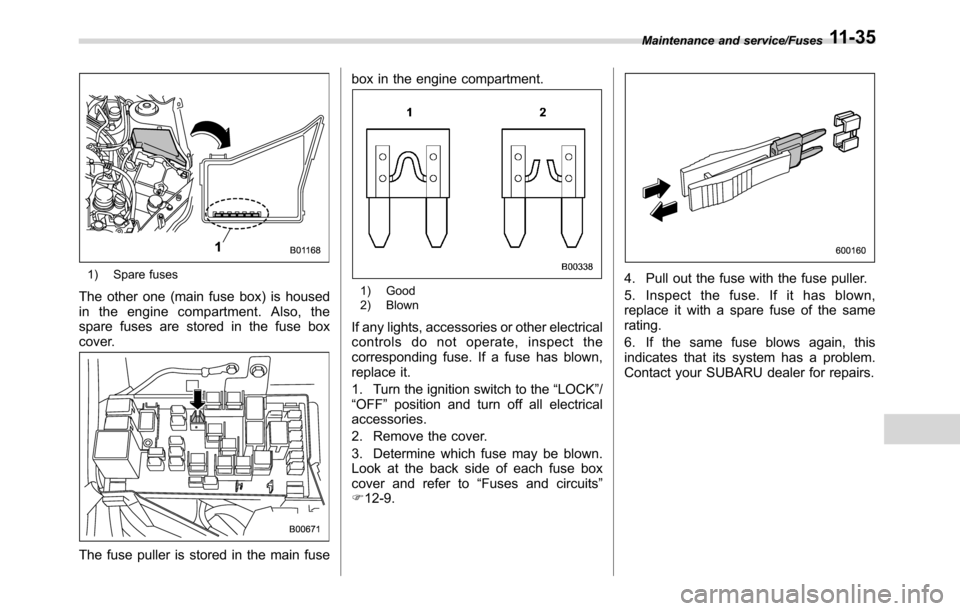
&BSD/RCTA OFF switch
BSD/RCTA OFF switch
BSD/RCTA OFF indicator
If the BSD/RCTA OFF switch is pressed,
the BSD/RCTA OFF indicator appears on
the multi information display of the combi-nation meter, and the BSD/RCTA is
deactivated.
Press the switch again to activate the
BSD/RCTA. The BSD/RCTA OFF indica-
tor will disappear.
NOTE
.In the following cases, the system
may not operate properly due to
blocked radar waves. Press the BSD/
RCTA OFF switch to deactivate the
system.
–When towing a trailer
–When a bicycle carrier or other
item is fitted to the rear of the
vehicle
–When using a chassis dynam-
ometer or free roller device, etc.
–When running the engine and
making the wheels rotate while
lifting up the vehicle
.If the ignition switch is turned to the
“LOCK”/“OFF”position, the last known
status of the system is maintained. For
example, if the ignition switch is turned
to the“LOCK”/“OFF”position with the
BSD/RCTA deactivated, the BSD/RCTA
will remain deactivated the next time
the ignition switch is turned to the
“ON”position.
.If the vehicle battery is disconnected
duetosituationssuchasbatteryterminal or fuse replacement, after the
battery is reconnected, the BSD/RCTA
will be activated.
&Certification for the BSD/
RCTA
U.S.-spec. models:
FCC ID: OAYSRR2A
CAUTION
FCC WARNING
Changes or modifications not ex-
pressly approved by the party re-
sponsible for compliance could void
the user’s authority to operate the
equipment.
This device complies with part 15 of the
FCC Rules. Operation is subject to the
following two conditions: (1) This device
may not cause harmful interference, and
(2) this device must accept any interfer-
ence received, including interference that
may cause undesired operation.
Starting and operating/BSD/RCTA
–CONTINUED–7-55
Page 480 of 572

Maintenance and service
Aluminum wheels............................................. 11-28
Windshield washer fluid.................................. 11-28
Adding the windshield washer fluid.................. 11-28
Windshield washer fluid................................... 11-29
Replacement of wiper blades.......................... 11-29Windshield wiper blade assembly..................... 11-30
Windshield wiper blade rubber......................... 11-30
Rear window wiper blade assembly.................. 11-31
Rear window wiper blade rubber....................... 11-32
Battery............................................................... 11-33
Fuses................................................................ 11-34
Installation of accessories............................... 11-36
Replacing bulbs............................................... 11-36
Headlights (models with HID headlights)........... 11-36Headlights (models without HID headlights)...... 11-37
Front turn signal light...................................... 11-38
Parking light.................................................... 11-38
Front fog light.................................................. 11-38
Rear combination lights................................... 11-38
License plate light........................................... 11-40
Map light......................................................... 11-40
Dome light and cargo area light....................... 11-41
Other bulbs..................................................... 11-41
Replacing key battery...................................... 11-42
Safety precautions........................................... 11-42
Replacing battery of access key....................... 11-42
Replacing transmitter battery........................... 11-43
Page 485 of 572
Engine compartment overview1) Brake fluid reservoir/Clutch fluid reservoir
(MT) (page 11-15)
2) Fuse box (page 11-34)
3) Battery (page 11-33)
4) Windshield washer tank (page 11-28)
5) Engine oil filler cap (page 11-8)
6) Engine coolant reservoir (page 11-11)
7) Radiator cap (page 11-11)
8) Engine oil filter (page 11-9)
9) Engine oil level gauge (page 11-8)
10) Air cleaner case (page 11-12) Maintenance and service/Engine compartment overview
11-7
Page 489 of 572

diluted with another brand or
type, the maintenance interval is
shortened to that of the mixing
coolant.
.Do not splash the engine coolant
over painted parts. The alcohol
contained in the engine coolant
may damage the paint surface.
&Cooling fan, hose and con-
nections
Your vehicle employs an electric cooling
fan which is thermostatically controlled to
operate when the engine coolant reaches
a specific temperature.
If the radiator cooling fan does not operate
even when the coolant temperature high
warning light blinks or illuminates inRED,
the cooling fan circuit may be defective.
Refer to“Coolant temperature low indica-
tor light/Coolant temperature high warning
light”F3-17.
Check the fuse and replace it if necessary.
Refer to“Fuses”F11-34 and“Fuse panel
located in the engine compartment”F12-
11 .
If the fuse is not blown, have the cooling
system checked by your SUBARU dealer.
If frequent addition of coolant is neces-sary, there may be a leak in the engine
cooling system. It is recommended that
the cooling system and connections be
checked for leaks, damage, or looseness.
&Engine coolant
!Checking the coolant level
WARNING
Never attempt to remove the radia-
tor cap until the engine has been
shut off and has cooled down
completely. Since the coolant is
under pressure, you may suffer
serious burns from a spray of boil-
ing hot coolant when the cap is
removed.
1)“FULL”level mark
2)“LOW”level mark
Check the coolant level at each fuel stop.
1. Check the coolant level on the outside
of the reservoir while the engine is cool.
2. If the level is close to or lower than the
“LOW”level mark, add coolant up to the
“FULL”level mark. If the reserve tank is
empty, remove the radiator cap and refill
coolant up to just below the filler neck as
shown in the following illustration.
Maintenance and service/Cooling system
–CONTINUED–11-11
Page 512 of 572
Maintenance and service/Fuses
remove rings, metal watchbands,
and other metal jewelry. Never
allow metal tools to contact the
positive battery terminal and any-
thing connected to it WHILE you
are at the same time in contact
with any other metallic portion of
the vehicle because a short cir-
cuit will result.
.Keep everyone including children
away from the battery.
.Charge the battery in a well-
ventilated area.
.Battery posts, terminals and re-
lated accessories contain lead
and lead compounds, chemicals
known to the State of California
to cause cancer and reproductive
harm. Batteries also contain
other chemicals known to the
State of California to cause can-
cer.
Wash hands after handling.
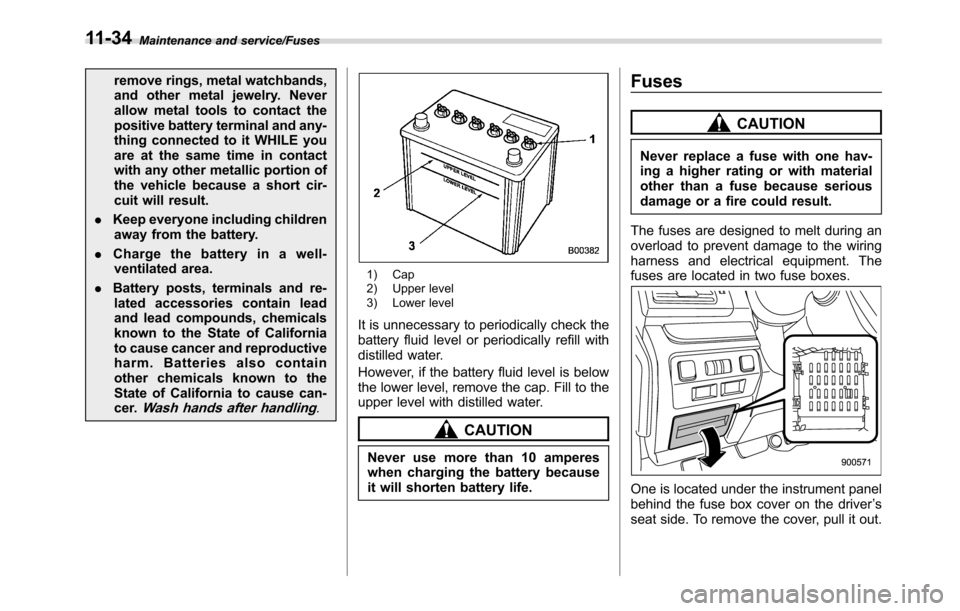
1) Cap
2) Upper level
3) Lower level
It is unnecessary to periodically check the
battery fluid level or periodically refill with
distilled water.
However, if the battery fluid level is below
the lower level, remove the cap. Fill to the
upper level with distilled water.
CAUTION
Never use more than 10 amperes
when charging the battery because
it will shorten battery life.
Fuses
CAUTION
Never replace a fuse with one hav-
ing a higher rating or with material
other than a fuse because serious
damage or a fire could result.
The fuses are designed to melt during an
overload to prevent damage to the wiring
harness and electrical equipment. The
fuses are located in two fuse boxes.
One is located under the instrument panel
behind the fuse box cover on the driver’s
seat side. To remove the cover, pull it out.
11-34
Page 513 of 572
1) Spare fuses
The other one (main fuse box) is housed
in the engine compartment. Also, the
spare fuses are stored in the fuse box
cover.
The fuse puller is stored in the main fusebox in the engine compartment.
1) Good
2) Blown
If any lights, accessories or other electrical
controls do not operate, inspect the
corresponding fuse. If a fuse has blown,
replace it.
1. Turn the ignition switch to the“LOCK”/
“OFF”position and turn off all electrical
accessories.
2. Remove the cover.
3. Determine which fuse may be blown.
Look at the back side of each fuse box
cover and refer to“Fuses and circuits”
F12-9.
4. Pull out the fuse with the fuse puller.
5. Inspect the fuse. If it has blown,
replace it with a spare fuse of the same
rating.
6. If the same fuse blows again, this
indicates that its system has a problem.
Contact your SUBARU dealer for repairs.
Maintenance and service/Fuses11-35
Page 523 of 572

Specifications..................................................... 12-2
Dimensions........................................................ 12-2
Engine............................................................... 12-3
Fuel................................................................... 12-3
Engine oil.......................................................... 12-4
Manual transmission, front differential and rear
differential gear oil........................................... 12-6
Fluids................................................................ 12-7
Engine coolant................................................... 12-7
Electrical system................................................ 12-7
Tires.................................................................. 12-8Brake disc......................................................... 12-8Fuses and circuits............................................. 12-9
Fuse panel located in the passenger
compartment................................................... 12-9
Fuse panel located in the engine
compartment................................................. 12-11
Bulb chart......................................................... 12-13Safety precautions........................................... 12-13
Bulb chart....................................................... 12-14
Vehicle identification....................................... 12-16
Specifications
12
Page 531 of 572
Fuses and circuits
&Fuse panel located in the passenger compartment
Fuse
panelFuse
ratingCircuit
1 20A
.Trailer hitch connector
2 15A—
3 15A
.Door locking
4 10A
.Front wiper deicer relay
5 10A
.Combination meter
.Clock
6 7.5A
.Remote control rear
view mirrors
.Seat heater relay
7 15A
.Combination meter
.Integrated unit
8 10A
.Stop light
9 15A
.Front wiper deicer
10 7.5A
.Power supply (battery)
11 7.5A
.Turn signal unit
12 15A
.Transmission control
unit
.Engine control unit
.Integrated unit
13 20A
.Accessory power outlet
(center console)
.AC110V (If installed)
14 15A
.Parking light
.Tail light
.Rear combination light Specifications/Fuses and circuits
–CONTINUED–
12-9