2017 SUBARU BRZ service
[x] Cancel search: servicePage 445 of 540

5
When trouble arises
443 5-2. Steps to take in an emergency
CAUTION
■Do not drive the vehicle with a flat tire.
Do not continue driving with a flat tire.
Driving even a short distance with a flat tire can damage the tire and the
wheel beyond repair.
■Be careful when driving over bumps with the compact spare tire
installed on the vehicle (vehicles with a compact spare tire).
The vehicle becomes lower when driving with the compact spare tire
compared to when driving with standard tires. Be careful when driving
over uneven road surfaces.
■Driving with tire chains and the compact spare tire (vehicles with a
compact spare tire)
Do not fit tire chains to the compact spare tire.
Tire chains may damage the vehicle body and adversely affect driving
performance.
■When replacing the tires (vehicles with a tire pressure monitoring
system)
When removing or fitting the wheels, tires or the tire pressure warning
valve and transmitter, contact your SUBARU dealer as the tire pressure
warning valve and transmitter may be damaged if not handled correctly.
■To avoid damage to the tire pressure warning valves and transmit-
ters (vehicles with a tire pressure monitoring system)
When a tire is repaired with liquid sealants, the tire pressure warning
valve and transmitter may not operate properly. If a liquid sealant is
used, contact your SUBARU dealer or other qualified service shop as
soon as possible. Make sure to replace the tire pressure warning valve
and transmitter when replacing the tire. (oP. 3 5 1 )
■Stowing the jack
When stowing the jack in the jack holder, make sure that the part that the
jack handle attaches to is pointing towards the inside of the trunk. Failure
to do so may damage the vehicle body.
Page 471 of 540
469 6-1. Specifications
6
Vehicle specifications
Oil viscosity (0W-20 is explained here as an example):
• The 0W in 0W-20 indicates the characteristic of the oil which allows
cold startability. Oils with a lower value before the W allow for easier
starting of the engine in cold weather.
• The 20 in 0W-20 indicates the viscosity characteristic of the oil when
the oil is at high temperature. An oil with a higher viscosity (one with a
higher value) may be better suited if the vehicle is operated at high
speeds, or under extreme load conditions.
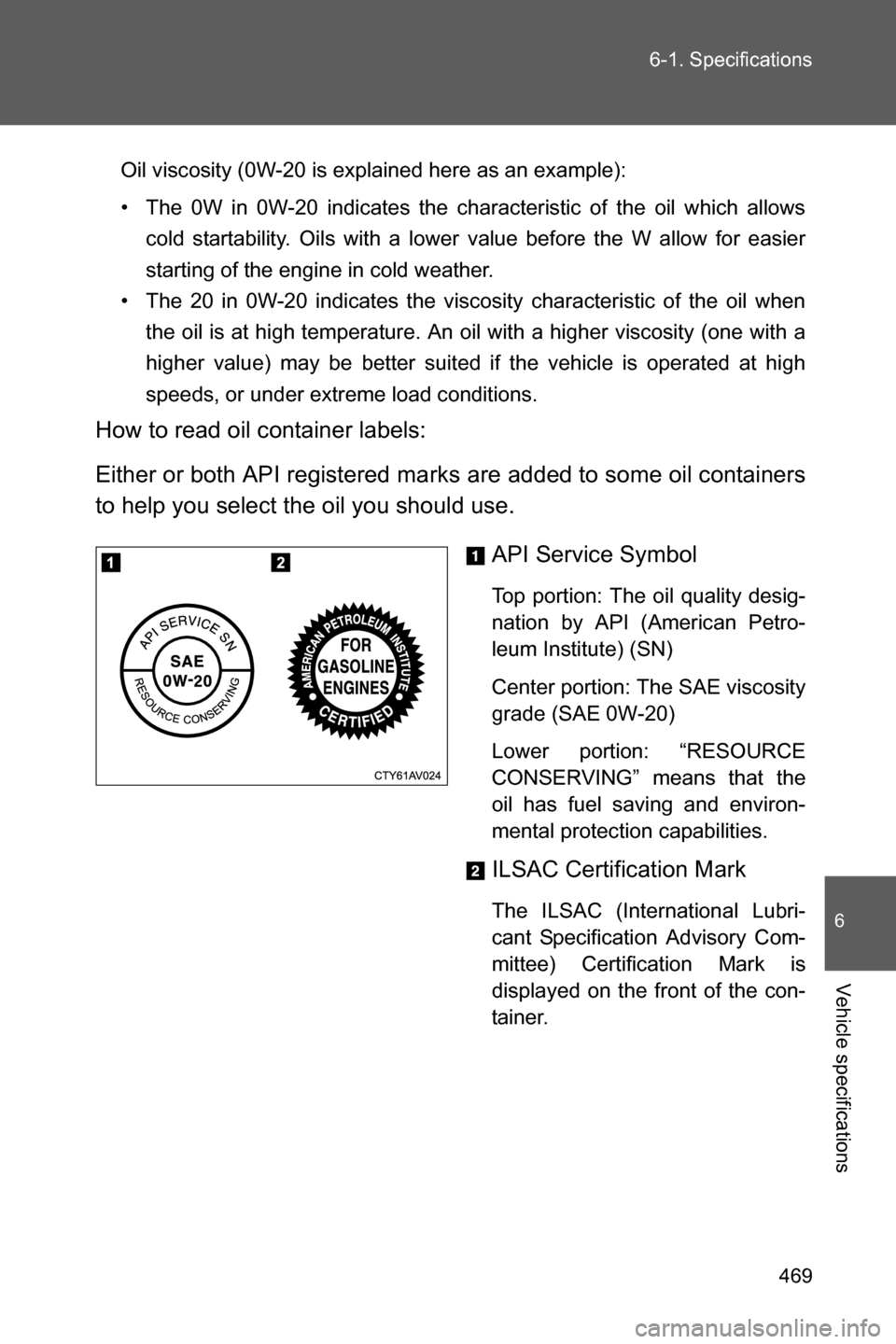
How to read oil container labels:
Either or both API registered marks are added to some oil containers
to help you select the oil you should use.
API Service Symbol
Top portion: The oil quality desig-
nation by API (American Petro-
leum Institute) (SN)
Center portion: The SAE viscosity
grade (SAE 0W-20)
Lower portion: “RESOURCE
CONSERVING” means that the
oil has fuel saving and environ-
mental protection capabilities.
ILSAC Certification Mark
The ILSAC (International Lubri-
cant Specification Advisory Com-
mittee) Certification Mark is
displayed on the front of the con-
tainer.
Page 479 of 540

477 6-1. Specifications
6
Vehicle specifications
■Gasoline for California-certified LEV
If your vehicle was certified to California’s low emission vehicle (LEV) stan-
dards as indicated on the underhood tune-up label, it is designed to optimize
engine and emission performance with gasoline that meets the clean burn-
ing low-sulfur California gasoline specifications. If you live in any other state
than California, your vehicle will operate on gasoline meeting Federal speci-
fications. Gasoline sold outside California is permitted to have higher sulfur
levels, which may affect the performance of your vehicle’s catalytic converter
and may produce a sulfur exhaust odor or smell. SUBARU recommends that
you try a different brand of unleaded gasoline having lower sulfur to deter-
mine if the problem is fuel related before returning your vehicle to an autho-
rized dealer for service.
■SUBARU recommends the use of gasoline containing detergent addi-
tives
●SUBARU recommends the use of gasoline that contains detergent addi-
tives to avoid build-up of engine deposits.
●All gasoline sold in the US contains detergent additives to clean and/or
keep clean intake systems.
■SUBARU recommends the use of cleaner burning gasoline
Cleaner burning gasoline, including reformulated gasoline that contains oxy-
genates such as ethanol or MTBE (Methyl Tertiary Butyl Ether) is available in
many areas.
SUBARU recommends the use of cleaner burning gasoline and appropri-
ately blended reformulated gasoline. These types of gasoline provide excel-
lent vehicle performance, reduce vehicle emissions and improve air quality.
Page 480 of 540
478 6-1. Specifications
■SUBARU does not recommend blended gasoline
●If you use gasohol in your SUBARU, be sure that it has an octane rating
no lower than 93 AKI (98 RON).
●SUBARU DOES NOT recommend the use of gasoline containing metha-
nol.
■SUBARU does not recommend gasoline containing MMT
Some gasoline contains octane enhancing additive called MMT (Methylcy-
clopentadienyl Manganese Tricarbonyl).
SUBARU DOES NOT recommend the use of gasoline that contains MMT. If
fuel containing MMT is used, your emission control system may be
adversely affected.
The malfunction indicator lamp on the instrument cluster may come on. If
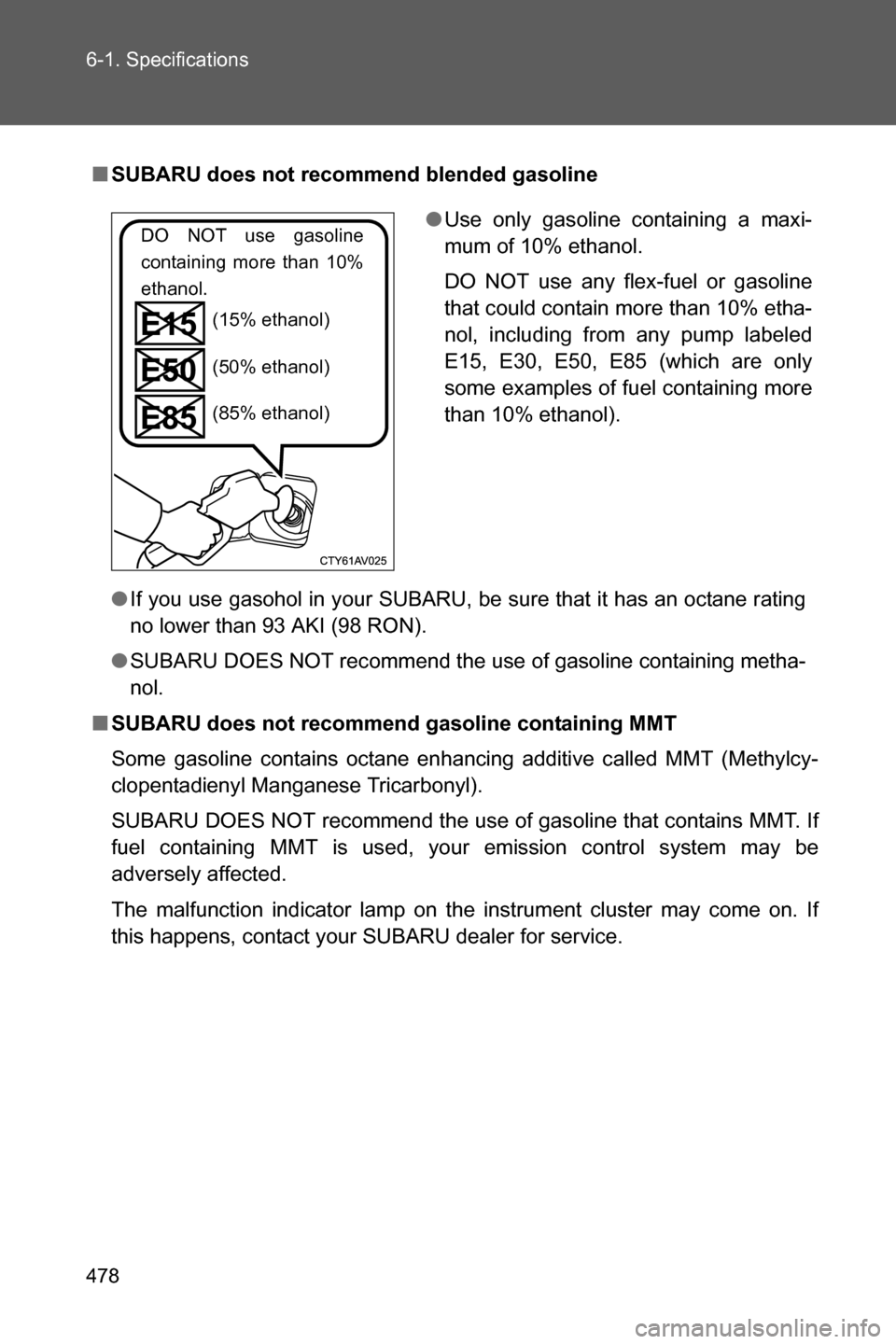
this happens, contact your SUBARU dealer for service.●Use only gasoline containing a maxi-
mum of 10% ethanol.
DO NOT use any flex-fuel or gasoline
that could contain more than 10% etha-
nol, including from any pump labeled
E15, E30, E50, E85 (which are only
some examples of fuel containing more
than 10% ethanol).
DO NOT use gasoline
containing more than 10%
ethanol.
(15% ethanol)
(50% ethanol)
(85% ethanol)
Page 487 of 540

485 6-1. Specifications
6
Vehicle specifications
■Treadwear
The treadwear grade is a comparative rating based on the wear
rate of the tire when tested under controlled conditions on a speci-
fied government test course.
For example, a tire graded 150 would wear one and a half (1 - 1/2)
times as well on the government course as a tire graded 100.
The relative performance of tires depends upon the actual conditions
of their use. Performance may differ significantly from the norm due
to variations in driving habits, service practices and differences in
road characteristics and climate.
■Traction AA, A, B, C
The traction grades, from highest to lowest, are AA, A, B and C,
and they represent the tire’s ability to stop on wet pavement as
measured under controlled conditions on specified government
test surfaces of asphalt and concrete.
A tire marked C may have poor traction performance.
Warning: The traction grade assigned to this tire is based on braking
(straight ahead) traction tests and does not include cornering (turn-
ing) traction.
■Temperature A, B, C
The temperature grades are A (the highest), B, and C, represent-
ing the tire’s resistance to the generation of heat and its ability to
dissipate heat when tested under controlled conditions on a speci-
fied indoor laboratory test wheel.
Sustained high temperature can cause the material of the tire to
degenerate and reduce tire life, and excessive temperature can lead
to sudden tire failure.
Grade C corresponds to a level of performance which all passenger
car tires must meet under the Federal Motor Vehicle Safety Standard
No. 109.
Grades B and A represent higher levels of performance on the labo-
ratory test wheel than the minimum required by law.
Page 532 of 540

530 Alphabetical index
Rear turn signal lights
Switch.................................... 191
Rear view camera..................... 242
Rear view mirror
Inside rear view mirror.............68
Outside rear view mirrors ........69
Rear window defogger ............ 292
Replacing
Fuses .................................... 372
Key battery ............................ 367
Light bulbs............................. 380
Tires ...................................... 431
Reporting safety defects
for U.S. owners ...................... 499
REV indicator ........................... 159
Seatbelts
Adjusting the seatbelt..............60
Automatic Locking
Retractor (ALR).....................62
Child restraint system
installation ........................... 143
Cleaning and maintaining
the seatbelts ....................... 319
Emergency Locking
Retractor (ELR).....................62
How to wear your seatbelt.......60
How your child should
wear the seatbelt ..................62
Pregnant women,
proper seatbelt use ...............64
Reminder light ....................... 406
Seatbelt guide .........................61
Seatbelt pretensioners ............ 61
Seat heaters..............................308
Seating capacity....................... 267Seats
Adjustment .............................. 53
Adjustment precautions .......... 54
Child seats/child restraint
system installation .............. 143
Cleaning................................ 318
Head restraint ......................... 58
Properly sitting in the seat....... 89
Seat heaters.......................... 308
Service reminder
indicators .............................. 198
Shift lever
Automatic transmission......... 181
If the select lever cannot
be shifted from P ................ 447
Manual transmission ............. 188
Shift lock system ..................... 447
Side airbags ............................... 91
Side maker lights
Replacing light bulbs............. 380
Switch ................................... 228
Wattage................................. 475
Side mirror
Adjusting and folding............... 69
Spare tire
Inflation pressure .................. 474
Storage location .................... 431
Spark plug ................................ 470
Specifications .......................... 464
Speedometer ............................ 194
Steering
Column lock release ............... 67
Steering wheel
Adjustment .............................. 67
Meter control switches .......... 214
Storage feature ........................ 298
Stuck
If your vehicle becomes
stuck ................................... 461
Sun visors ................................ 303
S