Page 343 of 540
341 4-3. Do-it-yourself maintenance
4
Maintenance and care
■Coolant selection
Only use SUBARU Super Coolant or similar high-quality ethylene glycol-
based non-silicate, non-amine, non-nitrite, and non-borate coolant with long-
life hybrid organic acid technology.
SUBARU Super Coolant is a mixture of 50% coolant and 50% deionized
water. (Enabled: -31qF [-35qC])
For more details about engine coolant, contact your SUBARU dealer.
WARNING
■When the engine is hot
Do not remove the radiator cap.
The cooling system may be under pressure and may spray hot coolant if the
cap is removed, causing serious injuries, such as burns.
CAUTION
■When adding engine coolant
Coolant is neither plain water nor straight antifreeze. The correct mixture of
water and antifreeze must be used to provide proper lubrication, corrosion
protection and cooling. Be sure to read the antifreeze or coolant label.
■If you spill coolant
Be sure to wash it off with water to prevent it damaging parts or paint.
Page 344 of 540
342 4-3. Do-it-yourself maintenance
Radiator and condenser
Check the radiator and condenser and clear away any foreign
objects.
If either of the above parts are extremely dirty or you are not sure of
their condition, have your vehicle checked by your SUBARU dealer.
Brake fluid
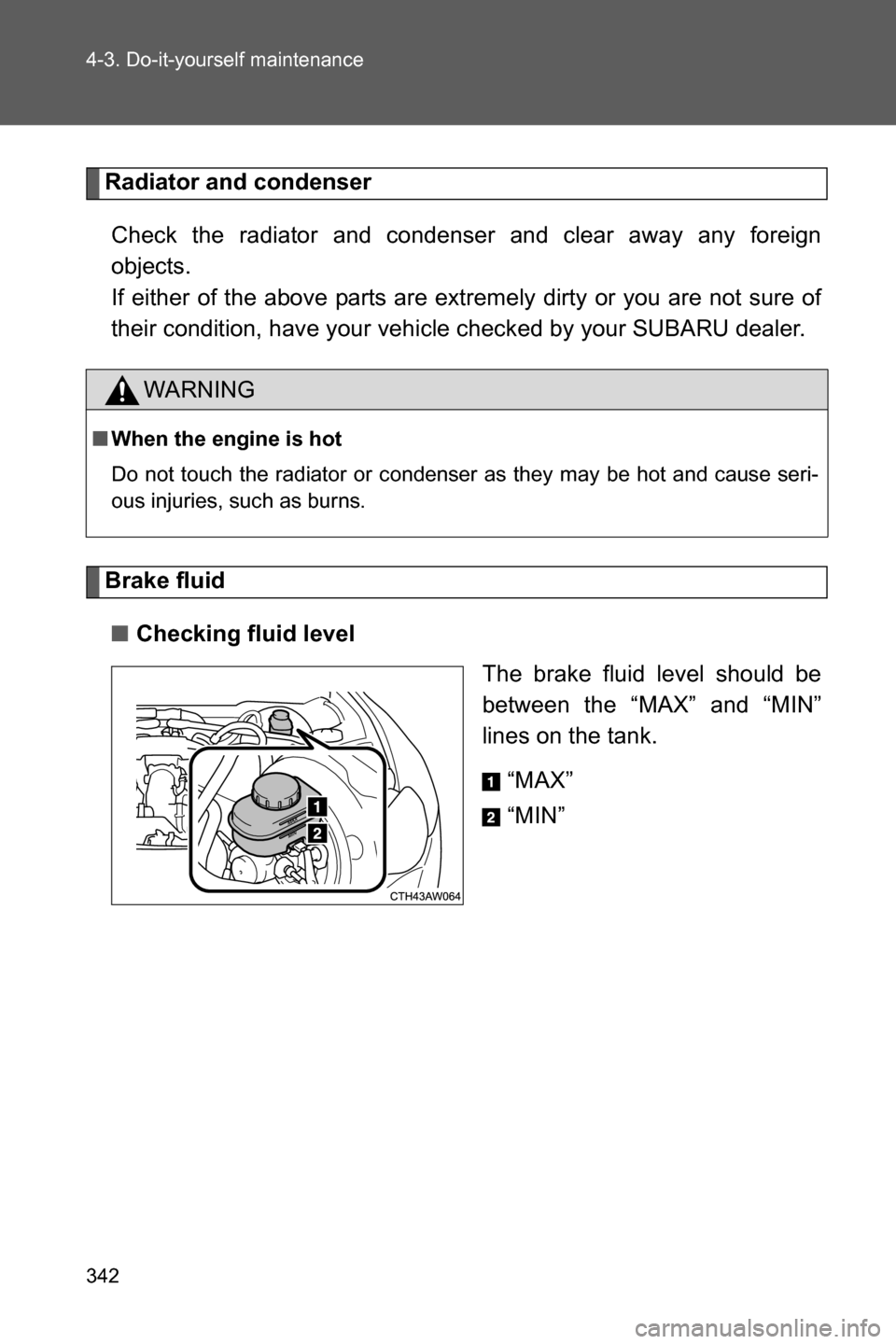
■Checking fluid level
The brake fluid level should be
between the “MAX” and “MIN”
lines on the tank.
“MAX”
“MIN”
WARNING
■When the engine is hot
Do not touch the radiator or condenser as they may be hot and cause seri-
ous injuries, such as burns.
Page 348 of 540

346 4-3. Do-it-yourself maintenance
■Before recharging
When recharging, the battery produces hydrogen gas which is flammable
and explosive. Therefore, before recharging:
●If recharging with the battery installed on the vehicle, be sure to discon-
nect the ground cable.
●Make sure the power switch on the charger is off when connecting and
disconnecting the charger cables to the battery.
■After recharging/reconnecting the battery (vehicles with a keyless
access with push button start system)
●Unlocking the doors using the keyless access with push button start sys-
tem may not be possible immediately after reconnecting the battery. If
this happens, use the remote keyless entry system or the mechanical
key to lock/unlock the doors.
●Start the engine with the push-button ignition switch in “ACC” mode. The
engine may not start with the push-button ignition switch turned off. How-
ever, the engine will operate normally from the second attempt.
●The push-button ignition switch mode is recorded by the vehicle. If the
battery is reconnected, the vehicle will return the push-button ignition
switch mode to the status it was in before the battery was disconnected.
Make sure to turn off the engine before disconnect the battery. Take extra
care when connecting the battery if the push-button ignition switch mode
prior to discharge is unknown.
If the engine will not start even after multiple attempts, contact your
SUBARU dealer.
Page 350 of 540
348 4-3. Do-it-yourself maintenance
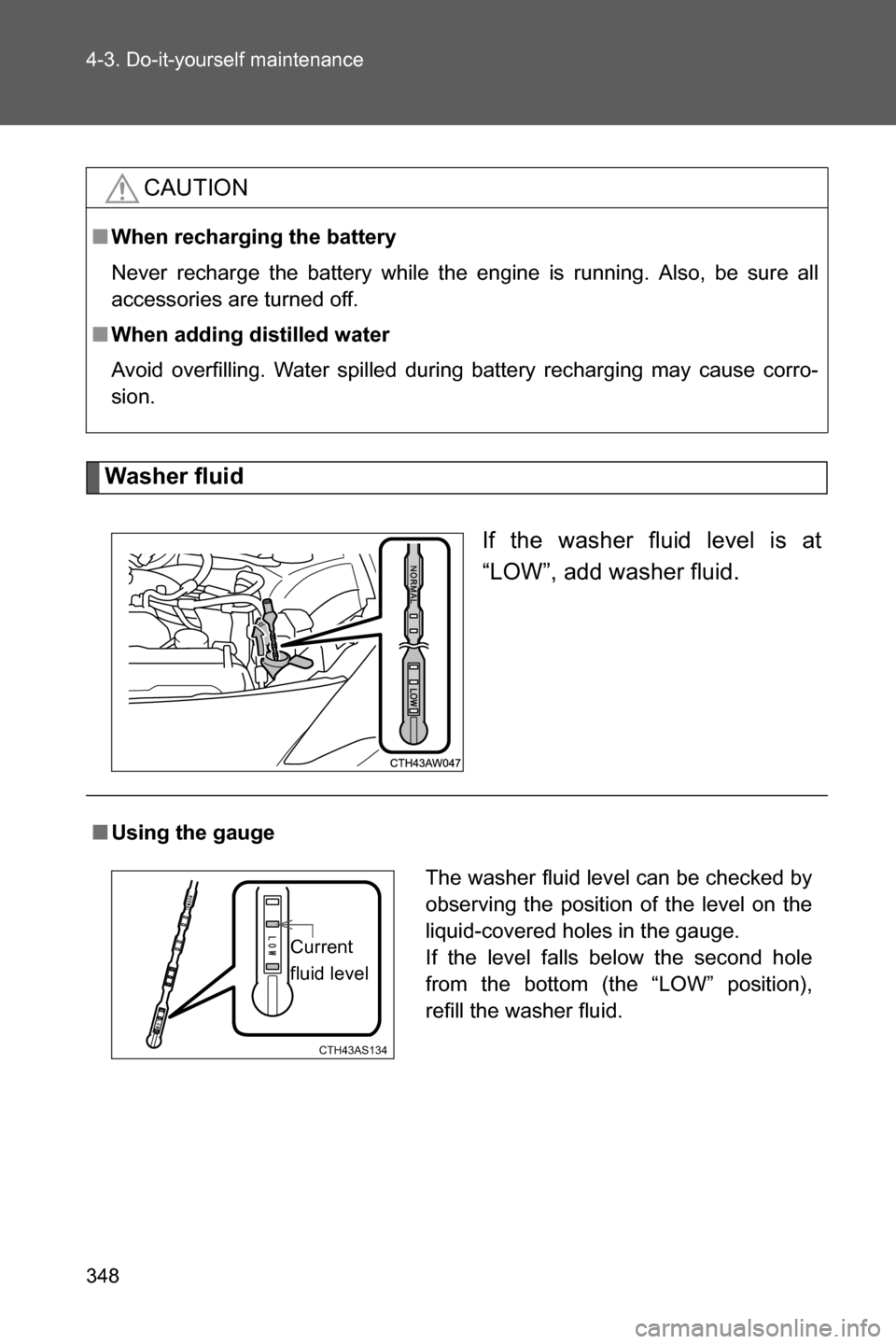
Washer fluid
If the washer fluid level is at
“LOW”, add washer fluid.
CAUTION
■When recharging the battery
Never recharge the battery while the engine is running. Also, be sure all
accessories are turned off.
■When adding distilled water
Avoid overfilling. Water spilled during battery recharging may cause corro-
sion.
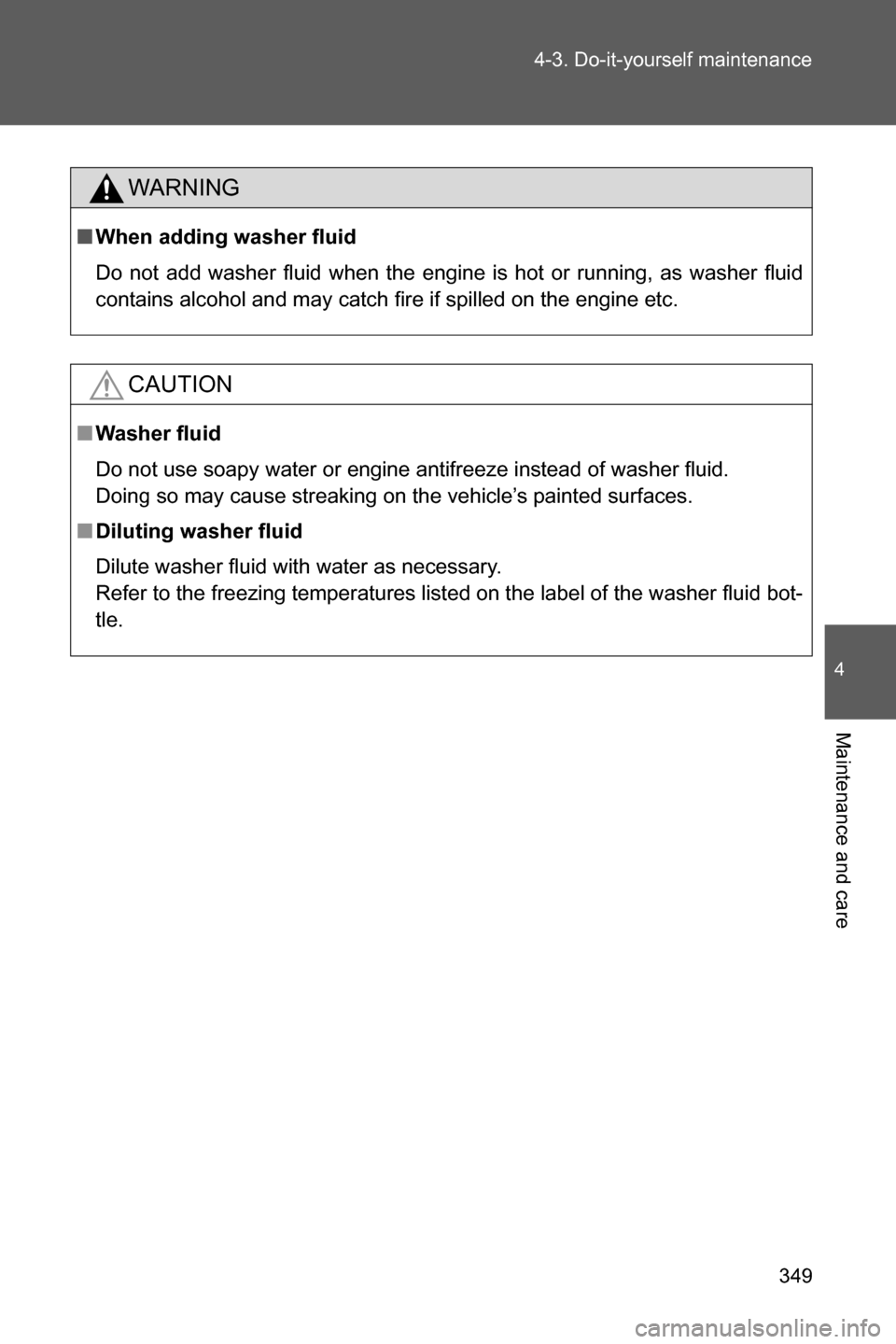
■Using the gauge
The washer fluid level can be checked by
observing the position of the level on the
liquid-covered holes in the gauge.
If the level falls below the second hole
from the bottom (the “LOW” position),
refill the washer fluid.
CTH43AS134
Current
fluid level
Page 351 of 540
349 4-3. Do-it-yourself maintenance
4
Maintenance and care
WARNING
■When adding washer fluid
Do not add washer fluid when the engine is hot or running, as washer fluid
contains alcohol and may catch fire if spilled on the engine etc.
CAUTION
■Washer fluid
Do not use soapy water or engine antifreeze instead of washer fluid.
Doing so may cause streaking on the vehicle’s painted surfaces.
■Diluting washer fluid
Dilute washer fluid with water as necessary.
Refer to the freezing temperatures listed on the label of the washer fluid bot-
tle.
Page 366 of 540
364
4-3. Do-it-yourself maintenance
Air conditioning filter
The air conditioning filter must be changed regularly to maintain air
conditioning efficiency.
■Removal method
Vehicles without a keyless access with push button
start system
Turn the engine switch off.
Vehicles with a keyless access with push button start
system
Turn the push-button ignition switch off.
Open the glove box. Slide off
the damper.
Push in each side of the glove
box and pull the glove box
toward you to disconnect the
claws.
STEP 1
STEP 2
STEP 3
Page 374 of 540
372
4-3. Do-it-yourself maintenance
Checking and replacing fuses
If any of the electrical components do not operate, a fuse may have
blown. If this happens, check and replace the fuses as necessary.
Vehicles without a keyless access with push button
start system
Turn the engine switch off.
Vehicles with a keyless access with push button start
system
Turn the push-button ignition switch off.
Open the fuse box cover.
Engine compartment
Push the tabs in and lift the lid
off.
Instrument panel
Remove the lid.STEP 1
STEP 2
Page 377 of 540
375 4-3. Do-it-yourself maintenance
4
Maintenance and care
Fuse layout and amperage ratings
■Engine compartment
FuseAmpereCircuit
1MIR HTR 7.5 A Outside rear view mirror defoggers
2RDI 25 A Electric cooling fan
3(PUSH-AT) 7.5 A Engine control unit
4ABS NO. 1 40 A ABS
5HEATER 50 A Air conditioning system
6WASHER 10 A Windshield washer
7WIPER 30 A Windshield wipers
8RR DEF 30 A Rear window defogger
9(RR FOG) 10 A
10D FR DOOR 25 A Power window (driver’s side)
11(CDS) 25 A Electric cooling fan
12D-OP 25 A
13ABS NO. 2 25 A ABS
14D FL DOOR 25 A Power window (passenger’s side)
15SPARE See note. Spare fuse