2017 SKODA YETI seats
[x] Cancel search: seatsPage 71 of 200

Adjusting the tilt of the backrest (do not lean on the backrest when ad-
justing)
Setting the extent of the curvature of the lumbar support
Note
After a certain time, play can develop within the adjustment mechanism of the
backrest angle.
Electrical adjustment
Fig. 56
Control elements on the seat
Read and observe
on page 68 first.
The seats can be adjusted by the respective operating element being pressed in the direction of area of the arrow » Fig. 56.
seat adjustment
▶ 1 - Move in the longitudinal direction
▶ 2 - Change in inclination
▶ 3 - Change in height
Adjusting the seat backrest
▶ 4 - Change in inclination
Adjusting lumbar support
▶ 5 - Change curvature
▶ 6 - The degree of curvature change
WARNINGThe electric front seat adjustment is functional even with the ignition off.
Therefore, when leaving the vehicle, never leave people who are not com-
pletely independent, such as children, unattended in the vehicle - there is a
risk of injury!CDABCNoteIf the inclination angle of the seat backrest relative to the seat surface is
greater than 102 °, then it is not possible for safety reasons to save this setting
in the memory of the electrically adjustable seats or the remote control key.
Memory Function of the electrically adjustable seat
Fig. 57
SET button and memory buttons
Read and observe on page 68 first.
Among the memory buttons
B
on the driver's seat, a setting for the driver´s
seat and exterior mirror position can be saved » Fig. 57.
Storing driver's seat and exterior mirror settings for the forwards drive
›
Switch on the ignition, adjust the seat and the exterior mirrors.
›
Hold down the
A
» Fig. 57 button and within 10 seconds press the de-
sired memory button
B
at the same time. Storing is confirmed by an acous-
tic signal.
Storing front passenger´s exterior mirror settings for reversing
Above the MAXI DOT display in the
Mirror down
menu item, the lowering func-
tion for the mirror on the passenger side must be enabled for reversing
» page 43 , Menu item
Settings
.
›
Turn on the ignition and press the desired memory button
B
» Fig. 57 .
›
Turn the rotary knob for the exterior mirror control to the position for the
front passenger mirror area » page 67.
›
Engage reverse gear.
›
Adjust the front passenger's mirror to the desired position.
›
Disengage reverse gear. The set position of the exterior mirror is stored.
69Seats and head restraints
Page 73 of 200

WARNING (Continued)■Do not adjust the seat back while driving - There is a risk of injury and ac-
cidents!■
When moving the seat backrest, keep limbs out of the area between the
seat and seat backrest – risk of injury!
■
Never transport the following items on the seat backrest when folded
forwards. ■ Objects that could restrict the driver's view.
■ Objects which make it impossible for the driver to control the vehicle
(e.g. if they roll under the pedals, or protrude into the driver's zone).
■ Objects which could lead to injury to passengers (e.g. if accelerating
sharply, braking or changing direction).
Armrest setting
Fig. 59
Adjust armrest
Read and observe on page 68 first.
›
To adjust the height , lift the armrest in the direction of the arrow
A
into one
of the six locking positions » Fig. 59.
›
To close , lift the armrest in the direction of arrow
A
until the stop and then
fold down again.
›
To longitudinally adjust move the armrest in the direction of arrow
B
to the
desired position.
Rear seats
Introduction
This chapter contains information on the following subjects:
Adjusting seats in forward/back direction
71
Adjusting the angle of the seat backrest
71Folding the seat backrest forwards and folding the seat fully forwards72Unlock and removing the seat72
Adjusting seats in crosswise direction
73
Folding back seats
73
Adjusting seats in forward/back direction
Fig. 60
Adjusting seats in forward/back
direction
›
Pull lever
A
in the direction of arrow
1
and move the seat to the desired po-
sition in the direction of arrow
2
» Fig. 60 .
Adjusting the angle of the seat backrest
Fig. 61
Adjusting the seat backrest
›
Pull lever
A
lever on the bottom in the direction of the arrow
1
pull and set
the desired tilt of the seat back in the direction of arrow
2
» Fig. 61 .
›
Check for yourself that the seat backrest is engaged by pulling on it.
71Seats and head restraints
Page 74 of 200

Folding the seat backrest forwards and folding the seat fullyforwardsFig. 62
Safety position of seat belt / folding the seat completely forward
Fig. 63
Lock forward folded seats
Folding the seat backrest forwards
›
Insert the belt buckle
A
of the seat belt into the opening in the side pan-
el » Fig. 62 .
›
Remove the head restraint from the rear middle seat.
›
Push the outer rear seats towards the rear as far as they will go » Fig. 60 on
page 71 .
›
Fold the outer rear seat backrests and the center seat to the stop on the
seat surface » Fig. 61 on page 71 .
›
Then pull the lever
A
» Fig. 61 on page 71 again and push the seat back
down until it clicks into place in a lower position.
Folding seats fully forwards and locking them
›
If the outer rear seat is fully folded forward, push it towards the rear as far as
it can go.
›
Pull the lever
B
» Fig. 62 in the direction of the arrow
1
and push the seat
completely forward in the direction of arrow
2
.
› Secure the folded forward seat with the aid of the fixing belt B to a guide rod
of the head restraint in the front seat » Fig. 63.WARNING■
The seat backs in occupied rear seats must be properly engaged.■When transporting objects in the luggage compartment that has been en-
larged by folding the backrest forward, ensure the safety of the passengers
transported on the other rear seats.■
The seat backrests must be securely locked in position so that no objects
in the luggage compartment can slide into the passenger compartment on
sudden braking – There is a risk of injury.
CAUTION
When moving the seat backrest, the seat belts should not be trapped - there is
a risk of damage to the seat belts.
CAUTION
■ Before folding the rear middle seat forward, make sure that the storage com-
partment, the ashtray and the cup holder in the rear part of the centre console
are closed - risk of damage.■
Only keep the seats in the folded forward position for as long as necessary to
transport cargo - there is a risk of damaging the front seat backrests. The
seats must be folded back once the cargo has been transported.
■
If the outer seat is not in the rear end position when folding forward, damage
can occur to the locking bolts when unlocking the seat.
Unlock and removing the seat
Fig. 64
Unlocking the folded forward
seat and carrying handles on the
seat surface
›
Unlock the folded seat by pressing seat locks » Fig. 62 on page 72
A
in the
direction of arrow » Fig. 64.
›
Remove the seat on the carrying handle
B
or
C
.
72Using the system
Page 75 of 200

NoteThe outer seats are not mutually interchangeable. In the rear area the left seat
is marked with the letter L and the right seat with the letter R.
Adjusting seats in crosswise direction
Fig. 65
Locking seats
›
Remove the middle seat » Fig. 64 on page 72 .
›
Fold the outer seat forwards and unlock » Fig. 64 on page 72 .
›
Move outer seat on the guide towards the middle of the vehicle up to the
stop.
›
Lock the folded forward seat by pressing the seat locks
A
in the direction of
arrow » Fig. 65 .
Folding back into the starting position is accomplished in the reverse order.
Folding back seats
Fig. 66
Folding the seat backrest back
into position
›
If the seat has been removed, first position it on the guide and lock it in place
using seat locking
A
» Fig. 65 on page 73 . Pull the seat upwards to ensure
that the seat is locked correctly.
›
Fold the seat in the horizontal position until it audibly click in place. Check
that the seat can no longer be lifted by pulling it up.
› Press the lever in direction of arrow 1
» Fig. 66 and fold back the seat back-
rest in the direction of arrow 2. Check this by pulling on the seat backrest.
Headrests
Introduction
This chapter contains information on the following subjects:
Setting the height
73
Removing/installing
74
Note
The middle rear head restraint is only adjustable in two positions.
Setting the height
Fig. 67
Setting the height of the headrest
›
Grasp the restraint and move upwards in the direction of
1
» Fig. 67 .
›
To move the headrest down, press the securing button
A
in the direction of
arrow
2
and hold it down while pressing the headrest in the direction of ar-
row
3
.
73Seats and head restraints
Page 76 of 200

Removing/installingFig. 68
Removing/installing the headrest
›
To remove the headrest, pull it out of the seat backrest up to the latch.
›
Press locking button
A
in the direction of arrow
1,
and pull out the head re-
straint in the direction of arrow
2
» Fig. 68 .
›
To insert the headrest, push the headrest into the seat backrest in the direc-
tion of arrow
3
until the locking button clicks into place.
Front seat heating
Fig. 69
Buttons for heating the front
seats
The seat backrests and seats can be heated electrically.
Seat heating buttons » Fig. 69
Left seat heating
Right seat heating
›
To turn on the heating with maximum heat , press the key
or
button.
By repeatedly pressing the button, the heat is turned down until it is com-
pletely switched off . The level of the seat heating is indicated by the number
of illuminated warning lights in the switch.
The seat heating only operates when the engine is running.WARNINGIf you are sensitive to pain and/or temperature, e.g. through medication,
paralysis or because of chronic illness (e.g. diabetes), we recommend not to
use the seat heating. If the seat heating is used, we recommend to make
regular breaks in your journey when driving long distances, so that the
body can recuperate from the stress of the journey. Please consult your
doctor, who can evaluate your specific condition.
CAUTION
The following instructions should be observed to avoid damage to the seats.■Do not kneel on the seats or otherwise apply concentrated pressure to them.■
Do not switch on the heating for unoccupied seats.
■
Do not switch on the heating for seats which have objects on them (e.g. a
child seat, bag or similar).
■
Do not switch on the heating for seats which have seat covers or protective
covers on them.
Note
If the on-board voltage decreases, the seat heating switches off automatically
» page 147 , Automatic shutdown of consumers - vehicle battery discharge
protection .74Using the system
Page 77 of 200
Useful features
Interior fittings
Introduction
This chapter contains information on the following subjects:
Ticket holder
75
Storage compartment on the dash panel
76
stowage compartments in the doors
76
Storage compartment in the front centre console
76
USB and AUX input
77
Cup holders
77
Cigarette lighter
78
Ashtray
78
12-volt socket
79
Waste container
80
Multimedia holder
80
Storage compartment under the front arm rest
81
storage net in the front centre console
81
Glasses compartment
81
Storage compartment on the front passenger side
82
Storage compartment for umbrella
82
Clothes hook
82
Storage pockets on the backs of the front seats
83
Storage compartment in the rear centre console
83
Folding table on the front seat backrest
83
Folding table on the middle seat backrest
84
Removable through-loading bag
84WARNING■ Do not place anything on the dashboard. These objects might slide or fall
down when driving and may distract you from concentrating on the traffic –
risk of accident!■
Make sure that while driving no objects can enter the driver's footwell -
There is a risk of an accident!
WARNING (Continued)■ Do not carry any objects on the front passenger seat except objects de-
signed for this purpose (e.g. child seats) – risk of accident!■
No objects should be placed in the storage compartments nor in the
drinks holders; the vehicle occupants could be endangered if there is sud-
den braking or the vehicle collides with something.
■
For safety reasons, lockable storage compartments should be closed
while driving - there is a risk of injury from the opened lid or through the
loose objects in the compartment.
■
Make sure no objects protrude from the storage compartments - There is
a risk of injury!
■
Do not exceed the permissible loads for the storage compartments, pock-
ets and nets - There is a risk of injury and a risk of damage to the compart-
ments, pockets and nets!
■
Ash, cigarettes, cigars and the like should only be stored in the ashtray -
There is a risk of fire/burns!
■
The storage compartments, multimedia holder and waste container are
not a substitute for the ashtray and must not be used for such purposes –
There is a risk of fire!
CAUTION
Do not place any large or sharp objects in the storage compartments, pockets
and nets -There is a risk of damage to the compartments, pockets and nets.
Ticket holder
Fig. 70
Ticket holder
Read and observe and on page 75 first.
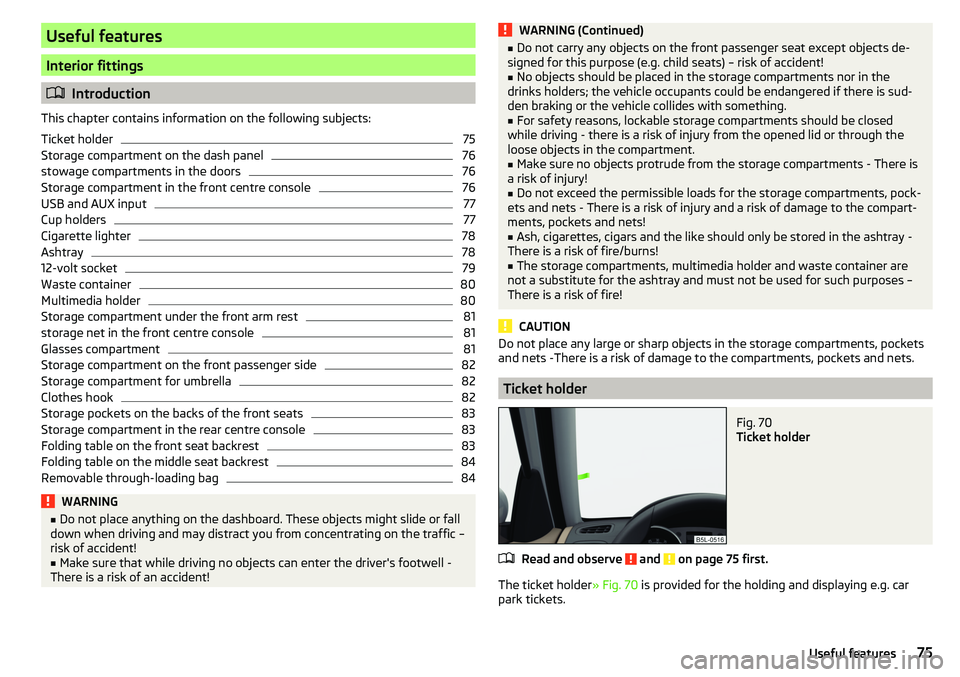
The ticket holder » Fig. 70 is provided for the holding and displaying e.g. car
park tickets.
75Useful features
Page 85 of 200

WARNING■Never leave any heavy or sharp-edged objects in the pockets of the items
of clothing hung up - There is a risk of injury.■
Do not use hangers to hang up the clothes - there is a risk of restricting
the effectiveness of head airbags and a danger of injury from the hanger.
■
Make sure that any clothes hanging from the hooks do not impede your
vision.
Storage pockets on the backs of the front seats
Fig. 91
Map pockets
Read and observe and on page 75 first.
The storage pockets » Fig. 91 are intended for the storage of maps, magazines,
etc.
Storage compartment in the rear centre console
Fig. 92
Opening the storage compart-
ment
Read and observe and on page 75 first.
›
To open Pull the top edge and open the compartment in the arrow direc-
tion » Fig. 92 .
›To
close , swivel the compartment against the direction of the arrow.
CAUTION
Before folding forward the rear centre seat, the storage compartment must be
closed - there is a risk of damage to the storage compartment.
Folding table on the front seat backrest
Fig. 93
Fold down the folding table
Read and observe and on page 75 first.
›
To Unfold Raise the table in the direction of the arrow in the horizontal posi-
tion » Fig. 93 .
›
Fold the table back into the vertical position by push the table away from the
arrow.
The maximum permissible load for the table is 10 kg.
WARNING■ The table must not be in the horizontal position while driving - risk of in-
jury.■
Do not use any cups or beakers which are made of brittle material (e.g.
glass, porcelain). This could lead to injuries in the event of an accident.
■
Never put hot beverage containers in the table cup holder. If the vehicle
moves, they may spill – There is a risk of scalding!
83Useful features
Page 88 of 200

Transport of cargo
Luggage Storage and Transport
Introduction
This chapter contains information on the following subjects:
Fastening elements
87
Fixing nets
87
Multifunction pocket
87
Fastening bar with sliding hook
88
Flexible storage compartment
88
Floor covering on both sides
88
Luggage compartment cover
89
Net partition
89
Storage compartments
90
Removable storage box
90
Removable lamp
90
Class N1 vehicles
91
When transporting heavy objects, the driving characteristics change due to the
shift in the centre of gravity. The speed and style of driving must be adjusted
accordingly.
When transporting cargo, the following instructions must be adhered to ▶ Distribute the load evenly in the luggage compartment and secure it with
suitable lashing straps to the lashing eyes or fixing nets so that they cannot
slip.
▶ Place heavy objects as far forward as possible.
▶ Tyre pressure should be adjusted for the load.
In the event of an accident, even small and light objects gain so much kinetic
energy that they can cause severe injuries.
The magnitude of the kinetic energy is dependent on the speed at which the
vehicle is travelling and the weight of the object.
WARNING■ Never exceed the maximum permissible load of the respective fasteners,
nets, hooks etc. If heavy objects have not been suitably secured, there is a
risk of injury!■
Do not exceed the permissible axle loads and permissible gross weight of
the vehicle – There is a risk of an accident!
■
An unsecured dirt or improperly attached load could slip during a sudden
manoeuvre or in an accident - There is a risk of injury!
■
Loose cargo could hit a deployed airbag and injure occupants – danger of
death!
■
When transporting loads in the luggage compartment that has been en-
larged by folding one of the rear seats forward, care should be taken to en-
sure the safety of passengers transported on the other rear seat.
CAUTION
■ Never exceed the maximum permissible load of the respective fasteners,
nets, hooks, etc. - these could be damaged.■
Please ensure that the heating elements for the rear window heater are not
damaged as a result of abrasive objects.
■
Do not place sharp objects in the nets and storage compartments in the lug-
gage compartment - there is a risk of damage to the net as well as the com-
partments.
■
Put the items in the storage compartments carefully and do not put point-
shaped objects - there is a risk of damage to the compartments.
86Using the system