2017 Seat Toledo height
[x] Cancel search: heightPage 76 of 248

Safety
Follow the manufacturer's instructions and
o b
ser
ve any statutory requirements when in-
stalling and using child seats. Always read
and note ››› page 74.
We recommend you always carry the manu-
facturer's Child Seat Instruction Manual to-
gether with the on-board documentation.
Important information regarding the
front p
assenger's airbag Read the additional information carefully
› ›
›
page 16.
Read and always observe the safety informa-
tion included in the following chapters:
● Safety distance with respect to the passen-
ger airbag ›
›› page 67, Why is it so important
to wear a seat belt and to sit correctly? .
● Objects between the passenger and the
pas
senger side airbag ››› in Front airbags
on p ag
e 70
.
The passenger side front airbag, when ena-
bled, is a serious risk for a child that is facing
backward since the airbag can strike the seat
with such force that it can cause serious or
fatal injuries. Children up to 12 years old
should always travel on the rear seat.
Therefore we strongly recommend you to
transport children on the rear seats. This is
the safest location in the vehicle. Alternative- ly, the front passenger airbag can be disa-
bled w
ith a key-operated switch ››› page 72.
When transporting children, use a child seat
suitable for the age and size of each child
››› page 73. WARNING
● If a c hi
ld seat is secured to the front pas-
senger seat, the risk to the child of sustain-
ing critical or fatal injuries in the event of an
accident increases.
● An inflating front passenger airbag can
strike the r
ear-facing child seat and project it
with great force against the door, the roof or
the backrest.
● Never install a child seat facing backwards
on the front p
assenger seat unless the front
passenger front airbag has been disabled.
Risk of potentially fatal injuries to the child!
However, if it is necessary, in exceptional ca-
ses, to transport a child in the front passen-
ger seat, the front passenger front airbag
must always be disabled ››› page 72. If the
front passenger seat has a height adjustment
option, move it to the highest position.
● For those vehicles that do not include a key
lock sw
itch to deactivate the airbag, the vehi-
cle must be taken to a technical service.
● All vehicle occupants, especially children,
must
assume the proper sitting position and
be properly belted in while travelling.
● Never hold children or babies on your lap,
this c
an result in potentially fatal injuries to
the child! ●
Never a l
low a child to be transported in a
vehicle without being properly secured, or to
stand up or kneel on a seat while travelling.
In an accident, the child could be flung
through the vehicle, causing possibly fatal in-
juries to themselves and to the other vehicle
occupants.
● If children assume an improper sitting posi-
tion when the vehic
le is moving, they expose
themselves to greater risk of injury in the
event of a sudden braking manoeuvre or in an
accident. This is particularly important if the
child is travelling on the front passenger seat
and the airbag system is triggered in an acci-
dent; as this could cause serious injury or
even death.
● A suitable child seat can protect your child!
● Never leave a child alone in the child seat
or inside the
vehicle because depending on
the season, very high temperatures may be
reached inside a parked vehicle, which could
be fatal.
● Children who are less than 1.5 metres tall
must
not wear a normal seat belt without a
child seat, as this could cause injuries to the
abdominal and neck areas during a sudden
braking manoeuvre or in an accident.
● Only one child may occupy a child seat
›››
page 75, Child seats. 74
Page 134 of 248

Operation
Head restraints Fig. 143
Front head restraint: adjust or re-
mo v
e. Fig. 144
Rear centre head restraint: release
point . Read the additional information carefully
› ›
›
page 12
Head restraints cannot be moved up or down
or removed on sports seats. Fitting and removing head restraints on front
seats
– P
ush the head restraint up as far as it will
go.
– Pr
ess catch 1
› ››
Fig. 143
and r
emove the
head restraint.
– To refit, insert the head restraint into the
hole
s in the backrest, pushing it down until
it engages.
Fitting and removing head restraints on rear
seats
To remove the head restraint, the correspond-
ing backrest must be partially folded forward.
– Unlock the backrest ›››
page 134
– Move the head restraint upwards until it ar-
rives
to the top.
– Press button 1
› ›
› Fig. 144
, while simulta-
neously pressing on the security hole 2 ›››
Fig. 144 with a fl at
screwdriver a maxi-
mum of 5 mm wide, and remove the head
restraint.
– To refit, insert the head restraint into the
hol e
s in the backrest, pushing it down until
it engages.
For maximum head restraint protection, ad-
just the head restraint so that its upper edge
is at the same level as the top of your head. The head restraint must be adjusted in line
with the height of
users. Correct adjustment
of the head restraint, together with the seat
belts, ensure effective passenger protection
››› page 57. WARNING
● Ba dly
adjusted head restraints increase the
risk of injuries in the event of an accident.
● Never drive with the head restraints re-
moved. Ri
sk of injuries!
● If the seats are in use, never drive with the
rear he
ad restraints in their out-of-use posi-
tion. Seat functions
He at
ed fr
ont seats* Fig. 145
Heated front seats.132
Page 135 of 248

Seats and head restraints
The cushion and backrest of the front seats
c an be he
at
ed electrically.
Press the or button ››› Fig. 145 to switch
on and adjust the heated front seats.
Press once to connect the heating at maxi-
mum force.
Press the button again to reduce the force of
the heating and switch it off. The force is indi-
cated by the number of warning lamps lit on
the button. WARNING
Do not use the heated seat if your perception
of p ain and/or t
emperature or that of your
passenger is limited, e.g. due to medication,
paralysis or chronic illness (e.g. diabetes). It
could cause burns on the back, buttocks and
legs that are difficult to heal. If you still want
to use the heated seat, take frequent breaks
on long journeys so that the body can recover
from the trip. Ask your doctor about your par-
ticular situation. CAUTION
● To av oid d
amaging the heating elements,
do not kneel on the seat or apply sharp pres-
sure at a single point to the seat cushion or
backrest.
● Do not use the heated seats if nobody is
sitting on them or if
there are items attached
to or lying on them, such as a child seat or a bag, etc. This could lead to a fault in the seat
heatin
g el
ements.
● Do not clean the seats with anything damp
›››
page 200. Note
● On ly c
onnect the heated seats when the
engine is running. This provides considerable
savings on the battery capacity.
● In the event of a drop in voltage in the on-
board sy
stems, the heated seats switch off
automatically to ensure enough power to con-
trol the engine ››› page 216, Automatic dis-
connection of electrical equipment . Armrest on front seats with inner stor-
ag
e* Fig. 146
Armrest/Opening and closing the
s t
or
age compartment. Adjusting armrest height
– Lift the armrest as far as it will go and then
fo l
d it downward. »
133
Technical data
Advice
Operation
Emergencies
Safety
Page 146 of 248

Operation
Rear shelf Fig. 166
Remove the shelf. Fig. 167
Remove the shelf. The shelf can be removed if a large load is to
be tr
an
s
ported.
Removing the shelf
– Remove the straps from the shelf 1›››
Fig. 166. –
Remo
v
e the shelf from its housing 2 by
knoc k
in
g it gently from underneath be-
tween the supports.
Fitting the shelf – Place the shelf on the side supports on the
trim.
– Adjust the shelf supports 3
› ››
Fig. 167
t
o
fit the supports 2 in the trim.
– Fit into place by knocking the top of the
shelf g
ently
between the supports.
– Attach the straps 1 to the tray.
WARNING
Do not place objects on the rear shelf that
cou l
d endanger the vehicle occupants in case
of a sudden braking manoeuvre or an acci-
dent. CAUTION
● The re ar shelf
supports a maximum load of
1 kg.
● If handled incorrectly, the rear shelf could
bend when clos
ing the rear lid, and become
damaged or damage the trim. Follow the in-
structions below:
–The shelf supports 3
››› Fig. 167 mu
st be
securely in place in the trim supports 2 .
– The siz e of
the load must not exceed the
height of the shelf. –
When open, the shelf mu s
t not be bent
against the shelf seal.
– There must be no objects in the space be-
tween the open shelf and the backrest of
the rear seat. Note
The shelf will lift when the rear lid is opened. Roof rack*
Introduction WARNING
● The loa d on the r
oof carrier must be proper-
ly secured. Risk of accident!
● Always secure the load using retaining
strap
s that are in good condition.
● Distribute the load evenly.
● When transporting heavy or large objects
on the roof, an
y change in normal vehicle be-
haviour due to a change in the centre of gravi-
ty or increased wind resistance must be taken
into account. Risk of accident! For this rea-
son, speed and driving style must be adjus-
ted for the situation.
● Avoid sudden manoeuvres and braking.
● Adjust your driving style to suit visibility,
the weather and r
oad and traffic conditions.144
Page 147 of 248

Transport and practical equipment
●
Never e x
ceed the allowed axle loads or al-
lowed maximum weight. Risk of accident! CAUTION
● On ly u
se SEAT-authorised roof carriers.
● Where roof carriers from other systems are
used or where they
are not fitted properly,
any damage caused to the vehicle will not be
covered by the warranty. Therefore, carefully
follow the Instruction Manual for installation
of the roof carrier.
● Remember that the rear lid must not hit the
roof lo
ad.
● The total height of the vehicle increases ac-
cordin
g to the roof load. Compare the height
of the vehicle with the heights of bridges or
other underpasses, for example, the height
of the garage door.
● Do not forget to remove the roof carrier be-
fore ent
ering an automatic carwash.
● Take into account that the load must not
damag
e the aerial located on the roof. For the sake of the environment
If aerodynamic resistance increases, fuel con-
sumption w i
ll also increase. Attachment points
Fig. 168
Basic roof carrier attachment points. Location of the basic roof carrier attachment
points
›
›
› Fig. 168:
Rear attachment points
Front attachment points
Install and remove following the instructions
given. A B CAUTION
Follow the instructions given in the manual. Roof load
The maximum permissible roof load (includ-
ing the s
up
port system) of 75 kg and the to-
tal authorised weight of the vehicle must not
be exceeded.
It will not be possible to carry the full maxi-
mum load if the roof carrier you are using is
rated for a load which is less than this figure.
In this case, you can only load the roof carrier
to the maximum load permitted in your in-
stallation manual. 145
Technical data
Advice
Operation
Emergencies
Safety
Page 149 of 248

Air conditioning
● The air c onditionin
g c
ompressor has
switched off temporarily because of in-
creased engine coolant temperature
››› page 99. If you cannot repair the fault yourself or
where coo
ling power continues to drop,
switch off the system. Contact a specialised
service.
Air vents Fig. 169
Air vents. Opening air vents 3 and 4
– Turn the vertical circular control upwards.
C lo
s
ing air vents 3 and 4
– Turn the vertical circular control down-
ward
s. Changing the direction of air delivery from
air vent
s 3 and 4
– The air circulation height can be varied by
chan
ging the position of the sliding adjust-
er upwards or downwards ››› Fig. 169.
– The air circulation direction can be varied
by c
hanging the position of the sliding ad-
juster to the right or to the left. The flow of air from the vents is controlled us-
ing contr
ol C
› ››
Fig. 170
. Vents 3 ››› Fig. 169
and 4 can be opened and closed individually.
Depending on the position of the adjusters
and on the weather, open vents can provide
air which is either heated, unheated or
cooled.
147
Technical data
Advice
Operation
Emergencies
Safety
Page 171 of 248

Driving
Engine management* This warning lamp monitors the engine man-
agement
sy
stem for petrol engines.
The warning lamp (Electronic Power Con-
trol) lights up when the ignition is switched
on while system operation is being verified. It
should go out once the engine is started.
If there is a fault in the electronic engine
management system while you are driving,
this warning lamp will light up. Take the vehi-
cle to a specialised workshop as soon as
possible and have the engine checked.
Emission control system* Control lamp
fla
she
s:
When there is misfiring that can damage the
catalytic converter. Reduce speed and drive
carefully to the nearest specialised workshop
to have the engine checked.
The control lamp lights up:
If a fault has developed during driving which
has reduced the quality of the exhaust gas
(e.g. lambda probe fault). Reduce speed and
drive carefully to the nearest specialised
workshop to have the engine checked. Engine pre-heating/fault system* The warning lamp lights up to show that the
glow p
lug
s are preheating the diesel engine.
The control lamp lights up
If the control lamp lights up when the en-
gine is started it means that the glow plugs
are preheating. The engine can be started
straight away when the lamp switches off.
Control lamp flashes
If a fault develops in the engine management
system while you are driving, the glow plug
system lamp will flash . Take the vehicle to
a specialised workshop as soon as possible
and have the engine checked. Driving tips
Drivin g thr
ough flooded roads Fig. 181
Driving through water. To prevent the vehicle from being damaged
when driv
in
g thr
ough water (i.e. flooded
roads), please observe the following:
● Determine the depth of the water before
entering.
Water can reach a maximum height
of below the door sill ››› Fig. 181.
● Drive at a maximum pace of walking speed.
Driving at
a higher speed can cause a wave
in front of the vehicle, which can cause water
to enter the engine air intake system or other
parts of the vehicle.
● Never stop in the water, never reverse and
never st
op the engine.
● Before driving through water deactivate the
Start
-Stop system ››› page 183. »
169
Technical data
Advice
Operation
Emergencies
Safety
Page 208 of 248
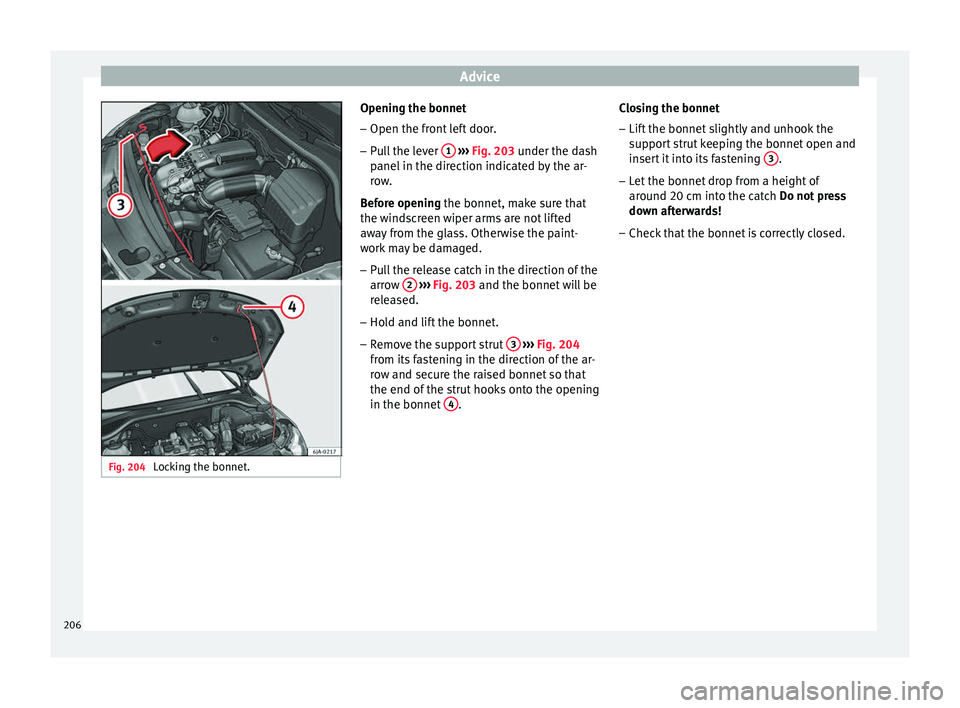
Advice
Fig. 204
Locking the bonnet. Opening the bonnet
–
Open the front left door.
– Pull the lever 1
› ››
Fig. 203
u nder the dash
panel in the direction indicated by the ar-
row.
Before opening the bonnet, make sure that
the windscreen wiper arms are not lifted
away from the glass. Otherwise the paint-
work may be damaged.
– Pull the release catch in the direction of the
arrow 2
› ››
Fig. 203
and the bonnet
will be
released.
– Hold and lift the bonnet.
– Remove the support strut 3
› ›
› Fig. 204
fr
om its fastening in the direction of the ar-
row and secure the raised bonnet so that
the end of the strut hooks onto the opening
in the bonnet 4 .Closing the bonnet
– Lift the bonnet slightly and unhook the
sup
por
t strut keeping the bonnet open and
insert it into its fastening 3 .
– Let the bonnet drop from a height of
ar ou
nd 20 c
m into the catch Do not press
down afterwards!
– Check that the bonnet is correctly closed.
206