Page 31 of 294
1.25
MANUAL DOOR LOCKING/UNLOCKING (1/2)
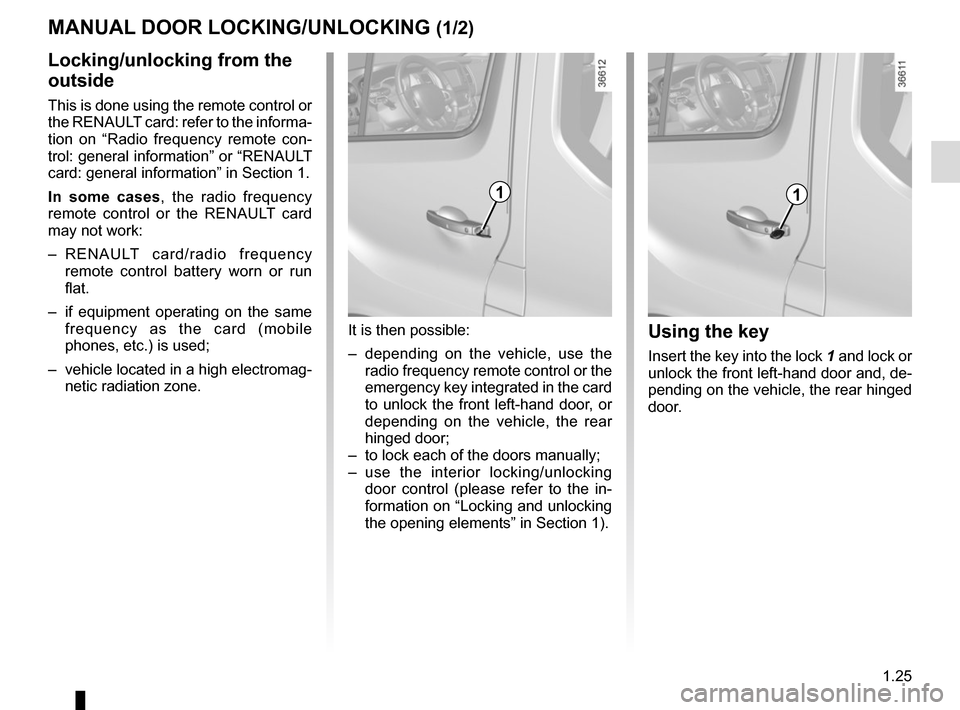
Using the key
Insert the key into the lock 1 and lock or
unlock the front left-hand door and, de-
pending on the vehicle, the rear hinged
door.
Locking/unlocking from the
outside
This is done using the remote control or
the RENAULT card: refer to the informa-
tion on “Radio frequency remote con-
trol: general information” or “RENAULT
card: general information” in Section 1.
In some cases, the radio frequency
remote control or the RENAULT card
may not work:
– RENAULT card/radio frequency remote control battery worn or run
flat.
– if equipment operating on the same frequency as the card (mobile
phones, etc.) is used;
– vehicle located in a high electromag- netic radiation zone.
1
It is then possible:
– depending on the vehicle, use the radio frequency remote control or the
emergency key integrated in the card
to unlock the front left-hand door, or
depending on the vehicle, the rear
hinged door;
– to lock each of the doors manually;
– use the interior locking/unlocking door control (please refer to the in-
formation on “Locking and unlocking
the opening elements” in Section 1).
1
Page 32 of 294
1.26
MANUAL DOOR LOCKING/UNLOCKING (2/2)
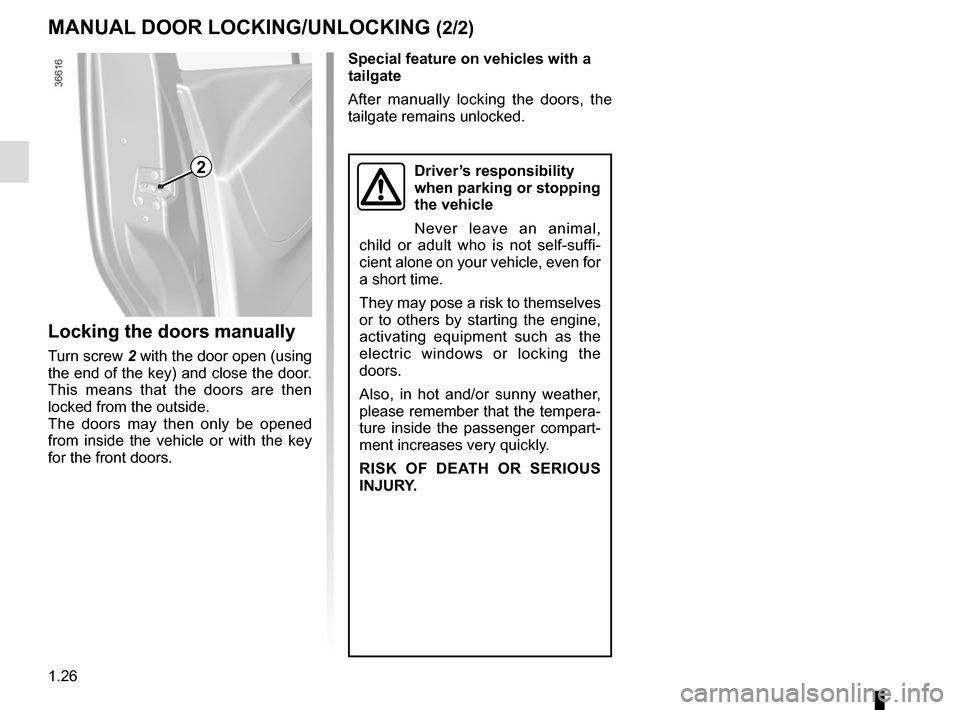
2
Locking the doors manually
Turn screw 2 with the door open (using the end of the key) and close the door.
This means that the doors are then
locked from the outside.
The doors may then only be opened
from inside the vehicle or with the key
for the front doors.
Special feature on vehicles with a
tailgate
After manually locking the doors, the
tailgate remains unlocked.
Driver’s responsibility
when parking or stopping
the vehicle
Never leave an animal,
child or adult who is not self-suffi-
cient alone on your vehicle, even for
a short time.
They may pose a risk to themselves
or to others by starting the engine,
activating equipment such as the
electric windows or locking the
doors.
Also, in hot and/or sunny weather,
please remember that the tempera-
ture inside the passenger compart-
ment increases very quickly.
RISK OF DEATH OR SERIOUS
INJURY.
Page 33 of 294

1.27
RENAULT ANTI-INTRUDER DEVICE (RAID)
Driver’s responsibility
If you decide to keep the
doors locked when you are
driving, remember that it
may be more difficult for those as-
sisting you to gain access to the
passenger compartment in the
event of an emergency.
You can decide whether you want to
activate this function.
To activate
With the ignition on , press switch 1
for approximately 5 seconds until you
hear a beep.
To deactivate
With the ignition on , press and hold
switch 1 for approximately 5 seconds,
until you hear a beep.
Operating principle
After the vehicle is started, the system
automatically locks the doors once your
speed reaches approximately 4 mph
(7 km/h).
The door can be unlocked:
– by pressing the door unlocking button 1.
– by opening a front door (vehicle sta- tionary).
NB: If a door is opened or closed, it will
automatically lock again when the vehi-
cle reaches a speed of 4 mph (7 km/h).
Operating faults
If you notice an operating fault (auto-
matic locking impossible), first check
that all doors are correctly locked. If
they are correctly locked and the fault
is still present, contact an approved
Dealer.
Also make sure that locking has not
been inadvertently deactivated.
If it has, switch the ignition off and on
again and reactivate it.
1
Page 48 of 294
1.42
Side Airbags
These airbags may be fitted to individ-
ual seats and are deployed at the sides
of the seats (door side) to protect the
occupants in the event of a severe side
impact.
Curtain Airbags
These are airbags fitted to each upper
side of the vehicle. They deploy along
the front door side windows to protect
occupants in the event of a severe side
impact.
SIDE PROTECTION DEVICES
Warning relating to the side airbag
– Fitting seat covers: seats equipped with an airbag require covers spe-
cifically designed for your vehicle. Contact an approved Dealer to find \
out
if these covers are available. The use of any covers other than those de-
signed for your vehicle (and including those designed for another vehic\
le) may
affect the operation of the airbags and reduce your protection.
– Do not place any accessories, objects or even pets between the seatback,\
the door and the internal fittings. Do not cover the seatback with any items\
such as
clothes or accessories. This may prevent the air bag from operating correctly
or cause injury when the airbag is deployed.
– No work or modification whatsoever may be carried out on the seat or int\
ernal fittings, except by qualified personnel from an approved Dealer.
Page 50 of 294

1.44
CHILD SAFETY: General information (1/2)
Carrying children
Children, and adults, must be correctly
seated and strapped in for all journeys.
The children being carried in your vehi-
cle are your responsibility.
A child is not a miniature adult. Children
are at risk of specific injuries as their
muscles and bones have not yet fin-
ished growing. The seat belt alone
would not provide suitable protection.
Use an approved child seat and ensure
you use it correctly.
A collision at 30 mph
(50 km/h) is the same as fall-
ing a distance of 10 metres.
Transporting a child without
a restraint is the equivalent of allow-
ing him or her to play on a fourth-
floor balcony without railings.
Never travel with a child held in your
arms. In the event of an accident,
you will not be able to keep hold of
the child, even if you yourself are
wearing a seat belt.
If your vehicle has been involved in
a road accident, replace the child
seat and have the seat belts and
ISOFIX anchorage points checked.
To prevent the doors being
opened, use the “Child
safety” device (refer to the
information on “Opening
and closing the doors” in Section 1).
Driver’s responsibility
when parking or stopping
the vehicle
Never leave an animal,
child or adult who is not self-suffi-
cient alone on your vehicle, even for
a short time.
They may pose a risk to themselves
or to others by starting the engine,
activating equipment such as the
electric windows or by locking the
doors.
Also, in hot and/or sunny weather,
please remember that the tempera-
ture inside the passenger compart-
ment increases very quickly.
RISK OF DEATH OR SERIOUS
INJURY.
Page 56 of 294

1.50
Rear centre seat
Check that the belt is suitable for secu-
ring your child seat. Consult an appro-
ved dealer.
Fit the child seat in a rear
seat wherever possible.
In the rear side seat
A carrycot can be installed across the
vehicle and will take up at least two
seats.
Position the child with their feet nearest
the door.
Move the front seat as far forward as
possible to install a rear-facing child
seat, then move back the seat in front
as far as it will go, although without al-
lowing it to come into contact with the
child seat.
For the safety of the child in the for-
ward-facing seat, do not move the seat
in front back past the middle of the
runner, do not tilt the seatback too far
(maximum of 25°) and raise the seat as
much as possible.
In all situations, remove the rear head-
rests (refer to the information on the
“Rear headrests” in Section 3). This
must be done before fitting the child
seat.
Check that the forward-facing child seat
is resting against the back of the vehi-
cle seat.
CHILD SAFETY: fitting a child seat, general information (2/2)
A child seat with a floor sup-
port must never be installed
on the rear centre seat.
RISK OF DEATH OR
SERIOUS INJURY.
Page 61 of 294

X = Seat not suitable for fitting child seats of this type.
U = Seat which allows a child seat with “Universal” approval to be ins\
talled using")
1.55
CHILD SEATS: attachment by seat belt (5/14)
X = Seat not suitable for fitting child seats of this type.
U = Seat which allows a child seat with “Universal” approval to be ins\
talled using a seat belt; check that it can be fitted.
(2) Raise the seat to the maximum and position it as far back as possible, \
tilting the seatback slightly (approximately 25°).
(3) A carrycot can be installed across the vehicle and will take up at least \
two seats. Position the child with his or her feet nea rest
the door.
(4) Move the front seat as far forward as possible to install a rear-facing \
child seat, then move back the seat in front as far as it will
go, although without allowing it to come into contact with the child sea\
t.
(5) Forward-facing child seat; position the seatback of the child seat in co\
ntact with the seatback of the vehicle seat. In all sit ua-
tions, remove the rear headrest of the seat on which the child seat is p\
ositioned. This must be done before fitting the child s eat
(please refer to the section entitled “Rear headrests” in Section\
3). Do not push the seat in front of the child more than half way
back on its runners and do not recline the seatback more than 25°.
Page 63 of 294

X = Seat not suitable for fitting child seats of this type.
U = Seat which allows a child seat with “Universal” approval to be ins\
talled using")
1.57
CHILD SEATS: attachment by seat belt (7/14)
X = Seat not suitable for fitting child seats of this type.
U = Seat which allows a child seat with “Universal” approval to be ins\
talled using a seat belt; check that it can be fitted.
(2) A carrycot can be installed across the vehicle and will take up at least \
two seats. Position the child with his or her feet nea rest
the door.
(3) Move the front seat as far forward as possible to install a rear-facing \
child seat, then move back the seat in front as far as it will
go, although without allowing it to come into contact with the child sea\
t.
(4) Forward-facing child seat; position the seatback of the child seat in co\
ntact with the seatback of the vehicle seat. In all sit ua-
tions, remove the rear headrest of the seat on which the child seat is p\
ositioned. This must be done before fitting the child s eat
(please refer to the section entitled “Rear headrests” in Section\
3). Do not push the seat in front of the child more than half way
back on its runners and do not recline the seatback more than 25°.