Page 234 of 346

3.40
LUGGAGE COMPARTMENT: 4-DOOR VERSION (2/3)
The sensor detects the approach and
then the removal of your foot and trig-
gers the opening of the boot lid.
Do not keep your foot in the air. Perform
the movement without stopping and wi-
thout touching the rear bumper.Activation/deactivation of the
hands-free function
Using the multifunction screen, select
menu “Vehicle”, “User settings” then
“Use handsfree card: open/close”.
Select “ON" or "OFF" to activate or de-
activate the function.
Usage features of the hands-free
function
– The hands-free function is no longer
available after a few days of lack of
movement of the vehicle, or after
around 15 minutes if the vehicle is
unlocked. To reactivate it, use the
unlocking button on the RENAULT
card.
– The hands-free function is only avail- able if the vehicle is stationary and
the engine is switched off (and not
on standby with the Stop and Start
function).
– The ‘hands-free’ feature may not work if the vehicle is equipped with a
towbar or is in an area of high elec-
tromagnetic radiation.
Using the hands-free function
The hands-free function enables
access to the luggage compartment
when you have your hands full.
Ensure that the RENAULT card is ap-
proximately 1 metre away in the cen-
tral area of the rear bumper of the vehi-
cle (area B). With the ignition off, stand
approximately 45 cm from the vehicle’s
rear bumper and move your foot for-
wards and backwards in area
A.
A
B
Disable the “hands-free”
function before you:
– wash the vehicle in a
roller-type car wash;
– wash the vehicle by hand;
– handle the towbar;
– ...
Risk of accidental opening of the
luggage compartment lid which
may cause injury.
Page 235 of 346
3.41
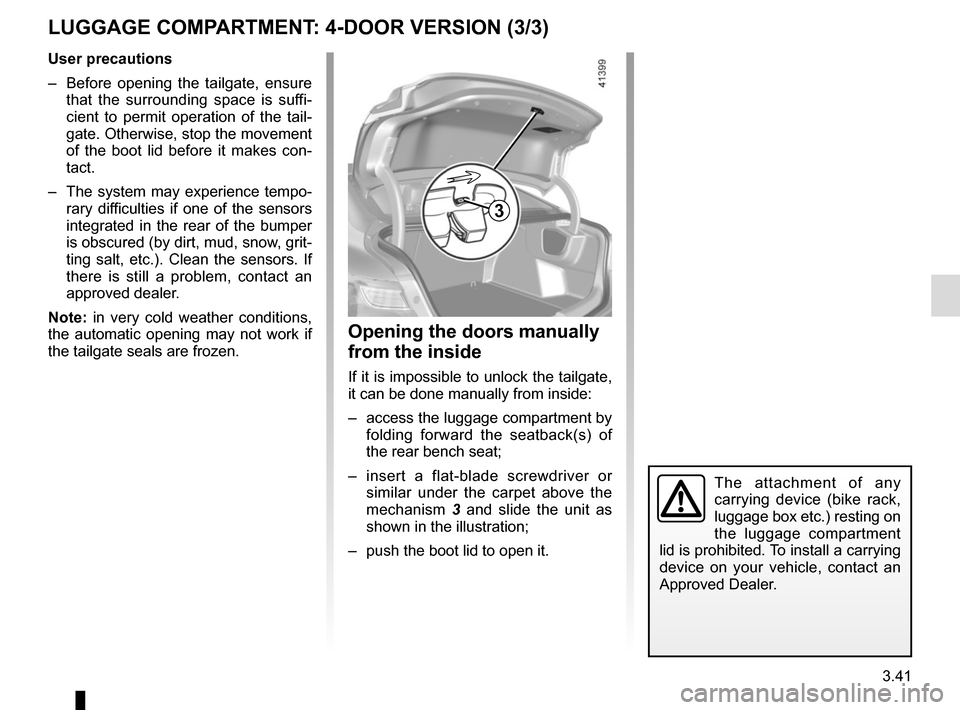
Opening the doors manually
from the inside
If it is impossible to unlock the tailgate,
it can be done manually from inside:
– access the luggage compartment by folding forward the seatback(s) of
the rear bench seat;
– insert a flat-blade screwdriver or similar under the carpet above the
mechanism 3 and slide the unit as
shown in the illustration;
– push the boot lid to open it.
3
User precautions
– Before opening the tailgate, ensure that the surrounding space is suffi-
cient to permit operation of the tail-
gate. Otherwise, stop the movement
of the boot lid before it makes con-
tact.
– The system may experience tempo- rary difficulties if one of the sensors
integrated in the rear of the bumper
is obscured (by dirt, mud, snow, grit-
ting salt, etc.). Clean the sensors. If
there is still a problem, contact an
approved dealer.
Note: in very cold weather conditions,
the automatic opening may not work if
the tailgate seals are frozen.
LUGGAGE COMPARTMENT: 4-DOOR VERSION (3/3)
The attachment of any
carrying device (bike rack,
luggage box etc.) resting on
the luggage compartment
lid is prohibited. To install a carrying
device on your vehicle, contact an
Approved Dealer.
Page 236 of 346
3.42
LUGGAGE COMPARTMENT: 5-DOOR VERSION
To open
Press button 1 and lift the tailgate.
To close
Lower the tailgate using the handles 2
inside the tailgate to help you.
1
Opening manually from
inside the vehicle
Special note:
If it is impossible to unlock the tailgate,
it can be done from inside.
– access the luggage compartment by folding forward the seatback(s) of
the rear bench seat,
– insert a pencil or similar object in cavity 3 and slide the unit as shown
in the illustration,
– push the tailgate to open it.
2
3
The attaching of any carry-
ing device (bike rack, lug-
gage box, etc.) resting on
the luggage compartment
lid is prohibited. To install a carrying
device on your vehicle, contact an
Approved Dealer.
Page 244 of 346
3.50
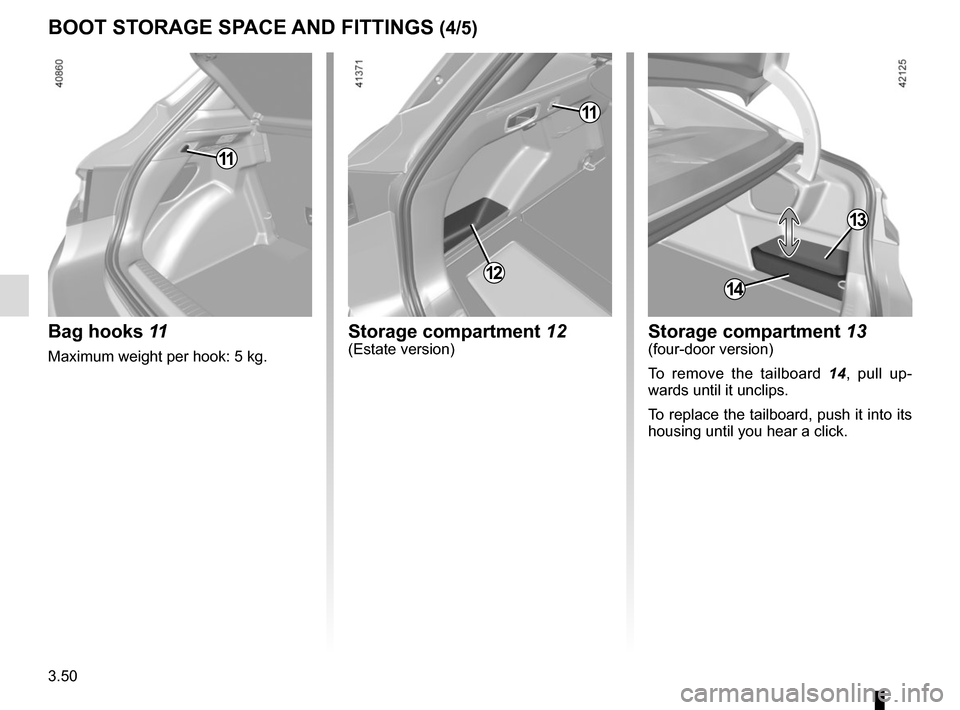
Storage compartment 12(Estate version)
12
Bag hooks 11
Maximum weight per hook: 5 kg.
BOOT STORAGE SPACE AND FITTINGS (4/5)
11
14
Storage compartment 13(four-door version)
To remove the tailboard 14, pull up-
wards until it unclips.
To replace the tailboard, push it into its
housing until you hear a click.
13
11
Page 247 of 346
3.53
Permissible nose weight, maxi-
mum permissible towing weight,
braked and unbraked: refer to
the information on “Weights” in
Section 6.
Choice and fitting of towing
equipment
Maximum weight of towing equip-
ment:
– 36 kg (5-door version);
– 37 kg (4-seater and estate ver-
sions).
For fitting and conditions of use,
refer to the equipment’s fitting in-
structions.
Please keep these instructions with
the rest of the vehicle documenta-
tion.
TRANSPORTING OBJECTS towbar
A
A: 895 mm (5-door version)
A: 1120 mm (estate version)
A: 1127 mm (4-door version)
If the towbar ball obscures the regis-
tration plate or the rear fog lights, it
should be removed when not in use.
In all cases, comply with local leg-
islation.
Page 248 of 346
3.54
ROOF BARS (1/2)
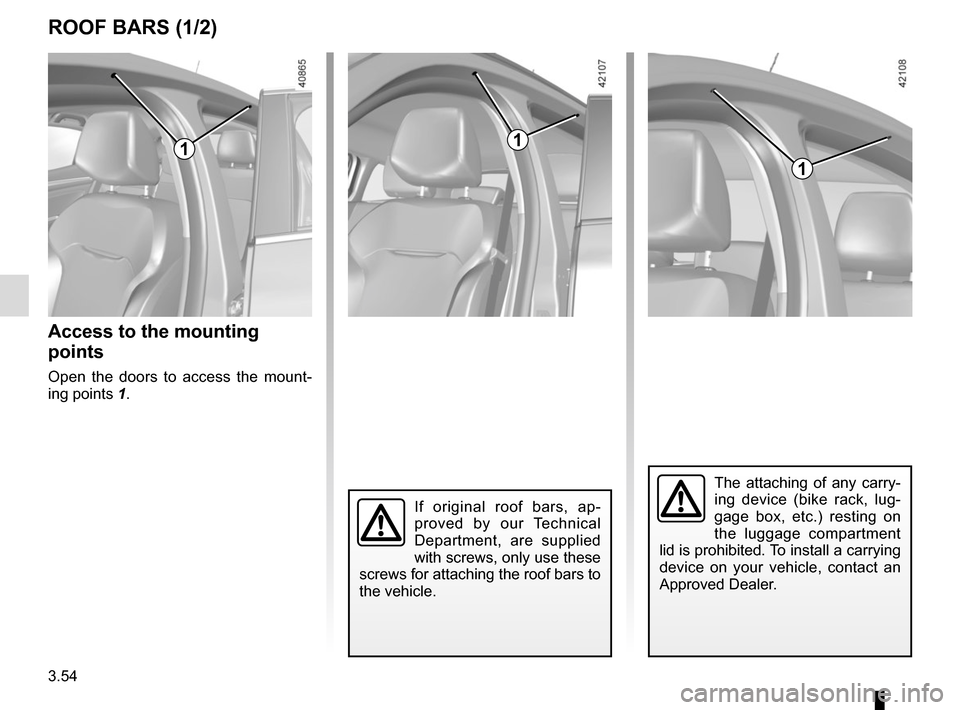
Access to the mounting
points
Open the doors to access the mount-
ing points 1.
If original roof bars, ap-
proved by our Technical
Department, are supplied
with screws, only use these
screws for attaching the roof bars to
the vehicle.
The attaching of any carry-
ing device (bike rack, lug-
gage box, etc.) resting on
the luggage compartment
lid is prohibited. To install a carrying
device on your vehicle, contact an
Approved Dealer.
11
1
Page 265 of 346

4.13
TYRE PRESSURE (1/2)
A
Label A
Open the door to read it.
Tyre pressures should be checked
when the tyres are cold.
If the tyre pressures cannot be checked
when the tyres are cold, increase the
pressures from 0.2 to 0.3 bar (or 3 PSI).
Never deflate a hot tyre. Vehicle fitted with a tyre pressure
monitoring system
If under-inflated (puncture, low pressure
etc.), the warning light
lights up
on the instrument panel; please refer to
«Tyre pressure monitoring system» in
Section 2.
A
C
D
FE
G
B
C
E
E
F
F
B : dimension of the tyres fitted to the
vehicle.
C: intended driving speed.
D : recommended pressure for optimi-
sing fuel consumption.
NB: driving comfort may be altered.
E: front tyre pressure.
F: rear tyre pressure.
G : tyre pressure for the emergency
spare wheel.
Vehicle used fully laden
(Maximum Permissible
All-up Weight) and
towing a trailer
The maximum speed must be limi-
ted to 60 mph (100 km/h) and the
tyre pressure increased by 0.2 bar.
Please refer to the information on
“Weights” in Section 6.
Risk of tyre blowouts.
Page 267 of 346
4.15
BODYWORK MAINTENANCE (1/2)
You should
Wash your car frequently, with the
engine off, with cleaning products rec-
ommended by the manufacturer (never
use abrasive products). Rinse thor-
oughly beforehand with a jet:
– spots of tree resin and industrial
grime;
– mud in the wheel arches and under-
neath the body which forms damp
patches;
– bird droppings , which cause a
chemical reaction with the paint that
rapidly discolours paintwork and
may even cause the paint to peel
off;
wash the vehicle immediately to
remove these marks since it is im-
possible to remove them by polish-
ing;
– salt, particularly in the wheel arches
and underneath the body after driv-
ing in areas where the roads have
been gritted.
Remove any plant matter (resin, leaves,
etc.) from the vehicle regularly.
What you should not doDo not degrease or clean mechani-
cal components (e.g. the engine com-
partment), underneath the body, parts
with hinges (e.g. inside the doors) and
painted plastic external fittings (e.g.
bumpers) using high-pressure clean-
ing equipment or by spraying on prod-
ucts not approved by our Technical
Department. Doing this could give rise
to corrosion or operational faults.
Wash the vehicle in bright sunlight or
freezing temperatures.
Do not scrape off mud or dirt without
pre-wetting.
Allow dirt to accumulate on the exterior.
Allow rust to form following minor im-
pacts.
Do not use solvents not approved by
our Technical Department to remove
stains as this could damage the paint-
work.
Do not drive in snow or muddy condi-
tions without washing the vehicle, par-
ticularly under the wheel arches and
body.
A well-maintained vehicle will last
longer. It is therefore recommended to
maintain the exterior of the vehicle reg-
ularly.
Your vehicle has been treated with very
effective anti-corrosion products. It is
nevertheless subject to various outside
influences.
Corrosive agents in the atmosphere
–
atmospheric pollution (built-up and
industrial areas),
– saline atmospheres (near the sea,
particularly in hot weather),
– seasonal and damp weather condi-
tions (e.g. road salt in winter, water
from road cleaners, etc.).
Minor impacts
Abrasive action
Dust and sand in the air, mud, road grit
thrown up by other vehicles, etc.
You should take a number of minor pre-
cautions in order to safeguard your ve-
hicle against such risks.