Page 132 of 232

3.6
Adjusting the ventilation
speed
Normal use
Turn control 3 to one of the four posi-
tions to start the ventilation system and
adjust the power.
Select position 1 for minimum ventila-
tion and position 4 for maximum ven-
tilation.
Position 0
In this position:
– the air conditioning or heating stops automatically even if button 6 is acti-
vated and the warning light remains
lit;
– the ventilation speed of air in the passenger compartment is zero;
– there is, however, a slight flow of air when the vehicle is moving.
This position should not normally be
used.
HEATING, AIR-CONDITIONING (3/3)
Air recirculation (isolation of
the passenger compartment)
Turn control 1 towards the air recircula-
tion symbol
K.
In these conditions air is taken from the
passenger compartment and is recircu-
lated, with no air being taken from out-
side the vehicle.
Air recirculation operates as
follows:
– isolating the passenger compart- ment from the outside air (driving in
polluted areas, unpleasant odours,
etc.);
– bringing the passenger compartment to the desired temperature as quickly
as possible.
Prolonged use of this position can
lead to condensation forming on the
side windows and windscreen and
problems due to the use of non-re-
newed air in the passenger com-
partment.
We therefore advise you to return to
normal mode (external air) as soon
as the air recirculation function is no
longer required, by turning control 1
again.
3
6
1
Page 133 of 232
3.7
AIR CONDITIONING/HEATING: programming (1/2)
Adjusting the programming
This function enables the electric net-
work (and the not the traction battery)
to be used under certain conditions, in
order to obtain a comfortable tempera-
ture prior to using the vehicle.
It triggers the heating in cold weather
and the air conditioning in warm
weather.
1
Operating conditions
– The ignition must be switched off;
– the battery charging must be finished for the function to be triggered;
– the vehicle has to be plugged into the mains;
and
– the control 1 must be in position
ṗ
at A to program the air conditioning
or at B to program the heating.
3
In cold weather (< 0°C), you are rec-
ommended to position the control 3
in air recirculation position and the
fan speed control 2 in position 2 or 3
only. This setting enables greater ef-
ficiency and lower energy consump-
tion in reaching the passenger com-
partment ambient temperature.
2
AB
Page 134 of 232

3.8
AIR CONDITIONING/HEATING: programming (2/2)
Activating the function
– With the ignition on, position the con-trol 1 in one of the
ṗ positions;
– turn off the ignition. The “COMFORT” message and the programmed time
are displayed on the instrument
panel for a few seconds;
– charge your vehicle;
The function triggers on the hour pre-
ceding the hour programmed in order to
reach a comfortable temperature.
Automatically switching off the
function
– About 30 minutes after the pro- grammed time;
– if the charging socket is discon- nected;
– if control 1 is not in one of the
ṗ
positions.
4
5
C
D
Setting the start time for the
function
– To programme the start time, use buttons C and D to navigate through
the menu until message COMFORT
PROG appears.
– hold down button D on stalk 5 - the
hours flash;
– press button C to adjust them; – hold down button
D on stalk 5 - the
minutes flash;
– press button C to adjust them;
– confirm by pressing button D on
stalk 5.
The message “COMFORT PROG” and
the programmed time are displayed on
the instrument panel 4.
Page 135 of 232
3.9
Conditions of use
– The engine must be running;
– switch 4 must be engaged;
– the ventilation control 2 should not
be at position 0;
– the temperature control 1 should not
be at the “Heating off” position 3;
– The fuel level should not be at mini- mum.
ADDITIONAL HEATING (1/2)
Depending on the vehicle, the addi-
tional heating is designed to heat the
passenger compartment. Powered
by a dedicated fuel tank (please see
“Additional heating tank” in Section 1),
this increases the comfort level without
reducing vehicle range.
Switching on this additional heating de-
activates other heating methods and
the air-conditioning.
2
When the fuel reaches the minimum
level, a warning light will come on
on the instrument panel. After a few
minutes of operation, a message on
the instrument panel will tell you that
the additional heating is switched
off.
3
1
4
Page 136 of 232

3.10
ADDITIONAL HEATING (2/2)
Operating fault
If the additional heating does not switch
on:
– start the vehicle;
– switch on the heating by pressing switch 4;
– wait for 5 minutes;
– turn off the heater;
– switch off your vehicle ignition;
– restart the operation 4 or 5 times.
If the additional heating still fails to op-
erate, please contact an authorised
dealer.
Operating principle
With the engine running, press switch 4.
The operation cuts out:
– when the ignition is switched off;
– after a few minutes, when the mini- mum fuel level has been reached.
With the engine running,
when you open the driv-
er’s door, a message will
appear on the instrument
panel along with a beep to tell you
to switch off the additional heating.
Warnings concerning the
use of additional heating
– Do not operate the ad-
ditional heating in an en-
closed location; exhaust fumes
are poisonous.
– Do not park the vehicle or oper- ate the additional heating in lo-
cations where flammable mate-
rial or substances such as grass
or leaves can come into contact
with a hot exhaust system.
– Do not operate the additional heating when filling the fuel tank.
4
Page 193 of 232

5.25
FUSES (2/2)
Number Allocation
1 Traction battery charger
2 Electric motor control unit
3 Air conditioning, pedestrian
horn
4 heating, brake lights,
traction battery
5 Rear windscreen wiper
6 Horn, diagnostic socket
7 Heated seats
8 Traction battery
9 Passenger compartment
ECU
10 Windscreen washer
11 Brake lights
12 Passenger compartment
unit, ABS, ESP
13 Electric windows, child
safety, heating and air
conditioning system, ECO
mode
14 Not used
15 Starter
12
3456
78910
11121314
15161718
19202122
23242526
27
28
29
Allocation of fusesThe presence of certain fuses de-
pends on the vehicle equipment
level.
Number Allocation
16 Brake lights, additional
equipment, navigation, ABS,
ESP, boot light, interior
lights, rain and light sensor,
charging warning light
17 Radio, navigation system,
display, alarm
18 Additional equipment
19 Heated door mirrors
20 Hazard lights, rear fog lights
21 Central locking of opening
elements
22 Instrument panel
23 Not used
24 ESP, radio, heating and air
conditioning system, heated
seats, stop lights
25 Front accessories socket
26 Towbar
27 Electric front windows
28 Rear-view mirror control
29 Engine cooling fan
Page 195 of 232
5.27
WINDSCREEN WIPER BLADES (2/2)
– In frosty weather, make
sure that the wiper blades
are not stuck by ice (to
avoid the risk of the motor
overheating).
– Check the condition of the wiper
blades.
Replace the wiper blades as soon
as they begin to lose efficiency
(approximately once a year).
Whilst changing the blade, take care
not to drop the arm onto the window
after it has been removed as this
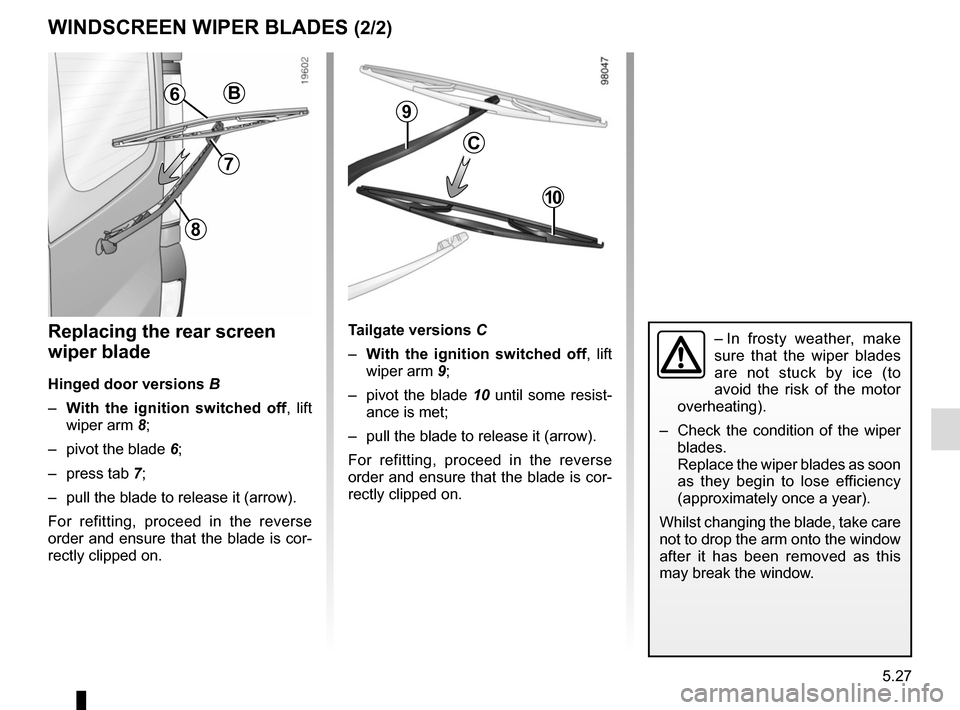
may break the window.Replacing the rear screen
wiper blade
Hinged door versions B
– With the ignition switched off , lift
wiper arm 8;
– pivot the blade 6;
– press tab 7;
– pull the blade to release it (arrow).
For refitting, proceed in the reverse
order and ensure that the blade is cor-
rectly clipped on.
B6
8
Tailgate versions C
– With the ignition switched off , lift
wiper arm 9;
– pivot the blade 10 until some resist-
ance is met;
– pull the blade to release it (arrow).
For refitting, proceed in the reverse
order and ensure that the blade is cor-
rectly clipped on.
C
9
10
7
Page 204 of 232
5.36
FAULTSPOSSIBLE CAUSESWHAT TO DO
The additional heating does not work. Fill up the fuel tank. Fill up with fuel – see information on the
“Additional heating tank” in Section 1.
The programmable heating does not
work. One of the usage conditions is not
complied with (the traction battery is
not charged, etc.).Refer to the information on “Heating/air
conditioning: programmable heating” in
Section 3.
The vehicle clock is poorly adjusted
or not adjusted. Adjust the clock on the instrument panel
see the information on “Clock and exterior
temperature” in Section 1.
OPERATING FAULTS (2/4)