Page 140 of 260

3.4
Switching air conditioning on
or off
The air conditioning is switched on (in-
dicator light illuminated) or off (indicator
light extinguished) using button 6.
The air conditioning system is used
for:
– lowering the temperature inside the passenger compartment;
– eliminating condensation more quickly.
The air conditioning does not operate
when the exterior temperature is low.
Adjusting the air temperature
Turn control 2 to obtain the desired
temperature. The further towards the
red the slide is, the higher the tempera-
ture will be.
When the air conditioning system is
used for long periods, it may begin to
feel cold. To increase the temperature,
turn control 2 to the right.
5 -
Heated rear screen and heated
door mirror de-icing/demisting con-
trol and indicator light.
6 - Air conditioning control and operat-
ing indicator light (depending on ve-
hicle).
Information and advice for use:
Refer to information on “Air condition-
ing: information and advice on use”.
The controls
1 - Air recirculation control.
2 - Adjusting the air temperature.
3 - Adjusting the ventilation speed.
4 - Adjusting the distribution of air in
the passenger compartment.
HEATING/AIR CONDITIONING (1/3)
1423
65
Page 142 of 260

3.6
Adjusting the ventilation
speed
Normal use
Turn control 3 to one of the four posi-
tions to start the ventilation system and
adjust the power.
Select position 1 for minimum ventila-
tion and position 4 for maximum ven-
tilation.
Position 0
In this position:
– the air conditioning stops automati- cally even if button 6 is activated (the
indicator light remains lit);
– the ventilation speed of air in the passenger compartment is zero;
– there is, however, a slight flow of air when the vehicle is moving.
This position should not normally be
used.
HEATING/AIR CONDITIONING (3/3)
Air recirculation (isolation of
the passenger compartment)
Turn control 1 towards air recirculation
symbol
â.
In these conditions air is taken from the
passenger compartment and is recircu-
lated, with no air being taken from out-
side the vehicle.
Air recirculation is for:
– isolating the passenger compart- ment from the outside air (driving in
polluted areas, unpleasant odours,
etc.);
– bringing the passenger compartment to the desired temperature as quickly
as possible.
Prolonged use of this position can
lead to condensation forming on the
side windows and windscreen and
problems due to the use of non-re-
newed air in the passenger com-
partment.
We therefore advise you to return to
normal mode (outside air) as soon
as the air recirculation function is no
longer required, by turning control 1
again.
13
6
Page 144 of 260
3.8
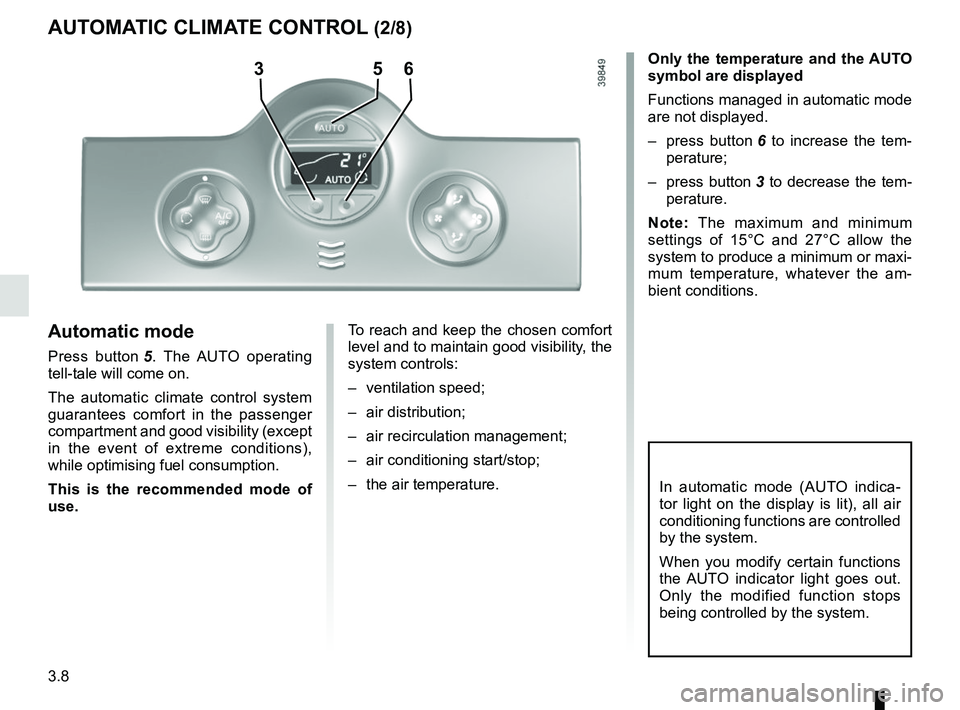
Only the temperature and the AUTO
symbol are displayed
Functions managed in automatic mode
are not displayed.
– press button 6 to increase the tem-
perature;
– press button 3 to decrease the tem-
perature.
Note: The maximum and minimum
settings of 15°C and 27°C allow the
system to produce a minimum or maxi-
mum temperature, whatever the am-
bient conditions.
In automatic mode (AUTO indica-
tor light on the display is lit), all air
conditioning functions are controlled
by the system.
When you modify certain functions
the AUTO indicator light goes out.
Only the modified function stops
being controlled by the system.
To reach and keep the chosen comfort
level and to maintain good visibility, the
system controls:
– ventilation speed;
– air distribution;
– air recirculation management;
– air conditioning start/stop;
– the air temperature.Automatic mode
Press button 5. The AUTO operating
tell-tale will come on.
The automatic climate control system
guarantees comfort in the passenger
compartment and good visibility (except
in the event of extreme conditions),
while optimising fuel consumption.
This is the recommended mode of
use.
AUTOMATIC CLIMATE CONTROL (2/8)
365
Page 146 of 260

3.10
ôThe air flow is directed mainly
to the dashboard air vents.
This position allows the passenger
compartment to be heated or cooled
more quickly.
öThe air flow is directed to all
the windscreen demisting
vents and the passenger footwells.
FThe air flow is directed mainly
towards the passenger
footwells.
The manual air distribution option
causes the operating tell-tale light
on display 4 to go out (automatic
mode), but only air distribution is no
longer controlled automatically by
the system.
Press button 5 to return to automa-
tic mode.
Distribution of air in the
passenger compartment
There are five possible combinations
for air distribution, which may be selec-
ted by pressing buttons 7 and 9 repea-
tedly. The arrows on display 4 indicate
the setting selected:
AUTOMATIC CLIMATE CONTROL (4/8)
õThe air flow is directed to the
windscreen demisting vents
and the side windows.
÷The air flow is directed to the
windscreen demisting vents,
the side windows and the passenger
footwells.
47
9
5
Page 147 of 260
3.11
AUTOMATIC CLIMATE CONTROL (5/8)
In automatic mode, depending on
the outside air conditions, the ven-
tilation may not start immediately at
maximum power but will increase
progressively until the engine tem-
perature is warm enough to heat the
passenger compartment air. This
may take from a few seconds to se-
veral minutes.
Varying the ventilation speed
In automatic mode, the system uses
the most suitable amount of air to reach
and maintain the desired comfort level.
Automatic mode is switched off by pres-
sing buttons 8 and 10.
These buttons allow you to increase or
decrease ventilation speed.
Switching air conditioning on
or off
In automatic mode, the system switches
the air conditioning system on or off,
depending on the climate conditions.
Exit automatic mode by pressing
button 2: the AUTO warning light on
display 4 goes out. Note: the “Clear View” function auto-
matically activates the air conditioning.
Press button
5 to return to automatic
mode.
4
8
10
25
Page 149 of 260
3.13
Note: if you wish to reduce the air flow
(which may produce a certain amount
of noise in the passenger compart-
ment), press button 10.
To exit this function , press:
– button 1 again;
– or button 5 (the AUTO indicator light
on the display will light up).
Clear View function
Press button 1.
The AUTO button indicator light (on the
display) goes out.
AUTOMATIC CLIMATE CONTROL (7/8)
This function rapidly demists/de-ices
the windscreen, the front side windows
and the door mirrors.
It imposes automatic operation of the
air conditioning and rear screen de-
icing, and inhibits air recirculation.
Press button 11 if you do not want the
heated rear screen to be activated.
1
10
5
11
Page 150 of 260
3.14
Prolonged use of the air recirculation
mode may cause the windows to mist
up or lead to odours, as the air is not
renewed.
We therefore advise you to return to
normal mode (external air or automatic
recirculation) as soon as air recircula-
tion is no longer needed, by pressing
button 12.Air recirculation
Pressing button 12 activates air recir-
culation (the symbol lights up on the
display).
During recirculation, air is taken from
the passenger compartment and is re-
cycled, with no air being taken from out-
side the vehicle.
Air recirculation allows the external at-
mosphere to be cut off (when driving in
polluted areas, etc.).
AUTOMATIC CLIMATE CONTROL (8/8)
12
Page 153 of 260
3.17
Map reading lights(depending on vehicle)
Tilt the switch 3 for permanent lighting.
In the front passenger seat, press
switch 2.Courtesy lights
Switches 1 or 3 provide:– permanent lighting;
– intermittent lighting, which comes on when a door is opened. It goes out
when the doors concerned are prop-
erly closed;
– immediate switching off.
INTERIOR LIGHTING (1/2)
2
1
Luggage compartment light A(depending on vehicle)
Tilt the switch 4 for permanent lighting.
A
34
Unlocking and opening the doors or
luggage compartment switches on
the timed courtesy lights.


