2017 RENAULT ALASKAN maintenance
[x] Cancel search: maintenancePage 296 of 340

1. Be sure the ignition switch is in the OFF position.
2. Be sure the headlight switch is in the OFF posi- tion.
3. Remove the fuse box cover j
Af rom beneath the
glove box.
4. Locate the fuse that needs to be replaced.
5. Remove the fuse using the fuse puller located in the main fuse box.
6. If the fuse is open, replace it with anew fuse.
7. Install the fuse box cover.
If the new fuse also opens, after installing, have the
electrical system checked, and if necessary
repaired, by an approved dealer or qualified work-
shop.
Extended storage fuse switch
(where fitted) To reduce battery drain, the extended storage fuse
switch comes from the factory switched off. Prior to
delivery of your vehicle, the switch is pushed in
(switched on) and should always remain on.
If the extended storage fuse switch is not pushed in
(switched on), the [Shipping Mode On Push Stor-
age Fuse] warning may appear in the vehicle infor-
mation display. See “Indicators for operation” in the
“2. Instruments and controls” section.
If any electrical equipment does not operate, re-
move the extended storage fuse switch and check for an open fuse.
NOTE
If the extended storage fuse switch malfunctions
or if the fuse is open, it is not necessary to re-
place the switch. In this case, remove the ex- tended storage fuse switch and replace it with a
new fuse of the same rating.
How to remove the extended storage fuse
switch:
1. To remove the extended storage fuse switch, be sure the ignition switch is in the OFF or LOCK
position.
2. Be sure the headlight switch is in the OFF posi- tion.
3. Remove the fuse box cover.
4. Pinch the locking tabs ➀found on each side of
the storage fuse switch.
5. Pull the extended storage fuse switch straight out from the fuse box ➁. HEADLIGHTS
Fog may temporarily form inside the lens of the exte-
rior lights in the rain or in
acar wash. Atemperature
difference between the inside and the outside of the
lens causes the fog. This is not amalfunction. If
large drops of water collect inside the lens, contact
an approved dealer or qualified workshop.
Replacing LED headlight
If replacement is required, contact an approved
dealer or qualified workshop. JVM0462XZ LIGHTS
8-20 Maintenance and do-it-yourself
Page 297 of 340

Replacing halogen headlight bulb
The halogen headlight is asemi-sealed beam type
which uses replaceable headlight (halogen) bulbs.
They can be replaced from inside the engine com-
partment without removing the headlight assembly.
CAUTION
High-pressure halogen gas is sealed inside the
bulb. The bulb may break if the glass envelope is
scratched or the bulb is dropped.
1. Disconnect the battery negative cable.
2. Disconnect the electrical connector from the
rear end of the bulb.
3. Pull off the rubber cap
➀.
4. Push and turn the retaining pin
➁to loosen it.
5. Remove the headlight bulb. Do not shake or
rotate the bulb when removing it.
6. Install the new bulb in the reverse order of
removal.
CAUTION
• When handling the bulb, do not touch the
glass envelope.
• Use the same number and wattage as origi-
nally installed:
Halogen headlight model
High/low beam bulb: 60W/55W (H4)
• Do not leave the bulb out of the headlight
reflector for
along period of time as dust, moisture and smoke may enter the headlight
body and affect the performance of the head-
light.
Aiming adjustment is not necessary if only the bulbs
are replaced. When aiming adjustment is neces-
sary, contact an approved dealer or qualified work-
shop.
EXTERIOR LIGHTS Item
Wattage (W)
Front turn signal 21
Clearance light (Halogen
headlight models) 5
Clearance light and daytime
running light (LED headlight
models)* LED
Front fog light (where fitted) 55
Daytime running light (where
fitted for halogen headlight
models) 19
Side turn signal light (on the
front wing) (where fitted) 5
Rear combination light Turn signal 21
Stop/tail 21/5
Reverse 21
Number plate light 5
High-mounted stop light (where fitted)* LED
*: See an approved dealer or qualified workshop
for replacement. JVM0470XZ
Maintenance and do-it-yourself
8-21
Page 298 of 340
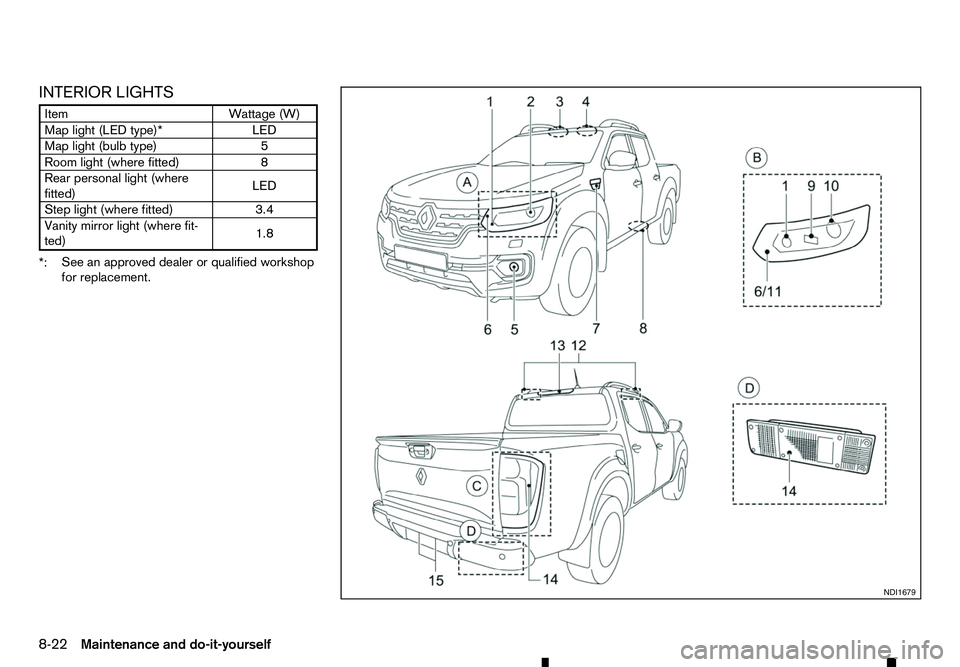
INTERIOR LIGHTS
Item
Wattage (W)
Map light (LED type)* LED
Map light (bulb type) 5
Room light (where fitted) 8
Rear personal light (where
fitted) LED
Step light (where fitted) 3.4
Vanity mirror light (where fit-
ted) 1.8
*: See an approved dealer or qualified workshop
for replacement. NDI1679
8-22 Maintenance and do-it-yourself
Page 299 of 340

LIGHT LOCATIONS
1. Front turn signal light
2. Headlight (halogen type)
3. Map light
4. Room light (where fitted)
5. Front fog light (where fitted) or Daytime run-
ning light (where fitted for halogen headlight
model)
6. Clearance light
7. Side turn signal light (where fitted)
8. Step light (where fitted)
9. Headlight (high beam) (LED type)
10. Headlight (low beam) (LED type)
11. Daytime running light (LED type)
12. Rear personal light (where fitted)
13. High-mounted stop light (where fitted)
14. Rear combination light (Turn signal/Stop/Tail/
Reverse)
15. Number plate light
j A: Halogen headlight model
j B: LED headlight model
j C: Models with cargo bed
j D: Models without cargo bed Replacement procedures
m
:
REMOVE
m :
INSTALL All
other lights are either type A, B, C,
DorE.When
replacing abulb, first remove the lens and/or cover. SDI2306 NDI1681
Front turn signal light
NDI1680
Clearance light (bulb type)
Maintenance and do-it-yourself 8-23
Page 300 of 340
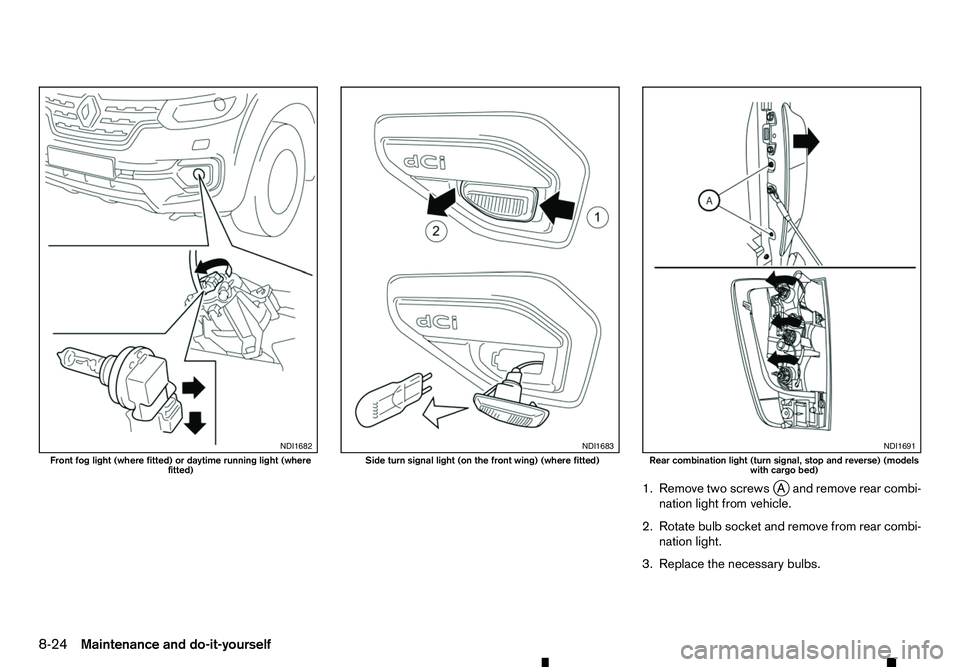
1. Remove two screws
jAa nd remove rear combi-
nation light from vehicle.
2. Rotate bulb socket and remove from rear combi- nation light.
3. Replace the necessary bulbs. NDI1682
Front fog light (where fitted) or daytime running light (where
fitted) NDI1683
Side turn signal light (on the front wing) (where fitted)
NDI1691
Rear combination light (turn signal, stop and reverse) (models
with cargo bed)
8-24 Maintenance and do-it-yourself
Page 301 of 340
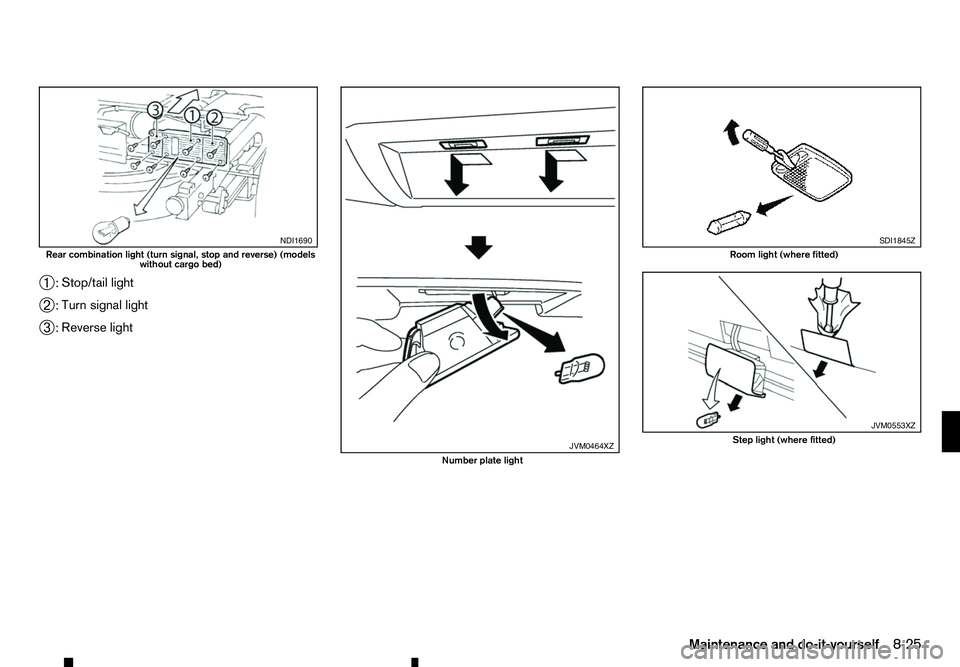
➀
:
Stop/tail light
➁ :
Turn signal light
➂ :
Reverse light NDI1690
Rear combination light (turn signal, stop and reverse) (models
without cargo bed) JVM0464XZ
Number plate light SDI1845Z
Room light (where fitted)
JVM0553XZ
Step light (where fitted)
Maintenance and do-it-yourself 8-25
Page 302 of 340
If you have
aflat tyre, see “Flat tyre” in the “6. In
case of emergency” section.
TYRE INFLATION PRESSURE
Periodically check the pressure of the tyres, includ-
ing the spare. An incorrect tyre pressure may ad-
versely affect tyre life and vehicle handling. The tyre
pressure should be checked when tyres are COLD.
Tyres are considered COLD after the vehicle has
been parked for 3ormore hours, or driven less than
1.6 km (1 mile). COLD tyre pressures are shown on
the tyre placard.
Insufficient pressure can lead to an overheating of
the tyre and subsequent internal damage. At high
speeds, this could result in tread separation and
even bursting of the tyre.
TYPES OF TYRES
CAUTION
When changing or replacing tyres, be sure all
four tyres are of the same type (that is, summer,
all season or snow) and construction. An ap-
proved dealer or qualified workshop may be able
to help you with information about tyre type, size,
speed rating and availability.
Replacement tyres may have alower speed rating
than the factory equipped tyres, and they may not
match the potential maximum vehicle speed. Never
exceed the maximum speed rating of the tyre. All season tyres
RENAULT specifies all season tyres on some mod-
els to provide good performance all year, including
snowy and icy road conditions. All season tyres are
identified by ALL SEASON and/or M&S on the tyre
sidewall. Snow tyres have better snow traction than
all season tyres and may be more appropriate in
some areas.
Summer tyres
RENAULT specifies summer tyres on some models
to provide superior performance on dry roads. Sum-
mer tyre performance is substantially reduced in
snow and ice. Summer tyres do not have the tyre
traction rating M&S on the tyre sidewall.
If you plan to operate your vehicle in snowy or icy
conditions, RENAULT recommends the use of snow
or all season tyres on all four wheels.
Snow tyres
If snow tyres are needed, it is necessary to select
tyres equivalent in size and load rating to the original
equipment tyres. If you do not, it can adversely af-
fect the safety and handling of your vehicle.
Generally, snow tyres have lower speed ratings than
factory equipped tyres and may not match the po-
tential maximum vehicle speed. Never exceed the
maximum speed rating of the tyre. If you install snow
tyres, they must be the same size, brand, construc-
tion and tread pattern on all four wheels.
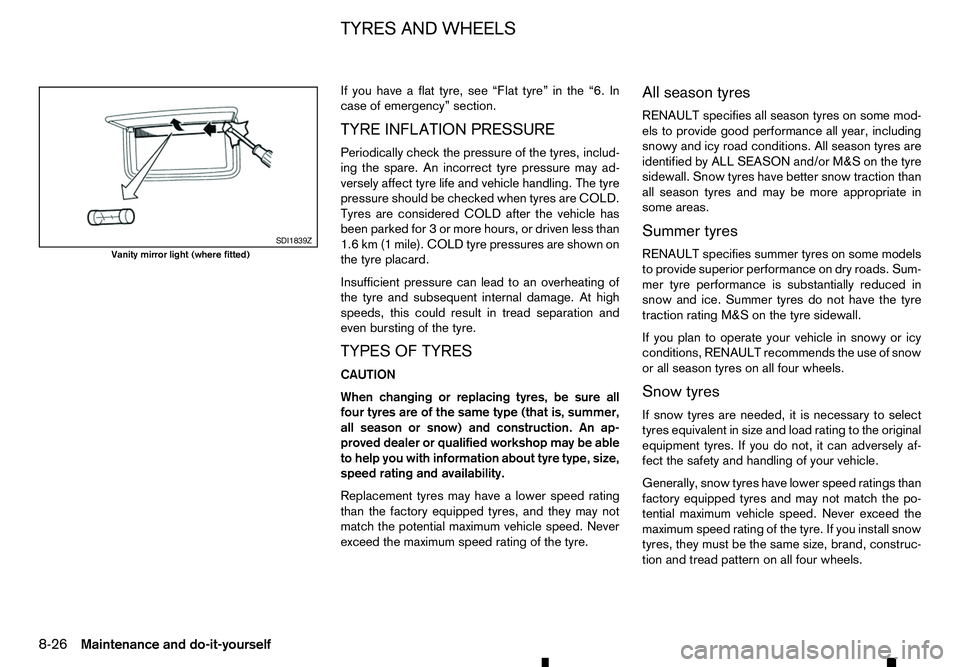
SDI1839Z
Vanity mirror light (where fitted)
TYRES AND WHEELS
8-26 Maintenance and do-it-yourself
Page 303 of 340

For additional traction on icy roads, studded tyres
may be used. However, some states and provinces
prohibit their use. Check local, state and provincial
laws before installing studded tyres. Skid and trac-
tion capabilities of studded snow tyres on wet or dry
surfaces may be poorer than that of non-studded
snow tyres.
Four-Wheel Drive (4WD) model
CAUTION
• Always use tyres of the same type, size, brand,
construction (bias, bias-belted or radial), and
tread pattern on all four wheels. Failure to do
so may result in
acircumference difference
between tyres on the front and rear axles
which will cause excessive tyre wear and may
damage the transmission, transfer case and
differential gears.
• ONLY use spare tyres specified for the 4WD
model.
If excessive tyre wear is found, it is recommended
that all four tyres be replaced with tyres of the same
size, brand, construction and tread pattern. The tyre
pressure and wheel alignment should also be
checked and corrected as necessary. Contact an
approved dealer or qualified workshop. TYRE CHAINS
Use of tyre chains may be prohibited according to
location. Check the local laws before installing tyre
chains. When installing tyre chains, make sure that
they are of proper size for the tyres on your vehicle
and are installed according to the chain manufactur-
er’s instructions.
Use chain tensioners when recommended by the
tyre chain manufacturer to ensure
atight fit. Loose
end links of the tyre chains must be secured or
removed to prevent the possibility of whipping ac-
tion damage to the wings or underbody. If possible,
avoid fully loading your vehicle when using tyre
chains. In addition, drive at areduced speed. Oth-
erwise, your vehicle may be damaged and/or ve-
hicle handling and performance may be adversely
affected.
Tyre chains must be installed only on the rear
wheels and not on the front wheels.
Do not drive with tyre chains on paved roads which
are clear of snow. Driving with chains in such condi-
tions can cause damage to the various mechanisms
of the vehicle due to some overstress. TYRE ROTATION
RENAULT recommends that tyres be rotated every
5,000 km (3,000 miles) for Four-Wheel Drive (4WD)
or every 10,000 km (6,000 miles) for Two-Wheel
Drive (2WD) model. However, the timing for tyre
rotation may vary according to your driving habits
and the road surface conditions. (See “Flat tyre” in
the “6. In case of emergency” section for the tyre
replacement.)
WARNING
• After rotating the tyres, adjust the tyre pres-
sure.
• Retighten the wheel nuts when the vehicle
has been driven for 1,000 km (600 miles) (also
in cases of
aflat tyre, etc.).
• Do not include the spare tyre in tyre rotation. SDI1662Z
Maintenance and do-it-yourself
8-27